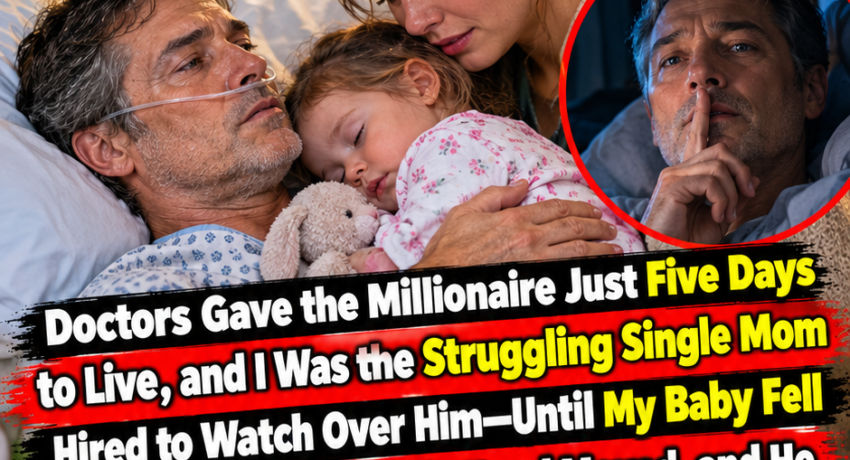
The doctors gave him five days. His family was already planning the funeral. I was only there for the paycheck – until the man everyone thought was gone opened one eye and asked me to keep him alive.
Part 1: The Night the Blanket Moved
The man everyone was waiting to bury reached out and wrapped his fingers around my baby’s blanket.
I stood frozen beside the bed, certain my exhausted brain was inventing things.
It was almost two in the morning. For three hours, I had been pacing the narrow staff quarters of the Crane estate in Pacific Palisades with my nine-month-old son, Sam, on my shoulder. He was teething and feverish, and nothing settled him – not walking, not humming, not a bottle. He just kept crying that thin, hoarse cry babies make when they’re too tired to stop.
Terrified of waking anyone, I carried him up the back stairs and slipped into the one room where nobody would complain about the noise.
Harrison Crane’s bedroom.
The doctors said he had days left. Five, maybe six.
Harrison was forty-six. He had built one of the largest freight companies on the West Coast from a single rented truck. But for two months, he had been confined to that enormous bed, unable to speak or move a finger. His chart said rapid neurodegenerative collapse. He was going to die in this room.
His nephew, Preston, was already discussing funeral arrangements over the phone in the hallway, in the same bored tone most people use to book a restaurant.
I had taken the job as his live-in caregiver because I was completely broke. Sam’s father had walked out when Sam was three months old, my savings were gone, and this was the only job that let me keep my baby with me. The agency had been blunt: Non-responsive patient. End-of-life care. Keep him comfortable and keep the family happy.
That night, I sank into the armchair beside the bed to rest my aching arms. Sam was still whimpering, and without really thinking, I laid him gently on Harrison’s chest.
Sam went quiet almost instantly. Within a minute, he was asleep, rising and falling with the breath of the man beneath him.
And then it happened.
Harrison’s fingers twitched on the sheet. Slowly – so slowly I thought I was imagining it – they slid across the fabric until they found the edge of Sam’s blanket and closed around it.
“Mr. Crane?” I whispered. My heart was pounding so hard I could hear it.
His eyelids fluttered. One eye opened, just a sliver, and found my face.
He wasn’t gone. He wasn’t even close to gone.
He was awake. Fully, completely aware.
Part 2: One Blink for Yes
I didn’t call anyone. I don’t fully know why. Maybe it was the way his eye moved – not to the door, not to the call button, but to me, and then to the hallway, and then back to me, with something in it that looked a lot like a warning.
So I spent the rest of that night learning how to talk to him.
One blink meant yes. Two blinks meant no. Looking toward the door meant someone was coming.
“Can you understand me?” I asked.
One slow blink.
“Have you been awake this whole time? The whole two months?”
One blink.
“Can you hear everything people say around you?”
One slow blink.
A chill ran down my spine. I thought of Preston at the foot of the bed with his phone to his ear, saying, Honestly, the sooner the better. It’s like waiting for a bus.
He had heard all of it.
“Should I get the doctor?”
Two hard, deliberate blinks.
By dawn, he had managed to move his lips. I leaned down until my ear was almost touching his mouth, and I felt, more than heard, the words.
“Preston… isn’t waiting… for my money,” he breathed. His voice was nothing but air. “He’s… speeding it up.”
Before I could ask what he meant, heavy footsteps sounded in the hall. I scooped Sam up just as the door opened.
Preston Crane walked in without knocking – tailored suit, expensive watch, permanent sneer. He didn’t look at his uncle. He never did.
“How’s our patient?” he asked, scrolling through his phone.
“No change,” I said, moving so that I was between him and the bed.
“Good.” He finally glanced up – not at Harrison, but at Sam. “Dr. Hale will be here at four. And Nora? If that kid screams through the night one more time, you and your little bastard can go find somewhere else to live.”
I pressed my teeth together until my jaw hurt. “It won’t happen again.”
He left without another word.
The moment his footsteps faded, Harrison opened his eyes.
“Don’t… tell him… anything,” he whispered.
I nodded. “I won’t.”
Part 3: The White Box
At four o’clock exactly, Dr. Victor Hale arrived with a worn leather medical bag.
He was polished and soft-spoken, the kind of doctor who called you “dear” and never met your eyes. I stayed in the corner folding towels, pretending to be invisible.
He took out a small white box with no pharmacy label – just a drug name handwritten in black marker. He drew a clear liquid into a syringe and injected it into Harrison’s IV line.
Ten minutes later, Harrison’s breathing turned shallow and uneven. His hand went completely slack on the sheet.
“He’s slipping,” Dr. Hale said, with a calm that turned my stomach. He made a note on his tablet. “Five days. Six at the outside.”
Then he did something I would remember for the rest of my life.
Instead of leaving the vials in the locked cabinet with the rest of Harrison’s logged medications, he slipped the white box back into his own bag.
That night, I sat on the floor of my room and typed the name from the box into my phone. I read the description three times.
It was a powerful paralytic. Given outside a hospital, without monitoring, it caused deep paralysis and suppressed breathing – symptoms easily mistaken for the final stage of a neurological disease.
I went back upstairs. Harrison lay exactly where I’d left him, his chest barely moving.
He wasn’t dying of a disease.
Someone was locking him inside his own body and smothering him in slow motion. And the nephew who stood to inherit everything walked into this room every single day to ask how much longer it would take.
I sat down beside the bed and took his hand. It was cold.
“I’m not going to let them kill you,” I told him.
It took a long time. But eventually, his fingers pressed against my wrist – so faintly that if I hadn’t been waiting for it, I would have missed it.
Sitting in that silent room, I understood I had just walked into something far more dangerous than losing a job.
I just had no idea how much more.
Part 4: Playing Dead
My quiet war against Preston started that night.
I couldn’t stop Dr. Hale’s visits without tipping everyone off. But I managed Harrison’s IV the rest of the day, and I recorded everything in a second notebook hidden in the lining of Sam’s diaper bag – every visit, every dose, every change in his pulse. I photographed the white box whenever Hale set it down. I kept the fluids running clean and kept Harrison moving whenever no one was watching.
Without the drug building up in his system, his recovery was staggering. First his wrist. Then his arm. Within four days, he could lift his head off the pillow on his own.
“Bottom drawer of my desk,” he told me one night, his voice still rough but finally sounding like a voice. “Behind the old tax ledgers. There’s a phone. Nobody knows it exists.”
I found it exactly where he said. He gave me a number from memory. “My attorney. Not the company lawyer. Mine. Walter Ames.”
We sent one short text. Then I cleared the log and hid the phone again.
During the day, Harrison gave the performance of his life. Whenever Preston walked in, his jaw went slack and his eyes went glassy, fixed on the ceiling.
“I never knew,” he murmured after one of Preston’s visits, “that pretending to be a corpse would turn out to be such a useful skill.”
I had to clap a hand over my mouth to keep from laughing.
For a few days, it almost felt like we were winning.
Then everything changed.
Part 5: The Swabs in the Trash
Two days later, I came back from buying diapers and knew instantly someone had been in my room. My duffel bag was zipped differently. The formula canisters had been moved.
And in the trash, I found two torn wrappers from sterile cheek swabs – the kind used for DNA tests.
I grabbed Sam, ran up to Harrison’s room, and locked the door.
“Preston searched my room,” I whispered. My hands were shaking. “He took DNA from Sam. Maybe from me, too. The swabs are in my trash.”
Harrison went very still. “DNA?”
“Why would he do that? What could he possibly want with my son’s DNA?”
Harrison’s eyes narrowed. “Leverage. He’s looking for something to use against you. Maybe he wants to accuse you of theft. Or claim you brought a stranger’s child into this house as part of some scheme to get close to me.”
His gaze drifted to Sam, who had fallen asleep on the bed beside him, one hand tucked under his cheek. Harrison watched him for a long time.
Then he asked a question I didn’t expect.
“You’ve never talked about the boy’s father.”
Something cold and familiar closed up inside my chest. “His name is Daniel. He grew up in foster care – moved around a lot, never really had anyone. We met waitressing at a diner downtown. He stayed until Sam was three months old. Then he left.”
“How old is he?” Harrison asked. He was looking at me with an intensity I didn’t understand.
“Twenty-nine.”
Harrison turned his face toward the ceiling. His jaw moved, as if he were chewing on words he couldn’t bring himself to say.
“What is it?”
“Nothing.”
It wasn’t nothing. I knew that the way you know a storm is coming before the first drop falls.
Part 6: “That’s Impossible”
Two days later, a courier arrived at the front gate with a sealed envelope addressed to Preston.
I was carrying a tea tray past the study when his voice exploded through the oak door.
“That’s impossible! Run it again! Somebody at that lab screwed up!”
The door flew open. Preston stormed past without noticing me, and a minute later his SUV was tearing down the driveway.
He came back after dark with Dr. Hale. They locked themselves in the study for nearly two hours.
As soon as Dr. Hale’s car pulled away, I went up to Harrison and told him everything.
He listened without interrupting. Then he looked down at Sam, who was curled against his side, and he was quiet for so long that I thought he might have drifted off.
“Nora,” he finally said. “I had a son.”
I thought I’d heard him wrong. “What?”
“I was seventeen.” His voice was thick with old grief. “So was she. Her parents moved her away the moment they found out. Later, I heard the baby had gone into foster care. I searched for years – sealed records, lost files, dead ends. Eventually I stopped. I buried myself in work. Then in money. It was easier than hoping.”
He looked at Sam’s small, sleeping face.
“If Preston compared your son’s DNA to mine – trying to prove you were some con artist who’d wormed her way into my house…”
He didn’t finish. So I finished it for him, and my voice came out barely above a whisper.
“Daniel could be your son.”
Harrison closed his eyes. A single tear slid down into the pillow. And as if he knew, Sam reached out in his sleep and wrapped his tiny hand around Harrison’s finger.
“And this little boy,” Harrison said, “might be my grandson.”
A wave of dread rolled over me.
Until that moment, Preston had only had one reason to want his uncle dead: money.
Now he had just discovered that a biological son and a grandson existed – direct heirs who would wipe out every dollar he believed was already his.
“He isn’t going to wait five more days,” I said.
“No.” Harrison’s voice changed. The weakness was still there, but underneath it, there was something hard as steel. He held out his hand. “Give me the phone.”
“Who are you calling?”
For the first time since I’d met him, Harrison Crane smiled. It was a sharp, dangerous smile – the smile of a man who had built an empire by never being the one caught off guard.
“The people Preston has spent weeks assuming would get here too late.”
Part 7: The Man on the Stairs
At 10:50 the next morning, three dark vehicles rolled up the long driveway.
Preston wasn’t home. He’d left early for a meeting downtown, confident his uncle was still lying helpless upstairs.
I opened the gates.
A silver-haired man with a leather briefcase stepped out, followed by a younger associate, two private investigators, and two plainclothes LAPD detectives. The man was Walter Ames, Harrison’s attorney for more than twenty years.
“Where is he?” Walter asked, his voice tight with urgency.
I pointed toward the grand staircase. “Getting ready.”
Walter looked at me as if I’d lost my mind.
Then a heavy thud echoed from the top of the stairs.
Then another.
Harrison appeared on the landing in dark trousers and a crisp white shirt, leaning hard on his late father’s wooden cane. He’d spent two nights practicing the walk from bed to door. He had never tried the stairs.
“Harrison…” Walter breathed. His briefcase hung forgotten at his side.
Harrison managed a faint smirk. “Don’t write my obituary just yet, Walter.”
He came down one step at a time. I walked one step behind him the entire way, ready to catch him if his legs gave out.
When he reached the bottom, his shirt was soaked through with sweat and his hand was white on the cane. But he was standing on his own two feet.
Walter crossed the foyer and pulled his old friend into a hug without a single word. Harrison patted his back twice.
“Work first,” he said roughly. “We can get emotional later.”
For the next hour, the living room became a war room. I brought out my notebook, the timestamped photos, and a video of Dr. Hale injecting the drug and pocketing the vials. The investigators had already traced wire transfers from a shell company controlled by Preston to Hale’s private account – and pulled their text messages.
One of them, sent eleven days earlier, read: Adjust the dosage. We can’t have an unexpected recovery before the power of attorney is signed.
At 12:20, the front door unlocked.
Preston walked in talking loudly into his phone. “No, I need you at the house right now, because—”
He stopped dead.
The phone slipped out of his hand and clattered across the marble floor.
First, he saw Walter Ames. Then the detectives. Then me, standing by the window with Sam on my hip.
And finally, his eyes landed on his uncle.
Harrison was sitting in his favorite leather armchair in the middle of the living room. Not in bed. Not hooked up to monitors. Sitting upright, both hands resting on the head of his cane.
Every drop of color drained out of Preston’s face. “Uncle Harrison…?”
“Good afternoon, Preston.”
“What… what are you doing out of bed?”
“That’s hardly the most interesting question you could be asking,” Harrison said coldly. He nodded toward the sofa across from him. “Sit down.”
Preston didn’t move. “Dr. Hale said you were completely paralyzed.”
“Dr. Hale has said a great many things lately.”
Preston’s eyes flicked toward the front door. One of the detectives shifted his weight and stepped casually in front of it.
Part 8: “I Heard Every Word”
Harrison leaned forward.
“A week ago, you were sure I’d be dead by Sunday. Four days ago, you went through this young woman’s room and took DNA from her child without permission. And two days ago, you got a lab result that sent you racing straight to Victor Hale.”
For the first time, Preston looked directly at me. The smug arrogance had vanished from his face. What was left was raw, naked panic.
“She’s manipulating you!” His voice cracked and climbed. “She shows up here with some random kid, and suddenly he’s related to you? Are you really that far gone? Can’t you see she’s running a scam?”
“What I see,” Harrison said, his voice dropping to something quiet and icy, “is a baby who made me move my hand after two months of lying in that bed listening to you plan my funeral.”
Preston swallowed hard.
Walter opened his leather folder. “An independent lab has confirmed a direct biological relationship between Mr. Crane and the child. We are in the process of locating the child’s father to confirm the paternal line.”
Preston took a step backward. “That doesn’t prove anything! That’s not a crime!”
“No,” said the lead detective evenly. “It’s a motive.”
Harrison brought the tip of his cane down against the floor with a sharp crack.
“When you got those results, Preston, you had two choices. You could have walked upstairs, sat down beside my bed, and told me I might have a family out there. After all these years. You could have given me that.” His voice caught, just for a moment. “Or you could go to Hale and double the dose.”
Preston’s chest was heaving. “You were… you were unconscious…”
“No,” Harrison said, holding his nephew’s gaze. “I heard every single word.”
The silence in that room was so heavy it felt like it had weight.
“I heard you ask Hale how many days I had left,” Harrison went on. “I heard you tell him not to move me to a hospital, because it would look more natural at home. I heard the two of you discuss what to do if I got my voice back before you could liquidate the trust. I heard you on the phone with your girlfriend, choosing the wine for my wake.”
Preston backed toward the hallway. “You can’t hold me here! You have no legal right—”
“Nobody’s holding you yet,” the detective said, unclipping a pair of handcuffs from his belt. “But you’re coming with us to answer some questions about attempted murder and medical fraud.”
Four hours later, Dr. Victor Hale was arrested at his private clinic in Beverly Hills.
In his office, investigators found unregistered drugs, falsified records, and a recording of a call in which Preston spelled out exactly what he wanted done. Hale had kept it as insurance, in case Preston ever tried to make him the scapegoat.
With the doses, the charts, the transfers, my notebook, and that recording, the case had no holes. Preston Crane and Victor Hale were both denied bail. They were charged with attempted murder, conspiracy, and elder abuse.
That night, after everyone had finally gone, Harrison asked me to bring Sam to his room.
He held my son for a long time without saying anything. Then he looked up at me.
“You could have walked out that first night,” he said. “Why didn’t you?”
“Because I know what it feels like,” I said, “to be in a room full of people and have no one notice you’re still there.”
Part 9: The Porch in the Rain
Six months later, sunlight poured through every window of the house.
Harrison’s recovery had stunned every specialist. He rarely needed the cane, though he kept it by the front door anyway, “for dramatic entrances.” He had asked me to stay on to run the household, with a real salary and an apartment on the property for Sam and me.
I was in the kitchen making Sam’s lunch when Harrison walked in carrying a thick manila folder.
“He’s in Portland,” he said quietly.
I turned around. My heart skipped. “Daniel?”
Harrison nodded and set the folder on the counter between us. “Working as a mechanic at a shipping yard near the river. Lives alone. No record. He just… moves. A new job every year or so. A new apartment. Like he’s never let himself stay anywhere long enough to be left.”
I looked down at the floor. I remembered the night Daniel packed his duffel bag. He hadn’t yelled. He hadn’t slammed any doors. He’d just stood in the doorway of our tiny apartment with hollow eyes and said, I don’t know how to be somebody’s son. How am I supposed to know how to be somebody’s dad?
“Are you going to contact him?” I asked.
“I’ve already booked a flight,” Harrison said. “I’m going tomorrow.”
“Harrison… he might not want to see you. He grew up believing nobody wanted him.”
“I know. For twenty-nine years, I let the fear of rejection keep me from looking hard enough. I’m not making that mistake again.”
He flew to Portland the next morning – alone. No lawyers, no driver. He climbed the stairs to a modest apartment near the docks, knocked, and waited.
Daniel didn’t open the door. So Harrison sat down on the top step and stayed there, through three hours of steady Portland rain.
Finally, the door opened.
He told me later that the first thing Daniel said to him was, “You’re going to get pneumonia, and then that’s going to be my fault, too.”
And the first thing Harrison said back was, “I’ve survived worse. Can I come in?”
They didn’t fix twenty-nine years in an afternoon. There were long silences, hard questions, and one moment when Daniel told him to get out – then came back five minutes later and asked him to stay.
But Daniel listened. And for the first time, he learned he had never been unwanted. He was a son whose father had searched for him – and, finally finding him, was willing to sit in the rain as long as it took.
Part 10: What Daniel Came Home To
Two months later, Daniel moved back to California. He didn’t ask for money or a title. He took a job at an auto shop in Santa Monica, determined to earn his place – not in Harrison’s will, but in his life.
The first time he came to the house, he stood in the doorway of the kitchen and looked at me for a long time.
“I owe you an apology,” he said.
“You owe your son one more than me,” I said. “But I’ll take mine first.”
He laughed – a short, surprised laugh I hadn’t heard in more than a year. Then he apologized. Properly. And then he knelt down on the kitchen floor, and Sam, who didn’t remember him at all, toddled over and handed him a soggy cracker as if they’d known each other forever.
Daniel held that cracker like it was made of glass.
We didn’t get back together. That was never the point. But we became two people raising a little boy together, one visit at a time. Daniel came every Sunday, then Wednesdays too, then random afternoons with a toolbox, fixing things that didn’t need fixing.
Harrison pretended not to notice. He also, I noticed, started leaving small things around the house to break.
Part 11: The Legacy
On a warm Sunday afternoon in late September, a little more than a year after the night Harrison grabbed that blanket, we gathered in the backyard to celebrate Sam’s second birthday.
There were no society guests. No executives. No photographers. Just Walter Ames and his wife, a few friends, Harrison, Daniel, Sam, and me.
Sam was racing across the lawn in a lopsided paper party hat, shrieking with joy, chasing the golden retriever puppy Harrison had given him that morning over my strong objections. Daniel sat on the patio steps with a paper plate of cake balanced on his knee, watching his son with a soft, slightly nervous smile – the smile of someone still learning how to be happy without waiting for it to be taken away.
Harrison came over and sat beside me on the porch bench. He handed me a glass of iced tea.
“You know,” he said, watching his son and grandson on the grass, “for twenty years, I thought this house was my empire. I thought my legacy was the trucks, the shipping contracts, the real estate, the accounts. I thought that’s what I’d leave behind.”
He took a slow sip of his tea.
“Turns out my legacy was a crying baby on a feverish night,” he said. “Lying on my chest, waiting for somebody to notice I was still alive.”
I looked out at Daniel, laughing now as Sam tackled his legs and the puppy tackled both of them. Then I looked back at Harrison. His eyes were clear and bright, full of the one thing no one in that house had expected him to have again.
Life.
The months of poison, fear, and betrayal were behind us. What we had built from that nightmare wasn’t a fortune or an empire.
It was a home. A place where no one was invisible and no one was left behind – where the millionaire buried alive, the son who believed no one wanted him, the little boy who brought them together, and the broke single mom who’d only come for a paycheck could all finally breathe.