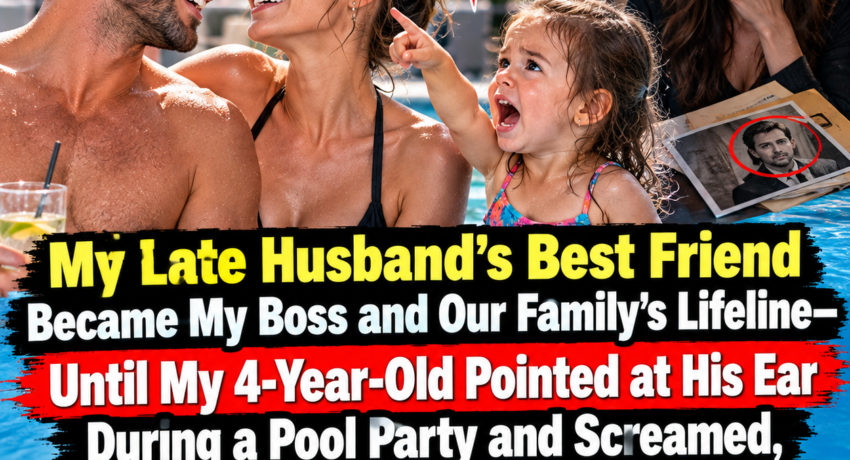
A year after cancer took my husband, his best friend was the only thing holding my little family together. He fixed our house, filled our fridge, and signed my paychecks. Then, in front of the entire firm, my daughter stared at the side of his head and told me her father was there. Harold went white as a sheet. And the secret behind his ear was only the beginning.
Part One: “Mommy, Daddy’s There”
I froze beside the glowing pool, one hand clenched around a wine glass, staring at the back of my boss’s ear.
Around me, the party kept going. Ice clinked in glasses. Someone laughed too loudly near the bar. Soft jazz floated from speakers hidden in the hedges. But I didn’t hear any of it. All I could hear was my four-year-old daughter’s voice, looping through my head like a scratched record.
“Mommy, Daddy’s there.”
My husband had been dead for a year.
And I was looking at exactly what she’d been pointing at.
Let me back up.
My name is Alison. I’m thirty-seven years old, and twelve months ago, cancer took my husband, Mike. It happened faster than anyone warned us it would. One season he was coaching the neighbors’ kids in the driveway, and the next he was a shape under hospital blankets, squeezing my hand and asking me to promise I’d be okay.
He left me alone with our daughter, Mia. She was three then. She’s four now.
Most nights she still asked the same question as I tucked her in. “When is Daddy coming home?”
I never found a good answer. I don’t think there is one.
Harold was Mike’s oldest and closest friend. They’d met as teenagers and stayed inseparable for more than twenty years, through college road trips, bad girlfriends, terrible haircuts, and every fishing season in between. Our families had been woven together for a decade of barbecues, holidays, and inside jokes nobody else understood.
He was also, conveniently or not, my boss at the firm.
After the funeral, Harold simply showed up. He didn’t ask what I needed. He just appeared, over and over, with whatever the moment required. Bags of groceries on the porch. A brand-new washer when mine died in a puddle of gray water. A toolbox and an hour of quiet fixing whenever something in the house broke.
Some afternoons I’d wake up on the couch, having collapsed from pure exhaustion, and find him sitting cross-legged on the living room rug, building Lego castles with Mia. He’d put a finger to his lips and smile, as if to say, Sleep. I’ve got her.
I was incredibly grateful.
And if I’m being truthful, I was also a little ashamed of how grateful I was. Of how much I’d started to need him.
Part Two: The Warning in the Office Kitchen
“You know he doesn’t have to do all that,” Rachel said.
It was the morning before the pool party. My co-worker and closest friend had cornered me in the office kitchen, holding two mugs of coffee like a peace offering she knew I wouldn’t want.
“He’s just being kind, Rach.”
“Alison.” She lowered her voice and glanced toward the door. “I love Harold. You know I do. But you’re a young widow on his payroll, and he’s practically living at your house. People are talking. Not mean talk. Just… talk.”
“They can talk.”
“I’m not worried about them,” she said gently. “I’m worried about you. About how it looks. About what it’s doing to your standing here.”
I took the coffee, thanked her, and waved her off. I went back to my desk and buried myself in spreadsheets.
But her words stuck to me like a burr in a sweater. Every time I shifted, I felt them.
That afternoon, Harold invited the whole firm to his house for a summer pool party. When he stopped by my office, he made a point of telling me to bring Mia, because he knew I didn’t have a sitter.
“She’ll love the pool,” he said. “And she loves my kitchen anyway. She keeps trying to steal Mike’s old travel mug off my counter every time you two visit.”
I laughed, because it was true.
Harold had kept Mike’s beat-up travel mug from their college road trip, dented, faded, with a sticker half peeled off the side. He drank his coffee from it every single morning. And every time we visited, Mia would toddle straight to the counter and reach for it with both hands, as if it were a small piece of her father she could hold.
“That mug’s hers whenever she wants it,” Harold added, softer.
I remember thinking, Goodness, we’re lucky.
And then I remember a second, quieter thought slipping in right behind it.
Are we, though?
Part Three: The Night Everything Tilted
Mia squirmed in my arms as we walked up the long driveway to Harold’s house. She wore her favorite yellow dress, the one with grass stains I’d never managed to scrub out no matter how many times I tried.
“Mommy, can I swim?”
“Not tonight, baby. We’re just visiting.”
She rested her cheek against my shoulder. “I want Daddy.”
“I know, sweetheart,” I whispered into her curls. “I know.”
Harold’s house was glowing. Strings of warm lights zigzagged over the patio. Women floated past in silk dresses, men in crisp linen suits, and a full bar gleamed beside the deep end of the pool. In my simple sundress, with a wriggling preschooler on my hip, I felt like a smudge in the corner of a glossy magazine spread.
Then I spotted Harold across the water, a drink in his hand, watching us come through the gate.
He smiled at us. But it wasn’t the easy, familiar smile I’d grown used to over the past year. This one was warmer. Heavier. And underneath it was something else, something I didn’t have a word for yet.
Mia waved at him with her whole arm. He lifted his glass toward us, like a man who’d been waiting all night for exactly this moment.
Before I could stop her, my daughter twisted out of my grip and shot across the patio as if she’d been fired from a slingshot. Her yellow dress flashed between the legs of Harold’s guests. Someone laughed. Someone else cleared their throat in that pointed way adults do.
“Mia! Honey, come back here, please!”
I chased her around a cocktail table and nearly knocked the champagne out of a woman’s hand.
“I’m so sorry,” I stammered. “She’s just excited.”
The woman gave me a smile that wasn’t really a smile at all.
Then Harold appeared out of nowhere, laughing, and scooped Mia up under her arms as if she weighed nothing.
“Gotcha, wild thing!”
“Harold, I’m so sorry,” I said, rushing over. “I’ll take her.”
“Alison. Relax. Breathe. She’s four. Nobody minds.”
He settled Mia onto his hip and turned so she could see the lights shimmering under the water. I watched my daughter’s whole body melt against him, the way it used to melt against Mike, and something twisted inside my chest. Something complicated. Something I didn’t want to look at too closely.
And then Mia went perfectly still.
Her eyes locked onto the side of Harold’s head. Slowly, her little hand lifted, hovering beside his ear, as though she were reaching for something only she could see.
“Mommy,” she said clearly. “Daddy’s there.”
I froze. A waiter passing behind us slowed his steps.
And I watched all the color drain out of Harold’s face in one long pull, like a window shade being yanked down.
Part Four: The Man Who Stepped Away
Harold set Mia down on the tiles too fast. She stumbled half a step, caught herself, and then pointed straight at him with her whole arm outstretched.
“Mommy, but Daddy’s there! Look! You need to save him!”
Heads turned all around us. A man near the bar stopped mid-sentence. The jazz suddenly seemed very loud in the silence.
My cheeks burned in a way that had nothing to do with the summer heat.
“Sweetheart. Sweetheart, come here.”
I dropped to my knees and pulled Mia against me, smoothing her hair, whispering soft nonsense into her curls until her little body stopped trembling.
“Harold, I’m so sorry,” I said, looking up at him. “She misses her dad. Sometimes she just… says things.”
He nodded. But he wasn’t really looking at me. He was staring at the ground between us, as though something had fallen there that he couldn’t pick back up.
“It’s fine. It’s fine, Alison. Kids, right?”
Then he took a step back.
Just one step. But it landed on me like the sound of a door closing.
“Excuse me for a minute.”
He walked toward the far end of the pool, where the string lights hung low and the shadows grew thick. I watched him go, Mia’s small fingers still curled into the collar of my dress.
“Come on, baby,” I murmured. “Let’s get you a cookie.”
I steered her to the dessert table, sat her on a lounger, and pressed a lemon square into her hand. She ate it slowly, swinging her feet, calm again, as if nothing at all had happened.
But I couldn’t shake it.
That sudden, ghostly pallor. The way he’d almost dropped her.
“Grief,” I muttered under my breath. “Kids and grief. That’s all it is.”
Except it wasn’t. I knew what embarrassment looked like, and I knew what awkwardness looked like. This was neither. This was the kind of shock a person shows when someone has accidentally said out loud the exact thing they’ve been terrified of hearing.
Rachel’s voice from the office kitchen curled back through my mind.
What it’s doing to your standing here.
I stood up. I asked Mrs. Peterson from accounting to keep an eye on Mia for a moment, and I walked toward the dark corner where Harold had disappeared.
I found him beneath the pergola with Benjamin, his business partner. Both of them held fresh drinks. Harold had his back to me. I slowed down, not wanting to interrupt, waiting for a natural pause so I could apologize one more time.
Benjamin’s voice drifted over, warm and teasing.
“And the renovation? Are you really going through with the whole second-floor rebuild? For a family? Come on, Harold. Are you finally settling down on us?”
I couldn’t make out Harold’s answer. It was low and short and mumbled.
But I saw his shoulders lock up beneath his linen jacket. That rigid stillness a person gets when a question has landed far too close to the bone.
My stomach dropped straight through the pool deck.
A second-floor rebuild. For a family.
Harold didn’t have a family. He’d never married. He’d never had kids. His parents lived out in Arizona. His sister was in Boston with three teenagers who wouldn’t be caught dead sleeping in his guest room.
So who, exactly, was the family?
I stood there clutching a cocktail napkin I didn’t remember picking up, and I felt the whole world tilt, just slightly, beneath my feet.
Part Five: The Compass Rose
I lingered a few feet behind Harold, waiting for a break in his conversation.
And then, almost against my will, my eyes drifted up to the back of his ear. Mia’s words replayed in my head.
Daddy’s there.
At first, I saw nothing. Just skin. The edge of his collar. A bit of graying hair he’d been letting grow longer these last few months. I’d noticed that change and thought nothing of it.
Then one of the garden spotlights swung across the patio and caught him at a new angle.
And I saw it.
A tiny tattoo, still faintly pink around the edges. A compass rose, no bigger than a dime, tucked neatly behind his earlobe.
My knees went soft.
Mike had that exact tattoo. In that exact spot. The same small compass rose he’d gotten when he was nineteen, on a road trip to Flagstaff with his best friend.
My husband used to laugh that nobody ever noticed it. But Mia had. A thousand times over. Riding high on his shoulders, her little fingers had traced that mark again and again, like it was a secret that belonged only to the two of them. Every night before bed, she’d reach for it while he read her stories.
To a four-year-old who ached for her daddy, that tattoo wasn’t just a drawing on someone’s skin.
It was him.
“Oh my God,” I gasped, far louder than I meant to. “How is this even possible?”
Harold spun around. His eyes found mine, and something in his face simply collapsed.
“Alison? Are you okay?”
“I… um. I just remembered I told the sitter I’d call. I should go.”
“You don’t have a sitter tonight.”
“I meant my friend. I’m sorry, I have to…”
I didn’t wait for him to finish. I gathered Mia, mumbled something about her being overtired, and drove home with my hands shaking so badly on the wheel that I had to pull over once just to breathe.
I didn’t sleep that night.
After Mia was tucked in, I dragged out the plastic bin of photographs I’d been avoiding for an entire year. I peeled off the lid, and the smell of old paper rose up like a memory.
And there they were. The Flagstaff trip.
Mike, grinning into the camera outside a tattoo parlor, a fresh square of gauze taped behind his ear. Sunburned. Nineteen. Immortal.
The next photo in the stack showed the two of them in some roadside diner, maybe an hour later, maybe a day. Harold was mid-laugh, his head half-turned toward Mike as if answering a joke. His ear was plainly visible in the light.
Nothing behind it. Just the freckled skin of a boy who’d changed his mind at the very last second.
I laid the two pictures side by side on the kitchen table and stared at them until the edges blurred.
For years, Mike had teased Harold about chickening out that day. It was one of their oldest running jokes.
“Six months ago,” I said out loud to the empty kitchen. “He started growing his hair out six months ago.”
By the time the sun came up, I already knew what I was going to do.
Part Six: “Turn Your Head, Harold”
Harold answered his door in a wrinkled T-shirt and sweatpants. The shadows under his eyes told me he hadn’t slept either. I’d left Mia at home with Rachel.
“I figured you’d come,” he said quietly.
“Can I come in?”
He stepped aside. His house felt far too clean in the flat morning light, almost staged. And there on the kitchen counter sat Mike’s old travel mug, like an accusation.
I didn’t sit down.
“Turn your head, Harold.”
“Alison…”
“Please. Just turn.”
Slowly, he did. I looked at the little compass rose behind his ear, no party lights, no shadows, nowhere left to hide, and something in my chest unclenched and clenched again in the very same second.
“When did you get it?”
“Six months ago.” His voice was flat and hollow. “I should’ve told you.”
“Why didn’t you?”
“Because I was ashamed.”
That was when I finally sat down.
“Ashamed of what? Of missing him? Harold, he was your best friend for more than twenty years.”
“That’s what I told myself.”
“What does that mean?”
He sat across from me and pressed both hands flat on the table, as if bracing himself for a blow.
“It means I got the tattoo because I loved him,” he said. “He begged me to get it with him when we were kids, and I refused, because I was a coward. I made a joke of it for twenty years. And then he was gone. And I wanted to finally give him the yes I owed him.”
His voice cracked on the last word. I had to look away.
“That’s why Mia thought it was him,” I said softly. “She traced Mike’s tattoo every single night before bed.”
“I know.” He rubbed his face with both hands. “I’d completely forgotten until she said it at the pool. When she reached for my ear, I… I honestly thought I was going to be sick.”
I nodded slowly. My eyes were stinging.
“Thank you for telling me, Harold.”
He looked up, surprised. “That’s it?”
“That’s it. For now.”
He walked me to the door. Out on the porch, he hesitated, and I could see him fighting with himself.
“Alison. There’s more I should probably say. But I don’t know how to say it.”
“Then don’t,” I said. “Not today.”
I got into my car and sat there for a full minute before I could turn the key. Because I’d seen his face the moment he stopped himself. And I knew, deep in my bones, that whatever he’d just swallowed back was the part that actually mattered.
And sooner or later, I was going to have to come back and ask for it.
Part Seven: The Room for Mia
I couldn’t let it go.
I sat at my dining table that morning with a cup of coffee that went cold in my hands, turning every moment over in my mind. The way he’d looked at us from across the pool. Benjamin’s teasing question. The second floor. For a family. In the kitchen, Rachel was making pancakes for Mia and humming, glancing at me every few minutes with worried eyes.
By noon, I picked up my phone and texted him.
Can I come by this afternoon? I need us to finish our conversation.
He answered within a minute.
Yes. Please.
That afternoon, I sat across from Harold in his living room with my hands cold in my lap. I made myself say it before I lost my nerve.
“The tattoo wasn’t only about Mike, was it?”
He didn’t answer.
“I’ve seen the way you look at us, Harold. I heard Benjamin at the party. The second-floor rebuild.” My voice wavered. “That’s for Mia and me. Isn’t it?”
His shoulders folded inward, like a man finally setting down something far too heavy to carry.
When he spoke, his voice was barely there.
“Somewhere this year, it stopped being just about Mike,” he admitted. “I started picturing it. A room for Mia, with a window seat, because she loves to look outside. A life. The three of us. I never said a word to you. But without even meaning to, I was setting the table for it.”
I let the silence sit between us. It felt like the whole house was holding its breath.
“I would never cross a line,” he said quickly. “I swear it. You can keep your job. I’ll back off completely. We can go back to how it was.”
For one long second, I almost said yes.
I thought about Mia’s preschool tuition. About the mortgage. About the washer he’d bought and the groceries on my porch and all the nights he’d been the only other adult in my world. Saying yes would have been so easy. So safe.
And then I understood.
Staying, even carefully, even with the best intentions on both sides, would keep me exactly where I’d been for a whole year. Frozen. Living on borrowed kindness. Standing still inside a life that had ended, leaning on the one man who reminded me most of what I’d lost.
“You’re not a bad man, Harold,” I said gently. “You’re a grieving one. And I’ve been leaning on you so hard that I let the lines blur too. That’s on me as much as you.”
I took a deep breath.
“But I can’t keep taking your help. I have to leave the firm. I need to find my own path. For me, and for Mia.”
He nodded, his eyes wet, his face full of shame and something that looked a lot like relief.
He offered me a generous severance and a glowing reference. No strings attached. No conditions. And for the first time in days, I believed him completely.
Part Eight: What My Daughter Already Knew
I drove home with every window rolled down, letting the warm wind tangle my hair.
When I pulled into the driveway, Mia was waiting on the porch steps, clutching her stuffed rabbit. Her curls were wild from her nap, sticking up in every direction. Rachel sat right beside her, one arm draped around her small shoulders.
I sat down next to them on the step.
And finally, for the first time in a year, I let myself cry. Not the hidden kind in the shower, or the silent kind in the car after drop-off. Real tears. Quiet and slow, spilling over like something that had been dammed up far too long.
Mia climbed into my lap and wrapped her little arms tight around my neck.
“I know Daddy’s not really there, Mommy,” she whispered. “I just miss him.”
All this time, I’d thought my daughter was confused. That her grief had tangled up what was real and what wasn’t. But she had understood more than any of us. She had seen a piece of her father in a place no one else thought to look, and she had simply wanted it back.
“Me too, baby,” I whispered into her hair. “Me too.”
Rachel reached over and squeezed my hand, hard, the way only a real friend does.
The road ahead wasn’t going to be easy. I had no job lined up, a mortgage to pay, and a little girl who would keep asking questions I couldn’t answer.
But for the first time since the funeral, the future didn’t feel like something borrowed. It felt like mine.
And sitting there on those porch steps, with my daughter in my arms and my best friend at my side, I knew one thing for certain.
We were going to be okay.