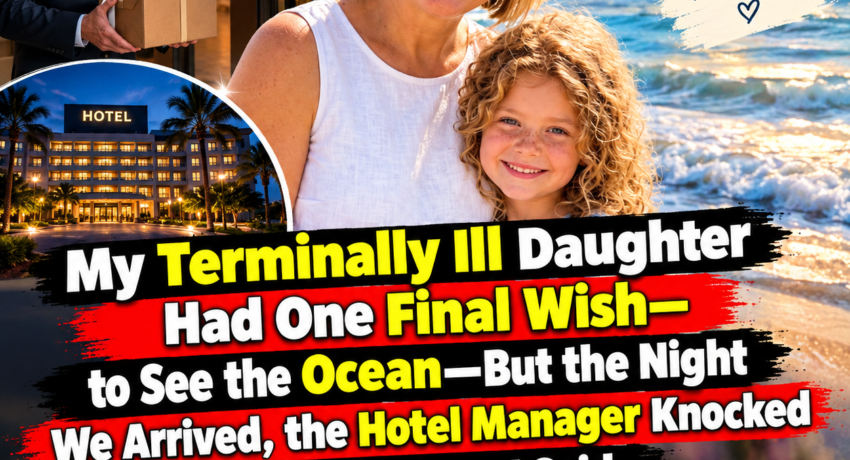
When the doctors told me my six-year-old had less than a year left, she asked for only one thing: to see the ocean. My father promised to help me make it happen. He never made it to the shore with us – but he had already arranged to be there in the only way he could.
Part One: The Chair in the Hallway
There is a particular kind of cold that lives in children’s cancer wards. It isn’t the air conditioning. It’s the quiet way everyone speaks, as if loud voices might tip something over.
That afternoon, I sat in a hard plastic chair outside the consultation room and stared at the floor tiles until they blurred. Somewhere down the corridor, Sophie was giggling at something her grandpa had said. It was the sweetest sound in the world, and it split me right down the middle.
The doctor sat across from me, holding her chart flat against his chest like a shield.
“I’m so sorry,” he said. “There’s no easy way to say this. The treatment can buy her time, but it can’t change where this is going. We’re likely looking at less than a year.”
Everything went still. The hum of the vending machine. The squeak of a nurse’s shoes. My own breathing.
“Is there anything,” I whispered. “Anything at all we haven’t tried?”
“We’re doing everything we can. I promise you that.”
I nodded, because if I opened my mouth, I didn’t know what would come out. My little girl was six years old. She was slipping through my fingers like water, and no prayer I knew was strong enough to close my hands around her.
Part Two: The Ocean Part Is the Best Part
That evening, Dad sat beside Sophie’s hospital bed with her battered Moana picture book open on his knee. It was their ritual. He’d read it so many times the spine had given up.
“Again, Grandpa,” Sophie said, tugging his sleeve. “The part where she sails out onto the ocean.”
“You only ever want the good part.”
“The ocean part is the good part.”
He laughed – that low, rumbling laugh I’d known my whole life – and turned back to page one. I stood in the doorway and pressed my hand over my mouth so neither of them would hear me come apart.
Later, when Sophie had fallen asleep with her stuffed bunny wedged under her chin, Dad found me in the hallway.
“She’s a fighter, that one,” he said.
“She shouldn’t have to be.”
He rested his hand on my shoulder, and for a long while neither of us spoke. We just listened to the monitors beeping behind the door – the soundtrack our lives had become.
“You’re not alone in this,” he said finally. “You know that, don’t you?”
“I know I have you, Dad.”
“You have a lot more than me, sweetheart. You just can’t see it yet.”
I thought he was only trying to comfort me. I had no idea he was already planning to prove it.
Part Three: Just Once
The next morning, Sophie held my hand and fixed me with those enormous, serious eyes.
“Mama, Grandpa says the ocean is bigger than a hundred hospitals.”
“It is, baby. Much bigger.”
“And you can smell it?”
I nodded, laughing even as my eyes filled.
“He said it’s loud, too. Like it’s always talking.”
She went quiet then, thinking the way only six-year-olds can – with her whole face. She turned toward the window, where a thin gray strip of sky was squeezed between two concrete buildings.
“I wish I could see it for real. Just once.”
Behind me, someone cleared their throat. Dad was standing in the doorway. He didn’t say a word, but his eyes met mine, and I watched him make some silent vow I couldn’t yet read.
I buried my face in Sophie’s hair. “We’ll find a way, sweetheart. I promise.”
I didn’t know how. I didn’t know when. I only knew that my daughter had asked the world for one small thing, and I would move heaven and earth to give it to her.
Part Four: The Envelope on the Table
That night, after Sophie drifted off, I sat hunched over my phone, scrolling through flight prices and hotel rates, doing math that never came out right.
Dad lowered himself into the chair beside me.
“Put that away,” he said. “Stop worrying about the money. I’ll cover it. Even if it’s only a few days, you take that girl to the ocean.”
“Dad, I can’t let you—”
“You can, and you will.” His voice was soft but left no room for argument. “She deserves that memory. So do you. Promise me you’ll go.”
“I promise.”
He smiled and patted my shoulder, and that was the end of it.
I’ve replayed that moment a thousand times since. How quickly he offered. How firmly he insisted. How he looked at me just a little too long, as if he were memorizing my face.
If only I’d understood.
Part Five: The Phone Call
The call came a few days later. I was sitting at Sophie’s bedside, helping her color a seahorse purple, when my phone rang. It was Dad’s neighbor, Mrs. Hendricks.
“Honey,” she said, and her voice was already breaking. “You need to sit down. Your father collapsed in the garden.”
A numbness crept up from my feet.
“Is he… please. Please tell me he’s okay.”
“The paramedics tried. They tried everything they could. I’m so sorry, sweetheart.”
I don’t remember ending the call. I only remember the crayon rolling off the tray table, and Sophie’s small hand on my shoulder.
“Mommy? Why are you crying?”
I looked at her, and all I could see was my father – reading Moana for the hundredth time, watching wave videos with her on his phone, pretending to be a sea turtle to make her laugh. And now I had to tell her he was gone.
She didn’t cry right away. She just held her bunny tighter and stared at nothing. Then she reached for my hand.
“It’s okay, Mommy. Grandpa went to heaven. I’m going there too, and when I see him, I’ll tell him how much we love him.”
I smiled for her. I held that smile all the way to the hallway, and then I slid down the wall and broke into pieces.
Part Six: For the Ocean
That night, I sat alone at my kitchen table in the dark. In front of me lay the envelope Dad had pressed into my hands only days before. It was thick with cash – money he must have been saving for months, maybe years. A yellow sticky note clung to the front, written in his shaky hand:
For the ocean. Don’t argue with me.
I laughed and sobbed at the same time.
“I’ll keep my promise,” I whispered into the empty kitchen. “For both of you.”
The next morning, I called Sophie’s doctor and asked if she could travel.
“At this stage of her treatment—” he began gently.
“Please.” My voice cracked. “My father just died. He paid for this trip so Sophie could see the sea. It’s the only thing she’s asked for. We have to go.”
The silence on the line stretched so long I thought the call had dropped.
“I understand,” he said at last. “I’ll clear her to fly. Keep her medications close, and make sure she rests.”
I hung up and let myself cry for exactly five minutes. Then I wiped my face and went back to planning my father’s funeral.
Part Seven: I Can Smell It
Two days after we buried Dad, Sophie and I boarded a plane.
She pressed her nose to the window the entire flight, gasping every time the clouds pulled apart to show the world below. I stared at the seatback in front of me and held myself together with both hands. She was all I had left now. I refused to let my grief stain the one thing she’d been waiting for.
We landed at midday. The moment the airplane doors opened, the salt air rushed in to meet us, warm and heavy and alive.
Sophie grabbed my sleeve and bounced on her toes.
“Mommy! I can smell it! I can smell the ocean! Grandpa was right!”
“He was, baby. He was right.”
The taxi ride passed in a haze of palm trees and impossible blue sky. Three separate times, I reached for my phone to call Dad and tell him we’d made it. Three separate times, I remembered.
At the front desk, the woman behind the counter leaned over to smile at Sophie.
“And who is this lovely young lady?”
“I’m Sophie,” she announced. “I came to see the ocean.”
“Well, Miss Sophie,” the woman said warmly, “we’ve been expecting you.”
Something in the way she said it snagged in my mind. But I was too tired, too hollowed out, to ask what she meant. I took the key and steered Sophie toward the elevator.
Part Eight: Bigger Than the Books
That afternoon, I carried Sophie down to the shore.
At the edge of the boardwalk, she stopped. She didn’t run, didn’t squeal. She just stood there, silent and small, staring out at the endless blue.
“Mommy,” she breathed. “It’s bigger than the books. And it’s prettier than the videos.”
“It really is, sweetheart.”
Then she was off, splashing through the shallows, shrieking at the cold, laughing in a way I hadn’t heard in almost a year. I stood on the wet sand and let myself memorize it – the sunlight in her hair, the foam around her ankles, the sound of her joy.
My phone buzzed in my pocket.
It was a message from her oncologist’s office. I read it three times before the words made sense.
Sophie’s latest labs came back this morning. The disease is progressing faster than expected. Please contact us as soon as you return.
I lifted my eyes to watch my daughter chase a wave, and I felt the sand slide away beneath my feet.
My father was gone. My daughter was dying. And soon, I would be completely, utterly alone.
Part Nine: The Knock
That evening, back in our room, I was helping Sophie wriggle into a dry sundress for dinner when a firm knock sounded at the door.
A man in a pressed suit stood in the hallway, a name badge on his lapel: R. Delgado, General Manager. In his arms, he held a large brown shipping box. His expression was gentle, almost solemn.
“Ma’am,” he said. “May I come in for just a moment?”
My heart lurched. “Is something wrong?”
“No. Nothing’s wrong.” He hesitated, as though weighing each word. “But there’s something about this trip you don’t know. I was asked to deliver this to you personally – but only once your daughter had seen the ocean.”
I stepped aside. Sophie sat up on the bed, head tilted, eyes locked on the box.
“Asked by whom?” I said.
Mr. Delgado set the box down carefully on the low table by the window.
“By a gentleman who called us a few weeks ago. He mailed this himself, along with very specific written instructions.”
The blood was roaring in my ears. “What did he tell you?”
“He said his granddaughter needed to see the ocean. That when you arrived, I was to bring this to your room.” He glanced at Sophie and smiled. “But he was very firm about one thing. Miss Sophie had to see the ocean first.”
I stared at the box, and the room tilted.
“Dad,” I whispered. “What did you do?”
Sophie scrambled onto her knees. “Grandpa sent us something?”
Mr. Delgado looked at her with a tenderness that surprised me. “He sent you a whole lot of somethings.”
Part Ten: He Knew
Inside the shipping box was another box – polished dark wood, heavier than it looked, tied with a wide satin ribbon.
“I don’t understand,” I said, though part of me already did. “He planned all of this. He… he knew he wouldn’t be here with us.”
The truth hit me with the force of a wave I hadn’t seen coming. The way he’d insisted on paying. The way he’d looked at me that night in the hospital, like he was saying goodbye without the words. The doctors had called it a heart attack. But had he known his heart was failing? Had he carried that secret alone so I wouldn’t have one more thing to carry?
The answer was sitting right in front of me, tied with a ribbon.
I pressed my hand over my mouth.
Mr. Delgado stepped quietly toward the door. “I’ll leave you two alone. Your father seemed like a very good man, ma’am. It was obvious how much he loved you both.”
“Thank you,” I managed.
The door clicked shut behind him. The only sound left was the ocean, murmuring just beyond the window – always talking, just like Dad had said.
Part Eleven: For My Girls
“Can I open it?” Sophie whispered.
I nodded. I didn’t trust my voice.
She slid off the bed and padded over in bare, sandy feet. Her small fingers brushed the ribbon, then pulled back.
“There’s a card, Mommy.”
A little tag hung from the bow. On it, in Dad’s unsteady handwriting, were three words:
For my girls.
I traced the letters with my thumb. The ink had bled slightly in places, where his hand must have trembled.
“Mommy,” Sophie said softly, “your hands are shaking.”
“I know, baby.”
“It’s okay.” She laid her palm over the back of my hand – exactly the way I had laid mine over hers a hundred times, in a hundred hospital beds. “Grandpa isn’t scary.”
A sound escaped me, half laugh and half something much deeper.
“No,” I said. “He’s not.”
I pulled the ribbon. The knot gave way far more easily than I expected, and the satin slipped free in one slow, tired curl. Sophie leaned in so close I could feel her breath, warm and quick against my arm.
I lifted the lid.
And for a moment, I couldn’t breathe at all.
Part Twelve: The Village
The box was full of envelopes. Dozens of them, packed edge to edge.
I lifted the first one with trembling fingers. The handwriting wasn’t Dad’s, but Sophie’s name was written across the front in careful, rounded letters.
“Read it, Mommy,” she whispered, climbing into my lap.
I unfolded the page and swallowed hard.
“Sophie, you are the bravest girl I have ever met. Every time you smiled through a needle poke, you taught me how to be a little stronger.”
Sophie’s eyes went huge. “That’s Nurse Marcy!”
I reached for another.
“Sophie, your smile made every single day in our classroom brighter. You reminded all of us that being kind is the bravest thing a person can do.”
“That’s Mrs. Lucy! My teacher!” She was grinning now, bouncing on my knee.
The next was from our elderly neighbor across the hall.
“Thank you for every drawing you slipped under my door. They’re all on my fridge, and I’m keeping every one.”
And then another, from the hospital janitor who used to wink at her in the elevator.
“To my favorite little customer. Those lollipops I gave you were never really to cheer you up. They were to thank you for cheering me up.”
They just kept coming. Nurses from the night shift. The woman from the bakery down the street. Her swim teacher from before she got sick. Children from her class, with crooked crayon hearts and misspelled words that meant everything.
“There are so many,” I breathed.
I counted more than thirty letters, every one of them for Sophie. Every one of them a small, bright piece of proof that my daughter had touched the world – that she mattered, and she would be remembered.
Part Thirteen: The Last Letter
At the very bottom of the box, beneath all the others, lay one envelope that was different.
It had my name on it. In Dad’s handwriting.
I opened it with shaking hands.
My dear girl,
If you’re reading this, it means I didn’t make it to the ocean with you. I’m sorry I never told you I was sick. I just couldn’t do it – not with everything you’re already carrying for Sophie.
But I couldn’t leave you believing you were alone, either.
So I went to everyone who has ever loved our Sophie, and I asked them to write her a letter telling her what makes her so special.
This box is your proof that there’s a whole village standing behind you.
Don’t you ever forget that.
And don’t let sadness steal your time with Sophie by the sea. None of us knows what tomorrow brings, sweetheart. So make the most of today.
All my love, always, Dad
I pressed the letter against my chest and cried into Sophie’s hair until I had nothing left.
“Mommy, why are you crying?”
“Because I love your grandpa so much, baby. And I miss him so much it hurts.”
I made myself breathe. In, and out. Then I lifted her chin and smiled – a real smile, the first in weeks.
“But he says right here that he wants us to have fun at the beach. So that’s what we’re going to do. Deal?”
Sophie reached up with both small hands, wiped the tears from my cheeks, and nodded solemnly.
“Deal.”
And we did. For four days, we built lopsided sandcastles and chased seagulls and ate ice cream for breakfast. Every night, we read three more letters before bed. Every morning, Sophie ran down to the water and shouted, “Good morning, Grandpa!” at the waves.
I finally understood what Dad had meant in that hospital hallway. I’d had a whole village all along. I just hadn’t been able to see it.
Part Fourteen: Another Option
Three weeks after we came home, Sophie was sitting up in her hospital bed, coloring a whale with a purple crayon, when her door swung open. Her oncologist leaned in.
“Ma’am, could I speak with you outside for a moment?”
My stomach dropped straight through the floor. I followed him into the hallway, bracing myself for the words I’d been dreading since the text on the beach.
“I have some news,” he said. “A new clinical trial has just opened. Based on Sophie’s most recent results, she qualifies.” He held up a hand before I could speak. “I can’t make you any promises. But for the first time, we have another option.”
I turned and looked through the little window in her door. Sophie was humming the ocean song from her favorite book, her crayon moving in slow, happy circles. On the shelf beside her bed sat a polished wooden box tied with a satin ribbon.
“Then we’ll take it,” I said.
I don’t know what tomorrow will bring. Nobody does – Dad taught me that.
But I know we won’t be facing it alone.