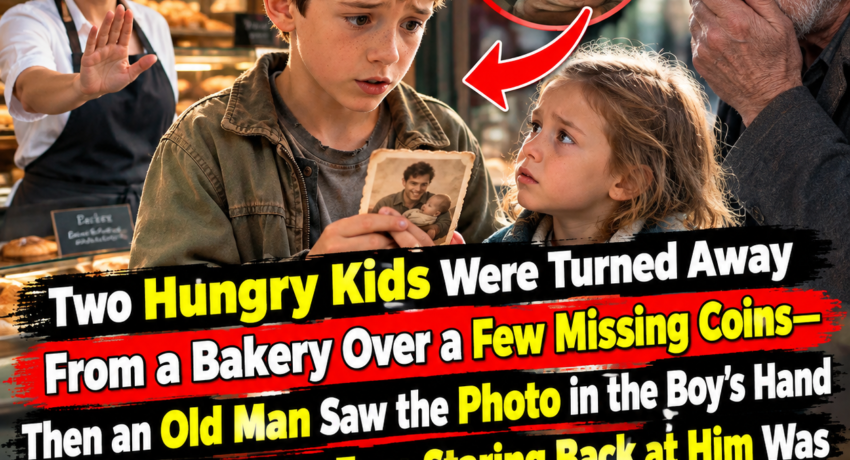
For almost twenty years, Walter Avery told himself his son had walked out of his life for good. He never imagined the proof he was wrong would arrive in the hands of an eleven-year-old boy with seven dollars and twelve cents in his pocket.
Part One: Seven Dollars and Twelve Cents
By the time Lily started crying, Mason had already made up his mind: he wasn’t going to ask anyone else for help.
He’d tried twice that morning. The first person walked right past without hearing him. The second heard perfectly well and looked away.
Mason could live with that. What he couldn’t live with was watching his little sister press her face to the bakery window as if bread belonged to some other world – a world with a door she wasn’t allowed through.
“Don’t cry,” he whispered.
“I’m not.” Lily scrubbed both cheeks with the sleeve of her faded sweater.
She was six years old and a terrible liar. Mason was eleven, and lately he’d become very good at it.
He’d told Lily they were going on an adventure. He’d told her the shelter was only for a little while. He’d told her he knew exactly where they were headed.
None of it was true.
The truth was in his backpack. Seven dollars and twelve cents. Two shirts. Lily’s toothbrush. A pair of socks. One old photograph. And the last note their father, Daniel, had written before he died.
Mason had never shown Lily the note. Some things, he believed, a big brother was supposed to carry by himself.
The first thing they noticed when they stepped inside wasn’t the food. It was the warmth. Heat rolled over their frozen faces like a blanket. There were wooden tables, paper bags stacked behind the counter, and glass cases crowded with loaves, muffins and pastries. The coffee machine hissed. Cups clinked against saucers. People murmured over breakfast.
For one moment, Mason let himself imagine they belonged there.
Then the woman behind the counter looked at their clothes. Not unkindly – just carefully. She was somewhere in her late forties, dark hair pulled back, eyes that looked like they hadn’t had a full night’s sleep in years.
“What can I get you?”
Mason glanced at Lily, who was staring at a tray of breakfast rolls. “One of those.”
The woman reached for a paper bag. “Anything else?”
“No.”
He dug into his pocket and counted the coins into his palm. He’d checked the price board outside, but half the numbers had been blurred by rain on the glass.
The woman looked at the money. Then at the register.
“That’s not enough, sweetheart.”
Heat flooded Mason’s face. “How much?”
She told him. He counted again anyway, as if numbers might change just because you needed them to.
“Can I pay you the rest later?”
The woman hesitated. Behind him, Lily sniffed.
“I’m sorry,” the woman said.
Mason straightened his shoulders at once. “It’s okay.”
She lowered her voice. “I really am.”
“We don’t need it.” He took Lily’s hand. “Come on.”
They drifted to an empty corner by the window, and Lily’s face finally crumpled.
“I’m hungry.”
“I know.”
“You said we could eat. You promised.”
Mason crouched in front of her. She turned her head away, and he gently turned it back.
“Hey. I’m going to figure it out.”
“How?”
“I always do.”
Another lie. But this one, Lily believed. She leaned into him, and Mason wrapped both arms around her as tightly as he could.
Part Two: The Face in the Photograph
At a table nearby, an elderly man set down his coffee.
He’d noticed the children the moment they walked in. Not because they were dirty, though they were. Not because they looked hungry, though they did. What caught his attention was the way the boy kept himself between the girl and everyone else in the room – watchful, protective, far too serious for someone his age.
The man’s name was Walter Avery. He was seventy-one, retired, widowed, and he’d been living alone longer than he liked to admit. He came to the bakery most mornings because his house was too quiet. For years he’d told people he came for the coffee. The coffee was ordinary. What he really came for was the sound of voices that didn’t expect him to answer.
He was watching the boy comfort his sister when something caught his eye.
A rectangular edge was sticking out of the boy’s hand. A photograph – not a phone screen, not a computer printout, but a real photograph, its corners worn soft and white. Mason had pulled it out of his backpack while hunting for money and never put it back.
Walter couldn’t see the image clearly. But something about it made his chest tighten.
He stood up – slowly, because his knees no longer tolerated sudden decisions – and walked toward the children. Mason noticed immediately. His arm tightened around Lily.
Walter stopped several feet away. “I’m not going to bother you.”
The boy said nothing.
“What have you got there?”
Mason glanced down. “Nothing.”
Walter nearly turned around. Then the photograph shifted in the boy’s fingers, and for half a second the whole image was visible.
Walter froze.
A young man – twenty-six, maybe – with dark hair and a tired, happy face, cradling a newborn boy swaddled in a hospital blanket.
Walter knew that face. He’d spent more than forty years trying to forget how hopeful it had once looked.
It was his own.
The bakery vanished. The tables, the coffee machine, the quiet morning chatter – all of it fell away.
Mason saw the change in him, and his suspicion deepened. “What?”
Walter couldn’t answer right away. His breathing had gone strange. He looked at the boy, then back at the picture.
“Who gave you this?”
Mason hesitated. “My dad.”
Walter’s hands went cold. “Your dad?”
The boy nodded.
Walter leaned in a little, careful not to touch the photograph. “What was your father’s name?”
Mason looked at the floor. “Daniel.”
For a moment, Walter forgot how to breathe.
Daniel.
Decades of anger, regret and unanswered questions collapsed into a single name. His eyes filled.
“Daniel…” His voice barely worked. “Daniel was my son.”
Silence.
Lily lifted her tear-streaked face from her brother’s chest. She looked at Walter. Then at the photograph. Then back at Walter.
“Then…” Her small voice wobbled. “Are you our grandpa?”
Every instinct Walter had told him to reach for them. He didn’t. He simply nodded.
“Yes.”
Mason’s grip on the photograph loosened. Lily stared at Walter as if trying to work out how a grandfather could just appear beside a bakery table. Then she stretched one small hand toward him.
Walter looked at it, and his face broke. He took her fingers gently in his.
No hug. No dramatic reunion. Just a six-year-old girl holding the hand of a man she’d met thirty seconds earlier.
Behind the counter, the bakery woman had stopped what she was doing.
Part Three: “Now I Prove the Rest”
Mason stayed on guard. “You knew my dad?”
The question was so impossible that Walter almost laughed. “I knew him from the day he was born.”
Mason studied the photograph. “You’re the man holding him.”
“Yes.”
“You look different.”
Walter smiled through his tears. “Time does that.”
“Why didn’t Dad ever tell us about you?” Lily asked.
The smile disappeared. Walter looked at Mason and could see the boy wanted the answer just as badly.
“I don’t know what he told you.”
“Nothing,” Mason said, his voice hardening. “He never talked about his family.”
Walter nodded slowly. “That sounds like Daniel.”
“Why?”
Walter looked out the window. Thirty years ago, he would have hidden behind pride. Twenty years ago, behind anger. Ten years ago, behind silence. But now there were two children in front of him who had inherited every one of those choices.
“Because your father and I stopped speaking.”
“Why?” Lily asked.
“Because I was stubborn.”
“Dad was stubborn too,” Mason said.
Walter almost smiled. “Yes.”
“He used to say that about himself.”
“I’m not surprised.”
Mason’s eyes narrowed. “If you’re really our grandpa, why have we never seen you?”
The question landed harder because it was fair. Walter let go of Lily’s hand only because he needed both hands to lower himself into the chair across from them.
“I didn’t know you existed.”
“You expect me to believe that?”
“No.” Walter looked him straight in the eye. “Not yet. But it’s true.”
The answer seemed to catch Mason off guard.
Just then the bakery woman approached with a paper bag holding two breakfast rolls. “I’m sorry,” she said, and set it on the table. “No charge.”
Mason stiffened. “You said—”
“I know what I said.” She glanced at Lily. “I was listening to the register before I was listening to common sense.”
Walter reached for his wallet.
“No,” she said.
“I’ll pay.”
“No.” She looked at Mason. “This one’s on me.”
Lily grabbed for the bag. Mason stopped her.
“Wait.” He turned to Walter. “Do you have ID?”
Walter blinked. “What?”
“You say you’re our grandpa.”
Walter considered this and nodded. “That’s reasonable.”
He pulled out his driver’s licence. Walter James Avery. Mason read it carefully, then flipped the photograph over. On the back, in faded ink, someone had written:
WALTER AND DANIEL — FIRST DAY HOME.
Something shifted in Mason’s face. Not trust – not yet. But one wall had cracked.
Walter saw the writing too, and his breath caught. “That’s your grandmother’s handwriting.”
“Our grandma?”
“My wife.”
“Where is she?” Lily asked.
Walter looked down. “She died nine years ago.”
“Oh,” Lily said softly.
“She would have loved you.”
Mason bristled. “You don’t know us.”
“You’re right,” Walter said. The boy waited. “But I know she would have wanted to.”
That answer, it seemed, was acceptable.
Lily opened the bag, and the smell of warm bread rose between them. She tore the first roll in half and pushed one piece toward her brother. He tried to refuse.
“Eat,” she ordered – in a voice that sounded exactly like his.
Walter noticed. Mason took the bread.
Then Walter asked the question he’d been circling. “Where is Daniel now?”
Mason stopped chewing. Lily lowered her food. Their faces told Walter the answer before Mason said a word.
“He died.”
The color drained out of Walter. “When?”
“Four months ago.”
Walter gripped the edge of the table. “How?”
“His heart.”
“He had a heart condition?”
Mason shrugged. “He said it wasn’t serious.”
Walter closed his eyes. Daniel had been forty-three. Forty-three. Far too young.
“When was the funeral?”
“There wasn’t much of one. Just us. Dad’s friend Mike. A pastor.”
Walter stared at the photograph. His son had died. His son had been buried. And on that same day, Walter had been eating breakfast, mending a fence, watching television – doing something that didn’t matter at all. He hadn’t even known.
The bakery woman quietly slipped away.
“And your mother?” Walter asked.
Lily looked at Mason. Walter saw another wound open.
“She died two years ago,” Mason said.
“I’m so sorry.”
Mason gave one short nod.
“What happened after Daniel died?”
No answer.
“Mason?”
“We were staying with someone. Dad’s friend.”
“Where is he now?”
“Gone.”
“Gone where?”
Mason’s chin came up. “We’re fine.”
Walter looked at their clothes, the overstuffed backpack, the way Lily had eaten. He didn’t say the obvious. Instead he asked, “Do you have somewhere to sleep tonight?”
Mason’s jaw tightened. “We’ll figure it out.”
Walter nodded. Then he said something the boy didn’t expect.
“Okay. But you don’t have to figure it out alone anymore.”
Mason shook his head immediately. “You don’t know us. You might not even be telling the truth. You can’t just show up and decide we’re family.”
Walter took every word without flinching. “You’re right.”
Lily looked back and forth between them.
Walter rested his fingers on the table beside the photograph, not on the picture itself. “This tells us something. It doesn’t tell us everything.”
“So what now?” Mason asked.
Walter looked at the children of the son he had spent decades missing in silence.
“Now I prove the rest.”
Part Four: A Folder Instead of Presents
Walter didn’t take the children home that morning.
He wanted to. And he could see that his wanting it frightened Mason. So he did something his younger self would never have managed.
He slowed down.
The bakery woman – her name was Ruth – let them stay at the corner table while Walter made phone calls. Not to the police. Not to anyone who’d arrive with sirens and turn the morning into a spectacle. He called a family services office. Then a lawyer he’d known for years. Then his younger sister, Louise.
By noon, the records confirmed the first truth. Walter Avery had a son named Daniel Avery. The birth date matched. The photograph matched Walter’s family albums. Daniel Avery had died four months earlier, leaving two children: Mason Avery, eleven, and Lily Avery, six.
Walter was their grandfather.
Mason listened to every call, and Walter let him. He didn’t lower his voice or step into another room. If this boy was ever going to trust him, he needed to hear how adults talked when they weren’t rewriting the story behind his back.
Ruth brought out sandwiches. Mason tried to refuse.
“This isn’t charity,” she said.
He eyed her suspiciously. “Then what is it?”
“Lunch.”
He stared. Ruth smiled a little. “Somebody used that line on me once.”
Mason ate.
By late afternoon, a temporary placement had been arranged with Louise, a retired elementary school secretary who lived nearby. Mason didn’t like it one bit.
“Why can’t Lily stay with me?”
“She can,” Walter said at once. “You stay together.”
The boy’s face loosened. “And you?”
“I’m going home.”
Lily looked crestfallen, and Walter saw it. “I’ll see you tomorrow.”
“You promise?”
Walter nearly answered too fast – then caught himself. Promises mattered to children who’d already watched grown-ups disappear.
“Yes.”
And he kept it. He knocked on Louise’s door at eight the next morning.
He didn’t bring presents. Mason noticed. Adults who showed up after long absences usually came loaded with toys, clothes, candy – things meant to speed up affection. Walter brought a folder.
Inside were photographs. Daniel as a baby. Daniel at six, missing his front teeth. Daniel with a baseball glove, on a bicycle, in his high school graduation gown.
Lily sat on the floor beside Walter. “That’s Dad?”
“That’s him.”
“He had weird hair.”
Walter smiled. “The nineties were hard on everybody.”
Mason sat across the room, pretending not to listen. Walter knew better.
Lily turned the next page. Daniel at seventeen – thin, defiant, leaning against an old pickup truck.
“He looks mad.”
“He probably was.”
“Why?”
The smile left Walter’s face. “Because we argued a lot.”
Mason finally spoke. “About what?”
“By then? Everything.”
“Why?”
Walter had to think. For years he’d told himself Daniel was a difficult child. That was the lie he’d built after everything broke. The truth was harder to hold.
Daniel had been curious and independent. He loved cameras, music, drawing – all things Walter had dismissed as distractions. Walter owned a small machine repair shop that his own father had run before him, and he’d simply assumed Daniel would take it over one day. Daniel had assumed his father would eventually understand he wanted something different.
Neither assumption survived.
“When your dad was eighteen,” Walter said, “he told me he wanted to study photography.”
Mason glanced at the old picture in his hands. “He liked taking pictures. He always had a camera.”
Walter smiled. “Always.”
“What happened?”
“I told him photography was a hobby. I told him the repair shop was real work.”
Mason’s face tightened. “That was mean.”
“Yes.”
Lily looked surprised he’d agree so easily.
“Daniel went to community college anyway,” Walter went on.
“Did you pay?” Mason asked.
“No.”
“Why not?”
Walter looked at his hands. “Because I thought if I refused, he’d come back to the shop.”
“Did he?”
“No. He worked nights and paid for it himself.”
Something that looked almost like pride crossed Mason’s face. “That sounds like Dad.”
“It does.”
Part Five: The Last Fight
The next photograph showed Daniel at twenty, a camera slung around his neck. Those were the years everything changed.
Daniel met Sarah – Mason and Lily’s mother.
Walter had liked Sarah. That was the part his memory had twisted over time. For years he’d blamed her for pulling Daniel away, when the real reason was much simpler: Daniel had wanted the distance.
“He married Mom?” Mason asked.
“Yes.”
“Did you go? To the wedding?”
Mason waited.
“No.”
Lily frowned. “You missed your own son’s wedding?”
Walter’s throat tightened. “Yes.”
“Why?”
“Because I was angry.”
“That’s stupid,” Lily said.
In the kitchen, Louise closed her eyes.
Walter nodded. “It was.”
Mason got to his feet. “So you didn’t know us because you didn’t care.”
“No.”
“Sounds like it. You didn’t go to his wedding. You wouldn’t pay for his school. You stopped talking to him.”
“Yes. Yes. And yes.”
Mason’s voice sharpened. “Then what part am I supposed to understand?”
Walter didn’t defend himself, and somehow that rattled Mason more than any excuse could have.
“The part where I was wrong.” He let the silence settle. “But there’s another part too.”
Mason crossed his arms.
“When Daniel was twenty-four, we had our last fight.”
“What happened?”
Walter could still see every detail. Daniel standing in the repair shop. Rain hammering outside. Sarah waiting in the truck. A cardboard box of Daniel’s things.
Daniel had come back to ask whether Walter wanted to have dinner with them. It should have been the easiest yes in the world. Instead, Walter asked him when he was planning to quit “playing photographer” and find a real job.
Daniel said he had a real job. Walter said taking pictures of houses and weddings wasn’t a future.
“It’s my future,” Daniel said.
Then Sarah came in and told him they were moving three states away.
Walter felt something he refused to call fear. So he dressed it up as anger instead.
“I told him that if he left, he shouldn’t expect me to keep fixing his mistakes,” Walter said quietly.
Mason stared.
“Daniel said he’d never asked me to.”
“What did you say?”
Walter’s voice dropped. “I told him if he walked out that door again, he shouldn’t bother coming back.”
Lily looked heartbroken. Mason looked furious.
“And he didn’t.”
“No.”
“Because you told him not to.”
“Yes.”
Mason turned away.
“I regretted it before his truck reached the end of the street,” Walter said.
Mason stopped. “Then why didn’t you call him?”
“I did. He’d changed his number.”
“Did you write?”
“I did. He never answered.”
“Did you go find him?”
Walter said nothing.
Mason turned back around. “You didn’t.”
“No.”
“Why?”
The answer was humiliating. “Pride.”
Mason let out a single laugh – nothing funny in it. “Dad died because you were too proud to go find him?”
Walter’s face changed. “No.”
Mason knew at once he’d gone too far. But anger rarely waits for permission. “You know what I mean.”
Walter lowered his eyes. “Yes.”
Lily started to cry. Mason hurried to her side. “Hey…”
Walter stood. “I should go.”
“No,” Lily said, looking up.
“It’s okay.”
“No.” She walked over to him. “Are you mad?”
“At Mason?”
She nodded.
“No.”
“Why not?”
Walter looked at the boy. “Because he asked the question I should have asked myself years ago.”
Mason stared at the floor.
Part Six: The Name at the Bottom of the Page
Walter was pulling on his coat at the door when Mason spoke again.
“Did Dad ever write to you?”
Walter turned. “Not that I ever received.”
Mason reached into his backpack. Out came the photograph – and then something else. A folded sheet of paper.
Walter’s heart skipped. “What’s that?”
“Dad’s.” Mason held it tight. “He wrote it before he died.”
He glanced at Lily, then slowly unfolded it.
At the top was a list. Bills. Phone numbers. Daniel’s friend Mike. The landlord. A contact at the school.
And at the very bottom, one line:
If you ever run out of people, find Walter Avery.
Walter’s legs nearly gave out.
“You,” Mason said. “Dad wrote your name.”
Walter took one step forward, then stopped. “May I?”
Mason hesitated – and handed it over.
Walter ran his thumb across his son’s handwriting. Daniel had remembered him. He hadn’t called. He hadn’t forgiven him enough to come home. But he had remembered.
Walter read the line again. If you ever run out of people, find Walter Avery.
“Why would he write that,” Mason whispered, “if he hated you?”
Walter stared at the page. “Maybe he didn’t.”
That possibility hurt worse than hatred ever could. Hatred, at least, would have explained the silence.
“Maybe he was going to call you,” Mason said.
Walter closed his eyes. Maybe. One of the cruelest words there is. Maybe Daniel had been planning to call. Maybe Walter could have called first. Maybe pride had stolen years that neither of them ever believed would run out.
Lily slipped her hand into his again. “You found us anyway.”
Walter looked down at her. “No.”
“What?”
He looked at the photograph. “You found me.”
Part Seven: One Day at a Time
After that, Walter saw Mason and Lily every day. Not for long, not at first. He learned them slowly.
Lily hated orange juice with pulp. Mason could fix almost anything mechanical if you gave him enough time. Lily loved dogs. Mason hated being asked how he felt. Lily slept with a lamp on. Mason slept so lightly he woke whenever anyone opened a door.
Walter learned not to ask why every time. Some answers only came when children decided they were safe enough to give them.
The kinship process began. Walter’s house was inspected, his finances reviewed, his health discussed. At seventy-one, he was older than most new guardians. He knew it. So did Mason.
One evening at Louise’s house, Mason asked him straight out. “What if you die?”
Walter stopped washing the plate in his hands. Lily was coloring at the table. He dried his hands.
“That’s a fair question.”
“You’re old.”
“He knows,” Louise called from the living room.
Walter ignored her. “I have a will.”
“That doesn’t help us.”
“No, it doesn’t.” Walter sat down across from him. “I also have your Aunt Louise.”
“She’s not our aunt.”
“Technically, she is. And I have a plan. If I ever get sick, you won’t have to wonder where you’re going. Everything is written down.”
“That’s what Dad did,” Mason said.
“Yes.”
Mason looked at the table. “Didn’t work out great.”
“No.”
“So why should I trust your piece of paper?”
Walter thought about it. “Don’t.”
Mason looked up.
“Trust what I do while I’m here.”
That answer became the foundation of everything between them. Walter didn’t make speeches. He showed up.
A school meeting? Walter was there. Lily caught a cold? Walter arrived with soup, medicine Louise had approved, and three new books. Mason had a science project? Walter came with his toolbox – and made Mason do every bit of the work.
“You’re not going to build it?”
“It’s your project.”
“You fix machines.”
“I do.”
“So help.”
“I am.”
“How?”
“By not letting you glue the wrong side.”
Mason rolled his eyes.
Two months after the bakery, the children spent their first night at Walter’s house. It was a modest two-story place with peeling white paint and a detached garage that smelled of sawdust and machine oil.
Mason paused in the hallway. “Dad grew up here?”
“He did.” Walter opened a door. “This was his room.”
He’d changed it over the years, but not completely. A small shelf still hung on the wall. And the doorframe still bore pencil marks – names and heights.
DANIEL — 8. DANIEL — 12. DANIEL — 15.
Mason touched the last one. “He was taller than me.”
“You’ve got time.”
“Where’s my room?” Lily asked.
“You pick.”
She thundered up the stairs. Mason stayed where he was.
“You kept all this?”
“Some of it. I kept telling myself I’d clear it out.”
“You didn’t.”
“No.”
Mason crossed to the shelf. An old camera sat there. He picked it up. “Dad had one just like this.”
“That was his. He left it behind.”
Mason went very still. “Can I…?”
“It belongs to you now.”
Mason held the camera in both hands, and something changed in his face. Suddenly Daniel felt closer – not because of any story Walter had told, but because his father’s fingerprints might once have rested on the very same metal.
“Did you ever look at his pictures?” Mason asked quietly.
“Not enough.”
Part Eight: The Letter He Never Sent
That night, after Lily fell asleep, Mason found Walter sitting in the garage with a cardboard box on the workbench.
“What’s that?”
“Things your dad left behind.”
Mason hesitated. “Can I look?”
“Of course.”
Photographs. Negatives. Old receipts. School papers. A cracked lens. And then Mason pulled out an envelope with one word on the front, in Daniel’s handwriting.
WALTER.
Walter stopped breathing. He’d never seen it before.
“You never opened this?”
“I didn’t know it was there. It must have been tucked inside the camera case.”
Mason handed it over. “Open it.”
Walter’s hands shook. The letter was dated twelve years earlier.
Dad,
I don’t know if I’m going to send this. Sarah says I should. She says two stubborn people can spend their whole lives waiting for the other one to move first. I told her she doesn’t understand us. She said that’s probably why she does.
I’m still angry. You were wrong about my work. You were wrong about Sarah. You were wrong when you made love feel like something I had to earn by becoming the man you wanted me to be.
But I was wrong too. I wanted you to come after me, because I wanted proof that I mattered. And when you didn’t, I decided that proved everything.
Maybe neither of us knew how to find the way back.
Sarah is pregnant. I haven’t told you. Maybe by the time I send this, I will have. Maybe I won’t.
If it’s a boy, I hope I’m better at being a father than we were at being father and son.
Daniel
Walter sank onto a stool. Mason had gone pale.
“He wrote that before I was born?”
Walter nodded, pressing a hand to his mouth. “Sarah was pregnant with you.”
Mason stared at the old camera. “So he wanted to tell you.”
“Yes.”
“But he never sent it.”
“No.”
“Why?”
Walter gave a broken laugh. “Probably the same reason I never drove three states to knock on his door.”
Mason looked at him. “You were both idiots.”
Walter laughed through his tears. “Yes. We were.”
And for the first time, Mason laughed too.
Then something inside him gave way. Not loudly. He just sat down on the garage floor as if his legs had decided for him.
“Dad was supposed to be here,” he said, looking at the letter. “He was supposed to watch me grow up. He was supposed to teach Lily to drive. He was supposed to—”
His face twisted.
For four months, Mason hadn’t cried. Not at the hospital. Not at the funeral. Not when his father’s friend said he couldn’t keep them anymore. Not once while he was telling Lily everything was fine.
Now it came all at once, so suddenly he looked ashamed of it.
Walter moved toward him, then stopped. “Can I sit?”
Mason nodded. Walter lowered himself onto the cold concrete beside him. He didn’t reach for him. Not yet.
“I was there when he died,” Mason choked out. “He kept saying he was okay. I called the ambulance, but it took too long. I should’ve called sooner.”
“You were eleven.”
“I knew something was wrong.”
“You were eleven.”
Mason shook his head hard. “Lily was crying, and Dad told me not to scare her. So I waited.”
Walter’s voice turned firm. “That was not your fault.”
Mason glared at him. “You don’t know. You weren’t there.”
Walter accepted that. “No, I wasn’t. But I know Daniel was the grown-up.”
Mason cried harder. “He told me to take care of Lily.”
Walter’s heart cracked. The boy hadn’t heard that as a moment’s instruction. He’d built his entire self around it.
“And you have,” Walter said. “Every single day.”
“I have to.”
“No.” Mason stared at him. “You love her. That’s not the same as being responsible for everything that ever happens to her.”
Mason looked away. “If I stop, who does it?”
“Me,” Walter said quietly. “Louise. Teachers. Doctors. People who care about you.”
“People leave.”
Walter didn’t deny it. “Yes.”
“People die.”
“Yes.”
“People make mistakes.”
Walter swallowed. “I’ve made enough to prove that.”
“Then how am I supposed to trust anybody?”
Walter looked down at Daniel’s letter. “Slowly. One day at a time.” His eyes filled. “You don’t owe me twenty years just because I’m your grandfather. Give me tomorrow.”
“And after tomorrow?”
“If I earn it, give me the next one.”
Mason looked at the floor. Then he leaned – just a little – until his shoulder rested against Walter’s arm. Walter didn’t move a muscle.
Several seconds passed. Then, barely audible: “Grandpa?”
It was the first time he’d said it. Walter shut his eyes. “Yes?”
“I’m tired.”
Not just his body. Walter knew that. “I know.”
Mason’s next words were so soft they almost disappeared. “I don’t want to be in charge anymore.”
Walter finally put his arm around him. He didn’t pull. He was just there.
“You don’t have to be.”
That was the real reunion. Not the bakery. Not the photograph. Not even the word Grandpa. It was the moment an eleven-year-old boy finally believed someone else might carry some of the weight.
Part Nine: The Empty Chairs
The very next morning, it all nearly fell apart.
Passing the study, Mason overheard Walter on the phone with the family lawyer.
“If custody is approved, I want both children with me. I don’t care how complicated it gets.”
Mason froze outside the door. He caught only pieces after that. Custody. Court. Placement. Lily.
He ran upstairs. Lily was putting her crayons back in their box.
“We’re leaving.”
She blinked. “What?”
“Now.”
“Why?”
“He’s trying to get custody.”
Lily frowned. “That means we live here.”
“No. It means he gets to decide everything.”
“Mason—”
“Get your shoes.”
Old fear moves faster than new trust. They slipped out the back door.
Walter discovered them gone nineteen minutes later. For one terrible second, history repeated itself. His son had walked away. Now Daniel’s children had too.
Louise panicked. Walter didn’t. He forced himself to think the way Mason thought. Where would the boy go when he was scared? Not the bus station. Not Daniel’s grave. Not the old shelter.
The bakery.
Walter drove there and saw them through the window – Mason at the same corner table, Lily beside him, Ruth sitting across from them. No one was touching them. No one was telling them to leave.
Walter opened the door. Mason jumped to his feet. “Stay there.”
Walter stopped.
Ruth caught his eye. “Listen first.”
He nodded.
Mason’s eyes blazed. “You lied.”
“About what?”
“You said we’d get a choice.”
“You do.”
“You told the lawyer you want custody.”
“I do.”
“But you said—”
“Mason.” Walter kept his voice calm. “Wanting you to live with me is not the same as taking away your choice.”
Mason was breathing hard. “You said both children. So you decide.”
“No.” Walter stayed by the entrance. “I told the lawyer there’s one thing I won’t negotiate on. You and Lily stay together.”
The anger in the boy’s face began to waver.
“If you choose Louise, you stay together. If the court decides on some other arrangement, I’ll fight for you to stay together.” Walter’s voice softened. “And if you choose me… you stay together.”
Lily looked at her brother. “Told you.”
Mason ignored her.
“I’m not trying to replace Daniel,” Walter said. “I couldn’t if I tried. I’m trying to be the grandfather I should have been from the day you were born.”
Mason stared at the floor. “I got scared.”
Walter nodded. “So did I.”
“You?“
“When I saw your chairs empty.” He swallowed. “I thought I’d lost Daniel’s children the same way I lost him.”
“We weren’t leaving forever,” Mason whispered.
“I know that now.” Walter took a slow breath. “But next time you’re scared…”
Mason braced for anger.
“…tell me before you age me four years in ten minutes.”
Ruth snorted behind the counter. Lily giggled. Even Mason smiled – barely.
Walter didn’t hold out his hand. He simply asked, “Ready to go home?”
Mason looked at Lily, then at Walter. “What home?”
Walter’s eyes filled. “Whichever one we build.”
Mason stood, picked the old photograph up off the table, and walked toward his grandfather. This time, Mason reached first.
Walter held him quietly. Lily threw herself into the hug a second later.
Ruth turned away and pretended to wipe down a perfectly clean counter.
Part Ten: Terrible Pancakes and a Wooden Box
The guardianship became official four months later. Walter celebrated by making pancakes.
They were awful.
Mason took one bite. “What is this?”
Walter looked wounded. “Breakfast.”
Lily examined hers. “It’s hard.”
“It’s not hard.”
She tapped it with her fork. The sound argued otherwise.
Mason burst out laughing. “Dad made terrible pancakes too.”
Walter froze. Then he smiled. “Good.”
“Good?”
Walter sat down. “Means I passed something on to him after all.”
“Bad cooking?”
“Family tradition.”
Lily drowned hers in syrup. “That doesn’t fix it.”
Walter laughed.
Their life together didn’t become perfect. It became normal, which was better.
Mason still woke when doors opened in the night. For the whole first year, he kept his backpack packed and hidden under his bed. Walter never said a word about it. Then one morning he noticed the backpack was empty. He didn’t say anything about that either.
Lily had nightmares. Sometimes she’d creep into Walter’s room at three in the morning. The first time, she just stood beside his bed.
“Grandpa?”
He was awake instantly. “What happened?”
“Can I stay here?”
He shifted over. “Sure.”
Five minutes later, she whispered, “Did Dad sleep here when he was little?”
Walter looked at the ceiling. “He did.”
“Did he get scared?”
“All the time. He was terrified of thunderstorms.”
Lily smiled in the dark. “Dad always said storms were cool.”
“He grew brave.”
She thought about it. “Or maybe he was still scared. But he stayed anyway.”
Walter smiled. “That sounds just like him.”
Mason discovered Daniel’s old camera still worked – barely. Walter took him to a repair shop, where the owner said fixing it would cost more than buying a newer one.
Mason looked at his grandfather.
“Fix it,” Walter said.
The owner shrugged. “Sentimental?”
Walter glanced at Mason. “Something like that.”
Mason started taking pictures. Not because his dad had, he insisted. He photographed Lily constantly, and she complained constantly. He photographed Walter working in the garage. The bakery. Ruth carrying trays. Louise asleep in an armchair one Thanksgiving. Ordinary things.
Walter understood. People who have lived through loss sometimes photograph everything, because they’re afraid memory alone won’t be enough. He never told Mason that. He let the boy decide for himself what his pictures meant.
The bakery became part of the family. Every Saturday morning, they sat at the same corner table. Ruth always tried to slip Lily something for free. Mason always objected. Walter always paid anyway.
One winter morning, Ruth set a small wooden box beside the register.
“What’s that?” Mason asked.
“Breakfast fund.” Walter raised an eyebrow, and Ruth sighed. “A customer can pay for an extra meal.”
“For someone who can’t?”
“Yes.”
Lily smiled. “Like us?”
Ruth looked at her. “Like anyone.” Then, more quietly: “I’ve thought about that morning a lot.”
“You said no because we didn’t have enough money,” Mason said.
“I know.”
“You weren’t mean about it.”
“That doesn’t mean I was right.”
Mason thought about that. Then he pulled five dollars from his pocket and dropped it into the box. “For somebody else.”
Ruth smiled. “Thank you.”
Walter added a twenty. Mason glared at him. “Show-off.”
“Retirement money.”
“You complain about prices every single day.”
“I contain contradictions.”
Lily laughed.
The breakfast fund grew. No signs with photos of grateful children. No announcements. No speeches. When someone needed something, Ruth quietly used the fund. That was all.
Part Eleven: Two Frames Side by Side
Years slipped by. Lily grew taller. Mason grew quieter in some ways and louder in others. Walter grew slower, and he hated every minute of it.
At seventy-six, his knees finally made him stop pretending stairs were nothing. Mason noticed.
“Move your bedroom downstairs.”
“No.”
“Why not?”
“Because I own this house.”
“That doesn’t make the stairs any younger.”
Walter stared at him. “When did you get so annoying?”
“Genetics.”
Walter had no comeback for that.
They converted the downstairs study. Lily chose the curtains without asking permission – blinding yellow.
“They look like the sun exploded,” Walter grumbled.
“Exactly.”
Mason photographed his expression. Walter threatened to destroy the camera. Mason reminded him it had belonged to Daniel. Walter surrendered.
When Mason turned eighteen, Walter gave him the photograph from the bakery – young Walter holding baby Daniel. Mason had guarded it for years, but Walter had never actually said whose it was. At dinner, he set a small frame in front of his grandson.
Mason stared. “You framed it?”
“I did.”
“You should keep it.”
Walter shook his head. “Your father gave it to you.”
Mason touched the glass. “It’s how we found you.”
Walter smiled. “It’s how you recognized me.”
“You recognized yourself.”
“Technical detail.”
Then Mason slid a second frame across the table. Walter frowned. “What’s this?”
A new photograph, taken the summer before. Walter sitting on the porch, Lily leaning over his shoulder, Mason beside him – all three of them laughing at something outside the frame.
“You printed this?”
“Yeah.” Mason set it beside the old one. “In that one, you’re holding your son.” He tapped the new picture. “In this one, you’ve got his kids.”
Walter couldn’t speak. Lily immediately burst into tears.
Mason looked at her. “You cry too much.”
“So does Grandpa.”
Walter cleared his throat. “False.”
Both of them laughed.
Later that night, Walter placed the two photographs side by side on the mantel. Young Walter and baby Daniel. Old Walter with Mason and Lily.
There were missing years between those frames, and nothing could ever bring them back. Daniel would never sit at the kitchen table again. He’d never see Mason graduate or watch Lily learn to drive. He’d never know that his father had finally learned how to apologize without tacking on an excuse.
But the grief had changed. It was no longer only the ache of what they’d lost. It had become part of what held them together.
The following spring, Mason graduated high school with a scholarship to study visual journalism. When the letter arrived, Walter read the first paragraph twice.
“Photography.”
Mason grinned. “Yeah.”
Walter looked up at the ceiling. “Your father is going to be unbearable about this.”
Mason laughed. “You used to hate photography.”
“I was wrong.”
“You say that a lot now.”
“Practice.”
College meant leaving home. Walter pretended he was fine with it. He wasn’t, and Mason knew it.
The night before he left, Mason found his grandfather in the garage, cleaning tools that were already spotless.
“You okay?”
“Yes.”
“Liar.”
Walter looked at him. Mason leaned against the workbench. “You think I’m not coming back.”
Walter didn’t answer, and Mason understood. History lives inside people even when nobody invites it. Daniel had left this house as a young man, and Walter had watched him go. Now his grandson stood in the same garage, getting ready to do the same.
“I’m going to college,” Mason said. “Two hours away. I have a phone.”
Walter frowned. “I understand modern technology.”
“Debatable.”
Walter ignored that.
Mason’s voice turned serious. “Grandpa. I’m leaving. I’m not disappearing. Those are different things.” He paused. “You taught me that.”
Walter smiled sadly. “No, I didn’t.”
“You did.”
Mason hugged him – no hesitation now, no waiting for permission. “I’ll come home. And if I don’t call for two days, do not drive to campus.”
“No promises.”
“Grandpa.”
“Fine.”
Mason left the next morning. He came home three weeks later with a bag of laundry. Walter considered this proof of deep family attachment. Lily considered it proof he was cheap.
Life went on. Mason became a photographer. Lily became a teacher. Walter became the grandfather at every school event who showed up far too early and complained about the folding chairs.
At Lily’s college graduation, she wore a tiny pin tucked inside her gown – a photograph of Daniel. No one in the crowd could see it. It was just for her.
Walter noticed. He said nothing until the ceremony ended. Then: “Your father would have been proud.”
Lily looked at him. “So are you.”
“Yes.”
“That’s enough.”
Walter smiled.
Part Twelve: The Corner Table
Years later, the bakery was being renovated. Ruth was retiring. The neighborhood had changed – new apartments, more traffic, unfamiliar faces. But the corner table stayed. Ruth flatly refused to get rid of it.
On her last morning, Walter came in with Mason and Lily. Mason was twenty-seven now, Lily twenty-two. Walter walked with a cane, which he hated almost as much as stairs.
They sat down at the table where it had all begun. Ruth brought breakfast.
“No charge.”
Mason smiled. “Still breaking your own rules?”
“I own this place until noon.”
Walter looked around. “Remember when you wouldn’t give them a single roll?”
Ruth glared at him. “I’ve been apologizing for sixteen years.”
Lily laughed. Mason touched the old photograph in his jacket pocket. He still carried it on certain days.
“You know what I remember?” Ruth said to him. “You standing right there, telling me you’d pay me later.”
“I was very confident.”
“You had seven dollars.”
“Seven twelve.”
“Right.”
Ruth turned to Walter. “And then he pulled out that photograph.”
Walter’s face softened. “I almost didn’t come over.”
Mason stared at him. “Really?”
“Really. I’d spent years teaching myself not to get involved in things.” He paused. “And I thought maybe I was imagining the resemblance.”
Mason grinned. “You looked weird in that picture.”
Walter frowned. “I was handsome.”
“No,” said Mason.
“No,” said Lily.
Walter looked betrayed. Ruth laughed.
Then the table grew quiet. Mason took out the photograph and laid it down between them – young Walter and baby Daniel, the picture that had tied three generations together before any of them understood what it meant.
Lily touched its worn corner. “I asked if you were our grandpa.”
Walter smiled. “You sounded very suspicious.”
“I was six.”
“You still sound suspicious.”
Mason looked at him. “What were you thinking? When she asked?”
Walter considered it. No one had ever asked him that.
“I was thinking I’d already missed too much.” Both of them went still. “And I was afraid you’d leave before I could do anything about it.” He smiled. “Turns out I worried for nothing.”
Lily reached across the table and took his hand – the same gesture she’d made at six years old. Walter looked down at their hands. A small hand then. An older one now. The same trust.
Mason raised his camera.
“Don’t,” Walter said immediately.
Click.
Walter sighed. “You never listen.”
Mason smiled. “Family tradition.”
That evening, Mason developed the photograph and printed two copies. One went on a wall in his own home. The other went on Walter’s mantel, beside the rest. It showed an old man at a bakery table, a young woman holding his hand, both of them laughing.
Daniel wasn’t in the picture. But he wasn’t missing from it, either. He was in Mason’s eyes. In Lily’s smile. In Walter’s regret, and in their forgiveness. In the long, crooked road that had led them back to each other.
Years earlier, Walter had believed family was something you could lose in a single argument. Daniel had believed pride could protect him from ever needing it. Mason had believed family meant keeping Lily safe entirely on his own. And Lily had believed family was whoever stayed close enough to hold her hand.
In the end, all of them were partly right – and partly wrong.
The photograph had proved blood. A name had proved the relationship. But neither of those built what came after.
That took mornings. Promises kept. Arguments survived. Doors left open. Honest answers. Breakfasts eaten together. And the courage to come back after walking away.
Part Thirteen: The Third Photograph
On Walter’s ninetieth birthday, the whole family gathered at the bakery one more time. Ruth came out of retirement for the morning. Louise was there. Mason brought his wife. Lily showed up late, blamed traffic, and Walter grumbled until she kissed his forehead.
Then Mason’s little son – eight months old – was placed on Walter’s lap.
Walter went completely still.
Mason lifted his camera. “Hold still.”
Walter looked down at the baby, then up at Mason. “No.”
“What?”
Walter’s eyes were wet, and suddenly Mason understood. The pose. The baby’s age. The memory. Young Walter holding Daniel. And now old Walter, holding Daniel’s grandson.
Mason lowered the camera. “We don’t have to.”
Walter looked at the baby again for a long moment. Then he smiled.
“No,” he said, settling the child gently against his chest. “Take it.”
Mason raised the camera. Lily stood at Walter’s side. Ruth leaned against the counter.
Click.
For a second, nobody said anything.
“Did you get it?” Walter asked.
Mason checked the screen, and his eyes filled. “Yeah.”
“Good.”
The new picture didn’t replace the first one. Nothing could, and that was never the point. The first photograph captured the beginning of a relationship Walter had failed to protect. The new one proved that failure hadn’t been the final chapter.
That night, Mason printed it and set it beside the other two on the mantel. Three photographs. Young Walter holding Daniel. Walter with Mason and Lily. Old Walter holding Daniel’s grandson.
Lily stood next to her grandfather, looking at them. “You know what’s strange? If you hadn’t gone to the bakery that morning…”
Walter shook his head. “Don’t.”
“Don’t what?”
“Turn it all into fate.” She smiled, and he went on. “I went to that bakery almost every morning. What mattered wasn’t that I was there. It was that Mason had the picture.”
Lily thought about it. “And that you looked at it.”
“Yes.”
“And that Dad kept it all those years.”
Walter nodded. “And that Mason answered when I asked his father’s name.”
Lily grinned. “And that I asked if you were our grandpa.”
Walter looked at her. “That too.”
She slipped her hand into his, and he squeezed it.
Then he looked at the old photograph one last time. For decades, it had been nothing more than a picture of a young father holding his newborn son. Then it became evidence. Then a bridge. Then a story.
And Walter finally understood. That photograph had never mattered because it proved who he used to be.
It mattered because two frightened children had handed him one last chance to decide who he would become.
Once, he had let his son walk away.
When Daniel’s children appeared in front of him, Walter did something different.
He stayed.
And so did they.