I thought watching my sister humiliate my little girl over a handful of flowers was the lowest that night could sink. Then Mia started talking – and I realized my daughter had been carrying a secret none of us knew existed.
Part 1: The Broken Girl
Two years ago, my daughter Mia used to race me to the mailbox every afternoon.
She always won. She’d slap the metal door with her palm, spin around with her ponytail flying, and shout, “Too slow, Mom!” as if it were the best news she’d heard all day.
Then one January evening, a car skidded across an icy road and slammed into ours.
I walked away with bruises and a cut above my eyebrow. Mia woke up in a hospital bed unable to feel her legs.
For months afterward, she wouldn’t look at her wheelchair. She’d turn her face to the wall when I rolled it beside her bed. She stopped asking to go to the park, stopped answering when her friends called. One night, when I was tucking her in, she said quietly, “I’m the broken girl now.”
I told her that wasn’t true. I told her every night. But I could see in her eyes that my words bounced off something hard she’d built inside herself.
She hated being seen in public. She hated the way strangers glanced at her chair and then quickly looked away. Most of all, I think, she hated the pity – the soft voices, the tilted heads, the way adults suddenly spoke to her as if she were made of glass.
Slowly, with physical therapy and patience and more tears than I can count, some of the light came back. But not all of it.
My oldest sister, Donna, had never been especially patient about any of it.
“Mom canceled dinner again?” she asked me one evening, arms folded.
“Mia’s having a bad day.”
Donna sighed like I’d handed her a bill. “Everything has been about her since the accident.”
“She’s ten, Donna.”
“And the rest of us still exist.”
I stared at her. “What exactly do you want Mom to do?”
“Nothing.” She waved her hand. “Forget it.”
So I did. Back then, I thought Donna was just being Donna – prickly, self-absorbed, always keeping score. It never occurred to me that the score she was keeping had a dollar sign attached.
Part 2: A Wedding Worth Rolling Into
My middle sister, Claire, was nothing like Donna.
When she got engaged, the first thing she did was call Mia – not me, Mia – and tell her she had a very important job at the wedding: to have the time of her life.
“Mom, I really want to go,” Mia told me afterward.
I hadn’t heard her sound that excited in months. Not about anything. So, of course, we went.
On the afternoon of the wedding, just before the reception, Claire pulled me aside. Her veil was slightly crooked, and she was glowing.
“I’m making sure Mia catches the bouquet.”
“Seriously?”
She smiled. “I want to see her face when she gets it.”
My throat tightened. “She’ll love that.”
At seven months pregnant, getting out of a chair had become a three-step negotiation between me, gravity, and my lower back. Claire watched me struggle and smirked. “Need help?”
“I need this baby to stop using my bladder as a trampoline.”
I crossed the ballroom to where Mia sat near the dance floor, bobbing her head to the music. Her cheeks were pink. Her dress sparkled every time she moved.
“Having fun?”
She beamed up at me. “Can we stay until the very end?”
I smiled back, and something in my chest ached with relief. I hadn’t seen her this happy since before the accident. For a few hours, she wasn’t the broken girl. She was just a kid at a party.
Then the DJ grabbed the microphone. “All right! All the single ladies, come on up!”
Mia hesitated. She looked at the crowd gathering on the dance floor, then at her wheels, then at me. “Me too?”
“Especially you.”
The guests laughed warmly and parted to make room for her chair as she rolled forward. Claire caught Mia’s eye, winked, turned her back, and tossed the bouquet in a soft, careful arc over her shoulder.
It landed perfectly in Mia’s lap.
“I got it!” she cried.
Her whole face lit up. It was the face I remembered from the mailbox – pure, uncomplicated joy.
It lasted about two seconds.
Part 3: “Do You Honestly Believe Any Man Will Ever Marry Her?”
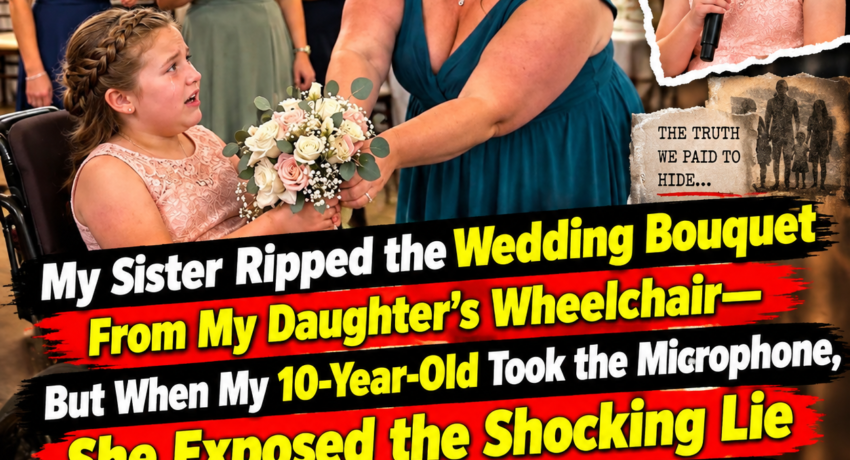
Before Mia could even touch the ribbon, Donna lunged in and ripped the bouquet out of her hands.
“Hey!”
Donna’s hip slammed into the side of Mia’s chair. One wheel lifted off the floor.
“Mom!”
I don’t remember crossing the distance. I only remember my hands closing around the handles and the chair thudding back down onto all four wheels, Mia gripping the armrests, her eyes huge.
Donna lifted the flowers triumphantly over her head. “Looks like I won!”
“Are you serious?” I snapped.
The music cut out. The room went silent.
“You almost knocked her over.”
Donna shrugged. “She’s fine.”
I marched toward her, one hand on my belly. “What is wrong with you?”
“Oh, please.”
“Claire threw those flowers to Mia.”
Donna rolled her eyes. “Why does she even need them? She can’t walk down an aisle. Do you honestly believe any man will ever marry her?”
Someone gasped.
I turned to look at my daughter, and my heart broke in a place I didn’t know could still break.
Her eyes had filled. And behind the tears, I saw it – that old, familiar fear. The belief she’d fought so hard to bury: that her wheelchair made her unlovable. That she was something to be pitied, not chosen.
Everything we had rebuilt in two years, Donna had knocked over in a single sentence.
Then Mia did something I didn’t expect. She wiped her cheeks with the back of her hand. And she lifted her chin.
My husband, Adam, caught my wrist as I started forward. “Emily.”
“Let go.”
“Emily, you’re seven months pregnant.”
“And?”
“And prison orange really clashes with your dress.”
“I’ll risk it.”
But before I could reach my sister, a small voice stopped me.
“Mom.”
I turned.
“I want to say something.”
Part 4: The Girl with the Microphone
Mia rolled toward the DJ booth. The guests moved aside without a word.
“Can I borrow your microphone?”
“Mia…” I said.
“Please.”
The DJ looked at me. I nodded, because I didn’t know what else to do. He handed it to her.
Her hands were trembling so hard the microphone crackled.
“Dear Aunt Donna,” she said, “I’ve wanted to tell you something important for a long time.”
Donna’s smile disappeared.
“After my accident, I thought nobody would ever love me because I couldn’t walk. I thought I was broken.” Her voice wobbled, then steadied. “But my mom taught me that people don’t leave because someone can’t walk.”
“That’s right, sweetheart,” I whispered, and my eyes stung.
Mia swallowed. “Sometimes people leave because they don’t like how that person treats them.”
“Oh, damn,” someone muttered near the back.
A few nervous laughs rippled through the room. Donna stood frozen, the stolen bouquet drooping in her hand.
What my daughter said next would unravel far more than my sister ever expected.
“So maybe you don’t need my bouquet,” Mia said. “Maybe you need to ask why all your boyfriends keep leaving.”
The ballroom erupted.
People laughed. People clapped. One by one, then all at once, guests rose from their chairs until the whole room was on its feet, applauding a ten-year-old girl in a sparkly dress who, twenty minutes earlier, had been afraid to roll onto the dance floor.
I watched Mia’s shoulders straighten under the sound. She didn’t look broken. She looked brave.
Donna turned scarlet. “She’s ten! She doesn’t know anything about my relationships!”
Mia looked straight at her. “I know more than you think.”
My smile faded.
Because I had no idea what she meant. And the way Donna’s face drained of color told me she did.
Part 5: “That’s Just Donna”
Donna dropped the bouquet onto the nearest table. “This family is unbelievable.”
Claire swept up beside her in a cloud of tulle. “No, Donna. What’s unbelievable is body-checking a child for hydrangeas.”
“They’re roses.”
“That’s your takeaway?”
“I didn’t body-check her!”
“You nearly tipped her chair!” I said.
“It was an accident.”
I let out a laugh with no humor in it. “Funny. We’ve had enough accidents in this family. We know what one looks like.”
Donna snatched up her purse. “You’ve always thought you were better than me.”
“Oh, good. We’ve reached this episode.”
Adam murmured, “Emily.”
“What?”
“Maybe don’t fight at Claire’s wedding.”
Claire raised her champagne glass. “The bride officially approves this fight.”
Donna jabbed a finger at me. “You have no idea what my life is like.”
“You remind me constantly,” I said under my breath.
“I work two jobs, Emily.”
“So did I, before Mia’s accident.”
“Easy to say when you have Adam.”
“Adam and I built our business together. From nothing.”
“Must be nice.”
There it was again – the same tune she’d been humming my whole life. Every man disappointed Donna. Everyone else simply had it easier. Once, she’d looked at my pregnant belly and sighed, “If I had your life, I’d have three kids by now.”
As if children were a loyalty program. Collect three and receive a free husband.
Our parents had always excused her. That’s just Donna. She’s had a hard life. She’s tired. And for years, I’d swallowed it along with everyone else, because that’s what you do for family.
But Donna hadn’t just insulted me this time. She’d gone after my daughter – the one person in this world I would walk through fire for.
Donna stormed out through the side doors. I started after her.
A small hand caught my sleeve.
“Mom, don’t.”
Part 6: The Promise Mia Kept
I lowered myself carefully beside Mia’s chair. “Honey, what did you mean back there?”
“About what?”
“You said you know more than Aunt Donna thinks.”
Mia suddenly became very interested in the frayed edge of her dress.
“Mia?”
“I don’t want to talk about it.”
That frightened me more than anything Donna had said. My daughter told me everything – including things no mother needs to know, like which boy in fifth grade could burp the entire alphabet.
“Did Aunt Donna say something to you?”
“No.”
“Did somebody else?”
She looked away. “I promised.”
“Promised who?”
“I can’t tell you.”
Later, when we were alone near the dessert table, I tried again, gently.
“Sweetheart, Aunt Donna has had some really awful relationships.”
Mia picked at the icing on a cupcake. “Has she?”
“Yes.”
“Like Eric?”
I blinked. “What about Eric?”
“He was her boyfriend, right?”
“For almost three years.”
“And he cheated?”
“That’s what she told us.”
“And the money?”
“She said he left her buried in debt. She needed help, so we helped. She’s family, no matter what.”
Mia frowned. “But he didn’t cheat.”
“What?”
“He didn’t.”
I stared at her. In that moment, Donna grabbing the bouquet stopped feeling like the whole story. It felt like the first crack in a wall.
“Mia, how would you know that?”
Her face changed instantly, shutting like a door. “I shouldn’t have said anything.”
“Who told you?”
“I promised.”
“Mia.”
“No.”
She rolled backward. “I’m sorry, Mom.”
And then she was gone, weaving toward Adam across the dance floor, leaving me holding a cupcake I no longer wanted.
Claire came up behind me. “Why do you look like that cupcake just confessed to murder?”
“Do you still have Eric’s number?”
Her smile vanished. “Why?”
“Mia just told me Donna lied about him.”
Claire glanced toward the doors Donna had stormed through. “That’s… weird.”
“Do you know something?”
“No. I swear.”
“Can you get his number?”
She hesitated. “Probably.”
“Do it.”
“You’re investigating Donna. At my wedding.”
“I prefer ‘multitasking.’”
“You’re terrifying,” Claire said, but she was already pulling out her phone.
Part 7: The Other Side of the Story
I called Eric the next morning, expecting a simple answer. I didn’t get one.
“Eric? This is Emily. Donna’s sister.”
A long pause. “Is Donna okay?”
“She’s fine.”
“Then why are you calling me?”
“I need to ask you something uncomfortable.”
“Well, that narrows it down.”
I took a breath. “Did you cheat on her?”
Silence. Then, to my surprise, he laughed – tired, not cruel. “No.”
“She told everyone you did.”
“I know.”
“You know?”
“She told people a lot of things, Emily.”
I sat up straighter. “Then why did you really leave?”
He sighed. “Because of my son.”
“Caleb?”
“When Donna and I started talking about marriage, she kept complaining about what I spent on him. Sports. School. Saving for college.”
“Why would she care?”
“She wanted to quit working. She said I was sacrificing our lifestyle for him.” His voice went quiet. “He’s twelve. He’s my kid. There wasn’t a version of that conversation I was ever going to lose.”
My stomach turned.
“Donna didn’t want a partner,” Eric said. “She wanted a provider.”
And suddenly her other breakups sounded different too. Ben had been “cheap.” Marcus had “never wanted to build a future.” How many men had we cast as villains without ever hearing their side?
But one question mattered more than the rest.
“What about the debts?”
“What debts?”
The way he said it – genuinely baffled – made the floor tilt under me.
“The debts you left Donna with.”
“Emily, I didn’t leave her with any debts. We never had joint credit cards. No loans. I paid my half of the lease through the end and walked away.”
“She told us she owed thousands because of you.”
A pause. Then, carefully: “I have no idea what she did with your money.”
I thanked him and hung up. My hands were shaking.
Donna probably thought the wedding was her karma – a little public embarrassment, and then life would go back to normal. She was wrong. I wasn’t going to let her humiliate my daughter and keep using our family’s love as her personal bank account.
Part 8: Four Directions
I opened my banking app. The baby kicked hard enough to make me shift in my chair.
“Easy,” I muttered. “Your aunt is already raising my blood pressure.”
Adam wandered into the kitchen as I typed Donna’s name into the search bar. “What are you doing?”
“Finding out how expensive my sister’s fictional breakup was.”
The transfers filled the screen.
$800.
$1,200.
$600.
$1,500.
And more. So many more.
Adam leaned over my shoulder and let out a low whistle. “And that’s only us.”
Only us. The words sat in my chest like a stone.
I called Claire. “How much have you given Donna since Eric left?”
A pause. “Maybe four thousand? Why?”
“Did she ask you not to mention it to anyone?”
A longer pause. Then, very quietly: “Oh.”
We called Mom and Dad together.
“How much have you given Donna?”
Mom hesitated. “Rent, mostly. Utilities. Her car payments.”
“And the debts?”
“Those too.”
Dad’s voice came on the line, rough. “She told us you girls couldn’t help her. That you were both stretched too thin.”
There it was.
Donna had told each of us the same story, in the same careful whisper: Nobody else is helping me. You’re all I have. She’d turned our love for her into four separate faucets, and she’d made sure none of us ever compared notes.
My daughter had uncovered one lie. I’d just uncovered the machine behind it.
But one question still gnawed at me. How had Mia known?
Part 9: What a Ten-Year-Old Carried
That evening, I found Mia in her room, sketching in her notebook. I sat down on the edge of her bed.
“Sweetheart, I talked to Eric today.”
Her pencil stopped.
“You were right. He didn’t cheat. I just need to know how you knew.”
For a long moment, she didn’t answer. Then she set the notebook aside.
“I heard Aunt Donna talking to him.”
“When?”
“That day I stayed at her apartment. When you had your doctor’s appointment for the baby.” She twisted her fingers together. “She thought I was asleep on the couch. But I wasn’t.”
“What did you hear?”
“She was yelling at him on the phone. And he said, ‘Stop telling everyone I cheated. You know why I left.’”
My chest tightened. “Why didn’t you tell me?”
“She caught me listening afterward.” Mia’s voice got very small. “She made me promise not to tell anyone. She said if I did, it would ruin the family. And that everyone would be mad at me.”
I closed my eyes. My ten-year-old, who already believed she was a burden, had spent months carrying her aunt’s lie on her small shoulders because she’d been told the truth would make her the villain.
“And you kept that promise?”
Mia looked down. “Until she said those things about me.”
Of course. She had kept Donna’s secret faithfully – right up until the moment Donna stood in front of a ballroom full of people and told her she’d never be loved.
I pulled her into my arms, as much as my belly allowed.
“You didn’t do anything wrong,” I whispered into her hair. “Do you hear me? Not one thing.”
“Even the microphone?”
I laughed through my tears. “Especially the microphone.”
Part 10: The Prize Table
Donna’s reckoning came three days later.
Our parents asked all three of us to come over. Donna arrived last, and she came in swinging.
“You called Eric? You went through your bank transfers?”
“Yes.”
“You had no right.”
“No right to check where my own money went?”
“I was struggling!”
Dad set a thick stack of printed transfers on the kitchen table. “Then explain these.”
Donna looked at the pile. The color left her face.
Claire leaned forward. “You told me Mom and Dad had cut you off.”
Mom stared at her oldest daughter as if she’d never seen her before. “You told us your sisters couldn’t help.”
“I was embarrassed.”
“So you lied to all of us,” I said.
Donna threw up her hands. “Fine! I lied! What was I supposed to do?”
“Tell us the truth.”
And that was when she stopped pretending. She pointed straight at my stomach.
“You have everything!”
I actually flinched. “What?“
“You have Adam. You have that big house. You have your business. You have Mia. And now you’ve got another baby on the way.” Her voice cracked. “And I have nothing!”
“You have two jobs, Donna.”
“And I’m sick of working two jobs just to count every dollar! I wanted a husband who would take care of me. Is that so terrible?”
“And when that didn’t happen?”
Her face hardened. “You all had houses. Husbands. Families. I figured helping me was the least you could do.”
I stared at her. “So instead of living within your means, you made us pay for the life you thought you deserved?”
She looked away.
“Donna…” Claire said softly.
“No! She gets everything. I work two jobs. I come home to an empty apartment. Every man I meet lets me down. And meanwhile, Emily gets to play perfect family.”
And strangely, my anger drained away.
Not because I felt sorry for her. But because, for the first time in my life, I finally understood her.
Donna thought life was a prize table at a county fair. And somewhere along the way, she’d decided someone had handed me the bigger ticket – and that the rest of us owed her the difference.
I rested my hand over my stomach, over the baby who was already kicking at the sound of raised voices.
“They’re people, Donna,” I said quietly. “Adam. Mia. This baby. They’re not prizes somebody forgot to give you.”
She didn’t answer.
“And none of us owe you money because your life didn’t turn out exactly the way you wanted.”
Mom nodded slowly. “No more rent.”
Dad added, “No more emergencies.”
Claire said, “No more secret transfers.”
Donna turned to me, and for a moment, beneath the anger, I saw my big sister – the one who used to braid my hair before school. “You too?”
“Especially me.”
“So you’re all cutting me off?”
“We’re stopping financing lies.”
“Then what am I supposed to do?”
“For starters?” I said. “Keep both jobs.”
She looked around the table, waiting for someone – anyone – to soften, to take her side, to say that’s just Donna one more time.
Nobody did.
She grabbed her purse and walked out. The door closed behind her with a quiet click, which somehow felt louder than a slam.
Part 11: The Photo
A few weeks later, Claire texted us a photo from the wedding.
In the foreground, Mia sat at the center of the dance floor, microphone in hand, chin lifted, surrounded by a sea of people on their feet.
In the background, Donna stood alone, clutching the stolen bouquet.
Mia rolled up and peered over my shoulder. “Did it work? Did she get married?”
“Nope.”
She grinned.
I did too.
Then she pointed at herself in the photo. “I look brave.”
“You are brave.”
She studied it for a long moment. “I don’t feel like the broken girl anymore.”
I had to look away for a second so she wouldn’t see me cry.
For years, I’d excused Donna. I’d helped her, defended her, and believed every crisis she carried through our door. I thought that was what loving family meant.
It took my ten-year-old daughter, a microphone, and a stolen bouquet to teach me otherwise.
Protecting family doesn’t mean protecting them from the consequences of their own choices.
And never again – not for a sister, not for peace, not for anyone – would I stay quiet when someone came after my child.