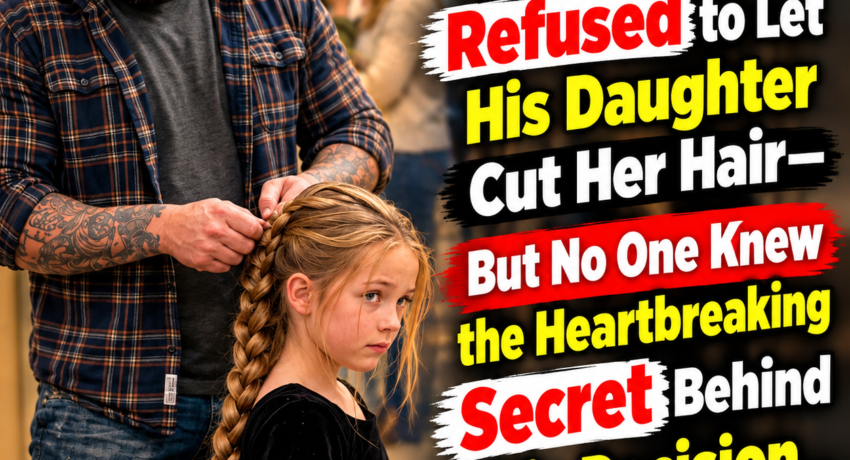
Goldie’s hair fell past her knees, and all of us could see what it cost her to carry it. We were sure her father had his own reasons for refusing to cut it. We were right about that. We just had no idea how heavy those reasons were.
Part One: The Girl Who Carried Her Hair
The first time I saw Goldie’s braid snag on the back of her chair, I was certain she was going to fall.
It was after a school assembly. She stood up too fast, the braid pulled taut, and her head snapped backward like someone had yanked a leash. She caught the seat in front of her with one hand and clutched the thick rope of hair with the other. A few kids laughed before they understood she was embarrassed.
Then Goldie laughed too, a bright little laugh, as if it were nothing.
That bothered me more than tears would have. Nine-year-olds cry when things hurt. It takes practice to laugh instead.
My daughter was in Goldie’s class, so I’d seen that hair many times. Loose, it reached past her knees. Even braided, it hung so low that she had to think about it every single time she sat down. People talked constantly about how beautiful it was.
And they talked about her father.
He came early to every school event, usually still in his work clothes, with a small folding mirror he kept in his car. He would sit Goldie on a bench in the hallway and do her hair himself, and he did it well. French braids threaded with ribbon. Pins placed so precisely they looked like a salon’s work. By the time the children walked onstage, not a single strand was out of place.
The other mothers adored watching him.
“Look at that dad,” someone would murmur.
“My husband can’t even manage a ponytail.”
“That girl is so lucky.”
Maybe she was. Her father never missed anything. But every time I watched him wind that enormous length of hair into order, my eyes drifted away from his hands and settled on Goldie.
I watched her hold the braid in her fist when she ran, so she wouldn’t step on it. I watched her gather it into her lap at lunch just to lean over her tray. Once, when she tried to stand up from a table, another child had accidentally pinned the end of it under a backpack. Goldie didn’t complain. She didn’t even say anything. She simply stood there, head tilted at an awkward angle, and waited until the backpack moved.
She was nine.
That was the part I couldn’t let go of. Why was a nine-year-old organizing so much of her small life around her hair?
I never asked her father. For a long time, none of us did.
That changed at the winter concert.
Part Two: The Winter Concert
The corridor outside the auditorium was packed with parents and children, everyone waiting for the doors to open. The air smelled of wet coats and hairspray. Goldie’s father had taken his usual spot by the window, and Goldie sat on a chair in front of him, already in her costume, a silver ribbon draped across his knee.
He parted her hair into sections, his fingers quick and careful, the way you’d handle something that could break.
Goldie kept glancing down the hall. The other girls were running up and down in their costumes, whispering, spinning, laughing at nothing.
“Hold still, sweetheart,” her father said.
“I’m trying.”
“Almost done.”
There was nothing harsh in his voice. Somehow that made it all more confusing.
When he finished, he tied the silver ribbon around the end of the braid and held up the mirror. Goldie studied her reflection.
“Pretty?”
“Very.”
She grinned, kissed his cheek, and ran off to her friends. He stayed behind, fitting the pins back into their little case, one at a time.
That was when one of the mothers spoke.
“Somebody should have let that child get a real haircut years ago.”
Heads turned. Goldie’s father didn’t look up. “Thank you,” he said evenly, “but we manage.”
The woman folded her arms. “That’s not the point. Look at her. She hauls that around like a backpack.”
He snapped the pin case shut.
A second mother joined in. “You can see she’s uncomfortable. At some point that stops being devotion and turns into something else.”
I remember wishing they would stop, and I remember, with some shame, that part of me agreed with every word.
Then a third woman said, very quietly, “Maybe you’re the one who can’t let go of something. And she’s the one paying for it.”
Goldie’s father stood. For a moment he didn’t look angry or defensive. He looked like a man who had just been struck somewhere old and tender.
Before he could answer, I noticed people looking past us.
Goldie was standing at the end of the corridor. She had come back. None of us knew how long she had been there, or how much she’d heard.
She walked straight through the middle of the adults and stopped in front of her father.
“Don’t talk to my dad like that.”
The first mother opened her mouth. Goldie didn’t let her speak.
“He takes care of me.”
Her father rested a hand on her shoulder. “It’s okay, sweetheart.”
“No. It’s not.”
She turned to face us, all those grown-ups towering over her, and her voice dropped low.
“He cries when he brushes it. I asked him to cut it, and he said we have to wait until I’m seventeen.”
Her father went completely still. He looked like someone had flung open a door he had spent years holding shut with his whole weight.
“Goldie,” he whispered.
She looked up at him, suddenly frightened by what she’d done. “I’m sorry.”
He swallowed hard, then crouched until they were eye to eye. “You don’t ever have to be sorry.”
Part Three: Because of My Mom
The hallway had gone silent. The same people who’d been criticizing him a minute earlier now stood stiff and uncomfortable. So did I. Whatever was passing between that father and daughter, it clearly had nothing to do with having beautiful hair.
One of the mothers asked, far more gently this time, “Why seventeen?”
Goldie’s father looked at his daughter. It was Goldie who answered.
“Because of my mom.”
He closed his eyes.
“My mom died when I was little,” Goldie said.
I had known her mother wasn’t around. My daughter had mentioned it once, in the offhand way children mention things. I hadn’t known how.
“She had cancer,” Goldie said. “She lost all her hair when she was sick.”
Her father lowered himself slowly onto the bench, as if his legs had stopped cooperating. Goldie stayed close beside him.
“I don’t remember everything about her. I was really small. But Dad tells me stories.”
He managed a weak smile. “Too many stories.”
“No.” She shook her head firmly. “Not too many.”
She reached behind her and drew the long braid forward over her shoulder, holding it the way you’d hold something that belonged to someone else.
“Mom used to joke about my hair. Dad says even when I was a baby, I had a lot.”
Her father rubbed his palms together. “Your mother said you came out looking like you’d already missed your first haircut.”
Goldie smiled, and a few of us smiled with her. Then her face changed.
“When Mom’s hair fell out, she told me I had enough hair for both of us.”
Her father stared at the floor.
“So she and Dad decided I would grow it.”
“Goldie,” he said softly. “We don’t have to do this here.”
“I want to tell them.”
He looked at her for a long moment. Then he nodded.
So Goldie told us. Before her mother died, her parents had made a plan. Goldie would grow her hair until she turned seventeen, and then she would cut it and donate it to an organization that made wigs for children who had lost their hair to cancer treatment.
“It was supposed to be for kids like Mom,” Goldie said.
Her father corrected her, gently. “For kids going through what Mom went through.”
Goldie nodded.
That explanation should have made everything simple. It didn’t. If anything, it made the question heavier. Goldie was nine. Seventeen was eight long years away. I found myself looking at the braid lying against the front of her costume, and she caught me looking.
“I still want to donate it,” she said quickly.
Part Four: “Then Why Can’t I Cut It?”
Her father looked up.
“I do,” Goldie insisted.
“I know you do.”
“But I don’t want it this long anymore.”
He looked genuinely surprised, as if the thought had never been allowed into the room.
Goldie twisted the end of the braid around her wrist, around and around. “It’s heavy. And it gets stuck on things.”
“I know, sweetheart.”
“You always say we’ll fix it.” Her voice was small but steady. “And you do fix it. You braid it tighter, or you pin it up. But then it’s still heavy.”
He opened his mouth and nothing came out. Around us, the adults had gone so quiet I could hear the radiator ticking.
“I’m sorry, Goldie,” he finally said, and closed his eyes.
When she spoke again, her voice was shaking.
“I don’t want you to think I don’t love Mom.”
He was on his feet so fast the bench scraped the floor behind him. “Never.”
The sudden movement scared her. He saw it, and his whole body softened at once.
“Goldie. I would never, ever think that.”
“But if I cut it—”
He knelt in front of her again. “No. Listen to me. Your hair is not proof of how much you love your mother.”
Her eyes filled. “Then why can’t I cut it?”
Nobody in that corridor moved.
He stared at her, and I thought he must have an answer ready. Because we promised. Because your mother wanted it. Because seventeen was the plan. But I watched each of those answers rise in his face and fall apart before he could say it. None of them held up anymore, not against the child standing in front of him, asking why her own comfort had to matter less than a promise made when she was too young to understand it.
The auditorium doors swung open. A teacher leaned out and called for the children.
Goldie wiped her face with the back of her hand. “I have to go.”
“Go,” he said.
She took two steps, then turned around. “Are you mad?”
His face crumpled. He crossed the space between them in two strides and pulled her into his arms.
“No,” he said into her hair. “I’m not mad. I’m not mad at all.”
She hugged him back, hard. Then she ran to join the others.
The concert began ten minutes later. I barely remember it. I remember Goldie singing, her braid pulled forward over one shoulder. And I remember her father, three seats away from me, watching her with tears sliding silently down his face, not bothering to wipe them.
Afterward, I saw them leave together, her hand in his. I didn’t approach them. Neither did any of the mothers who had spoken up in the hall.
Part Five: The Salon
Two days later, my daughter burst through the front door. “Goldie’s cutting her hair!”
“What?”
“On Saturday! She told practically the whole class.” She was bouncing on her toes. “She said she’s donating it now.”
That weekend, Goldie’s father sent a message to several of the parents who had been in the corridor. There was no reproach in it. He wrote that what happened at the concert had forced him and Goldie into a conversation they should have had a long time ago. And he said that if any of us wanted to, we were welcome to come by the salon.
I almost didn’t go. It felt too private, like walking into someone else’s grief. But my daughter wanted to be there for her friend, so we went.
Goldie was already in the chair when we arrived. Her hair had been separated into several thick braids, and without the ribbons and pins I could finally see how much of it there was. It seemed impossible that it all belonged to one small girl.
Her father stood beside her. He looked like he hadn’t slept. Goldie, on the other hand, was glowing.
“Nervous?” my daughter asked her.
“A little.”
The hairdresser showed Goldie where her hair would end afterward, just above her shoulders. Goldie looked at her father. “Is that okay?”
He shook his head. “Don’t ask me.”
She blinked, confused.
He smiled. “It’s your hair.”
Slowly, she smiled back. “Okay.”
The hairdresser banded the first braid. Goldie’s father abruptly turned away.
“Dad.” She reached for him.
He turned back. His eyes were wet. “I’m fine.”
“No, you’re not.”
He let out one short laugh. “No. I’m not.”
The hairdresser lowered her scissors and waited. Goldie’s father crouched beside the chair.
Part Six: What He Had Been Holding
“I need to tell you something,” he said.
Goldie listened.
“I kept telling myself this was your mother’s promise.” He paused. “But it wasn’t only that. Doing your hair every morning, washing it, brushing it, braiding it… it made me feel close to her.”
Goldie took his hand.
“When she was sick, she was so afraid she’d miss the ordinary things with you. School mornings. Pictures. Dances. Birthdays.” His voice broke. “After she was gone, taking care of your hair was something I could still do that felt like it connected us to her. Like I was doing it for both of us.”
Goldie squeezed his fingers.
“And somewhere along the way,” he said, “I stopped asking whether the promise still made sense for you.”
“I like it when you do my hair,” Goldie said.
“I know.”
“Just not this much hair.”
He laughed through his tears. “That’s fair.”
Then he grew serious. “I’m sorry. It should have been cut the moment it started to hurt you.” He held her gaze. “Your mom wanted us to do something kind. She would never have wanted that promise to feel like a punishment.”
“I still want to give it away,” Goldie said.
“I know.”
“And I want to grow it again.”
He blinked. “You do?”
“Maybe.” A grin crept in. “But not to my knees.”
“Deal.”
“And if I hate it, I cut it.”
“Agreed.”
“Even if I’m not seventeen yet.”
“Absolutely.”
The hairdresser lifted the first braid. “Ready?”
Goldie took a deep breath. “Ready.”
The scissors closed.
The sound was softer than I expected, barely more than a whisper. The braid came away in the hairdresser’s hand, and Goldie’s father pressed his fist to his mouth.
Goldie reached up and touched the suddenly light hair near her shoulder.
The second braid came off. Then the third. Then the fourth. By the time the last one fell, Goldie was crying too, and her father wrapped his arms around her from the side, holding on.
For one uneasy moment, I wondered if either of them regretted it.
Then Goldie pulled back and shook her head. Her short hair swung around her neck, and she burst out laughing.
“Dad, look!”
“I see.”
“It’s so light!”
She shook it harder, and the whole room laughed with her. Even her father.
The long braids were bundled carefully for donation. Goldie touched them once before they were set aside, a small, solemn goodbye.
“Mom would like this, right?”
Her father looked at the hair, and then at his daughter.
“Your mom would like you,” he said. “Long hair, short hair, purple hair, no hair. She would like you.”
Goldie went very still. Then she smiled. “Even purple?”
“Okay, let’s not get carried away.”
That finally broke the tension, and everyone laughed.
The mother who had spoken first at the concert was standing beside me. She wiped her eyes. “I feel awful,” she whispered.
I understood. We had all seen something real and decided we knew why it was happening. Our worry for Goldie hadn’t been imaginary. She had been struggling. But we had squeezed the whole thing into a tidy story: a controlling father, obsessive, unable to let go.
The truth was more tangled than that. He had been unable to let go. But not because he cared about hair more than his daughter. He had been carrying a grief so heavy he hadn’t noticed when he’d started asking his child to carry part of it too.
Before we left, he walked over to the mothers from the concert. For a moment, nobody knew what to say.
Finally, one of them said, “I’m sorry. I didn’t know.” Her face flushed. “I shouldn’t have spoken to you like that.”
He looked across the salon at Goldie, who was still tossing her head from side to side just to feel it move.
“Maybe not,” he said. “But I’m glad I heard what you were seeing.” He paused. “I didn’t like hearing it. The worst part was realizing Goldie had been trying to tell me the same thing all along.”
Part Seven: Lighter
A few weeks later there was another school event. I arrived early and found Goldie and her father in the hallway, in their usual spot.
Same folding mirror. Same little case of pins.
But Goldie sat differently now. No braid pooled on the floor beside the chair. Nothing had to be lifted, gathered, or guarded.
Her father took two small sections from the front and began braiding them together. Goldie watched him in the mirror.
“Too tight.”
He loosened it at once. “Better?”
“Better.”
He added a single small ribbon. Goldie stood, and her hair brushed her shoulders. That was all. She turned her head left, then right, checking. “Good?”
Her father smiled. “Perfect.”
Then she ran toward her friends.
Nothing caught on the chair. She didn’t reach back to grab her hair. She didn’t look back at all.
Her father watched her go. For a moment, his hand lingered on the little case of pins. Then he closed it.
I thought about the promise Goldie’s parents had made all those years ago. In one sense, they hadn’t kept it. Goldie hadn’t waited until seventeen.
But watching her run down that hallway, free and light and nine years old, I understood they hadn’t broken it either. Goldie had still given her hair away. She had still done something generous in her mother’s name. She just wasn’t being asked to carry the weight of it on her back anymore, as proof that the love was real.
Her father had finally understood something the rest of us had nearly missed too.
Sometimes honoring the person you lost means holding on.
And sometimes it means knowing that the person you loved would have wanted you to let go.