For twelve years I wondered what I had done to make my stepdaughter close the door on me. I had finally made peace with never knowing. Then one ordinary afternoon, a delivery truck pulled up to my house and proved that peace had been built on a lie.
Part One: The Box
The box sat in the middle of my living room like something alive, something that might breathe if I looked at it long enough.
My name was written across the top in handwriting I hadn’t seen in twelve years. Neat, generous loops. The A in “Alice” leaning forward the way it always had, as if it were in a hurry to reach me.
I couldn’t stop my hands from trembling.
Three days earlier, I had made the hardest decision of my marriage. For the first time in thirteen years, I had not sent Chloe, my stepdaughter, a birthday present. I had finally let her go.
And now this.
David, my husband and Chloe’s father, stood behind the couch without moving. His face had drained to the color of old newspaper.
“Alice,” he said quietly. “Maybe wait. Just take a minute.”
“A minute for what?”
He didn’t answer. That silence should have told me everything.
I lowered myself onto the rug beside the box and rested my palm flat on the cardboard. It was still warm from riding in the back of a sun-baked truck, and for one strange second it felt like touching someone’s shoulder.
But I’m getting ahead of myself. None of this means anything unless you know how we got here.
Part Two: The Second Chance
I’m fifty-eight. I married David twelve years ago, at an age when I’d quietly assumed love had lost my address for good.
He called me his second chance. He whispered it into my hair at our little backyard wedding, under a string of paper lanterns, and I believed him with every part of me.
His daughter, Chloe, was seventeen. Her mother had died a few years earlier, and I want to be very clear about this: I never tried to take that woman’s place. Not once. Some seats at a table are meant to stay empty, out of love.
I only wanted a chair of my own beside them.
I knew it wouldn’t be easy. A grieving teenager doesn’t hand her home over to a stranger just because her father is smiling again. So I went slowly. I cooked her favorites those first weeks: baked ziti, and that dreadful blue-box macaroni she adored. I asked about her friends without digging. I gave her room without vanishing. I never pushed into her private life, but I made sure she knew I was there if she ever wanted to talk.
And for a little while, it worked.
She laughed at my terrible jokes. She sat on the counter and asked how I got my pie crust to flake. One evening she stood beside me chopping onions, both of us crying and pretending it was only the onions, and she bumped my hip with hers and said, “You’re kind of okay, Alice.”
I carried that sentence around like a coin in my pocket for years.
Then, almost overnight, the warmth went out of her. She stopped coming into the kitchen. She answered me in single words. She looked through me at dinner as if I were a window.
“Is she all right?” I asked David one night, drying a plate. “She barely looked at me tonight.”
“She’s a teenager, honey. Grades. Boys. Don’t take it personally.”
“Did something happen?”
“I don’t think so. I’ll talk to her.”
He always talked to her. That was how it worked in our house. I asked, he handled it, and he came back with a gentle explanation that somehow left me feeling small for having asked at all.
Part Three: The Things I Chose Not to See
A few months after the wedding, Chloe left for a college ten hours away, in another state. She didn’t come home for Thanksgiving. Or Christmas. Or the summer after.
“She got a job on campus,” David told me.
“For the entire summer?”
“Maybe she needs the money, Al. Don’t make her feel guilty.”
So I didn’t. Year after year, I didn’t.
Looking back, the signs were everywhere. I just kept stepping over them.
The Christmas card from Chloe’s roommate that arrived already opened, the top slit clean and neatly taped shut again. “Mailman must have snagged it,” David said.
The fact that David was always the one to get the mail. Always. In the rain. With a fever. Even when I was already standing at the door with my shoes on and offered to go myself.
The argument in the garage the weekend before Chloe left for school. I heard it through the door: David’s voice low and hard, Chloe sobbing, “That’s not fair. That’s not fair.” When I asked him about it, he said, “Her grades. Nothing for you to worry about.” Later, he told me it was about her changing majors. I noticed the story had changed. I let it go.
His phone buzzing late at night, and the small, practiced tilt of the screen away from me. “My brother.” “Spam again.”
I believed him every time.
Guilt will make you believe almost anything. So will love. And I was carrying both, stacked on top of each other like bricks, so heavy I stopped noticing I was carrying them at all.
Part Four: Twelve Birthdays
To understand what that box meant, you have to understand the twelve birthdays that came before it.
When Chloe turned eighteen, my first year as her stepmother, I bought her a delicate gold necklace with a tiny star hanging from it. She used to doodle stars in the corners of her homework back when she still did it at our kitchen table. I wrapped it myself, slowly, making the corners perfect. David offered to drop it at the post office on his way to work. “Save you the trip,” he said, and kissed my forehead.
Two weeks later, it came back. RETURN TO SENDER, in thick black marker.
I stood in the laundry room and cried into a dish towel so David wouldn’t hear me.
At twenty-one, I sent a soft leather bag, the kind a young woman carries to her first real job. It came back.
At twenty-five, I sent a cookbook. I remembered how much she’d loved baking before everything went wrong: chocolate chip cookies, banana bread, a lopsided birthday cake she once made for her dad with frosting sliding off one side. I remembered her laughing at my even worse frosting. I remembered her saying my name warmly, not like something she’d stepped in.
The cookbook came back unopened, like all the others.
Somewhere around the fifth or sixth returned package, I stopped pretending it was an accident. I called Chloe, but the number only rang and rang. I asked David to please tell her how much I’d love for her to visit. He said he already had.
“We had a terrible fight about it,” he told me. He sat beside me on the bed and took my hand like a doctor about to deliver bad news. “She said she can’t stand having you in this house, Alice. She thinks I chose you over her.”
I couldn’t speak for a long time.
“Did I do something?” I finally asked.
“No, honey. She’s still grieving her mother. It isn’t about you.”
“But she was warm at first. Remember? She used to help me chop onions.”
“Kids change,” he said. “Please. Stop taking it so personally.”
So I stopped asking.
But I didn’t stop sending.
Every year: a scarf, a journal, a small pair of earrings. Every year, David took the package to the post office. Every year, it came home. And every year, I set it on the top shelf of the hall closet with the others and whispered the same two words to myself.
Maybe next year.
Love makes you a gifted liar, especially to yourself. Guilt handles whatever love can’t.
Part Five: Year Thirteen
Chloe was turning thirty.
I sat on our bedroom floor with a small silver picture frame in my lap, wrapped in blue paper because blue had been her favorite color at seventeen. Maybe it wasn’t anymore. I realized, sitting there, that I didn’t know one true thing about the woman she had become.
I held that frame for almost an hour.
I thought about her as a stranger now: a thirty-year-old woman who shared my last name on a piece of paper and nothing else. Someone who, as far as I knew, had spent twelve years telling me as clearly as she could that she didn’t want me.
“You have to hear her,” I whispered to the empty room. “Love her enough to stop.”
I remembered David the year before, watching me tape up another package. “You need to let it go, Al,” he’d said. “You’re only hurting yourself.”
Slowly, I peeled the blue paper away. I carried the frame to the hall closet and set it on the shelf beside twelve unopened boxes, every gift I had ever given her, all of them come home to me like birds that couldn’t find anywhere else to land.
I didn’t tell David. I didn’t want to see relief on his face.
I went downstairs and made dinner as if it were any other Tuesday.
Three days passed. Strangely, I felt lighter, like someone who had finally set down a suitcase she’d been carrying through an airport for years.
Then, on the afternoon of the third day, the doorbell rang.
Part Six: What Was Inside
I wiped my hands on a dish towel and opened the door.
A young man in a brown uniform stood on the porch, clipboard tucked under one arm, a delivery truck idling at the curb behind him.
“Ma’am?” He squinted at his paperwork. “You Alice? I’ve got a heavy one for you.”
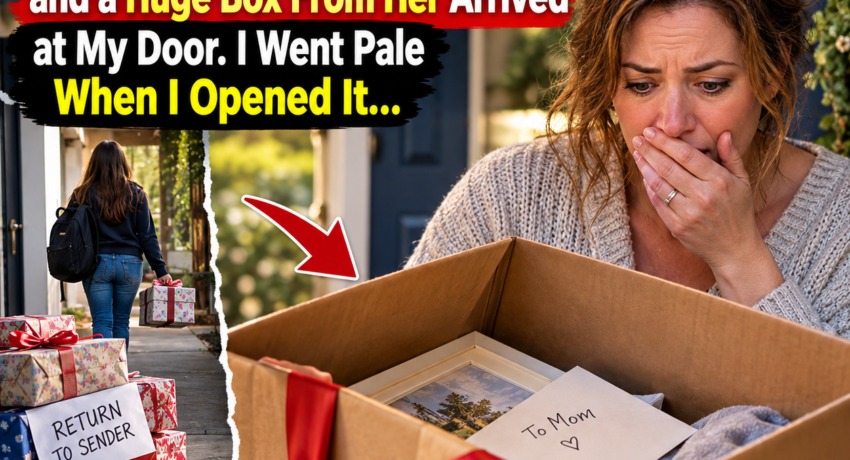
It took him and David together to carry the box into the living room. It was enormous, and it was from Chloe.
I stared at the return label, and my mind went white. Why would she send me anything? Why now, after I’d finally stopped?
Taped to the top was a folded note with my name on it. I opened it and read it out loud before I could lose my nerve.
“Maybe Dad will finally tell you himself why I stayed away. It was never about you, Alice. Look inside and you’ll understand everything.”
Beside me, David went completely still. It wasn’t the stillness of surprise. It was the stillness of a man watching something he’d been dreading for years finally walk through the front door.
“David,” I said. “What does she mean?”
“She’s bitter, Alice. You know how she is.”
“No. I don’t know how she is. That’s the whole point.”
“Don’t open it.”
I looked up at him. And for the first time in twelve years, I didn’t do what he asked.
“I’m opening it,” I said. “You can help me or you can stand there.”
He helped. Not because he wanted to, but because some part of him must have known it was over.
I lifted the flaps.
Inside, nestled in tissue paper and stacked with obvious care, were twelve small gift boxes. Every tag was written in Chloe’s hand. Every one said Alice.
I felt the blood leave my face.
Beneath the gifts were cards. Twelve of them, each dated on my birthday. Each addressed simply to “Alice.” Not Stepmom. Not Mrs. anything. Just my name, the way a friend would write it.
I opened one.
She thanked me for the lasagna I used to make on Sunday nights. She thanked me for hugging her at the wedding when nobody else seemed to know what to say to her. At the bottom, in smaller letters: I hope you’re okay.
I opened another, written when she was twenty-two. She said she was sorry for how cold she’d been that first summer. She asked if maybe, someday, we could talk.
I had never seen a single one of them.
At the very bottom was a thick bundle of envelopes held together with a rubber band. Letters, all addressed to me: from her college dorm, from an apartment in Denver, from a little place in Portland. Years of them.
Every single one was marked RETURN TO SENDER.
And that was when I finally saw it. The thick black marker. The blocky capital letters. The slight hook at the bottom of the R.
It was the same handwriting that had come back on every gift I had ever sent her.
It was David’s.
Part Seven: The Truth
I held one of the envelopes up. My hands didn’t shake anymore. I was past shaking.
“You sent these back,” I said. “My name. Our address. And you sent them back. You sent mine back, too. Every one. You never mailed a single gift.”
My husband sank onto the couch as if his legs had simply quit.
“Alice.”
“Say it.”
“I was scared.”
“Of what?”
“Of losing you. Of losing her. Of the two of you…”
“Of the two of us what, David?”
He stared at the carpet. “Of the two of you being closer to each other than either of you were to me.”
The silence that followed was so complete I could hear the refrigerator humming in the next room.
“You told me she hated me,” I said.
“I know.”
“You told me there was a fight. That she couldn’t stand me living here.”
“There was no fight. Not like that.”
“Then what did you do?”
He pressed his hands over his face, and when he spoke, the words came out muffled and ugly.
“I told her you found her exhausting. That you wanted the house to ourselves. I told her that a few weeks after you moved in.”
I thought of the girl on the kitchen counter. The hip bump. You’re kind of okay, Alice. And then the window-glass stare at dinner, almost overnight.
“She was seventeen,” I said.
“I know.”
“She was a child who had just buried her mother. And you told her the woman moving into her mother’s house didn’t want her.”
“I thought it would blow over.” His voice cracked. “I thought she’d come around, and I’d fix it quietly, and no one would ever have to know. And then every year it got harder to say. Every year it got bigger.”
I sat back down on the floor beside the box. I needed something solid under me.
“Why now?” I asked. “Why did she send this now?”
“She called me last week.”
“And?”
“A couple of weeks ago, you ran into Margaret from next door at the grocery store. You talked about Chloe. You called her ‘my girl.’” He swallowed hard. “Margaret’s daughter, Maya, is friends with Chloe. Maya told her what you said. She told her you’d never hated her. That you’d been asking about her for twelve years.”
I looked down at the cards in my lap. A stack of birthdays I had never been allowed to have. On the other side of the house, twelve of hers sat in a closet, waiting.
I picked up Chloe’s note again and read it one more time. It was never about you, Alice.
Then I stood up.
“Give me her phone number.”
“Alice, please, let me explain it to her first…”
“Her real number, David. Not the one you told me was disconnected.”
He hesitated. I said his name once more, low and level, and something in him folded. He scrolled through his phone for a long moment and read the number aloud in a voice I barely recognized.
“Now leave the room,” I said. “I have a call to make. Alone.”
He went.
Part Eight: The Call
I dialed with fingers that wouldn’t quite cooperate.
It rang once. Twice. On the third ring, a cautious voice answered.
“Hello?”
For a second, I couldn’t make a sound. She said it again, softer, as if she already half-knew.
“It’s me,” I finally managed. “It’s Alice. I’m here, sweetheart. I’m right here.”
There was a sharp breath on the other end.
“Alice. I thought you hated me,” she said. “Dad never mentioned you. Not once. I figured that was your rule.”
“I thought you hated me,” I whispered. “He told me you couldn’t stand me being in the house.”
A long pause. Then I heard her start to cry, and I was crying too, and for a while neither of us said anything at all. We just listened to each other breathe across twelve lost years.
“I loved lasagna nights,” she said at last, laughing through it. “I loved how you laughed at my awful knock-knock jokes, even the ones that made no sense.”
“I still have every gift I ever bought you,” I told her. “The necklace with the star. The cookbook. All of it. I thought about you every single year, Chloe. Every year.”
She was quiet for a moment.
“Can I drive down this weekend?”
“Yes,” I said, and it came out half laugh, half sob. “Please. Yes.”
When David came back, I was sitting on the couch with her cards in my lap.
“Alice, I’m so sorry. I never meant…”
“You didn’t just steal twelve years from us,” I said quietly. “You stole them because you were more afraid of coming second than of ending up alone.”
He didn’t answer. I didn’t need him to.
“I don’t know what this marriage is anymore,” I told him. “But I’m not deciding that today. Today isn’t about you.”
Part Nine: The Door
That Saturday, a small blue car pulled into our driveway. I was already waiting on the porch. I’d been waiting, in one way or another, for twelve years.
The woman who stepped out was taller than I remembered, with her mother’s cheekbones and her father’s stubborn chin. But when she smiled, uncertain and hopeful, I saw the seventeen-year-old on my kitchen counter all over again.
She was holding a cookbook. The one I’d sent for her twenty-fifth birthday. I had mailed it to her the morning after our call, and this time I drove it to the post office myself.
“I brought this,” Chloe said, her voice catching. “I thought maybe we could finally try it together.”
I didn’t trust myself to speak. I just opened the door wide, and we walked into the kitchen side by side.
For years, I believed the silence between us was a wall she had built to keep me out.
It turned out to be a door. One my husband had locked from both sides and hidden the key.
That year, I learned that sometimes the gift you finally stop sending is the one that makes room for the right one to arrive.