The pool was the last thing my husband ever built for our children. When my neighbor decided my kids were too loud, she poured concrete into it at dawn, certain she’d won. She never imagined what I’d do next.
The Last Thing He Built
The backyard smelled like sunscreen and chlorine, and for a few hours every afternoon, it still felt like Steve was there.
I stood at the kitchen sink with a dish towel in my hands, watching my four kids tear through the water he’d poured for them two summers ago. The pool was the last thing he ever built. He finished it three weeks before the cancer took him, and I have never once been able to look at it without seeing him standing at the edge, sunburned and proud, telling me the kids were going to remember this forever.
“You built them a summer,” I’d told him.
“I built us a memory,” he’d said back.
He was right. Every splash still sounded like him.
“Mom, watch this!” my oldest yelled, and folded himself into a cannonball that soaked his little sister.
“I see you,” I called, and for one clean moment, grief and happiness sat in the same yard without fighting each other.
Then I looked past the fence and found Katherine at her window.
Not glancing over. Watching. She had a way of studying my yard like she was auditing it — arms crossed, mouth flat, eyes narrowed the way they got right before she found something to complain about.
She’d been finding things to complain about since the day we moved in.
My youngest climbed out dripping and pressed against my leg. “Is that lady mad again?”
“Don’t you worry about her,” I said, wrapping her in a towel. “Some people just carry their frown with them everywhere they go.”
She laughed and ran back to her brothers. I didn’t laugh. I kept my eyes on that window a beat longer than I needed to, because something about the stillness behind that glass had started to feel less like nosiness and more like a countdown.
I had no idea yet how right that instinct was — or how much it would cost me to keep ignoring it.
A Woman Who Collects Grievances
Katherine didn’t yell the first time. She never does, at first.
Last Christmas she came over about my porch gnomes.
“They’re an eyesore,” she said, standing on my welcome mat like she’d been summoned. “They drag down the whole street.”
I thanked her for her opinion and left the gnomes exactly where they were.
A few weeks before the pool, it was my roses.
“Roses go on the left side of a walkway,” she informed me, pointing at my flower bed like it had personally offended her ancestors. “Yours are on the right. It’s wrong.”
“They seem happy there,” I said.
“Happy isn’t the point,” she snapped. “Order is the point.”
I smiled, said something soft, and went back inside. That was how I handled Katherine. That was how I’d handled everything since Steve died — smooth it over, say sorry, keep the peace, because a fight was one more thing I didn’t have the strength to carry alone.
I told myself that made me patient.
Looking back, I think it just made me an easy target.
What I didn’t know then was that Katherine wasn’t just a woman who liked her hedges trimmed and her flower beds correct. She measured the world in boundaries — property lines, noise levels, who owed her silence and who owed her an apology — and she had decided, somewhere in that tidy head of hers, that my family owed her both.
I kept telling my children not to worry about her.
I should have been worrying about her myself.
“This Is the Last Time I Ask Nicely”
I was slicing sandwiches when I heard the shouting.
It wasn’t my kids. My kids don’t scream — Steve and I taught them that early, and they’ve never broken the rule. This was an adult voice, sharp enough to cut through a closed window, and my stomach dropped before my brain caught up to why.
I dropped the knife and ran outside.
Katherine was standing over my youngest at the edge of the pool, arms folded, my fence gate hanging open behind her. She hadn’t knocked. She hadn’t called out. She had simply walked into my yard like it was hers to enter.
“What’s going on?” I asked, stepping between her and my child.
“Your kids are TOO LOUD,” she said. “I want peace and quiet. Is that too much to ask?”
I looked at my four children, frozen and dripping, their faces gone white the way children’s faces go when an adult’s anger lands too close to them.
“I’m sorry,” I heard myself say. “I’ll ask them to keep it down.”
The apology tasted like metal. I’d been in the kitchen the entire time. I hadn’t heard a single scream — only splashing, only laughter, only the ordinary noise of children being children in the last place their father ever built for them.
“See that you do,” Katherine said, already turning to leave.
She stopped at the gate and looked back at me with an expression I hadn’t seen on her before. Not annoyance. Something colder.
“Because I promise you,” she said, “this is the last time I ask nicely.”
She walked out like she owned the path beneath her feet.
My oldest tugged my sleeve once she was gone. “Mom, we weren’t yelling. We promise.”
“I know, baby,” I whispered. “I know.”
That was the part that kept me up that night. I knew they were telling the truth. And I’d still said sorry anyway.
The Quiet Before
The next afternoon, I didn’t stay in the kitchen. I brought a chair outside and sat by the pool the whole time, watching every second like a lifeguard grading her own children.
They splashed. They giggled. Not once did anyone raise their voice above the ordinary hum of kids having fun.
Katherine’s curtains still moved.
“She’s spying again,” my son muttered, not even bothering to look over.
“Ignore her,” I said. “She’s got nothing better to do.”
No visit came that day. No shouting. But late in the afternoon, through my own kitchen window, I caught her pacing on the phone, one hand jabbing toward my yard like she was giving someone directions to a crime scene.
I told myself it was nothing.
I have replayed that thought more times than I can count since. It was the last calm night I had for a long while, and I spent it convincing myself that a woman who complained about gnomes and roses had nothing worse in her than complaints.
I tucked my kids in. I sat at the kitchen table long after the house went quiet, thinking about Steve, the way I still did most nights, and telling myself tomorrow would be easier.
I did not know that somewhere on the other side of that fence, Katherine had already stopped complaining.
She had started planning.
Concrete at Dawn
At five in the morning, a deep mechanical rumble tore me out of sleep. The whole house seemed to shake with it.
I sat up fast. “What is that?”
It didn’t stop. It got louder — a grinding, churning sound coming from somewhere in the backyard, somewhere it had no business being.
I stumbled to the window, my hand shaking on the curtain.
For a second, my brain simply refused what my eyes were telling it.
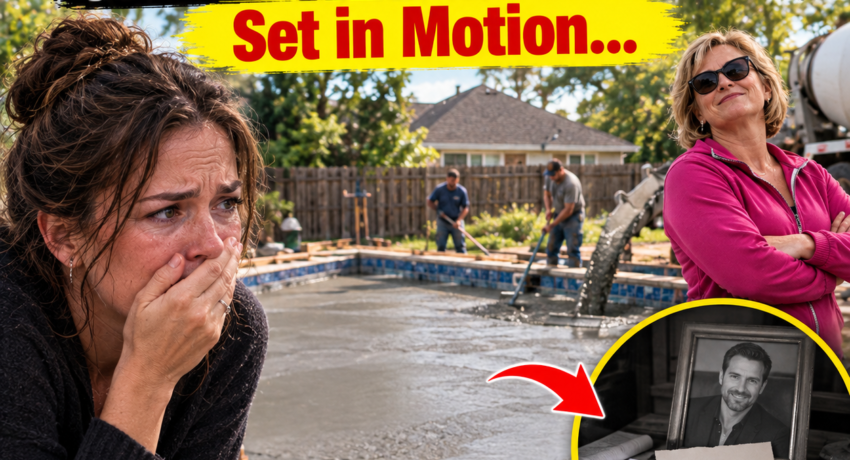
A concrete truck was backed against my fence, chute swung out over my yard, drum turning slow and steady in the gray morning light. Katherine stood beside it with her arms crossed, watching with something close to satisfaction. Behind the wheel sat her husband — the man who owned the construction company two towns over.
I heard the first heavy slap of wet concrete hit water.
“No,” I breathed. “No, no, no.”
I couldn’t move. I gripped the windowsill and watched thick gray sludge pour into the deep end — into the water my husband had built with his own two hands, into the pool where my children had laughed every single day since he left us.
“Mom?” My daughter’s voice, small, behind me. “What’s that noise?”
I forced my voice steady even as everything in me was breaking. “Go back to your room, sweetheart. Take your brothers and sister. I’ll handle it.”
She hesitated, then obeyed.
Katherine tilted her face up toward my window. She knew exactly where I was standing.
She wanted me to see this.
Every apology I had swallowed for two straight years rose up in my throat at once — and this time, I didn’t swallow it.
I let the curtain fall. I turned toward the nightstand, toward my phone, and for the first time since Steve died, I knew with total clarity exactly what I was going to do next.
The One Thing She Never Expected
I ran outside in my robe, bare feet slapping cold stone, the roar of the truck swallowing every other sound in the yard.
“Now there will finally be SOME PEACE AND QUIET!” Katherine shouted over the noise, arms crossed, watching the gray sludge climb up the walls of the pool. “I warned you!”
Her husband sat behind the wheel, eyes fixed straight ahead, his company’s logo bright across the door in the early light.
I stopped a few feet from her. My whole body was shaking, and it had nothing to do with the cold.
“Katherine,” I said. “Do you understand what you just did?”
“I understand I finally get to sleep,” she snapped. “Maybe now you’ll teach those kids some manners.”
I opened my mouth to argue — and then something in me went very still.
I closed it again.
Arguing with Katherine had always been like arguing with a locked door. I’d learned that with the gnomes. I’d learned it with the roses. I wasn’t going to learn it a third time.
So I did the one thing she never expected from me.
I stopped talking, and I pulled out my phone.
“What are you doing?” she demanded.
I didn’t answer. I filmed the truck. I filmed the plates. I filmed the logo glowing on the driver’s door.
“Are you recording me?” Her voice climbed. “Put that down!”
“Say it again,” I said quietly.
“Say what?”
“What you told me. About the peace and quiet. Say it to the camera.”
She hesitated — and in that hesitation, I saw something cross her face I had never once seen there before.
Doubt.
“You walked through my gate,” I said. “You brought your husband’s company truck onto my property. You poured concrete into a pool my husband built before he died.”
“Don’t you dare make this about your husband,” she hissed.
“It was always about my husband,” I said. “You just never once bothered to ask.”
I turned to the man behind the wheel. “Turn it off. This is vandalism, and you’re only making it worse for yourself.”
He glanced at Katherine, then at me, and for one flicker of a second, he looked genuinely afraid.
“Katherine,” he started, “maybe we should—”
“Finish it,” she barked. “We started, we finish.”
The concrete kept coming.
So did my recording.
The Call I’d Been Saving
I walked back inside once the truck finally cut its engine, the silence almost louder than the noise had been.
My four children were huddled at the kitchen window, pale-faced, my youngest crying quietly against her brother’s shoulder.
“Mommy, our pool,” my oldest whispered. “Daddy’s pool.”
I knelt down and pulled all four of them into my arms at once, their damp hair pressed against my neck.
“Listen to me,” I said. “That woman thinks she took something from us. She’s wrong. Things can be rebuilt. And people who break rules eventually learn why the rules were there.”
I kissed each of their heads and sent them upstairs to change.
Then I sat down at the kitchen table with my phone in front of me, and I let myself feel, for one full minute, exactly how tired I was of being the reasonable one.
Two years of shrinking myself smaller. Two years of apologizing for noise I never made.
Not anymore.
I scrolled through my contacts to a name I’d saved months earlier and never once let myself call — a real-estate attorney a friend had recommended back when Katherine first started her campaign about the roses. Boundaries mattered more to Katherine than almost anything in her life.
This morning, she had driven a truck straight across mine.
I pressed call. My hand didn’t shake.
“Good morning,” a man answered.
“You gave me your number a while back,” I said. “I kept hoping I wouldn’t need it. I need it now.”
“Tell me what happened,” he said.
“My neighbor filled my swimming pool with concrete this morning. She used her husband’s construction company truck. I have all of it on video — the truck, the plates, the logo, her admitting she did it on purpose.”
There was a pause.
“Don’t touch anything,” he said. “Don’t let that truck leave before you know exactly where it’s registered. I’ll have people out there today.”
I set the phone down gently on the table, and for the first time in two years, I felt something other than grief settle into my chest.
The Reckoning
By that afternoon, a man in a dark suit was knocking on Katherine’s door. Two others waited by his car — one carrying surveying equipment, the other a clipboard.
“Who are they?” Katherine demanded, marching across the grass toward me.
“My attorney,” I said. “I believe he brought a land surveyor and an insurance adjuster with him.”
She went very still.
“You crossed my property line,” I continued, my voice level. “You destroyed private property. Your husband used his company’s equipment with no permit and no permission.”
The surveyor drove a marker into the soil near the fence line. “The boundary’s here,” he called out. “That truck was well inside her yard.”
The adjuster didn’t even look up from his clipboard. “This qualifies as unauthorized use of insured commercial equipment. The company carries the liability.”
Katherine’s face drained of color.
“You can’t do this to me.”
“I already sent the footage to the local news station,” I told her. “You and your husband’s company are about to become a headline.”
She stormed onto my grass, shaking, all the certainty gone out of her voice. “No — anything but this. How could you do this to me?”
“I only did what you taught me to do,” I said, steady for the first time in two years. “People like you only understand consequences.”
The story aired that night. Within days, her husband’s company had a reputation across three counties, and none of it was the kind that wins new contracts. A civil court ordered Katherine to pay for the full restoration of the pool, every cent, in a judgment that named her personally.
Within weeks, a moving truck sat outside her house.
She never once came over to say goodbye.
What Real Peace Sounds Like
Mrs. Mitchell, a few houses down, told me later that Katherine and her husband had left the state entirely, starting over somewhere no one had heard the story yet.
I didn’t feel triumphant when I heard it. Mostly, I felt tired in a way that had finally stopped hurting.
Months later, I stood at the edge of the newly rebuilt pool, watching my four children cannonball into water that sparkled exactly the way it used to. I knelt down and pressed my palm flat against the concrete edge — smooth, new, poured by someone else’s hands this time, but built, in every way that mattered, on the foundation Steve had left us.
“I protected it,” I whispered, to him, to no one, to the water. “I protected what you left us.”
For the first time since the morning that truck backed up against my fence, the yard was quiet in the way it was always supposed to be — not the silence Katherine had demanded, but the ordinary, easy quiet of a family that finally, finally got to just be happy in their own backyard.