Part 1 — His First Time Above the Clouds
My eight-year-old son studied the airplane safety card as if it contained instructions for surviving a mission to another planet.
Mike examined every picture carefully, then leaned across his mother to look out the window.
“Mom, when we fly through clouds, do they feel wet?”
Stella smiled.
“I think they probably do.”
“How wet?”
She pretended to consider the question.
“Cloud wet.”
Mike nodded seriously, apparently satisfied.
I turned my face toward the aisle before he could see my expression.
For months, my son’s questions had been about hospitals.
Why did medicine make him tired?
Why did nurses need so much blood?
Would his hair remember how to grow back?
Would he ever play soccer again?
So hearing him wonder about clouds felt almost unbearably beautiful.
This was his first flight.
His first trip to Disneyland.
And, according to the doctors, possibly one of his last great adventures.
The plane began moving toward the runway.
Mike pressed his forehead against the window.
Outside, one of the baggage workers noticed him and waved both hands.
Mike nearly jumped out of his seat.
“Dad! He saw me!”
“I think he did.”
Mike waved back with his entire arm.
Then the engines grew louder.
As the airplane accelerated, he grabbed the armrests.
The moment the wheels left the ground, he laughed.
Not a tired laugh.
Not the weak smile he sometimes gave nurses because he knew they were trying to cheer him up.
A real laugh.
The kind he had before cancer became the center of our lives.
Beside me, Stella reached across Mike and slipped her hand into mine.
Neither of us said anything.
We had learned that some moments were too fragile to describe while they were happening.
Eight months earlier, we had been an ordinary family.
Then one afternoon, Mike stopped chasing a soccer ball in our backyard.
He stood near the fence, one hand pressed against his side.
“You okay?” I called.
He nodded at first.
Then shook his head.
That evening, he developed a fever.
Three days later, Stella and I were sitting in a doctor’s office while a man we barely knew explained that our eight-year-old son had cancer.
By the time he used the word terminal, Stella was gripping my hand so tightly my fingers hurt.
I remember almost nothing else clearly.
Only the doctor’s pen.
It rolled slowly across his desk while he talked.
Then it fell onto the floor.
Nobody picked it up.
After that day, our lives became hospital bracelets, medication schedules, blood tests, scans, and untouched meals.
Mike’s soccer cleats remained beside the back door.
Mud hardened inside the grooves.
For months, I couldn’t bring myself to clean them.
Doing so felt too much like admitting he might never need them again.
At the hospital, nurses learned which arm Mike preferred for needles.
Stella learned to pack an overnight bag in less than five minutes.
I became very good at sleeping upright in uncomfortable chairs.
I also became very good at lying to relatives.
“He’s doing okay today.”
“The treatment went well.”
“We’re taking things one week at a time.”
Mike heard those conversations.
He knew when we were pretending.
Then one afternoon, a woman named Claire from Make-A-Wish came into his hospital room.
She wore bright green sneakers and carried a folder decorated with stars.
“If you could go anywhere in the world,” she asked, “where would you go?”
Mike answered immediately.
“Disneyland.”
Claire smiled.
“Why?”
He glanced at the medicine dripping through the tube connected to his arm.
“Because nobody is sick at Disneyland.”
My heart nearly broke.
A month later, Claire called.
His wish had been approved.
We waited until the tickets were physically in our hands before telling Mike.
Hope had become something Stella and I handled carefully.
Too many plans had disappeared after bad scans or sudden fevers.
When we finally handed him the tickets, he read the destination twice.
Then he looked up.
“All three of us?”
Stella nodded.
“All three.”
He hugged the tickets against his chest.
And that was how we ended up in row 12, flying toward California.
None of us knew our real destination was about to become something much bigger.
Part 2 — The Captain Said His Name
Mike had the window seat.
Stella sat beside him.
I took the aisle and pretended not to notice how often she glanced at his face to check his color.
A flight attendant named Dana brought him apple juice.
Mike immediately began questioning her.
“Do pilots really say ‘roger’?”
“Sometimes.”
“Do airplanes have keys?”
Dana smiled.
“I’ll ask.”
“Can airplanes get tired?”
That one made her pause.
She glanced at me before answering.
“Not when they know where they’re going.”
Mike grinned.
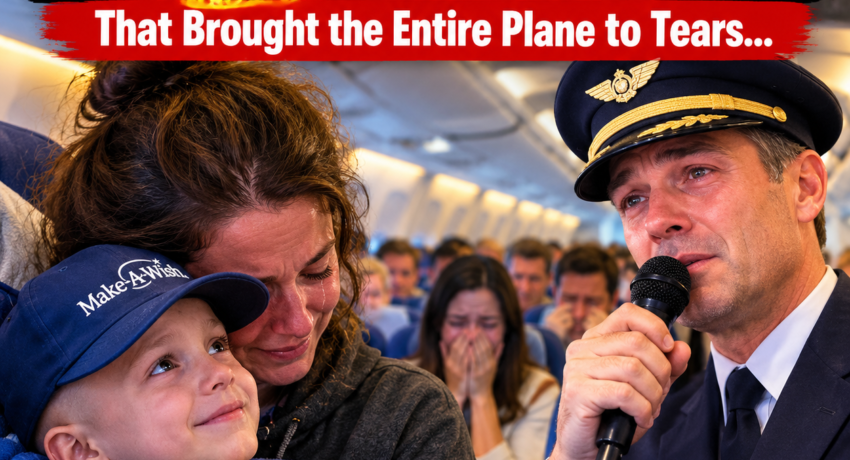
A few minutes later, the captain’s voice came through the speakers.
“Ladies and gentlemen, this is Captain Harris. We’re cruising at thirty-five thousand feet and expecting a smooth flight into Los Angeles.”
Mike frowned.
“He didn’t say ‘roger.’”
I laughed.
Then Captain Harris continued.
“We also have a very special passenger traveling with us today. Mike, sitting in 12A, I hope you’re enjoying your first flight.”
Mike froze.
His straw stopped halfway to his mouth.
Passengers around us began turning.
Mike slowly lowered his juice.
“He knows my seat.”
I looked toward Dana.
She was standing near the front galley with a smile she clearly had no intention of explaining.
Then the captain spoke again.
“Mike, there’s something about this trip that you and your parents don’t know.”
Stella’s hand immediately found mine.
I felt her fingers tighten.
The cabin grew strangely quiet.
Captain Harris continued.
“Everyone, please reach beneath your seat. Inside the life-vest pocket, you’ll find a small folded card.”
Passengers leaned forward.
A soft wave of paper rustling moved through the airplane.
I reached beneath my seat and found a square piece of cardstock.
Someone had drawn a crooked blue airplane across the front.
One wing was much larger than the other.
Three uneven circles floated where the windows should have been.
Across the top, written in large letters, were the words:
BOARDING PASS TO SOMEWHERE BETTER
I turned it over.
No destination.
No passenger name.
No explanation.
Then Mike unfolded his.
His smile disappeared.
He stared at the drawing.
“I’ve made these before.”
Stella leaned closer.
“What do you mean?”
Mike looked at us.
“I used to make these at the hospital.”
Before either of us could respond, Captain Harris began telling a story.
And suddenly I remembered something I had nearly forgotten.
Part 3 — The Boy Who Wanted to Go to the Moon
Several months earlier, another child had been receiving treatment on Mike’s floor.
His name was Nolan.
I remembered him only vaguely.
A thin little boy.
Quiet.
Usually curled beneath a blanket in the room beside Mike’s.
Captain Harris explained that Nolan had gone through several especially difficult days.
He stopped talking.
Barely ate.
Fought the nurses whenever they tried to touch his IV.
His mother sat beside him every afternoon holding sandwiches he never finished.
Then one day, another patient appeared in his room, dragging an IV pole behind him.
That patient was Mike.
Mike had brought crayons and folded paper.
He sat on the floor beside Nolan’s bed and drew two terrible airplanes.
Then he handed Nolan one of them.
“Pretend we’re already on vacation,” Mike had told him.
Mike never said the medicine wouldn’t hurt.
He never told Nolan he had to be brave.
He never promised everything would be fine.
He simply asked one question.
“Where should we go?”
Nolan finally pointed upward.
“The moon.”
It was the first thing he had said in three days.
Beside me, Mike whispered,
“I remember him.”
So did I.
Not clearly.
But suddenly pieces returned.
Crayons scattered across the pediatric floor.
Children carrying folded papers.
A nurse handing one to a frightened little girl before treatment.
At the time, I had once asked what they were.
The nurse smiled.
“Travel documents.”
I had been too exhausted to ask anything more.
Captain Harris continued.
The next day, another child asked Mike for a boarding pass.
Then another.
Soon, nurses began keeping boxes of crayons near the station.
Before difficult procedures, children were given imaginary boarding passes.
Some traveled to beaches.
Others chose castles.
One child wanted a dinosaur island.
Another invented a planet where nobody needed medicine.
The cards didn’t stop treatments from hurting.
They simply gave frightened children somewhere else to go in their imagination.
Mike looked around the airplane.
“But it was just a game.”
The captain’s voice seemed to answer him.
“Mike never realized how far that game traveled.”
Part 4 — His Little Game Had Left the Hospital
According to Captain Harris, one of the pediatric nurses eventually told a volunteer about the boarding passes.
The volunteer shared the story with a charity that worked with airlines transporting Make-A-Wish families.
Then pilots and flight crews began hearing about a little boy who had been making boarding passes for sick children even though he had never been on an airplane himself.
Captain Harris paused.
Then came the part that neither Stella nor I could have imagined.
“For the past several months,” he said, “one handmade boarding pass has traveled in the cockpit of every Wish flight operated through our program.”
The cockpit door opened slightly.
Dana lifted a laminated card high enough for everyone to see.
Even twelve rows away, I recognized the crooked blue airplane.
Mike stared at it.
“It reminds our crews,” Captain Harris continued, “that sometimes hope begins long before takeoff.”
I leaned back against my seat.
For months, illness had made Mike’s world seem painfully small.
Hospital rooms.
Home.
Clinic.
Hospital again.
But somehow something he created with a few crayons had traveled farther than any of us.
Captain Harris continued.
“When our team received today’s passenger list and saw Mike’s name, one of our coordinators contacted the nurses who cared for him.”
Dana began walking down the aisle carrying a photograph.
When she reached us, she held it out.
It showed a hospital bulletin board covered with dozens of handmade boarding passes.
Children stood beneath them wearing pajamas and masks.
And right in the middle was Nolan.
He was smiling.
In his hand was Mike’s pass to the moon.
The captain’s voice softened.
“Today is the first time every passenger on one of these flights has carried a boarding pass.”
I looked around.
Nearly every person in the cabin was holding one.
The man across the aisle removed his glasses and wiped his eyes with his shirt.
A woman behind us held the card against her lips.
A teenager by the window had tears running openly down his face.
Mike looked frightened.
He leaned toward Stella.
“Did I make everybody sad?”
She turned toward him immediately.
“No, sweetheart.”
“Then why are they crying?”
I opened my mouth.
Nothing came out.
Captain Harris answered for me.
“Mike, sometimes people cry when they discover the world is kinder than they expected.”
Nobody spoke.
Then he added:
“You’ve been flying with us much longer than today, son.”
The applause began somewhere behind us.
It wasn’t loud at first.
It traveled softly through the cabin, row by row.
Almost as if everyone were afraid of overwhelming him.
Mike slowly lifted one hand.
Then he waved.
Exactly the way he had waved at the baggage worker before takeoff.
Around us, hundreds of hands waved back.
Stella folded over him and pressed her face into his hair.
I wrapped my arms around both of them.
And for the first time since Mike’s diagnosis, I stopped measuring his life only by what he would lose.
Part 5 — What Cancer Couldn’t Take From Him
Since the day we heard the word terminal, I had kept a silent list.
The soccer seasons Mike might never play.
The school years he might never finish.
The birthdays nobody could promise us.
The graduations we might never attend.
The man he might never become.
I had measured his future in missing pieces.
But at thirty-five thousand feet, I finally understood something.
Cancer had taken many things from my son.
It had not taken his ability to matter.
Mike had walked into hospital rooms Stella and I never saw.
He had sat beside frightened children whose names we might never know.
And when their bodies were trapped inside rooms filled with machines and medicine, he had given their imaginations somewhere else to travel.
Disneyland was everything he hoped it would be.
For three days, Mike laughed more than he had in months.
He met characters.
Ate too much ice cream.
Insisted on riding attractions that terrified Stella.
On our final evening, we stood beneath the fireworks.
Blue light covered Mike’s face.
Then red.
Then gold.
I kept trying to memorize him.
Not the photographs.
Not the videos.
The actual feeling of him beside me.
The warmth of his shoulder.
The way his sneaker bumped mine whenever the crowd cheered.
The sound of his breathing between bursts of fireworks.
For those few minutes, illness seemed far away.
I wished distance worked that way forever.
It didn’t.
Three weeks after we came home, Mike was too weak to attend school.
He was lying on the couch beneath his favorite blanket when a large package arrived.
Stella carried it inside.
There was no ordinary cardboard box inside.
Instead, we found a scrapbook bound in dark navy fabric.
A little paper airplane had been stitched onto the cover.
We opened it.
Every passenger from our flight had been given a page.
Their handmade boarding pass was attached beside a message.
A man wrote about losing his brother.
The teenager who had been crying on the plane wrote:
I’m afraid of flying. That day, I forgot to be scared because I was watching you.
Another passenger wrote:
Thank you for reminding me that imagination can still take us somewhere better.
Some notes filled an entire page.
Others were only a sentence.
We kept turning.
Near the back, we found Captain Harris’s page.
Beside his boarding pass, he had written:
Pilots rely on instruments when clouds hide the horizon. People like you remind us that sometimes hope works the same way.
Mike slowly traced the words with his finger.
Then Stella turned to the final page.
None of us spoke.
Beneath a clear plastic sheet rested an old piece of folded paper.
The edges were worn.
The blue crayon had faded.
The airplane still had one enormous wing.
And the three windows were still floating far above where they belonged.
Mike’s first boarding pass.
The one he had made for Nolan.
Part 6 — The Pass That Came Back
A note beneath it explained everything.
One of the hospital nurses had saved the original after Nolan completed treatment and eventually went home.
Beneath the drawing were the words:
Hope sometimes arrives before the plane does.
Mike stared at the card for a long time.
Then he rested his hand on the clear plastic protecting it.
“Dad?”
I sat beside him.
“Yeah, buddy?”
“I thought I was only helping Nolan pretend.”
His voice had become softer over the previous weeks.
“I know.”
Mike kept looking at the little airplane.
“I didn’t know he was helping me too.”
Stella sat on his other side.
“What do you mean?”
Mike thought for a moment.
Then he whispered,
“Maybe pretending somewhere better exists is how you start believing you can get there.”
I felt my throat close.
The scrapbook remained open across our knees.
The three of us sat together on the couch for a long time.
No television.
No phones.
No pretending everything was fine.
Just our son between us.
And a crayon airplane that had somehow traveled farther than all of us.
Part 7 — Winter
Mike died that winter.
Six months after his first airplane flight.
On his final afternoon, snow covered our backyard.
The soccer goal was still standing near the fence.
A white layer softened its shape until it almost disappeared.
His old cleats were still beside the back door.
I had never cleaned the mud from them.
By then, Mike spent most of his time sleeping.
His breathing had become shallow.
Stella sat on one side of his bed.
I sat on the other.
The old boarding pass lay in my hands.
I had removed it carefully from the scrapbook a few days earlier.
I don’t know why.
Maybe I simply wanted it close.
Maybe part of me had begun seeing it as more than paper.
Mike’s eyes opened slightly.
I leaned toward him.
“Hey, buddy.”
His fingers moved beneath the blanket.
I slipped the boarding pass into his hand.
For a few seconds, he stared at it.
Then I asked the question that had started everything months earlier.
“Where are we going?”
Mike’s mouth moved.
I leaned closer.
His voice was barely there.
“Somewhere better.”
I closed my hand around his.
And that was enough.
Part 8 — The Flight That Never Ended
For a long time after Mike died, people told Stella and me that his life had been meaningful.
I understood what they were trying to say.
But when you lose a child, meaning does not replace him.
Nothing does.
I still wanted to hear Mike running upstairs.
I wanted muddy soccer cleats.
Unfinished homework.
Questions about clouds.
I wanted ordinary mornings.
I wanted more time.
But eventually, I began hearing stories.
A nurse contacted us.
Then another family.
Then one of the volunteers.
The boarding passes were still being made.
Children still received them before frightening treatments.
Some asked to go to the moon.
Others chose beaches, castles, mountains, amusement parks, or imaginary planets where hospitals didn’t exist.
And pilots were still carrying one in the cockpit on special Wish flights.
Mike never knew most of those children.
They never knew him.
But somewhere, on difficult mornings, a scared child might still be handed crayons and a folded piece of paper.
Someone might ask:
“Where would you like to go?”
And for a few minutes, that child could leave the hospital without taking a single step.
Mike’s first real flight took him to California.
It gave him Disneyland, fireworks, and three extraordinary days with his parents.
But the flight he gave away began much earlier.
It started on a hospital floor with two crooked airplanes and a boy who wanted to visit the moon.
And somehow, that one never landed.