Part 1 — What Maya Told Me in the Car
My daughter Maya was eight years old when she said the sentence that made me question everything I thought I knew about my marriage.
Maya wasn’t a dramatic child.
She didn’t invent wild stories to get attention, and she wasn’t the sort of kid who exaggerated every shadow into a monster. Even when she was excited, she usually spoke softly.
She was thoughtful.
Gentle.
And still young enough to believe that the moon followed our car at night because it didn’t want her to feel lonely.
That was why I knew immediately that something was wrong when she spoke so calmly on the way to school.
“Dad?”
“Yeah, sweetheart?”
She kept looking through the passenger-side window.
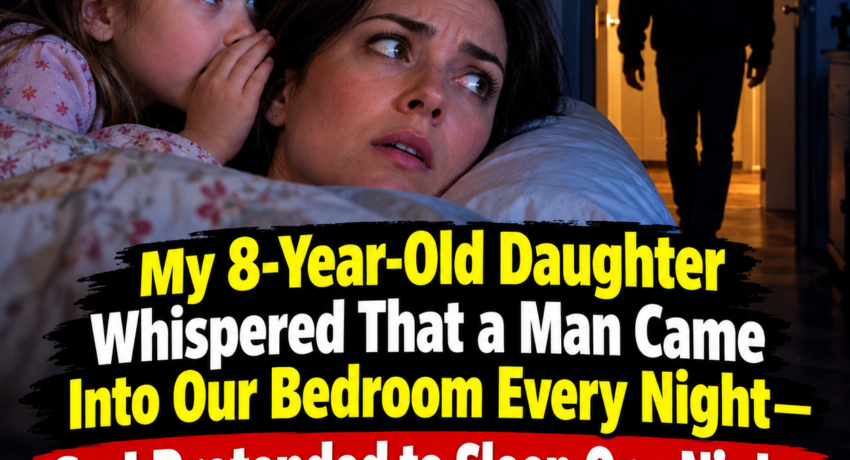
“There’s a man who comes into your bedroom at night.”
My fingers tightened around the steering wheel.
For several seconds, I wasn’t sure I had heard her correctly.
“What did you say?”
Maya didn’t turn toward me.
“A man comes into your room after you fall asleep.”
A cold sensation moved through my chest.
“What man?”
“I don’t know.”
She sounded as though she were describing a neighbor’s dog.
“He walks really slowly. Like he’s trying not to make the floor squeak.”
I forced myself to keep my eyes on the road.
“And Mom?”
Maya finally looked at me.
“She closes her eyes.”
“She’s asleep?”
Maya shook her head.
“I don’t think so.”
My mouth went dry.
“Why not?”
“Because sometimes she looks sad before she closes them.”
There was no fear in Maya’s face.
No excitement.
No sign that she expected a dramatic reaction.
Only certainty.
That frightened me more than anything.
“Maya, did you dream this?”
“No.”
“Did you see something on television?”
“No.”
“Did somebody tell you this?”
She frowned.
“Dad, I saw him.”
Then she adjusted the straps of her pink backpack and went back to watching the city move past her window.
I spent the rest of the drive inventing explanations.
A dream.
A shadow.
A coat hanging in the hallway.
A child’s imagination connecting unrelated things.
Anything made more sense than what she had actually said.
Yet the harder I tried to dismiss it, the heavier the feeling in my stomach became.
When we reached school, Maya leaned across the console and kissed my cheek.
“Bye, Dad.”
“Have a good day.”
She climbed out and hurried toward the entrance, her pink backpack bouncing behind her.
I watched until she disappeared among the other children.
Then I sat there with both hands resting on the steering wheel.
My entire life felt slightly tilted.
And instead of going to work, I drove straight home.
Part 2 — The Details I Hadn’t Wanted to Notice
Sarah was in the kitchen when I walked through the door.
Morning sunlight stretched across the countertops. Coffee steamed beside the toaster. Her hair was pulled into a loose knot, and she was wearing an oversized long-sleeved shirt despite the warm weather.
She smiled when she saw me.
“You’re back already?”
Normally, I would have kissed her.
That morning, I simply stood there.
For the first time since we’d married, I didn’t know how to look at my wife.
Part of me wanted to laugh at myself.
I wanted to tell Sarah exactly what Maya had said and let her roll her eyes, explain the misunderstanding, and restore the world to normal.
Instead, I started noticing things.
The shadows beneath Sarah’s eyes.
The way the shirt hung more loosely from her shoulders than I remembered.
The faint grayness beneath her skin.
And when I stepped closer, she flinched.
Barely.
Just a tiny movement.
But I saw it.
“David?”
“What?”
“Are you okay?”
“Yeah.”
The lie came automatically.
She studied me.
“You sure?”
“Just forgot something.”
I didn’t know why I lied.
Perhaps because Maya’s words had planted suspicion before reason had time to defend my wife.
Perhaps because I suddenly wanted to observe rather than ask.
That decision changed everything.
For the rest of the day, ordinary details began feeling suspicious.
Sarah’s phone buzzed on the counter.
She grabbed it almost immediately.
When I entered the room, she turned the screen facedown.
Later, while I was walking past the laundry room, I heard her speaking quietly on the phone.
I wasn’t trying to listen.
Then one sentence stopped me.
“Tonight, then. After he’s asleep.”
I froze outside the doorway.
My stomach dropped.
Sarah lowered her voice before I could hear anything else.
A minute later, she emerged carrying a stack of folded towels.
She looked completely composed.
“Chicken or pasta tonight?”
I stared at her.
“What?”
“For dinner.”
“I don’t care.”
Her smile disappeared.
“David, what’s wrong with you today?”
“Nothing.”
For a second, I thought she might push.
She didn’t.
At dinner, Maya talked about spelling practice.
Sarah reminded her to eat her vegetables.
I nodded when appropriate and barely tasted my food.
Everything looked normal.
That was the worst part.
After dinner, we washed dishes together.
Sarah dried while I loaded the dishwasher.
Our shoulders almost touched.
Neither of us said what we were really thinking.
As bedtime approached, my anxiety became almost unbearable.
Before going into our bedroom, I stopped at Maya’s door.
She was tucked beneath her blanket with her stuffed bear beneath one arm.
“Maya?”
She looked up.
“Yeah?”
I sat beside her.
“I need you to tell me the truth about something.”
Her forehead wrinkled.
“I did.”
“I know. I mean about the man.”
Her expression remained serious.
“You’ve really seen him more than once?”
She nodded.
“How often?”
“A lot.”
“Every night?”
“Almost.”
My heart hammered.
“What does he do?”
“I don’t know. I go back to bed.”
“Does he carry anything?”
Maya thought about it.
“A black thing. Like a box.”
“And Mom?”
“She doesn’t yell.”
“Does she talk to him?”
“Sometimes really quietly.”
Then Maya repeated the detail that should have made me think differently.
“She always looks sad.”
Sad.
Not happy.
Not excited.
Not secretive.
Sad.
I should have stopped there and reconsidered everything.
Instead, jealousy had already decided what story I was living inside.
I kissed Maya’s forehead.
“Go to sleep, okay?”
“Okay.”
I turned off her light and walked toward my bedroom.
That night, I decided I was going to find out who entered my room while I slept.
Part 3 — I Pretended to Be Asleep
Sarah came to bed a little after eleven.
She smelled freshly showered, but underneath the scent of soap was something else.
Something faintly sharp.
Sterile.
I couldn’t place it.
She climbed beneath the covers.
“Did you take your sleep aid?”
I looked toward her.
“Yeah.”
It wasn’t entirely true.
She had been encouraging me to take something mild at night because I’d been sleeping badly for months.
That evening, I went into the bathroom, ran the faucet so she would hear it, and pretended to swallow the tablet.
Instead, I slipped it into my pocket.
Then I returned to bed.
Sarah turned off the lamp.
Darkness settled over the room.
I waited.
Minutes passed.
Then an hour.
I concentrated on breathing evenly.
Slow inhale.
Slow exhale.
Deep enough to sound convincing.
Beside me, Sarah’s breathing was strangely controlled too.
She wasn’t asleep.
I became certain of that.
Neither of us moved.
At exactly 1:13 a.m., the bedroom door began to open.
Every muscle in my body tightened.
The movement was painfully slow.
A thin strip of hallway light appeared across the floor.
Then the opening widened.
Someone stepped inside.
A man.
My heart slammed against my ribs.
He was tall and dressed in dark clothing.
In one hand, he carried a narrow black case.
Maya had been telling the truth.
He closed the door carefully enough that the latch never clicked.
Then he stood still for several seconds.
He didn’t turn on the light.
He didn’t hesitate.
He knew our room.
Or at least he had been inside often enough to know exactly where he was going.
He moved toward Sarah.
Not toward my side.
Hers.
My anger rose so violently that I could feel my pulse in my throat.
Sarah didn’t move.
But in the dimness, I saw her eyes close more tightly.
She wasn’t sleeping.
She was preparing herself for him.
The man stopped beside the mattress.
Nobody spoke.
Then he leaned toward her.
“It’ll only take a minute,” he whispered.
Sarah gave the smallest nod.
Something inside me broke loose.
Every fear I’d carried all day transformed into rage.
I imagined another man visiting my wife while I lay drugged beside her.
Night after night.
In our bedroom.
In our home.
With our daughter watching from the hallway.
My hand started moving toward the bedside lamp.
Then I heard a strange sound.
Snap.
The unmistakable stretch of rubber.
Gloves.
A second later, a smell reached me.
Alcohol.
Something sterile.
The black case opened.
Inside, metal caught the thin line of hallway light.
Sarah slowly pulled the collar of her nightshirt away from her shoulder.
The man reached into his case.
Something slender and silver appeared between his fingers.
For one second, my anger collided with confusion.
Then instinct took over.
I slammed my hand against the lamp switch.
Light flooded the bedroom.
The man spun toward me.
I sat upright.
“Get away from my wife!”
Sarah gasped.
“David!”
I was already climbing out of bed.
“Who the hell are you?”
The stranger stepped backward and raised both hands.
He was wearing medical gloves.
A surgical mask hung beneath his chin.
And clipped near his collar was an identification badge.
“Sir,” he said, remarkably calm, “please don’t come any closer.”
“David, stop!” Sarah cried.
I looked at her.
Then I saw what she’d been hiding.
Her nightshirt had fallen away from her left shoulder.
Beneath her collarbone was a square piece of medical dressing.
Underneath it sat a port.
The skin around it was bruised purple and yellow.
I stopped moving.
My anger vanished so suddenly that I felt physically dizzy.
On the bedside table, the black case stood open.
Vials.
Alcohol wipes.
Syringes.
Sterile tubing.
Medication.
Medical equipment.
I stared at Sarah.
“What is that?”
She couldn’t look at me.
“Sarah?”
Her hands began trembling.
“What is happening?”
She covered her face.
The stranger removed his gloves.
“I think I should give you two some privacy.”
I turned toward him.
“Who are you?”
“My name is Marcus.”
He paused.
“I’m a private home-care nurse.”
I stared.
“A nurse?”
“Yes.”
“What are you doing in my bedroom at one in the morning?”
Marcus glanced toward Sarah.
Then back at me.
“I’ve been coming here for approximately three weeks to administer Mrs. Vance’s overnight treatment.”
The word barely registered.
“Treatment?”
Marcus closed the case halfway.
“Her trial medication.”
I looked at Sarah.
She was crying now.
“What trial?”
Marcus’s expression shifted.
He had clearly realized I knew nothing.
“I’ll wait in the hall.”
He gathered some of his supplies.
“The infusion hasn’t been completed. I’ll come back in ten minutes if that’s all right, Mrs. Vance.”
Sarah nodded without lifting her head.
Marcus left.
The door clicked shut behind him.
Suddenly the room was silent.
I sat on the edge of the mattress.
For the first time, I really looked at my wife.
And I saw what had been in front of me for months.
The weight she had lost.
The sharpness of her collarbones.
The pale skin.
The exhaustion.
The long sleeves.
The dark circles.
All the things I’d noticed and explained away.
“Sarah,” I whispered.
She lowered her hands.
Tears covered her face.
“Please tell me what’s happening.”
Part 4 — The Secret Wasn’t an Affair
Sarah pulled her knees toward her chest.
For several seconds, she seemed unable to speak.
Then she said quietly,
“It started about eight months ago.”
My stomach tightened.
“What started?”
“I was tired all the time. My joints hurt. I kept waking up feeling like I hadn’t slept at all.”
Her voice trembled.
“I thought it was stress. I thought maybe I was just getting older.”
“Sarah…”
“I went in for blood work.”
She swallowed.
“The results weren’t right. They did more tests.”
She finally looked directly at me.
“I have lymphoma, David.”
Everything inside me stopped.
“What?”
“A rare, aggressive form of non-Hodgkin’s lymphoma.”
I stared at her.
“No.”
“By the time they found it, it was advanced.”
“No.”
I stood up because sitting suddenly felt impossible.
“No, Sarah. You’ve been here every day. We’ve had dinner together. You’ve taken Maya to school. You—”
My voice broke.
Eight months.
My wife had been seriously ill for eight months.
And I hadn’t known.
“Why didn’t you tell me?”
She began crying harder.
“How could you not tell me something like that?”
“Because you were barely holding yourself together!”
Her answer came out almost as a shout.
I stopped.
Sarah wiped her cheeks.
“Your father had just died.”
I looked away.
“You were working eighty-hour weeks trying to make partner. You were having panic attacks before work. You weren’t sleeping. Half the time you sat in the driveway for ten minutes before you could even make yourself come inside.”
My anger collapsed beneath shame.
Sarah continued.
“I kept thinking I’d tell you after the next test. Then after the next appointment. Then after we had a treatment plan.”
“So you just did all of this alone?”
“I didn’t know what else to do.”
“You could have told your husband.”
“I was terrified!”
“So was I!”
“You weren’t the one who was sick!”
The words hit both of us.
Sarah immediately covered her mouth.
“I’m sorry.”
I sat down again.
“No. You’re right.”
For a few moments, neither of us spoke.
Then I glanced toward the port.
“Why is Marcus coming at night?”
“My oncologist got me into an experimental targeted-immunotherapy program.”
She touched the edge of the dressing.
“The medication has to be administered on a strict cycle. The first few hours after treatment are usually the worst for me. My blood pressure drops. I get nauseous. Sometimes I throw up.”
I remembered mornings when she’d claimed she’d eaten something bad.
Days when she stayed in bed and told me she had a migraine.
“So they send him here?”
“The trial sponsor arranged overnight home nursing.”
“Why overnight?”
Sarah looked down.
“Because I asked.”
I closed my eyes.
Of course.
She had built an entire medical schedule around hiding her illness from her own family.
“I receive the treatment while you’re asleep,” she continued. “Marcus stays long enough to make sure my blood pressure is stable. I take medication for the nausea. By morning, I’m usually well enough to function.”
My stomach twisted.
“And the sleep aid?”
She hesitated.
Then answered.
“I’ve been putting a mild herbal sleep aid in your evening tea.”
I looked at her.
“You’ve been making me sleep through this?”
“I was afraid you’d hear Marcus come in. Or hear me getting sick.”
“Sarah…”
“I know.”
She lowered her face.
“I know how terrible it sounds.”
I pressed both palms against my eyes.
Hours earlier, I had convinced myself my wife was betraying me.
The truth was that she’d been lying beside me fighting for her life while trying to make sure I never saw her suffer.
“And Maya,” I whispered.
Sarah’s head lifted.
“She knows?”
“She saw Marcus.”
Sarah went pale.
“What?”
“She told me this morning that a man comes into our room every night.”
“Oh God.”
“You didn’t know?”
“No.”
Sarah looked toward the hallway.
“Marcus is always so careful.”
“The floorboard outside Maya’s room squeaks.”
Sarah covered her mouth.
“She must have heard him.”
“She said you always looked sad.”
That was when Sarah broke.
Not the quiet tears from before.
Her entire body folded as she began sobbing.
I moved across the mattress and wrapped my arms around her.
She felt frighteningly thin.
I held her carefully at first.
Then tighter.
“No more.”
She pressed her face against my chest.
“No more what?”
“No more doing this alone.”
“David—”
“I mean it.”
I buried my face in her hair.
“No more secrets. No more sneaking treatment into the middle of the night. No more trying to protect me from reality.”
She clung to me.
“I didn’t want you to lose everything because of me.”
“What everything?”
“Your career. Making partner. Your work.”
I pulled back and looked at her.
“You think any of that matters more than you?”
Tears filled her eyes again.
“I thought—”
“No.”
My voice cracked.
“You’re my wife.”
I took her hand.
“And we’re going through this together.”
Part 5 — What We Told Maya
Marcus finished Sarah’s infusion later that night.
This time, I didn’t pretend to sleep.
I sat beside her.
I watched him clean the port, connect the medication, check her blood pressure, and record numbers on his tablet.
Every few minutes, I looked at Sarah and wondered how many nights she’d done this alone while I slept inches away.
By morning, she was exhausted.
The treatment had left her nauseous and weak.
After helping her settle into bed, I went downstairs.
Two cups of coffee sat untouched on the kitchen counter.
I had already called work.
I didn’t ask permission for time off.
I simply told them I wouldn’t be coming in.
Whatever happened with the partnership could happen without me.
A few minutes later, small footsteps sounded on the stairs.
Maya appeared wearing her school clothes with her pink backpack hanging from one shoulder.
She stopped in the doorway.
Children notice more than we think they do.
She looked at the untouched coffee.
Then at my face.
“Dad?”
“Come here.”
She walked toward me.
I knelt so we were eye level.
“Is Mom sick?”
There was no point lying anymore.
“Yes, sweetheart.”
Her face fell.
“Really sick?”
“She’s been sick for a while.”
Maya’s eyes immediately filled.
“But she’s getting medicine.”
I brushed a strand of hair away from her cheek.
“A lot of medicine. And we’re going to help her.”
She glanced toward the stairs.
“Is that why the man comes?”
“Yes.”
“He isn’t bad?”
“No.”
I smiled gently.
“His name is Marcus. He’s a nurse.”
Maya blinked.
“A boy nurse?”
Despite everything, I laughed softly.
“Yes. Men can be nurses.”
“Oh.”
She considered this.
“He gives Mom medicine?”
“He does.”
“So he wasn’t sneaking in because he wanted to hurt her?”
“No.”
“He was being quiet because we were sleeping.”
Maya nodded slowly.
Then she asked the question I’d been afraid of.
“Is Mom going to die?”
My throat tightened.
I couldn’t promise something nobody could guarantee.
So I took her hands.
“Mom has a serious illness. But she has good doctors, she has treatment, and we’re going to do everything possible to help her get better.”
Maya stared at me.
“Are you scared?”
Children can find the truth adults try hardest to hide.
“Yes.”
Her lower lip trembled.
“Me too.”
I pulled her into my arms.
For a few moments, she simply held me.
Then she whispered against my shoulder,
“I don’t want Mom to look sad anymore.”
My eyes closed.
“She doesn’t have to be sad by herself anymore.”
Maya pulled back.
“Did I do something bad by telling you?”
“No.”
I held her face between my hands.
“You did exactly the right thing.”
“Really?”
“You saw something you didn’t understand, and you told me.”
I kissed her forehead.
“You helped our family, Maya.”
A tiny bit of tension left her face.
Then she looked toward the stairs again.
“Can I see Mom?”
“Of course.”
She dropped her backpack beside the counter and ran upstairs.
School could wait.
That morning, everything else could wait.
Part 6 — We Stopped Hiding From the Hard Days
The months that followed were the hardest our family had ever experienced.
But hardship felt different once it was shared.
I took leave from the firm.
At first, I told myself it would be temporary.
Eventually, I stopped counting the days.
I learned Sarah’s medication schedule.
I learned which foods she could tolerate after an infusion.
I learned which blanket she wanted when chills came.
I learned to recognize the difference between ordinary fatigue and the kind that meant I needed to call her doctor.
I cooked.
Badly at first.
Maya ate one of my early attempts at chicken and asked if Sarah’s medicine had damaged my cooking.
Sarah laughed so hard she had to hold a pillow against her stomach.
I considered that a victory.
Marcus kept coming at night for another three months.
But everything was different now.
I met him at the door.
The first time, the two of us stood awkwardly in the hallway remembering that I’d nearly attacked him.
“I owe you an apology,” I said.
He shrugged.
“You thought a stranger was leaning over your wife at one in the morning.”
“I still threatened you.”
“I’ve had worse Tuesdays.”
Eventually, he became familiar enough that Maya stopped calling him “the man.”
“Marcus is here!” she’d announce.
During every infusion, I stayed beside Sarah.
Sometimes we talked.
Sometimes we watched terrible late-night television.
Sometimes she was too nauseous to speak, and I simply held her hand.
There were bad days.
Terrible ones.
Days when Sarah couldn’t get out of bed.
Days when food tasted wrong and even the smell of coffee made her sick.
Days when Maya came home from school cheerful, saw her mother sleeping, and became quiet without anyone asking.
Fear never disappeared completely.
It simply stopped being a secret resident in our home.
We named it.
Talked about it.
Cried when we needed to.
Asked for help.
And slowly, the silence inside our house changed.
Before, it had been the silence of things hidden.
Now it became the silence of people resting beside one another because no explanation was necessary.
By December, Sarah had finished the trial.
Her doctors ordered another PET scan.
Then we waited.
Those few days were almost unbearable.
Every time the phone rang, my stomach tightened.
On a Tuesday afternoon, Sarah sat on the sofa beneath a thick blanket while Maya read beside her.
I was standing near the window when my phone rang.
Sarah’s oncologist.
Sarah immediately put down her mug.
Maya looked up from her book.
I answered.
“Hello?”
“David?”
“Yes.”
“I have Sarah’s scan results.”
I gripped the phone.
Sarah’s eyes never left my face.
“Tell me.”
There was a brief pause.
Then the doctor’s voice softened.
“The treatment worked.”
I stopped breathing.
She continued.
“The scan shows no evidence of active disease. Sarah is in full remission.”
My head dropped.
For several seconds, I couldn’t speak.
“David?”
I was crying too hard.
“Thank you.”
I ended the call and crossed the room.
Sarah looked terrified.
“What?”
I dropped to my knees in front of her.
“David, what did she say?”
I rested my forehead against her lap.
Then I looked up.
“It worked.”
Her eyes widened.
“What?”
“The cancer isn’t showing on the scan.”
Sarah covered her mouth.
“You’re in remission.”
For a moment, she didn’t move.
Then a sound escaped her—half laugh, half sob.
Maya’s book fell to the floor.
“Does that mean she’s better?”
I nodded through my tears.
“It means the medicine worked.”
Maya launched herself toward us.
Sarah wrapped her arms around our daughter.
I wrapped mine around both of them.
None of us looked graceful.
We cried.
Laughed.
Talked over one another.
Maya probably didn’t fully understand the medical meaning of remission.
She understood the only part that mattered to her.
Her mother had been given good news.
And for the first time in months, hope felt larger than fear.
Part 7 — The Night Our House Became Quiet Again
That night, our home felt safe in a way I hadn’t experienced for almost a year.
No careful footsteps moved through the hallway after midnight.
No black medical case appeared beside our bed.
No infusion pump clicked softly in the darkness.
No one in our family was carrying a secret alone.
Sarah lay beside me.
Her hair was beginning to look healthier. Some color had returned to her cheeks, and the deep shadows beneath her eyes weren’t as pronounced anymore.
I listened to her breathing.
Not because I suspected something.
Simply because I could.
Because she was there.
I switched off the lamp.
Outside the window, snow had begun falling in soft, slow flakes.
The bedroom settled into darkness.
A few minutes later, I heard a familiar floorboard squeak in the hallway.
Sarah heard it too.
Neither of us moved.
Maya’s door opened.
Tiny footsteps approached.
Then her face appeared in our doorway.
She was clutching her stuffed bear against her chest.
“Dad?”
“Yeah?”
“Can I sleep in here tonight?”
I smiled.
“For a little while?”
Before I could answer, Sarah lifted the edge of the duvet.
“Come on.”
Maya hurried across the room.
She climbed between us and wriggled beneath the blankets.
Sarah wrapped an arm around her.
I reached across both of them and placed my hand over Sarah’s.
For several minutes, nobody spoke.
Then Maya whispered,
“Dad?”
“Yes?”
“Do you still think the moon follows our car?”
I smiled into the darkness.
Months earlier, I might have corrected her.
I might have explained orbits and perspective and why the moon appears to move with us.
That night, I wasn’t interested in correcting anything.
I pulled my family a little closer.
“Of course it does.”
Maya turned her face toward me.
“Everywhere?”
“Everywhere.”
She seemed satisfied with that.
Within minutes, her breathing became slow and peaceful.
I lay awake a little longer.
Once, I had believed protecting the people we loved meant hiding whatever might frighten them.
Sarah had believed it too.
We had both been wrong.
Sometimes love wasn’t shielding someone from the darkness.
Sometimes it was trusting them enough to let them stand beside you until the darkness passed.
And as snow covered the world outside our window, I held my wife and daughter close.
For the first time in a very long time, none of us had anything left to hide.