Part 1 — Thursdays Belonged to Ryan
If you had asked me six months ago what held my family together, I probably would have pointed to the calendar hanging beside our refrigerator.
It wasn’t beautiful.
Just a plain white wall calendar covered in colored blocks.
Pink meant I was picking up our six-year-old son, Toby.
Blue meant Ryan, my husband, had pickup duty.
Green meant soccer practice.
Appointments, school events, grocery reminders, birthdays—everything had a color.
I used to joke that our entire marriage could be explained with highlighters.
But secretly, I loved that calendar.
There was something comforting about knowing where everyone was supposed to be.
Something safe about routine.
And Thursdays were always blue.
Ryan picked Toby up from school at 2:55 every Thursday.
At exactly 3:15, without fail, my phone would buzz.
Home safe.
Sometimes there was a picture.
Toby eating apple slices.
Toby’s shoes kicked off beside the couch.
His blue backpack hanging from the hook near our back door.
I never questioned any of it.
Why would I?
Ryan was Toby’s father.
He loved our son.
And after everything I’d lost in my own family, the little life the three of us had built mattered more to me than almost anything else.
One Tuesday morning, Toby sat at the kitchen table eating toast while I checked the week’s schedule.
“Mom?”
“Yeah, bud?”
“Can Daddy take me to the park after school?”
“Not today. Daddy’s working late.”
He frowned.
“Thursday?”
I smiled.
“Thursday. Daddy picks you up Thursday.”
Toby nodded as though I had just reminded him of some permanent law of the universe.
Ryan walked into the kitchen tightening his tie.
He kissed Toby’s hair, then leaned over and squeezed my shoulder.
“You’re a lifesaver.”
“For what?”
He pointed toward the lunch container sitting beside his keys.
“You made me actual food.”
“Instead of another gas-station sandwich?”
“Exactly.”
“I’d like my husband to survive past forty.”
He laughed.
“I don’t deserve you.”
There was a bank envelope beside his coffee mug.
I reached for it only because it was close to Toby’s plate and he had already spilled orange juice once that morning.
But Ryan picked it up before I could.
“I’ve got it.”
His voice changed slightly.
“Work stuff.”
I barely noticed.
“Okay.”
I slid his lunch toward him.
“Just don’t forget this.”
He smiled, kissed me, and left.
At thirty-six, I thought I understood my life.
I had a husband.
A son.
A house filled with ordinary routines.
And after years of family pain, ordinary felt like a blessing.
I hadn’t spoken to my mother, Elaine, in ten years.
Not since my father’s funeral.
Not since the day I became convinced she had betrayed him in the cruelest way possible.
I had built walls after that.
Ryan knew every one of them.
He knew exactly why they were there.
Which was why I never imagined he might be the one quietly opening a door behind my back.
Part 2 — The Look I Didn’t Understand
That Tuesday night, Ryan barely touched his dinner.
His phone buzzed twice beneath the table.
The second time, I saw him glance at the screen and quickly lock it.
“Everything okay?”
He looked up.
“Yeah.”
“You sure?”
“Client issue.”
“Again?”
“They’re being difficult about a deadline.”
“On a Tuesday night?”
“You know how people are.”
He turned the phone face down.
“Sorry. That’s rude.”
I watched him for a moment.
“You’ve seemed stressed lately.”
Ryan reached for his water.
“I’m handling it.”
There it was.
His favorite answer whenever I got too close to a problem he didn’t want to discuss.
I’m handling it.
For most of our marriage, I had interpreted those words as strength.
Ryan fixed things.
He took responsibility.
He didn’t like burdening other people.
Only later would I understand that sometimes I’m handling it really meant I’ve already decided you don’t get a say.
Across the table, Toby was arranging green beans into some kind of fort.
“Daddy?”
“Yeah, buddy?”
“Are you home tomorrow?”
“No. Thursday.”
Ryan smiled.
“Same as always.”
Toby stopped moving.
He looked at Ryan.
Then at me.
Then quickly down at his plate.
It lasted less than a second.
A tiny hesitation.
At the time, I thought nothing of it.
Later, I would replay that expression until I could hardly stand it.
Because my six-year-old had already known something I didn’t.
Part 3 — “Why Didn’t My Other Mom Pick Me Up?”
Thursday afternoon, a storm rolled through town.
The power flickered at my office twice before going out completely.
After nearly an hour, management gave up and sent everyone home.
I checked the time.
2:37.
For once, I could surprise Toby.
I almost texted Ryan.
Then I stopped myself.
He loved those rare moments when one of us appeared unexpectedly at school.
So I drove there instead.
I imagined Toby spotting me and running across the sidewalk yelling, “Mom!”
That part happened.
But everything afterward changed my life.
I signed him out a few minutes before dismissal ended.
He climbed into the back seat, buckled himself in, and sat unusually quietly.
Normally, Toby told me everything at once.
Who got in trouble.
Who brought cookies.
Who ran fastest at recess.
That afternoon, he stared out the window.
“You okay, bud?”
“Uh-huh.”
I glanced at him in the mirror.
“You seem quiet.”
He kicked his sneakers gently against the seat.
Then he said:
“Mom?”
“Yeah?”
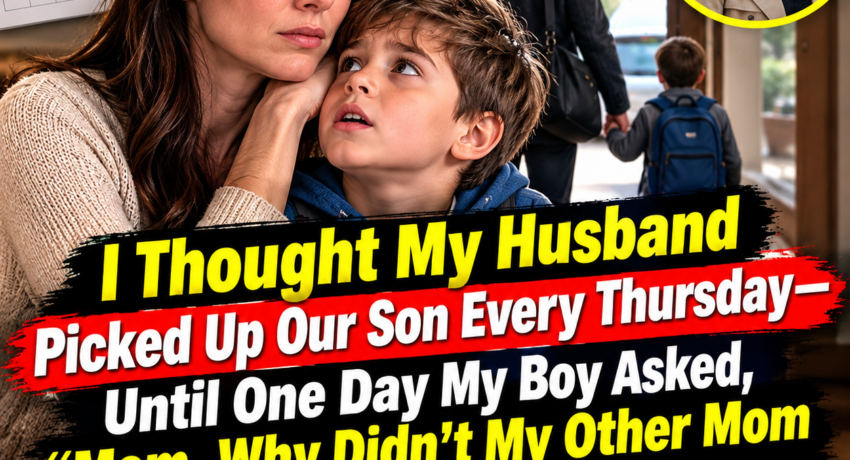
“Why didn’t my other mom pick me up today?”
For a moment, I thought I had misheard him.
“My what?”
“My other mom.”
A cold sensation moved through my chest.
“Toby, what do you mean?”
He looked confused by my confusion.
“The lady who gets me on Thursdays.”
I gripped the steering wheel tighter.
“Daddy picks you up on Thursdays.”
Toby shook his head.
“No, he doesn’t.”
Everything inside me went still.
“What?”
“Daddy’s never there.”
I pulled onto a side street and slowed the car.
“Who picks you up?”
“My other mom.”
“What’s her name?”
He shrugged.
“I don’t know.”
Then he reached into the pocket of his jacket.
“She said I should give Daddy this.”
He dropped something into the cupholder between the front seats.
It made a small metallic sound.
I looked down.
An old brass key.
Worn around the edges.
Scratched near the top.
My breath disappeared.
I knew that key.
Or at least, I knew its twin.
I had used one exactly like it almost every day until I was twenty-six years old.
Before I could touch it, my phone buzzed.
3:15.
Exactly on time.
I stared at the screen.
Ryan: Home safe.
Below the message was a photograph.
Toby’s blue backpack hanging beside our back door.
My heartbeat became painfully loud.
Because Toby was sitting behind me.
And the backpack in that picture was still on his shoulders.
Ryan had staged the photograph.
I zoomed in.
Same hook.
Same hallway.
Same backpack.
But the image had obviously been taken earlier.
Maybe days earlier.
Maybe weeks.
I looked at my son in the mirror.
“Toby?”
“Yeah?”
“How long has the other lady been picking you up?”
He thought carefully.
“A long time.”
“How long?”
He shrugged.
“Since before soccer started.”
Months.
My throat tightened.
Every Thursday.
Every Home safe message.
Every staged photograph.
Every ordinary evening when Ryan walked through our door and acted as if nothing unusual had happened.
All lies.
But one question frightened me even more.
Who was the woman my son called his other mom?
And why had she given Ryan a key to a house I had spent ten years trying to forget?
Part 4 — I Let My Husband Lie to My Face
I didn’t question Toby anymore.
He was six.
Whatever Ryan had done, I wasn’t going to turn our child into an investigator.
Instead, I drove toward home.
A block away, I pulled over again.
“Toby, I need your help with something.”
He brightened.
“What?”
“When you go inside, tell Daddy you came back from the other mom’s house.”
His face scrunched.
“But you picked me up.”
“I know.”
“Why do I have to say that?”
“Because I want to surprise Daddy.”
That was close enough to the truth for a six-year-old.
“He thinks I’m still at work.”
Toby grinned.
“Okay!”
I watched him run toward the house.
Then I drove around for twenty minutes.
When I finally pulled into the driveway, Ryan was in the kitchen.
He looked up.
“You’re home early.”
“Power outage.”
I put my handbag on the counter.
“How was pickup?”
There was a moment.
Tiny.
Almost invisible.
Then he smiled.
“Good. Same as always.”
My stomach turned.
“You two have fun?”
“Yeah.”
Ryan looked toward Toby.
“Had some apple slices when we got home, right, buddy?”
Toby stared at the table.
My husband had no idea that our son had just walked through the door without him.
And still the lie came effortlessly.
“Sounds nice,” I said.
That evening, I helped Toby with his bath.
Read him two stories.
Kissed his forehead.
Pretended everything was normal.
Then Ryan went upstairs to shower.
His phone was on the kitchen counter.
For ten years of marriage, I had never searched his messages.
That night, I did.
I expected another woman.
An affair.
A stranger.
Someone from work.
I was prepared to hate a name I had never heard before.
Instead, the newest message thread contained a single name.
Elaine.
My mother.
My hands went numb.
I opened the conversation.
There were seven months of messages.
Arrangements.
Thursday pickups.
Photographs of Toby.
My mother pushing him on a swing.
My mother helping him frost cookies.
My mother sitting beside him with a storybook.
My mother hugging my son.
Seven months of a relationship I had not even known existed.
One message from the week before read:
Elaine: Same time next Thursday.
Then:
Elaine: She can never know about this. Not yet.
I stared at the screen.
My mother.
The woman I had cut out of my life ten years earlier.
The woman I blamed for one of the most painful losses I’d ever endured.
Ryan had secretly brought her into my son’s life.
And he had taught Toby to keep it from me.
I returned the phone exactly where I’d found it.
Then I went outside.
The brass key was still in the cupholder.
This time, I picked it up.
I closed my fingers around it.
And I knew exactly which door it opened.
My childhood home.
Part 5 — The House With the Blue Door
I did not confront Ryan that night.
Anger wanted answers immediately.
Experience told me lies become more creative when people know they’ve been caught.
So I waited.
The following Thursday, I borrowed a coworker’s Corolla.
At 2:55, I parked far enough from Toby’s school that nobody would notice me.
A silver sedan entered the pickup line.
An older woman leaned toward the passenger window.
Then stepped partially out and waved.
Toby saw her.
And ran.
Not cautiously.
Not reluctantly.
He ran toward her the way children run toward someone they love.
“Come on, sweetheart!” she called. “I made your cookies.”
My hands clenched around the steering wheel.
The woman helped him into the back seat.
Then drove away.
I followed.
Two cars behind.
Then three.
The streets gradually became familiar.
Too familiar.
Oak Street.
Maple Avenue.
The bridge my father used to cross every morning on his way to work.
My breathing became shallow.
“No,” I whispered.
The silver sedan stopped in front of a white house with a blue door.
My childhood home.
Then the driver stepped out.
Gray hair.
Shorter than I remembered.
Slightly stooped shoulders.
But I knew the way she reached for Toby’s backpack.
I knew her before she turned around.
My mother.
Elaine.
Toby skipped beside her.
“Grandma, hurry! I’m hungry!”
Grandma.
I hadn’t expected that word to hurt.
It did.
Elaine laughed softly.
“I’m coming, baby.”
She reached into her handbag and removed a brass key.
The twin of the one Ryan had hidden from me.
Then she opened the blue door.
The same door I’d slammed behind me ten years earlier.
And my mother walked inside holding my son’s hand.
For several seconds, I sat in the car unable to move.
Ten years earlier, I had stood in a hospital hallway waiting for doctors to save my father.
We had been told there was a surgery that might help.
Then he died.
After the funeral, I found the bank withdrawal slip.
The money meant for his medical care had been removed.
My mother’s signature was at the bottom.
I confronted her.
She denied stealing anything.
I didn’t believe her.
I was grieving.
Angry.
Certain.
I told her I never wanted to see her again.
And I kept that promise for a decade.
Now Ryan had brought her back into my life without permission.
Not only into mine.
Into Toby’s.
I got out of the car.
Walked up the porch steps.
And opened the blue door without knocking.
Part 6 — My Mother Had Been Waiting Ten Years
Toby spotted me first.
“Mommy!”
His face lit up.
“You came too!”
I forced a smile.
“Go color for a little while, sweetheart.”
“Okay!”
He ran into the living room.
Then only Elaine and I remained in the hallway.
For a long moment, neither of us moved.
My mother looked older.
Of course she did.
Ten years had passed for her too.
“Claire…”
“Don’t.”
Her mouth closed.
“You don’t get to say my name like we’ve just been apart for a few weeks.”
“I know.”
“Do you?”
My voice shook.
“Because my son has apparently been spending every Thursday here for seven months.”
Elaine looked toward the living room.
“I wanted to tell you.”
“Then why didn’t you?”
“I was afraid you wouldn’t listen.”
“So you went through my husband?”
Her expression tightened.
“I contacted Ryan because I found something.”
“What?”
“Something about your father.”
I almost laughed.
“My father?”
“Bank records.”
She swallowed.
“And a document he wrote.”
My anger faltered just enough for fear to enter.
“What document?”
Elaine walked toward the dining table.
A folder sat there.
“I’ve spent years going through boxes. Records. Papers. Everything your father left behind.”
“Why?”
Her eyes met mine.
“Because you believed I took that money.”
“You signed the withdrawal.”
“I know.”
“You never explained it.”
“I tried, Claire.”
“You said you didn’t know.”
“Because I didn’t.”
I looked toward the folder.
“What did you find?”
“Something in your father’s handwriting.”
She paused.
“I think it explains what really happened.”
I held up the brass key.
“And this?”
Her face softened.
“It’s the spare.”
“For this house?”
She nodded.
“Ryan was supposed to give it to you.”
“When?”
“After he finally told you everything.”
A bitter laugh escaped me.
“So instead you gave it to my six-year-old?”
“I didn’t know you’d be picking him up.”
“Then why didn’t you call Ryan when Toby wasn’t there?”
Elaine frowned.
“I thought Ryan had picked him up himself.”
Everything inside me stopped.
“What?”
“He’s Toby’s father. When Toby wasn’t waiting, I assumed Ryan had taken him.”
Suddenly the staged backpack photograph flashed through my mind.
Ryan hadn’t known where our son was either.
My mother thought Toby was with Ryan.
Ryan thought Toby was with my mother.
And at exactly 3:15, my husband had sent me:
Home safe.
Without knowing whether our son was safe at all.
I felt sick.
Then the front door opened.
Ryan walked in.
His face went white when he saw me.
“Claire.”
I turned toward him.
For the first time that day, my anger felt simple.
“Explain.”
Part 7 — The Debt He Tried to Hide
Ryan closed the door.
“Claire, please let me—”
“Seven months.”
He stopped.
“You lied to me for seven months.”
“I know.”
“You added my mother to Toby’s school pickup list.”
“Yes.”
“You staged photographs.”
His eyes dropped.
“Yes.”
“You sent me Home safe today without even knowing where our son was.”
That one hit him.
He looked toward Toby’s voice coming faintly from the living room.
“I thought he was here.”
“And she thought he was with you.”
Ryan closed his eyes.
“I know.”
“No. You know now.”
My mother stood quietly beside the table.
I looked at Ryan.
“Why?”
He dragged both hands over his face.
Then finally said:
“I owe money.”
I waited.
“A lot.”
“How much?”
His voice dropped.
“Eighty-four thousand dollars.”
I thought I had misunderstood.
“What?”
“I cosigned a business loan for someone from work.”
My stomach tightened.
“Who?”
“It doesn’t matter now. His business failed. The loan became my responsibility.”
“You cosigned an eighty-four-thousand-dollar loan and never told me?”
“I thought he’d repay it.”
“But he didn’t.”
“No.”
“And then?”
Ryan looked at the floor.
“I tried to refinance things.”
Something in his tone terrified me.
“What things?”
Silence.
“Ryan.”
“The house.”
For a moment, the room seemed to move beneath my feet.
“You used our house?”
“I put it up as collateral.”
I stared at him.
“Toby’s home?”
“I was going to fix everything before it became a problem.”
A humorless laugh escaped me.
“There it is.”
“What?”
“I’m handling it.”
His face changed.
“You weren’t protecting me.”
“I was trying to.”
“You were protecting your pride.”
He looked away.
I pointed toward my mother.
“So when you couldn’t solve it alone, you called the one person you knew I would never contact.”
Elaine lowered her gaze.
Ryan nodded.
“She’d reached out before.”
I turned sharply toward him.
“When?”
“A couple of years ago.”
My chest tightened again.
“And you never told me?”
“She wanted me to convince you to speak to her.”
“And?”
“She offered to help us financially if we ever needed it.”
“You said no?”
“At the time.”
“At the time.”
Ryan flinched.
“When the debt got bad, I called her.”
My mother’s voice came quietly.
“I gave him the money.”
I looked at her.
“Why?”
“I didn’t ask for Toby.”
She immediately understood where my mind had gone.
“I swear to you, Claire. I never told Ryan he had to bring Toby here.”
I turned back to my husband.
“Then explain Thursdays.”
Ryan swallowed.
“The first time I brought Toby, your mother and I were searching the study for your father’s papers.”
I stared at him.
“You brought our son here?”
“I didn’t have anyone to watch him.”
“Toby met her.”
“Yes.”
“And then?”
“He liked her.”
Ryan’s voice softened.
“She loved meeting him.”
My mother wiped quickly at one eye.
“She asked if she could see him again.”
I looked toward the living room.
“So because she gave you money, you agreed.”
“It wasn’t like that.”
“Wasn’t it?”
“Claire—”
“She paid your debt, and suddenly my son became part of the arrangement.”
“No.”
“You couldn’t say no to the woman who had just rescued you financially.”
Ryan said nothing.
That silence told me enough.
“And ‘my other mom’?”
His face tightened.
“I told Toby Elaine was your mother.”
“So he called her that.”
Ryan nodded.
“He came up with it himself.”
Of course he had.
He was six.
He had been handed a grandmother with no context and expected to make sense of a family secret that the adults around him had created.
“Go stay with your brother,” I said.
Ryan looked up.
“Claire.”
“Tonight.”
“Please don’t decide anything while you’re angry.”
I almost laughed.
“You’ve spent seven months deciding things for me.”
His shoulders sagged.
“Tomorrow, I want every document related to that loan.”
He nodded.
“Every bank statement.”
“Yes.”
“Every paper involving this house.”
“Yes.”
“And every communication with my mother.”
He swallowed.
“Okay.”
“And us?”
He asked the question so quietly I almost didn’t hear it.
“What happens to us?”
I looked at the man I had trusted enough to believe a staged photograph of our child’s backpack.
“I don’t know.”
For once, Ryan didn’t say he would fix it.
He simply nodded.
Then he left.
I thought that was the worst truth I would learn that day.
I was wrong.
Part 8 — The Letter That Changed Ten Years
After Ryan left, Elaine sat across from me at the dining table.
The folder remained between us.
I didn’t want to open it.
Ten years earlier, I had built an entire understanding of my mother’s character around one bank slip.
Part of me suddenly feared what would happen if that certainty disappeared.
“You said Dad wrote something.”
Elaine nodded.
She slid the folder toward me.
Behind the old withdrawal record was a handwritten page.
My father’s handwriting.
I recognized it immediately.
I read the first lines.
Then again.
My vision blurred.
According to the note, my father had already known his prognosis was much worse than I understood.
The doctors had told him the surgery was extremely unlikely to save him.
He had chosen not to spend everything chasing a treatment he believed would only leave his family with less after he was gone.
Instead, he transferred the money into an account under my mother’s name.
For her.
For me.
For the house.
I looked up.
“You knew?”
Elaine shook her head violently.
“No.”
“But your signature—”
“I thought I was signing paperwork related to his treatment.”
“You expect me to believe that?”
Her face crumpled.
“Claire, you remember my eyesight.”
I did.
She had needed reading glasses for as long as I could remember.
“He put papers in front of me,” she continued. “Hospital forms. Bank forms. I signed where he asked.”
Her voice broke.
“I didn’t know he’d moved the money until after he died.”
“But when I found the withdrawal—”
“You had already decided what it meant.”
Her words weren’t cruel.
That made them worse.
“I tried to tell you I hadn’t taken his surgery money for myself.”
I looked down at the page again.
“You couldn’t prove it.”
“No.”
“Why not?”
“Because I didn’t understand what he’d done either.”
She touched the folder.
“This letter was buried with old financial papers in the study. I’ve searched that room so many times over the years.”
I remembered my father’s desk.
His drawers filled with receipts, old warranties, tax forms, handwritten notes, envelopes he swore he’d organize eventually.
Elaine wiped her face.
“I wasn’t trying to prove I was perfect.”
She looked at me.
“I was trying to prove I didn’t do the thing you hated me for.”
My chest tightened.
For ten years, I had carried the same story.
My mother took the money.
My father died without the surgery.
She chose herself.
I had repeated that story until it became part of me.
And now my father’s handwriting was telling me something different.
He had made the decision.
Not her.
The money hadn’t been stolen from him.
He had moved it deliberately.
Elaine had spent a decade living under an accusation she couldn’t disprove.
And I had spent a decade refusing to listen.
“I buried him,” I whispered.
“So did I.”
The words were soft.
They broke me.
For years, I had acted as if my grief belonged to me alone.
As if Elaine’s loss didn’t count because I believed she had caused it.
“I hated you.”
Tears spilled down my mother’s face.
“I know.”
“I said terrible things.”
“I remember.”
“I didn’t let you explain.”
“You were grieving.”
“That doesn’t excuse everything.”
“No.”
She didn’t rescue me from the guilt.
Maybe I needed that.
I looked toward the living room.
Toby was humming to himself while coloring.
My son had known this woman for seven months.
I had known her my entire childhood.
And somehow we had both spent years living with versions of her the other had never seen.
Part 9 — Some Doors Open Slowly
Three weeks later, Ryan was still staying with his brother.
We had not decided whether our marriage would survive.
I wasn’t ready to answer that question.
He had given me every document I’d requested.
The debt was real.
So was the collateral agreement.
So were his lies.
He started meeting with a financial adviser and an attorney to untangle what he’d done.
He apologized.
More than once.
But I had learned that apologies and trust are not the same thing.
Ryan had not betrayed me because he stopped loving me.
In some ways, that made it harder.
He had convinced himself that hiding the truth was protection.
That making decisions alone was responsibility.
That he could lie now and explain later after everything had been fixed.
He had to understand why that couldn’t happen again before I could decide what remained between us.
My relationship with my mother was different.
Not magically healed.
Not erased.
We didn’t hug and pretend ten years had disappeared.
Some hurts don’t work that way.
We started smaller.
Coffee.
Short phone calls.
Questions I should have asked years ago.
Questions she finally had answers for.
And Toby?
For him, things were much simpler.
He already loved her.
That was perhaps the strangest part.
While the adults around him had spent years building walls out of grief, secrets, pride, and fear, Toby had walked straight through them with a box of crayons and a plate of cookies.
One Sunday afternoon, I sat on the back steps while he and Elaine chased giant soap bubbles across the lawn.
My mother was terrible at it.
She swung the plastic wand far too hard and missed almost every bubble.
Toby laughed so loudly that the neighbors probably heard him.
“Grandma!”
He doubled over.
“You missed again!”
“I am doing my best!”
“You’re bad at this!”
Elaine laughed.
“So was your mother!”
I looked up.
She froze.
For a second, I could see the fear on her face.
As though she thought mentioning my childhood might close the door again.
Instead, I smiled.
“I was six.”
“You were terrible at bubbles.”
“I was excellent at bubbles.”
“You cried when they popped.”
“I was sensitive.”
Toby ran toward me.
“Mom, come help Grandma!”
Grandma.
The word didn’t feel like a slap anymore.
Not yet completely natural.
But no longer unbearable.
I stood.
Elaine held out the wand.
Our fingers touched.
Neither of us pulled away.
Ten years earlier, I had believed certainty was what kept me safe.
I had been certain my mother betrayed my father.
Certain cutting her off was the only way to protect myself.
Ryan had been equally certain that hiding his debt would protect our family.
We had all made life-changing choices based on what we believed we understood.
And Toby—without meaning to—had exposed every one of those illusions with a single innocent question.
Mom, why didn’t my other mom pick me up today?
I still didn’t know what would happen with my marriage.
I didn’t know how long rebuilding trust with Elaine would take.
Maybe years.
Maybe some pieces would never fit exactly the way they once had.
But as I watched my mother chase my laughing son through the yard, I understood something I hadn’t ten years earlier.
Opening a door doesn’t mean pretending nothing happened behind it.
Sometimes it only means you’re willing to look inside again.
And for now, that was enough.