PART 1: The Funeral That Was Never Supposed to End This Way
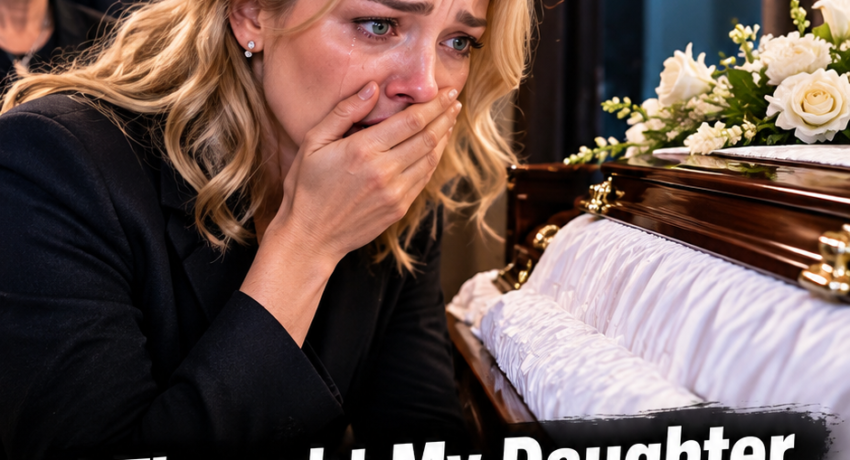
I was leaning over my six-year-old daughter’s white casket, close enough to smell the funeral home’s lilies, when I heard her voice.
“Mommy… I’m cold. Daddy said I had to sleep.”
I didn’t scream. I didn’t call out. Twenty-two years in the Army Medical Corps had taught me that panic kills people faster than whatever is actually wrong with them, so I stood perfectly still with my hand on the casket’s edge and let my mind catch up to what my ears had just told me.
Lily wasn’t supposed to be able to speak.
Lily wasn’t supposed to be alive.
Two days earlier, my ex-husband, Derek Winslow, had called to tell me our daughter died in her sleep from what he called “a respiratory event.” He said it flatly, the same tone he used to read off supply requisitions back when we were still married, and something about that flatness had bothered me even through the shock. I asked for her hospital records. I asked to see her body. I asked for an independent autopsy. Every request either disappeared into silence or came back with an excuse from Derek’s mother, Diane, who told the rest of the family I was “trying to turn our granddaughter’s death into another custody stunt.”
They scheduled the funeral for four days out. They scheduled the cremation for the morning after that. Diane called it “closure, quick and clean, the way Lily would have wanted.” I remember thinking, even through the fog of grief, that no six-year-old has ever had an opinion about how fast she wanted to be cremated. And until the moment I stood beside that casket, running my thumb along its cool white edge, I had no proof that anything about Lily’s death was wrong — only a mother’s certainty that something was.
The chapel was nearly empty. Derek’s side of the family filled two rows near the front; my side barely filled one, most of them still stationed overseas or scattered across bases I’d served at over the years. I had asked to have a few minutes alone with her before the service started, and Derek, for once, hadn’t argued.
Then I heard the whisper.
Then her eyelids fluttered.
I opened the casket.
Lily lay against the white lining, pale, damp with sweat, her breathing so shallow I had to bend down to be sure it was there at all. When I slid my hand beneath her to lift her out, my fingers struck something hard and unyielding at her wrists.
Restraints. Thin plastic ties, threaded through a slit someone had cut into the casket’s padded lining.
“Mommy,” she breathed again. “I’m so cold.”
Whatever numbness grief had wrapped around me for two days burned away in that instant. I checked her pulse first — fast, thready — then her arms, where I found a row of fresh puncture marks along the inside of her elbow, the kind I’d seen a hundred times on patients who had been sedated repeatedly instead of just once.
“Who did this to you, baby? Who did this?”
Her lips barely moved. “Daddy said it was sleeping medicine. Grandma held my arm. Paula locked the door.”
Three years earlier, Derek had won full custody of Lily by convincing a family court judge that a mother stationed overseas half the year was too unstable an environment for a six-year-old. After that, every visit I scheduled came back canceled. Lily was sick. Lily didn’t want to see me. Lily’s therapist recommended “space.” For three years I believed my daughter was slowly being turned against me one appointment at a time.
I understood now that something far worse had been happening behind Derek’s front door.
Beneath the casket’s padding, taped where a searching hand could find it, was a small brass key. I still don’t know who left it there or why, but I used it to cut the ties from Lily’s wrists and pulled her against my chest just as footsteps came pounding down the hallway outside.
PART 2: The Room With No Windows Could Wait
Derek’s voice hit the door first, sharp and cracking. “What are you doing in there? Get away from her!”
I didn’t answer him. I carried Lily into the small adjoining viewing room, threw the bolt, and pressed her against my chest with one arm while I dialed 911 with the other.
“This is Colonel Renee Ashcombe, United States Army Medical Corps,” I said, keeping my voice level because Lily could hear every word of it. “My six-year-old daughter was declared dead forty-eight hours ago. She’s alive. She’s heavily sedated and was restrained inside a casket scheduled for cremation tomorrow morning. I need paramedics and armed officers at Cedar Hollow Funeral Home immediately.”
The dispatcher was still confirming the address when Derek started pounding on the door hard enough to rattle it in its frame.
Then I heard his mother’s voice from the hallway, and it wasn’t panic underneath it. It was fury.
“Nobody was supposed to open that casket before the furnace!”
The dispatcher heard it too. She went quiet on the line for exactly one second before asking me to repeat what had just been said.
Lily’s face was buried against the front of my uniform jacket, her whole body trembling. “Mommy,” she whispered. “Daddy said if I slept long enough, he wouldn’t have to give Grandpa’s money back.”
I went still.
My father, retired General Walter Ashcombe, had set up an irrevocable trust for Lily years earlier — a fund meant to cover her education and, eventually, her adult life, administered by whichever parent held legal custody. Derek was that trustee. Derek was also, I would learn within hours, more than twelve million dollars in debt.
Outside the door, Diane’s shouting had turned into something closer to screaming at Derek — something about time, and the furnace schedule, words too fractured to make out over Lily’s ragged breathing and my own pulse pounding in my ears.
Sirens rose in the distance, faint, then closer.
I held my daughter and told her the only true thing I had. “Nobody is taking you anywhere again. I’ve got you. I’m not letting go.”
I believed, in that moment, that I had just uncovered the worst thing my ex-husband was capable of.
I had no idea how wrong I was. Within six hours, a search warrant would take detectives into the basement of Derek’s house, through a wall panel that wasn’t supposed to open, into a room that had nothing to do with our daughter at all.
PART 3: What the Toxicology Report Wouldn’t Let Them Deny
Paramedics stabilized Lily in the funeral home’s parking lot before the ambulance even pulled away, and by the time we reached the military medical center, the first toxicology numbers were already reshaping the case.
The sedative levels in her blood weren’t consistent with a single dose. The pattern — peaks and partial recoveries logged in her small body over what the ER toxicologist estimated was several days — meant someone had been dosing her repeatedly, adjusting the amount each time as though managing a dial rather than administering medicine.
While a pediatric team worked to stabilize her, state police detained Derek, Diane, and a woman named Paula Kessler, who had worked in Derek’s house for the past two years as a housekeeper, and apparently as a good deal more than that.
Their stories didn’t hold together for even a full hour.
Derek told detectives Lily’s “death” had come from a medical mistake he hadn’t fully understood himself. Diane insisted the restraints found inside the casket were standard practice for transport. Paula swore, flatly and immediately, that she had never once seen Lily restrained.
Then a nurse found a high-dose fentanyl patch still adhered to the skin between Lily’s shoulder blades — a medication no pediatrician on earth would prescribe for a six-year-old, and one whose batch number could be traced directly back to whoever had supplied it.
A judge signed the search warrant before sunrise.
I spent those hours in a hallway chair I refused to leave, running through every visit Derek had canceled over the last three years, searching for a pattern I hadn’t let myself see while I was living inside it. A sudden fever the week before my leave started. A “bad week with her therapist” right before a scheduled video call. At the time, each excuse had sounded plausible on its own. Lined up end to end, they looked like a schedule.
I was standing outside the pediatric ICU, watching Lily sleep through a wall of glass, when Detective Alan Choi walked toward me holding a tablet like it weighed more than it should have.
“Colonel Ashcombe,” he said. “You need to see this.”
The first photo showed a section of exposed drywall in Derek’s basement — a panel pried away from a doorframe built to look like it wasn’t there at all. Behind it: a windowless room with foam paneling on the walls, a child-sized cot bolted to the floor, and a door that locked only from the outside.
On a shelf, prescription bottles. Several matched the sedatives already found in Lily’s bloodstream.
Detective Choi swiped to the next image before I’d fully absorbed the first.
A child’s desk. A stack of school notebooks. The name written across every cover in careful, looping cursive wasn’t my daughter’s.
It was Ava Brennan — six years old, missing for three months, a case that had made national headlines the week she disappeared.
I recognized the name instantly. Her father, Nathan Brennan, was a defense contractor who had recently filed a multimillion-dollar fraud lawsuit against Derek’s construction company.
“Was she kept in that room?” I asked.
Detective Choi’s jaw tightened. “Forensics found her hair, some clothing, and a school ID. We also recovered two forged passports under a different name.”
Whatever had happened to my daughter, it wasn’t the isolated act of one desperate father protecting a trust fund. It was one piece of something considerably larger, and I had a feeling we’d only seen the smallest corner of it.
PART 4: Twelve Million Reasons
My father arrived at the hospital just after dawn, still in whatever clothes he’d grabbed when I called him at four in the morning. Retired two-star generals aren’t supposed to look shaken. Walter Ashcombe looked like a man who had aged five years overnight.
He was the one who finally explained, in plain terms, exactly what Derek stood to gain.
“The trust has a clause,” he said. “If Lily dies while Derek still holds custody, a portion of the principal releases early to the trustee for ‘dependent-related expenses.’ Not the whole trust. But enough to cover a debt his size, quietly move the rest, and disappear before anyone thought to audit it.”
“How much debt?”
“Twelve million. Maybe more, once the lawyers finish counting.”
While we talked, investigators were already closing in on Dr. Elliot Marsh, the physician who had signed Lily’s death certificate two days earlier without, records would later show, ever actually examining her body. Marsh turned out to be Paula Kessler’s older brother.
Detectives also recovered copies of Lily’s trust paperwork, a life insurance policy Derek had quietly taken out on her eighteen months prior, and printed instructions on expediting probate for a deceased minor’s estate. None of it looked improvised. All of it looked planned, in writing, well in advance of the day Derek picked up the phone and told me our daughter was gone.
Then, just before seven a.m., an investigator jogged toward us down the hallway, phone still pressed to his ear.
“We found Ava Brennan.”
I was on my feet before the chair behind me finished scraping the floor. “Is she alive?”
“Yes. State troopers raided a rented house about two hours outside the city. She’s alive. The woman watching her is already cooperating.”
For one full second, relief was the only thing I felt.
Then his expression changed, and I understood there was more coming.
“There’s something else,” he said. “The caretaker’s talking, and she says Derek Winslow wasn’t the one giving her orders.”
I looked through the ICU glass at my daughter’s small, sleeping shape beneath the monitors and felt the floor of the last twelve hours tilt under me all over again.
If Derek hadn’t been running this — if he’d been a piece of someone else’s plan instead of its author — then someone had spent months orchestrating the suffering of two little girls, and until that moment I hadn’t even considered who that person might actually be.
When the investigator said the name a few minutes later, it wasn’t who I expected. Not even close.
PART 5: The Name Behind Both Girls
The woman guarding Ava Brennan was a fifty-eight-year-old former private-duty nurse named Wanda Price. When troopers pulled her out of the rental house, Ava was weak, dehydrated, and heavily sedated, but breathing steadily on her own. Under questioning, Wanda gave up the name of the person who had been paying her, in cash, for three straight months.
It wasn’t Derek.
It was Diane Winslow.
I sat with that for longer than I want to admit. Diane had never liked me — she’d told the family court, under oath, that I “cared more about my career than my daughter” — but disliking your daughter-in-law is one thing. Orchestrating the abduction of a child is another entirely.
Investigators pieced the plan together over the following two days, and the pieces fit with a precision that made my skin crawl.
Ava had been taken because her father, Nathan Brennan, had uncovered evidence that Derek’s construction company was funneling nearly nine million dollars in client escrow funds into a network of shell accounts — the same debt my father had already described to me. Diane arranged Ava’s abduction to pressure Nathan into withdrawing his fraud complaint before it ever reached a grand jury. When he refused, she began preparing forged identity documents instead, planning to move the child permanently out of the country.
Investigators found three things in Wanda’s rental house that tied the two cases together beyond any doubt: a burner phone with a single saved contact labeled only “D.W.,” a bank deposit slip for four thousand dollars made out in cash the week Ava disappeared, and a folded printout of my custody appeal, date-stamped and highlighted in three places — the hearing date, the judge’s name, and the paragraph describing what would happen to the trust if I won.
Diane hadn’t just planned Lily’s death. She’d been tracking my case number.
Lily hadn’t needed to be kidnapped. Derek already had full legal custody of her. But my appeal — filed six weeks earlier, after a judge finally agreed to reconsider the original custody ruling — was scheduled for a hearing in eleven days. If I won, Derek’s access to Lily’s trust disappeared, and with it his only remaining way to cover the escrow shortfall before Nathan’s lawsuit forced a full audit of the company’s books.
So Diane decided Lily had to die before that hearing ever took place.
Dr. Marsh signed the false certificate. Paula supplied and administered the sedatives on a rotating schedule designed to keep Lily unconscious without drawing attention from anyone outside the house. Derek, investigators came to believe, had gone along with all of it — reluctantly, by his own later account, but he’d gone along.
What none of them had counted on was Lily surviving the dose meant to keep her silent through the cremation.
I would learn exactly how close it had come to going the other way — and exactly who had quietly refused, at the very last moment, to let it — from a recording pulled off Derek’s own home security system.
PART 6: The Recording
Detectives played portions of that recording for me the following afternoon, pulled from a camera mounted above Derek’s kitchen doorway that Diane apparently hadn’t known existed. Even now, I can hear certain lines exactly as they were spoken.
Dr. Marsh’s voice, tight with alarm: “Her pulse is too weak. She needs a hospital, not a casket.”
Diane’s, flat and immediate: “If she wakes up in a hospital and starts talking, we all go to federal prison.”
Then Paula’s, breaking in a way that told me she hadn’t planned to say it out loud: “I only agreed to help with paperwork. I never agreed to hurt a child.”
It was Paula, investigators eventually confirmed, who had quietly shaved down two of the final three doses without telling anyone — not enough to raise suspicion, but enough, maybe, that Lily’s small body found a way to survive what should have killed her outright. It wasn’t mercy, exactly, that saved my daughter. It was one frightened woman’s private refusal to see something through all the way to the end.
On that same recording, Diane reminded Paula that she was already tied to Ava’s disappearance and had nowhere left to run even if her conscience got the better of her.
Then Derek’s voice entered the recording, calmer than either of theirs.
“Cremation’s at eight tomorrow morning. Once she’s in the furnace, there’s nothing left to audit.”
I asked to see him after that. I’m still not entirely sure why. Closure, maybe. Or the simple need to look at the man I had once married and understand how he had arrived here.
He looked smaller across the interrogation table than I remembered him, stripped of the tailored suits and the easy confidence that had once convinced a judge I was the unfit parent.
“Renee, I never wanted it to go this far.”
“You put restraints on our daughter and sealed her inside a casket.”
He told me Diane had convinced him Lily was “already gone, functionally,” and that whatever happened next wouldn’t really count as anything if her heart had already stopped once. He told me about the debt, the frozen accounts, the audit he knew was coming. It wasn’t an apology so much as an explanation, delivered as though the explanation might do the apologizing on his behalf.
It didn’t.
I asked him one more question before the guard came to take him back to holding. “Did you ever love her? At all, honestly?”
He looked at the table for a long time before he answered. “I told myself I did. I think I meant it, some days. I just wanted the debt gone more.”
I didn’t say anything back. There wasn’t a version of that sentence I needed to hear twice.
And it didn’t change what the financial records would show next — that for three years, Derek hadn’t simply kept Lily from me once. He had built an entire system, with other people’s quiet cooperation, to keep doing it indefinitely.
PART 7: What the Money Trail Reframed
The full shape of what Derek had built came out through bank records, not through anything he ever said to me directly.
For three years, a court-appointed family therapist named Dr. Patricia Lowell had been the one repeatedly recommending that my visits with Lily be limited “for her emotional stability.” Financial records showed Lowell had received more than $150,000 from Derek’s company in consulting fees that lined up, almost too neatly, with each new recommendation issued against me.
It reframed everything I thought I understood about the last three years. The canceled visits hadn’t been a grieving, overcautious father’s instinct. They had been a paid, deliberate campaign to keep me from ever getting close enough to see what was actually happening to our daughter — sedation used, investigators suspected, on smaller occasions before that final week, whenever Lily’s fear of her father or grandmother risked becoming visible to anyone outside those walls.
I sat with all of it while Lily spent two weeks in pediatric recovery, relearning how to trust the world around her one small test at a time.
She barely spoke the first few days. When she slept, she often woke screaming that the white box was locked again, or begging someone to leave the hallway light on.
One night a nurse came in to adjust her IV line, and the instant Lily saw the equipment, she started to cry and beg not to be given “sleeping medicine” ever again. I moved to her bedside immediately and took her face gently between both hands so she had to look at me.
“Nobody gives you medicine without explaining it to you first. Not ever again. Nobody locks you up again. And nobody takes you away from me again.”
She stared at me, tears still sliding down. “Not even Grandma?”
“Not ever again.”
Her voice dropped even smaller. “Not even Daddy?”
That question nearly broke something in my chest, but I didn’t let it show on my face.
“Not even Daddy.”
She studied me for a long moment, the way a child does when she’s checking an answer for a lie, and then she threw both arms around my neck.
“Then you really are my real mommy.”
A week later, a therapist who specialized in trauma recovery in young children started seeing Lily three times a week. She taught her simple things at first — naming five objects in the room, counting her own breaths, telling an adult “I don’t like that” out loud instead of freezing. It sounds small. For a child who had spent months learning that speaking up got the door locked, it was almost everything.
Ava Brennan was reunited with her father that same week. Months of isolation had left real, visible damage, but she was alive, and with proper medical and psychological care ahead of her, Nathan told me later that she had started sleeping through full nights again for the first time since she’d come home.
Paula agreed to testify against Diane and Derek in exchange for a reduced sentence, laying out the financial scheme, the forged documents, and the plan involving both girls in exhausting detail. Dr. Marsh lost his medical license and was sentenced to just under nine years for falsifying Lily’s death and assisting an attempted homicide. Dr. Lowell was convicted separately of bribery and judicial fraud.
PART 8: The Choice
Diane received life in prison without the possibility of parole. Derek was sentenced to forty-one years on charges that included attempted murder, kidnapping conspiracy, and financial fraud, built on the recordings, the toxicology reports, the forged trust documents, and testimony from three separate accomplices.
The day family court permanently restored my full parental rights, I expected to feel something close to victory. Instead I felt hollowed out, the way you do after finishing a mission you never asked to be given in the first place.
Before closing the case, the judge looked at me directly.
“Colonel Ashcombe, nothing this court orders can undo what was done to you and your daughter.”
I looked at Lily sitting quietly beside me and answered without needing to think about it.
“No, Your Honor. But we can make sure the people who allowed it never get the chance to do it again.”
That commitment ended up costing something specific.
My father and I restructured Lily’s trust under strict court oversight, requiring three independent signatures for any future disbursement so that no single guardian could ever again gain unsupervised control of it. Then, with my father’s full agreement, we redirected forty percent of the trust’s projected future growth — not the principal Lily would eventually need, but the decades of compounding earnings that would otherwise have sat there untouched — into a new nonprofit legal fund.
Its purpose was narrow and specific: independent legal and psychological representation for children caught in high-conflict custody cases, in situations where a parent’s money and influence could make abuse look, on paper, like protection.
It wasn’t money given away out of guilt. It was a number my father and I discussed for hours before either of us signed anything, a real reduction in what Lily would eventually inherit, made because we had both just watched what unregulated money and unchecked authority could do to a child when nobody was ever required to check either one.
Lily herself doesn’t know the dollar figure, and she won’t for years. What she does know is that the fund now has a name — the Open Door Foundation, for children she’s never met, in versions of this story where a mother might not reach the casket in time. My father let her pick the name off a short list. She didn’t ask why. She just liked how it sounded.
None of it made Lily’s recovery any faster. Healing didn’t arrive the moment a judge signed an order, or the moment Diane and Derek were led out of the courtroom in handcuffs. It came slowly, in months of therapy, in nights she still needed a hallway light left burning, in the small, repeated proof that the world hadn’t quietly gone back to being dangerous the second those courtroom doors closed behind us.
PART 9: Not Cold Anymore
Late spring, almost eight months after the funeral that never should have happened, I took Lily to the park near my father’s house.
She ran across the grass longer than she stopped to check over her shoulder for me, which by itself felt like a milestone nobody else in the world would have noticed. She tripped over a tree root, went down hard on both knees, and popped back up laughing before I’d even made it off the bench.
The sound of it stopped me completely.
My father sat beside me, watching her chase a soccer ball nobody else was even playing with. His eyes were wet.
“I used to think that trust fund was what was going to secure her future,” he said quietly.
I reached over and took his hand. “Money never protected anyone by itself, Dad. People do.”
Lily came sprinting back toward us a few minutes later, cheeks flushed, and wrapped both arms around my neck the way she’d started doing dozens of times a day since we came home. I held on a few seconds longer than usual, the way I always did now.
“Are you cold, baby?”
She pulled back just far enough to look at me, grinning, out of breath.
“Not anymore, Mommy.”
I used to think justice would feel like the moment a verdict got read out loud in a courtroom. It didn’t. It felt like this instead — an ordinary Tuesday afternoon, my daughter laughing in the sun with grass stains on both knees, completely unafraid of whatever might come next.
Derek and Diane had tried to erase her for twelve million dollars and their own silence.
They hadn’t come anywhere close.
I still keep the small brass key from the casket in the top drawer of my desk. I don’t know why. Maybe because whoever left it there, in that last moment of the plan, chose to give my daughter a chance nobody had promised her. Some nights I think it was Paula. Some nights I’m not sure it matters anymore.
What matters is that Lily sleeps with her door open now, the hallway light on low, and some mornings I wake up before she does and just stand in her doorway for a minute, listening to her breathe on her own, in a bed, in sunlight, exactly where she belongs.