For eighteen years, I believed the hardest part of my daughter’s story had happened before I found her.
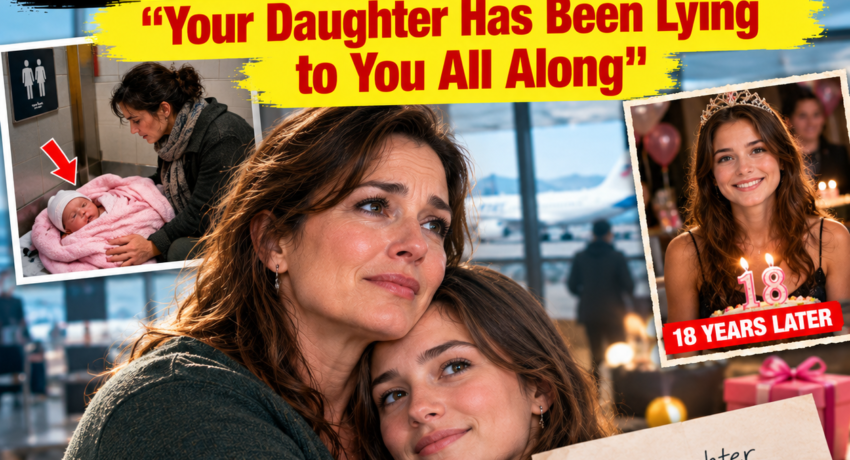
Then, on the morning of her eighteenth birthday, someone left an envelope in my mailbox.
Written across the back were the words: “Your daughter has been lying to you her whole life.”
Before I could open it, a woman across the street called my name. In her hand was something that should have been in my daughter’s bedroom.
The Cry Behind the Door
After a decade as a flight attendant, I could usually tune out airport noise. Rolling suitcases, boarding calls, exhausted travelers arguing over missed connections—it all faded into the background by the end of a shift.
But that morning, coming off a red-eye from Denver, I heard a sound near Gate 17 that made me stop walking.
A baby was crying inside the women’s restroom.
The cry was thin and uneven, with long pauses that frightened me more than the sound itself. I pushed through the door, my overnight bag bumping against my leg.
“Hello? Does someone need help?”
No one answered.
I followed the whimpering toward the last stall. Beside it, on an open changing table, lay a newborn wrapped in a yellow blanket far too thin for the cold room.
For a second, I waited for someone to step out of a stall and explain. Then I saw the note pinned to the blanket.
“Please take care of her. Her name is Hope.”
My bag slipped from my shoulder.
“Oh, sweetheart.”
I gathered her against me, supporting her head with a hand that had begun to shake. Her cheek pressed against my uniform, and her tiny fingers caught the fabric near my collar.
“Somebody help!” I called toward the door. “Please, get security!”
The hours afterward came in fragments: a security officer speaking into a radio, a nurse taking Hope from my arms, a detective asking whether I had seen anyone leave.
I kept giving the same helpless answers. I hadn’t seen her mother. I didn’t know how long she had been there.
Later, an investigator told me they were trying to identify two women, one younger and one older, who had been seen together near the restroom. Neither was found.
Hope went into temporary care. Eventually, I was allowed to go home.
I stood inside my front door for a long time without turning on a light.
Two months earlier, my own little girl had died at eleven months old. Her things were still in the nursery. Sometimes I opened the door because I couldn’t bear to keep it closed; sometimes I closed it because I couldn’t bear to look inside.
My husband had left the day after her funeral.
“Every time I look at you, I think about her,” he’d said.
I remembered watching him carry his bag to the car. I had been too exhausted by grief to ask why he thought I could stay in that house alone when he couldn’t stay in it with me.
Now I stood there with the memory of another baby’s hand gripping my shirt.
I called the next day to ask about Hope. Then I called again.
When visits became possible, I told myself I only needed to see that she was safe. But one afternoon, she curled her fingers around my index finger and fell asleep before I could bring myself to leave.
I sat beside her, crying quietly.
For the first time in weeks, I wanted to make plans for tomorrow.
The Life We Built
Bringing Hope home took time. There were interviews, paperwork, and long stretches when I worried that wanting to raise her would never be enough.
I understood why people asked difficult questions. I was grieving. I lived alone. Love could make me certain while leaving everyone else with reasonable doubts.
But I knew Hope could never take my first daughter’s place. I still loved and missed that little girl. I also wanted to learn everything about the baby who watched me so solemnly from the crook of my arm.
When the adoption was finally complete, I carried Hope through my front door and stood there holding her while she slept.
This time, I turned on the lights.
She grew into a child with unruly dark curls, perpetually scraped knees, and firm opinions about how pancakes should be made. She rescued spiders from the bathtub with a plastic cup and a look of intense disgust.
“They’re gross,” she explained once, “but they still want to live.”
I laughed so hard I had to sit down.
There were school mornings when we couldn’t find both shoes, fevers that kept me awake, and arguments about whether glitter belonged anywhere near the kitchen table. Our house filled with the ordinary mess of raising a child, and I became grateful for things I had once complained about.
Every birthday, Hope asked for the airport story.
When she was small, she listened with a gray stuffed rabbit tucked under her chin. One ear had folded over permanently, and no amount of washing ever made him look clean for long.
“You found me,” she would say when I finished.
“God sent you somewhere I could hear you.”
That answer always made her settle more comfortably against me.
At fourteen, she listened from the other end of the couch. At sixteen, she rolled her eyes at the parts that made me emotional, then asked me to finish whenever I paused.
Bunny gradually moved from her pillow to the armchair in her bedroom. A few months before her eighteenth birthday, I carried in clean laundry and noticed the chair was empty.
“Where’s Bunny?”
Hope glanced up from her phone.
“I got rid of him.”
“You did?”
“Mom. I’m almost eighteen.”
I looked at the chair a moment longer, then put down the laundry. I had been trying to get better at letting her grow up without making every change feel like a loss.
So I didn’t ask again.
The Woman Across the Street
On Hope’s eighteenth birthday, I was awake before six.
Her favorite lemon cake waited in the laundry room refrigerator, hidden behind a carton of milk. I set blue candles on the kitchen counter, then stepped outside to collect the mail I had forgotten the evening before.
A white envelope lay between an electric bill and a grocery flyer. It had no stamp or address.
I turned it over and read the sentence written in black marker.
“Your daughter has been lying to you her whole life.”
A short, disbelieving laugh escaped me. Her whole life? She had been a newborn when I found her. What kind of accusation was that?
Then someone called, “Claire?”
A woman stood beside a dark blue car across the street. She looked to be in her late thirties, with dark curls and brown eyes. There was something about her mouth that felt painfully familiar.
My gaze dropped to her hand.
She was holding Bunny.
I screamed before I could stop myself. For one awful second, seeing my daughter’s childhood toy in a stranger’s hand made me afraid something had happened to her.
The woman flinched. “Please. I don’t want to frighten you.”
I hurried across the street.
“Where did you get that?”
She looked down at the rabbit.
“Hope sent him to me.”
“Who are you?”
“My name is Rachel.” She swallowed. “I’m Hope’s mother.”
I stared at her, finally understanding the resemblance I had noticed before she spoke.
“You can’t appear outside my house holding my daughter’s things and expect me to understand what you’re talking about.”
“We’ve been in contact for a while.”
“How long?”
Rachel shifted the rabbit into her other hand.
“Since she was fifteen.”
Three years. I tried to fit those words into the life I thought we had been living.
“Why are you here today?”
“She’s eighteen. We talked about getting to know each other properly. Spending time together.”
“Today?”
“She mentioned staying with me for a while.”
I looked back at the house. Upstairs, my daughter was asleep. Inside, her birthday candles waited beside the coffee maker.
Had she planned to leave without telling me?
I held up the envelope.
“Did you write this?”
Rachel hesitated, then nodded.
“You accused her of lying her whole life.”
“I knew she hadn’t told you about us. I needed you to listen.”
“So you thought you’d scare me first?”
She lowered her eyes.
I walked back toward my house, aware of her following me. At the steps, I turned.
“Wait here. I need to speak to my daughter.”
Before I reached the handle, the front door opened.
Hope stood there in pajama shorts and an old sweatshirt, her curls flattened on one side.
“Mom? What’s happening?”
“Happy birthday,” Rachel said behind me.
Hope looked past my shoulder. The confusion vanished from her face, replaced by something much closer to fear.
“Rachel? I told you not to come.”
What My Daughter Had Hidden
I turned toward Rachel. A moment earlier, she had made it sound as though Hope had been waiting for her.
Now my daughter was gripping the edge of the door.
“Hope,” I said carefully. “Is it true you’ve been talking to her for three years?”
Her eyes filled before she answered.
“Yes.”
“And you sent her Bunny?”
She glanced at the rabbit. “She said she didn’t have anything of mine. That sometimes it felt like she’d imagined having a baby at all.”
The explanation made my stomach tighten. I remembered how casually Hope had told me she’d thrown him away.
“She contacted me when I was fifteen,” Hope continued. “I was curious. I wanted to ask her things.”
“You could have told me.”
“I know.”
“Did you think I would stop you?”
“No.” She wiped at her cheek with her sleeve. “I thought it would hurt you.”
I didn’t answer immediately. Part of me wanted to insist that she should have known better. Another part was remembering how often she watched my face whenever a conversation touched on losing someone.
“I kept thinking I’d tell you when I understood it myself,” she said. “Then we’d talk again, and there would be more to explain. After a while, I didn’t know how to admit how long it had been.”
Rachel stepped forward.
“She was protecting you.”
Hope lifted her head.
“Please don’t speak for me.”
Rachel stopped.
“I asked you to wait,” Hope continued. “I said I needed to talk to Mom first.”
“You said you wanted to meet me.”
“Eventually. When I was ready.”
“We discussed you coming to stay.”
“We discussed a lot of things. I never agreed to go anywhere today.”
I looked down at the envelope, creased now from the way I had been holding it.
Hope noticed.
“What’s that?”
I handed it to her. She read the words once, then looked at Rachel.
“You wrote this about me?”
“I didn’t mean it the way it sounds.”
“How else was she supposed to read it?”
Rachel’s eyes shone. “I’ve waited so long. Every time we got close to meeting, you needed more time.”
“Because I needed more time.”
Hope’s voice was quiet, but she no longer sounded uncertain.
Rachel looked from her to me, then drew a trembling breath.
“You deserve to know why I left you. All of it.”
Hope went still beside me.
The Other Woman at the Airport
“I was nineteen,” Rachel began. “Your father was gone. I didn’t have money or anywhere I could take a baby. My family wouldn’t help me. I was completely alone.”
I had spent eighteen years imagining the young woman who had written Hope’s name on that note. Some days I had been furious with her. Other days, holding a sleeping child against my shoulder, I had wondered how desperate someone had to be to walk away.
Hearing her speak brought back a detail I hadn’t thought about in years.
“What about the other woman?” I asked.
Rachel looked at me.
“The investigator said two women had been seen together near the restroom. They were trying to identify both of you.”
Hope turned toward her.
“Who was with you?”
Rachel pressed her lips together.
“Please,” Hope said. “Just tell me.”
“My mother.”
Hope stared at her.
“Your mother was there?”
Rachel nodded, tears spilling down her cheeks.
“She didn’t want me to keep you. She was paying for my apartment and my food. I had nothing of my own. She told me I could come home if I left you. If I kept you, I was on my own.”
The anger in me shifted enough to make room for pity. I could picture a frightened nineteen-year-old, newly responsible for a baby, depending on someone who had made that dependence a threat.
“She made me do it,” Rachel whispered.
Hope looked down at the porch boards.
“What she did to you was cruel,” I said. “But Hope is asking you to be honest with her now.”
Rachel reached toward her. Hope stepped back.
“I’ve regretted it every day,” Rachel said.
“Then why weren’t you honest when I asked?”
“I wanted you to understand.”
“I was trying to understand. I’ve been trying for three years.”
Hope’s tears were falling freely now.
“You told me what happened to you. I felt terrible for you. And whenever I wasn’t ready for something, I felt like I was hurting you again.”
Rachel shook her head. “That isn’t what I wanted.”
“But you came here after I asked you not to. You told Mom I was going away with you.”
She held up the envelope.
“And you left this.”
Rachel had no answer.
Hope took a breath that shook on the way out.
“You know what it felt like when your mother decided what should happen to your life. Why wouldn’t you listen when I asked to decide something about mine?”
The Choice Was Hers
For several seconds, the only sound was a car passing at the end of the street.
Then Rachel looked at me.
“You raised her for eighteen years. Aren’t you going to say anything? Aren’t you going to fight for her?”
I understood the invitation. I could have listed every night I’d stayed awake, every school conference, every scraped knee. I knew how to make a case for the life Hope and I had shared.
But Hope was standing beside me, listening. She had already spent years worrying about what her curiosity might cost me.
I didn’t want her to spend another morning measuring love by how much guilt she could bear.
“Hope isn’t something either of us gets to win,” I said.
Then I faced my daughter.
“If you want Rachel in your life, we’ll find a way to talk about that. I may have feelings I need to work through, but you don’t have to manage them for me.”
Hope pressed her sleeve beneath her eyes.
“And if you aren’t ready,” I continued, “you get to say that. Eighteen doesn’t mean you owe anyone an answer today.”
She nodded slowly, then looked at Rachel.
“I’m not going with you.”
Rachel’s expression crumpled.
“Hope, please—”
“I don’t hate you. But I asked you to wait, and you didn’t listen. I can’t pretend that doesn’t matter.”
She moved closer to me.
“If we meet again, I choose when and where. And you don’t contact Mom behind my back.”
Rachel wiped her face.
“All right.”
Hope held out her hand.
For a moment, Rachel seemed to think she was reaching for her. Then Hope looked at the rabbit.
“I’d like Bunny back.”
Rachel glanced down. “You gave him to me.”
“I know. I’m asking you to give him back.”
She hesitated, her fingers resting against the bent ear. Finally, she placed the rabbit in Hope’s hand.
My daughter pulled him against her chest with an old, familiar motion that made my throat ache.
Rachel walked down the steps alone. Beside her car, she turned once more.
“I do love you.”
Hope watched her without answering.
We stayed there until the blue car disappeared around the corner.
Lemon Cake and a Worn Gray Rabbit
Hope sat on the front step, and I lowered myself beside her. For a while, she rubbed her thumb over a worn patch on Bunny’s ear.
“Are you angry with me?” she asked.
“Yes.”
Her head dipped.
“I’m hurt,” I said. “I wish you’d trusted me enough to tell me.”
“I did trust you. I just…” She stopped, frustrated with herself. “I knew how much you’d already lost.”
I turned toward her.
“Oh, Hope.”
“I thought you might hear that I wanted to know her and think you weren’t enough.”
I let those words settle before I answered. My first instinct was to promise I would never have felt that way. But the fear had been there that morning, sharp and immediate, when Rachel said Hope might leave.
“It might have hurt,” I admitted. “I might have needed time. But you were fifteen. You shouldn’t have had to decide which parts of your life I could handle.”
“I still should have told you.”
“Yes. You should have.”
She leaned against my shoulder.
“I told her you were my mom. Whenever she pushed too hard, I told her that.”
My eyes filled.
“I know who I am to you, sweetheart. We need to work on the honesty. You don’t have to prove that you love me.”
She began to cry again, and I put my arm around her.
We had more to talk about than we could possibly finish on those steps. Three years of secret conversations would take time to understand. Rachel’s arrival had left questions neither of us knew how to answer yet.
For that moment, I was content to sit with my daughter while she stopped trying to hold everything together.
Eventually, she gave a small, wet laugh.
“Great start to being eighteen.”
I kissed the top of her head.
“Well, your cake survived.”
She lifted her face. “Lemon?”
“Did you think I’d risk anything else?”
A real smile appeared, brief but unmistakable. Then she looked down at the rabbit in her lap.
“Bunny could use a bath.”
“Bunny has needed a bath since you were three.”
She laughed, and I heard enough of the little girl I remembered to make me smile too.
When we stood, she took my hand.
For years, I had told her that God sent her somewhere I could hear her. I thought about that as we went inside, about how quickly I had answered a cry from a baby I didn’t know.
My daughter was older now. Sometimes what she needed to tell me would be difficult to hear.
I held her hand a little tighter and listened as she began.