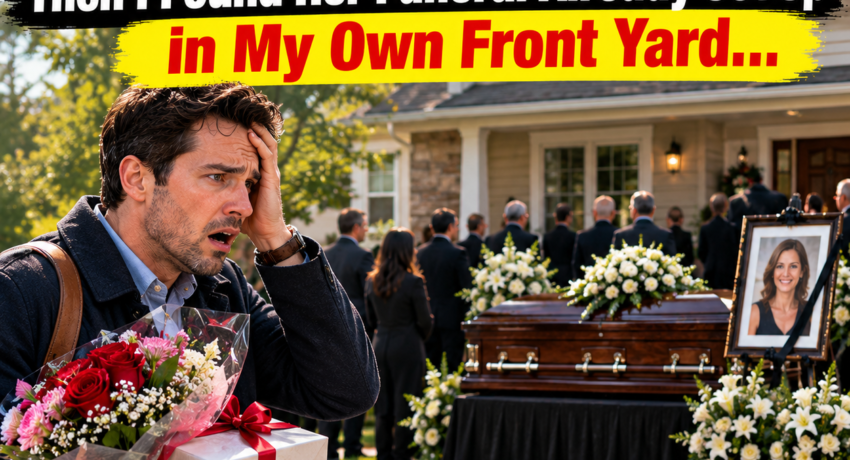
I walked through my own front gate carrying a green silk scarf for my wife and a porcelain doll for my daughter, home at last after three days off the grid on a high-security freight assignment. The whole drive back I had pictured the porch light on and Claire’s voice calling down the hall.
Instead I found folding chairs under a white canopy, a memorial card with my wife’s name printed on it, and a black ribbon tied to my own front gate. My mother told me I was too late. Then my six-year-old daughter tugged my sleeve and said the sentence that stopped the funeral cold: “Daddy, Uncle Cole hurt Mommy, and Grandma took her phone.” I closed the casket lid myself and called 911. I did not yet know that the man covering it all up signed my paycheck.
The Funeral That Should Never Have Happened
“Grandma is lying. Mommy didn’t die because she wanted to.”
My daughter screamed those words in front of her mother’s open casket, and for one full second, nobody in that crowded living room made a sound.
My name is Nathan Reese. Three hours earlier I had been standing in a rental car outside Cedar Falls, Ohio, running on airport coffee and forty-eight hours without sleep, rehearsing how I would apologize to my wife for missing her birthday call. In my bag I had a green silk scarf for Claire and a porcelain doll for our daughter, Lily. I had spent the entire drive home composing the small, ordinary speech husbands give after a business trip. I never got to say a word of it.
What I found instead was a canopy staked into my own front lawn, a folding-chair aisle leading to my porch, and my wife’s name on a laminated memorial card taped to the gate.
My mother, Margaret, came down the porch steps with her eyes swollen half shut.
“You’re too late, Nathan,” she said. “Claire’s been gone almost three days.”
I remember the ground tilting under me.
“Three days? Why didn’t anyone call me?”
“Your phone was out of range the whole assignment,” she said. “Gordon told us not to interrupt the operation for anything.”
Gordon Pierce was my boss. I filed that detail away without understanding yet why it mattered.
Three days felt impossible. I had called Claire from the terminal before boarding, and she had sounded tired but fine, teasing me about forgetting to pack a real jacket. I kept turning that phone call over in my mind, trying to find the crack in it I must have missed.
I pushed past her into the house. The casket was already set up in the middle of my own living room, lid propped open, ready to be sealed. My aunt Sandra, who ran the only funeral home in town, was directing two of her staff to move the flower arrangements.
“We really shouldn’t delay the service past seven,” she told me smoothly, not quite meeting my eyes. “Claire had been struggling for a long time. It’s kinder to let her rest and protect her name.”
“Protect her from what?”
Nobody answered that. Nobody in that room would look at me directly except one person.
My father, Walter, sat in his wheelchair near the staircase. A stroke eighteen months earlier had taken most of the movement on his right side and almost all of his speech, but his eyes had never lost a thing. When he saw me, he slammed his left fist against the wheelchair armrest, three hard knocks, and stared toward the staircase that led up to the bedrooms.
My mother dropped to her knees beside the casket, sobbing loudly enough to fill the room.
“Claire, sweet girl, why would you do this to us? We loved you.”
That was the moment Lily broke free of Claire’s mother, who had been holding her hand by the door, and pointed straight at my mother.
“Grandma is lying! Uncle Cole kicked the door in! He hurt Mommy! Grandma took her phone and locked us inside!”
Across the room, my brother Cole went the color of the tablecloth behind him.
“She’s confused,” my mother said, too quickly. “She’s a child. She’s been through a shock.”
I dropped to my knees in front of my daughter.
“Look at me, sweetheart. Tell me exactly what you saw.”
She wrapped both arms around my neck and shook so hard I could feel it in my own chest.
“Mommy screamed your name. Uncle Cole wouldn’t let her out. Grandma locked the door from outside. Mommy cried all night, Daddy.”
My father slammed the armrest again, harder, and this time pointed down at the cushion beneath him.
Aunt Sandra raised her voice over the room. “Nathan, don’t make a scene at your own wife’s funeral. Bury her first. Family matters can wait until after.”
I borrowed a cousin’s phone and dialed 911.
My mother lunged for my arm. “This stays inside the family.”
I looked at her — really looked, the way you look at a stranger — and understood I no longer recognized the woman who raised me.
“A dead woman is not a family matter.”
Sirens rose somewhere down the block. Sandra backed toward the hallway, already typing on her phone. I caught four words on her screen before she turned it face-down:
“He’s already suspicious.”
When the first officer stepped through the door, Cole tried to slide toward the back stairwell. I stepped directly into his path.
“Nobody goes upstairs. Nobody touches anything up there.”
He wouldn’t lift his eyes off the floor.
On his left cheek was a fresh red scratch, three parallel lines, the kind a person leaves when they are fighting for their life with the only weapon they have — their own fingernails.
I had no idea yet what the police were about to find in my wife’s bedroom.
What Was Left in the Room Upstairs
Detective Marissa Ortiz halted the service on the spot and sealed the third floor as a possible crime scene before the first officer had finished writing down my name. She was younger than I expected, maybe forty, with the kind of steady voice that made grieving people trust her without meaning to. She asked me to wait downstairs. I couldn’t make myself sit.
It didn’t take her forensics team long to find what Sandra’s rushed preparations hadn’t managed to erase. Splintered wood around the bedroom doorframe. Glass fragments swept under the dresser but not vacuumed out from under the rug. Fresh scuff marks circling the lock plate, as if someone had jimmied it more than once.
Someone had tried to clean that room. They just hadn’t had enough time to do it well.
A child psychologist sat with Lily in the kitchen while I waited in the hallway, unable to make my legs carry me any farther. Lily repeated the same account, almost word for word, three separate times without anyone leading her: Cole had broken in. Mommy had screamed. Grandma had taken the phone. The door had been locked from outside.
My mother kept insisting Claire had been unstable, that Lily had simply had a nightmare and mixed up her dreams with reality. But the medical examiner’s preliminary notes, read to me in a small voice by Detective Ortiz an hour later, described injuries that no nightmare could explain.
Then my father asked, through slow, deliberate blinks and a nod toward the side table, for his letter board.
It took him nearly forty minutes, one shaking finger at a time, to spell out six words.
COLE. DOOR. SCREAMS. MARGARET. PHONE. SANSA. — he corrected himself — SANDRA.
Then he pointed down at his own wheelchair cushion again, harder this time, jabbing at the fabric until an officer finally understood and knelt beside him.
Taped to the underside of the wheelchair frame, wrapped in a sandwich bag, was a small SD card.
On it: photographs of threatening text messages, two short audio recordings, and Claire’s own voice, recorded eleven days before she died, speaking quietly into what sounded like a phone held close to her chest.
“If anything happens to me, I need someone to know Cole has been coming into Nathan’s office when he thinks no one’s home. I heard him on a call last week. I don’t know who he was talking to, but I heard him say the words ‘ledger’ and ‘keycard,’ and I heard the other man say Friday like it was a deadline.”
I sat down hard on the hallway floor.
My wife had been keeping a record of her own fear, and I had been three states away carrying a green scarf, thinking about how to apologize for missing a phone call.
Detective Ortiz looked up from the recording, and for the first time all day, her expression wasn’t neutral anymore.
“Mr. Reese, do you know anything about a ledger or a keycard connected to your work?”
I did. Both were sitting in my home safe, exactly where my boss, Gordon Pierce, had personally asked me to keep them during my assignment.
The Debt Nobody Told Me About
The ledger in my safe tracked transport routes and security windows for an upcoming freight shipment worth just over ten million dollars. The keycard opened our company’s live tracking terminal remotely. Gordon had called me himself the week before my trip and asked me, as a personal favor, to hold both items at home instead of leaving them in the office vault.
I hadn’t thought twice about it. Gordon had been my supervisor for six years. I trusted him the way you trust a person you’ve never had a reason to doubt.
What I didn’t know was that my own brother had a reason to want inside that safe.
Cole owed twenty-two thousand dollars to a private lender named Deke Malone, racked up over eighteen months of bad bets and worse decisions. Malone had made him an offer three weeks before Claire died: bring him the contents of that safe, and the debt would disappear.
My mother, it turned out, had known about at least part of it. She had quietly pawned two pieces of her own jewelry and taken money set aside for my father’s medication, then put our family home up as collateral against a private loan to cover what she could of Cole’s debt — all without telling my father, who could no longer speak well enough to object even if he had known.
Claire had found out weeks before any of us. She noticed Cole let himself into my home office twice while I was traveling, and she started paying closer attention. She photographed his messages. She recorded a call through the office door. She quietly signed a short-term lease on a small two-bedroom house near the elementary school where she taught, and she began making a plan that had nothing to do with divorce papers and everything to do with getting our daughter — and my father — somewhere safe.
She was going to take my father with her. She had decided he was the only person left in that house who actually believed her.
I learned later that she’d toured the little rental on a Tuesday afternoon during her lunch break, alone, and paid the deposit in cash from a savings account I didn’t know she’d opened. She’d told the landlord she needed to move in “soon, but quietly.” She never once mentioned any of it to me, not because she didn’t trust me, but because she was trying to protect me from having to choose between my wife and my own family before she had proof strong enough that I wouldn’t have to.
Two days before she died, Claire handed a sealed envelope to her closest friend at school, Renee Shaw, and asked her to hold it “just in case.” Renee brought that envelope to the police station the morning after the funeral was stopped. Inside was the signed lease, printed copies of Cole’s messages, and a letter addressed to me.
Nathan — I’m not trying to break up this family. I need to get our daughter and your father somewhere safe. I told you three nights ago that I was scared. You told me to wait until you got back. I’m asking you now, please come home before they find out how much I already know.
I read that letter twice, standing in a hallway that smelled like candle wax and old flowers, and I could not make my hands stop shaking.
Her last phone call to me, four days earlier, came back to me word for word.
“I’m scared, Nathan.”
“You’re overreacting. Just give it a few more days.”
I had told my wife to wait.
Then Detective Ortiz’s team pulled something else from behind the bathroom mirror in our bedroom — a small voice recorder, the kind you’d use for dictation, still running on battery power, tucked into a gap behind the medicine cabinet.
What was on it was not going to let anyone in my family keep telling their version of that night.
The Recorder Behind the Mirror
Claire had hidden that recorder three weeks earlier, the same week she started the lease paperwork. She must have suspected that whatever happened next, she would need more than her own word.
She was right.
The recording opened with the bedroom door being forced. Wood splintering. Claire’s voice, sharp with fear, telling Cole to stop, that it wasn’t too late for him to walk away and return what he’d already taken.
Cole didn’t answer her in words. What followed was the recording moving in a way that made Detective Ortiz stop playback and ask me, gently, if I wanted to step out of the room. I didn’t. I needed to know.
When my mother’s voice entered the recording minutes later, it wasn’t asking what had happened. It was giving instructions.
“We are not calling anyone. We are going to settle this as a family.”
Claire, crying, begging her to call for help.
The sound of the door being locked from the outside.
My mother had chosen my brother. In the middle of it, with my wife hurt and asking her, specifically, for help, she had chosen to protect Cole instead.
Claire spent the rest of that night locked in a room with our six-year-old daughter, injured, unable to reach a phone that had already been taken from her. She wrote down what happened in a small notebook the police later found tucked inside a shoebox in the closet. She tried to send a message from an old, barely-charged tablet that still had a saved wifi password.
The draft was time-stamped 4:51 a.m. It had never sent.
Nathan, please. Cole broke in. Your mom has my phone. I can’t get us out of this room.
She died before sunrise, from injuries made worse by hours without medical care, in a locked room in her own home, with our daughter beside her.
At 5:30 that morning, my mother finally unlocked the door.
She did not call an ambulance.
She called her sister.
Aunt Sandra arrived within the hour with a van from the funeral home, and by the time the sun was fully up, the story of what had happened to Claire had already been decided by two women standing over her body, discussing which details to keep and which to erase.
By the time I landed that afternoon, wreaths were already being unloaded from a delivery truck two streets over. I had no idea, walking off that plane with a scarf folded carefully in my carry-on, that the two people who would greet me at the door had already spent six hours rehearsing what they would and wouldn’t tell me.
The Van at the Crematorium
State troopers located Sandra’s van later that same day, parked behind her funeral home near the incinerator used for medical waste disposal. Inside, they recovered two heavy bags containing torn bedding, a broken section of door hardware, and Claire’s shattered phone — items pulled from our bedroom before I had even landed at the airport.
Security footage from the funeral home’s own parking lot showed Sandra arriving before dawn, well over an hour before I got home, carrying those two bags inside herself while Cole waited by the gate, watching the street.
One of Sandra’s longtime employees, shaken and clearly relieved to finally say it out loud, told Detective Ortiz that Sandra had personally ordered him to run the incinerator early that morning, had wiped the funeral home’s security log for the prior night, and had pushed hard to move the burial forward before any paperwork could be properly reviewed by the county.
She had also forged a line on Claire’s preliminary paperwork, listing an unremarkable cause of death, to make sure no one asked for an autopsy before the ground closed over her.
What Sandra hadn’t accounted for was the recorder behind the mirror, or the SD card taped under a wheelchair cushion belonging to a man everyone in that house had stopped listening to. For eighteen months, my family had treated my father like furniture — present, harmless, easy to talk around. Claire had been the only one who still asked him real questions and waited through the long silences for his answers. Maybe that was why she trusted him with the one piece of evidence she couldn’t risk losing.
Once Cole’s phone was seized, forensic technicians pulled a saved contact labeled only “G.P. — work” along with a short voicemail: a man’s voice, calm and businesslike, telling Cole to “have the ledger and the card ready by Friday, or the interest doubles like we discussed.”
It was the same voice from the recording Claire had made through my office door.
Detective Ortiz played it for me twice to be sure I wasn’t imagining it.
I wasn’t. It was Gordon Pierce.
My Boss’s Real Assignment
Gordon had never actually needed me to keep that ledger and keycard safe at home for security reasons. He needed them out of the company vault and somewhere he controlled the access to — and my house, with a brother he knew was drowning in debt, was exactly that.
While I was three states away on an assignment Gordon himself had arranged, and while my family staged a funeral in my front yard, Gordon was quietly using my credentials to study the shipment routes and security windows for that ten-million-dollar freight run. His plan, investigators later pieced together, was to divert part of the shipment during a scheduled blind spot in our tracking system — and to make sure that if anyone ever noticed, the trail would end at my name, not his.
A grieving husband, recently widowed under tragic circumstances, quietly resigning under a cloud of suspicion, was a far cleaner story than a company vice president with a gambling contact on his payroll. Gordon had spent six years building exactly that kind of trust with me — remembering Lily’s birthday, covering my shifts when Claire was sick, telling me more than once that I was the only person at that company he’d let hold a spare key to his own office. I had believed every bit of it. That was the part that stayed with me longest: not that he’d used my house, but that he’d used my loyalty to get there.
When my mother had called Gordon that morning to say Claire was dead, Detective Ortiz later confirmed, he hadn’t asked a single question about how or why. He had only asked whether Cole had secured the ledger and the card. Then he’d made sure nobody at my company mentioned anything to me until after the funeral was safely finished.
Claire’s SD card ended that plan before it ever left the planning stage.
Working off her recordings, the voicemail, and financial records subpoenaed from Deke Malone’s operation, state investigators raided Malone’s office two days later and recovered the physical ledger, the keycard, and a signed loan document listing my parents’ house as collateral.
Gordon was arrested at a highway motel forty minutes from the freight yard. Officers found route maps, cash, and paperwork for vehicles that didn’t officially exist anywhere in his suitcase.
Once each of them realized how much the others had already said, the story fell apart fast, and nobody bothered protecting anyone but themselves.
Cole blamed our mother for locking the door.
Margaret blamed Sandra for pushing the funeral forward.
Sandra insisted she had only been trying to protect the family’s name.
Gordon blamed Cole for panicking and hurting Claire in the first place, as though that had never been part of the plan he’d set in motion.
Not one of them, in four separate interviews, referred to Claire as a person.
To them, she had only ever been an obstacle. A witness. A woman who didn’t share their last name and therefore, in their minds, didn’t fully belong to their definition of family.
What My Father Finally Said
My father asked, through the same halting letter board, to give a formal statement of his own.
It took him almost half an hour to spell out that months before that night, he had noticed Cole acting strangely around Claire, and had once seen him take a spare house key off the hook by the garage door without asking. He had heard Claire crying, more than once, asking my mother for help with something she wouldn’t explain. He had tried, in his limited way, to warn me.
My mother had hidden his communication board twice that spring and told the rest of the family he was simply confused since his stroke.
“Why didn’t you try harder to tell me?” I asked him, my voice cracking in a way I hadn’t let it since I was a teenager.
It took him nearly twenty minutes to answer.
FEARED BREAKING FAMILY. WANTED TO PROTECT YOUNGEST SON. MY SILENCE HELPED THE WRONG PERSON.
I couldn’t tell him he was blameless, because he wasn’t, not entirely. But there are different sizes of guilt in a story like this one, and his was nothing next to what my mother had done with a locked door and a stolen phone.
When I visited her at the county jail six weeks later, her first words weren’t about Claire.
“You have to help your brother. Claire is already gone. Prison won’t bring her back.”
I stood up before I’d even decided to.
“You still think he’s the only one worth saving.”
“He’s your blood, Nathan.”
“Claire was somebody’s daughter too. She was my wife. She was Lily’s mother. She begged you to call for help, and instead you took her phone.”
My mother cried, but every tear was for Cole. Not once, in that entire visit, did she say Claire’s name.
I drove home from that jail in silence, both hands tight on the wheel, and realized somewhere on the highway that I had spent thirty-four years believing my mother would protect anyone in our family who needed it. It had simply never occurred to me that “anyone” had always meant Cole, and only Cole.
Seven months later, the trials ended within the same two-week stretch. Cole was convicted of assault, reckless homicide, robbery, and evidence tampering, and received the maximum sentence the judge could hand down. Margaret was convicted of unlawful confinement, failure to seek emergency medical help, and evidence tampering. Sandra was sentenced for evidence destruction, forgery of medical paperwork, and illegal disposal of evidence. Gordon and Deke Malone each received long federal sentences for conspiracy, extortion, and corporate theft.
An internal company review cleared me of any involvement in the planned theft, but cited me for keeping sensitive company property at home against policy — even though I’d only done it because my own supervisor had personally instructed me to. I resigned before they could decide what to do with that finding.
Being innocent of the conspiracy didn’t mean I had made no mistakes at all. I had told my wife to wait. I would carry that longer than any court record.
The House Claire Chose
I took a smaller logistics job outside Cedar Falls and moved Lily and my father into the two-bedroom house Claire had quietly leased before she died — the one she’d picked out because she believed, correctly, that it would finally be a safe place for the people she loved.
It has three bedrooms, a small fenced yard, and one enormous oak tree that drops its leaves directly onto the porch every October. It is nothing like the house we left behind, and that was exactly the point.
Lily started therapy twice a week. For months, the sound of a door lock catching would send her running for the nearest exit. I got in the habit of narrating every closed door out loud.
“Lily, Daddy’s closing this door now. You can open it again whenever you want.”
Eventually she stopped sleeping in her sneakers, ready to run in the middle of the night. Eventually she started drawing again — whole pages of crayon suns and stick-figure families instead of locked doors.
Her therapist told me healing wouldn’t look like a straight line, and she was right. Some weeks Lily wanted every light in the house left on. Other weeks she’d ask me, out of nowhere, whether Grandma was ever coming back, and I never quite knew which answer would let her sleep that night. I learned to just tell her the truth in small enough pieces that she could carry it.
One afternoon I found a drawing of three people standing under a row of sunflowers. The woman in the middle wore a bright green scarf.
“Who’s that?” I asked, already knowing.
“That’s Mommy,” Lily said, matter-of-fact in the way only a six-year-old can manage. “She’s somewhere nobody can ever lock her in again.”
I had to step out onto the porch so she wouldn’t watch me fall apart.
My father kept up with his physical therapy twice a week. The first full sentence he managed to say out loud, almost a year after his stroke, was Claire’s name.
“Claire. Forgive me.”
On the anniversary of her death, the three of us drove out to the cemetery together. Lily left a folded note against the headstone: Mommy, we live in the new house now. Grandpa’s with us. Daddy comes home early every day now.
I took the green silk scarf out of my jacket — the one I’d bought the week before I lost her, the one I never got to give her — and laid it beside the flowers.
“I’m home, Claire,” I said quietly. “I just came back too late for you to still be waiting.”
A breeze lifted the corner of the scarf and let it settle again.
For a long time I believed being a good husband meant working hard, sending money home, and handling problems from wherever the job sent me. I have had a year now to understand that Claire never needed a provider from a distance. She needed someone who believed her the first time she said she was afraid.
My failure wasn’t the traveling. It was believing there would always be more time to listen later.
Blood does not make abuse a private family matter. Protecting someone from the consequences of what they did is not love, not when it costs someone else everything. And silence, no matter how well-intentioned, almost never keeps a family together — it just decides, quietly, who inside that family gets sacrificed first.
Claire had been called dramatic for wanting a lock changed. Paranoid for asking questions about a debt that wasn’t hers. In the end, the evidence she left behind proved she had been trying to save every single one of us, Cole included, because she’d given him one last chance to walk away before anyone got hurt.
He didn’t take it. Nobody in that house listened in time.
So when Lily is old enough to ask why her grandmother chose an uncle over her mother, I will tell her the truest thing I know.
“Because she confused loving someone with covering up what he did. And when you protect something cruel, you become part of it.”
I don’t know if I will ever feel completely at peace with any of this. But I know one thing for certain: I will never again ask the people I love to stay quiet just to preserve the appearance of a happy family.
A house doesn’t become a home because everyone in it shares a last name.
It becomes a home the day nobody inside it has to beg to be believed.