Part 1: The Stranger in Room Four
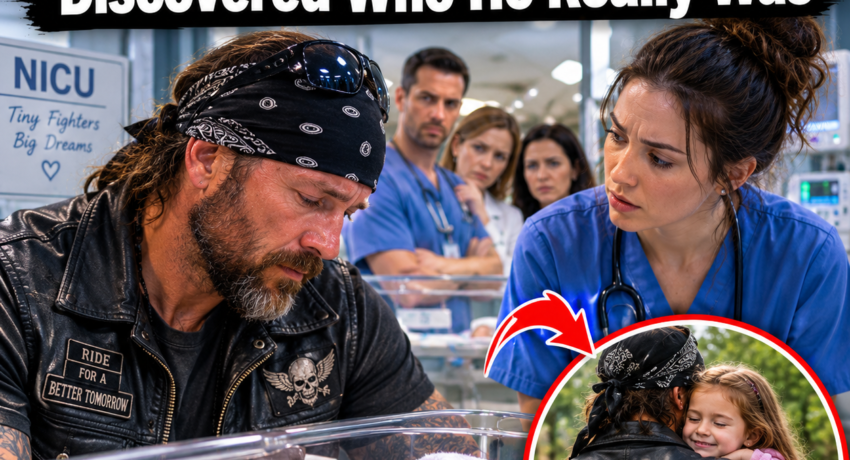
At 7:15 on a Tuesday morning in April, a man who looked as though he could lift a motorcycle with one hand walked into our NICU and asked to hold a baby who did not belong to him.
He wore a black leather vest covered in faded patches, heavy boots, and a gray shirt stretched across broad shoulders. His beard reached nearly to the second button, and both arms were covered in old tattoos.
I was standing behind the nurses’ station with a chart tucked against my hip when he approached.
“Which baby are you here for?” I asked.
“Daisy Doyle. Room Four.”
For a moment, I simply stared at him.
Daisy had been in our unit for five days. Her care card clearly said, “No visitors on file.” Not once had anyone come to see her—not a parent, grandparent, sibling, or friend.
“And who are you?” I asked.
The man lowered his eyes to his boots.
“Wade Doyle,” he said. “I’m her grandfather.”
He said it quietly, almost apologetically.
I had worked in the NICU for nineteen years. I knew that people sometimes arrived with stories that fell apart under the smallest question. A stranger asking to hold a three-pound infant was not something I could take on faith.
“May I see your identification?” I asked. “I’ll also need to check Daisy’s chart before you can go near her.”
“Take as long as you need,” he replied. “I’ll be right here.”
His driver’s license confirmed his name and address. He was fifty-seven years old and lived eleven miles away in Piqua.
Daisy’s mother, Selena, was twenty-four years old and unconscious in the ICU two floors above us. Her car had spun across black ice on Route 55 five nights earlier. The emergency team had delivered Daisy before Selena ever regained consciousness.
There was no father listed on the birth certificate. No emergency contact appeared on the hospital forms except a note a state trooper had copied from Selena’s phone:
Dad—call only if I’m dying.
Until that moment, I hadn’t known Selena had a father.
I certainly hadn’t known he looked like Wade Doyle.
By the time I allowed him into Room Four, I had already decided to watch him closely. He washed his hands, used sanitizer, and waited for permission before touching anything.
Then he sat in the green vinyl rocking chair beside Daisy’s isolette and held her against his chest as though she were made of glass.
I watched from the doorway.
He didn’t ask for a blanket, a cup of coffee, or an explanation. He didn’t complain about the wires attached to Daisy’s tiny body. He only stared down at her face and whispered something I couldn’t hear.
At that moment, I believed I was protecting Daisy from a stranger.
By the end of the day, I would realize I had been protecting my assumptions instead.
Part 2: The Baby No One Came to See
I had spent nearly two decades working in that NICU. Long enough to recognize the different kinds of silence—the calm silence of a sleeping baby, the terrifying silence after a monitor alarm, and the heavy silence that settled around an infant nobody visited.
I kept a small legal pad in my scrub pocket. Officially, it was for notes. In reality, I used it to record the names of babies who went days without a visitor.
If a baby’s name stayed on that list too long, I contacted social work myself.
Daisy Doyle had been written there on her second day.
She had been born at thirty-one weeks, weighing three pounds and four ounces. Her lungs were immature, her body was fragile, and she needed help breathing. While the nurses cared for her, her mother remained unconscious upstairs, surrounded by machines and doctors.
The accident had happened just before midnight. Selena’s car had struck a guardrail after sliding across the icy road. She had suffered a severe head injury, and doctors had placed her in a medically induced coma.
No one knew when she would wake up.
No one knew whether she understood that her daughter had survived.
Every shift, I checked Daisy’s monitors, adjusted her blanket, and placed a finger near her tiny hand so she could curl her fingers around it.
I told myself it was simply part of my job.
But the truth was more personal.
My own father had left when I was twelve. He disappeared on a cold Sunday morning in October, taking the good cooler and leaving behind a short note on the refrigerator.
I’m sorry.
The handwriting was so neat it looked printed.
I never saw him again.
For years, I wondered what I had done to make leaving so easy. Eventually, I stopped wondering and started building my life around the absence. I became the person who noticed when someone else was being left behind.
That was why Daisy bothered me so much.
Her crib was surrounded by equipment, but no familiar voice came through the room. No one brought photographs. No one asked whether she had slept. No one stood beside the isolette and said, “I’m here.”
I had looked at the line copied from Selena’s phone many times.
Dad—call only if I’m dying.
I had judged it harshly.
A daughter who only wanted her father contacted in an emergency, I thought, probably had a father who had earned that distance.
When Wade arrived, I assumed I already understood the kind of man he was.
I was wrong.
Part 3: The Complaint
By nine o’clock, Wade was still sitting beside Daisy.
He had barely moved. He held her against his chest with one enormous hand curved protectively around her back while the other rested near her head. Whenever a monitor made a sound, his eyes immediately lifted toward it.
At 9:20, Diane Marsh, our unit manager, called me into the medication room.
“We received a complaint,” she said.
“About Wade?”
“The Henderson family in Room Two says there’s an intimidating man sitting in Room Four for hours. They want to know whether he’s authorized to be here.”
“He’s Daisy’s grandfather. I checked his identification.”
“Identification proves who he is. It doesn’t prove that he has visitation rights.”
I knew she was right.
We had strict rules for a reason. Families fought over custody. People lied. A person who appeared harmless could still pose a danger. I had once watched a soft-spoken man in pressed khakis try to leave the unit with a baby who was not legally his. It had taken three security officers and a locked stairwell to stop him.
Nobody forgot something like that.
“We don’t have a release from Selena,” Diane continued. “She can’t confirm the relationship. There’s no guardianship paperwork, no emergency authorization, and he wasn’t listed on the original form.”
“I understand.”
“If we allow him to remain without documentation, security may have to escort him out.”
I looked toward the small window in the medication room. Through it, I could see Wade rocking Daisy.
“He hasn’t asked for anything,” I said. “He sanitized his hands before touching her. He hasn’t even complained about waiting.”
“That doesn’t change the policy.”
“No. But give me until the end of my shift. Let me speak with him and check everything properly.”
Diane studied me.
“Until six o’clock,” she said. “After that, the decision comes from administration.”
When I returned to Room Four, Wade was leaning over the isolette. His forehead nearly touched the plastic wall.
“Mr. Doyle,” I said.
He turned around.
“We need documentation if you’re going to remain in the unit beyond today. It’s a safety requirement.”
He nodded as though he had expected the conversation.
“I understand.”
“I’m not asking you to leave right now. I’m just telling you what we need.”
“I’ve got a license, an old address, and a reputation that probably isn’t helping me.” He glanced at his vest. “But I’m not leaving that baby unless somebody physically makes me.”
There was no anger in his voice. Only determination.
I told him I would see what I could do.
At the time, I meant it politely.
I didn’t know that I would spend my lunch break searching through old hospital records for proof that a stranger’s story was true.
Part 4: The Things I Couldn’t Explain
The first clue appeared shortly before noon.
Priya, one of the newer nurses, was checking Daisy’s oxygen levels when she asked Wade to move his arm so she could reach the monitor.
That was when she noticed the tattoo on the inside of his wrist.
It showed two tiny footprints, each no larger than a thumbnail. Beneath them were the initials R.D. and the number 11.
“That’s an unusual tattoo,” Priya said.
Wade looked at it.
“My son,” he answered. “He lived for eleven days.”
His voice was steady, but his thumb moved slowly across the ink.
Priya told me about it later while eating a granola bar at the nurses’ station.
“A biker with a tattoo for a baby who died,” she murmured. “It’s sad.”
I nodded, though I couldn’t stop thinking about the way he had said it. Not dramatically. Not to gain sympathy. He had stated it like a permanent fact carved into him.
The second clue came around one o’clock.
Daisy became restless. Her little face tightened, and her hands curled into fists.
Before I could reach the isolette, Wade began to hum.
The tune was soft and uneven, but I recognized it immediately.
It was the melody printed on a faded card attached beneath the mobile over Daisy’s bed. The card had been there for years. The handwriting had almost disappeared, but nurses still hummed the song to restless babies.
I had sung it hundreds of times without ever asking where it came from.
“How do you know that melody?” I asked.
Wade stopped.
For the first time that morning, he looked nervous.
“My wife used to sing it,” he said. “A long time ago.”
He didn’t offer anything more.
The third clue came at 3:40.
The green rocking chair had one wheel that always caught against a particular floor tile. Most people struggled with it the first time they moved the chair.
Wade reached down and corrected it with two fingers without even looking.
He had learned the chair’s weakness.
You didn’t learn something like that in a few hours.
You learned it by sitting there again and again.
I had walked past that chair thousands of times. I had wiped it down, moved it, and dusted beneath it. That afternoon, for the first time, I lowered myself to the floor and looked closely at the small brass plaque fixed beneath the seat.
The words were tarnished, but still readable.
In loving memory of River Doyle. Held for eleven days. Donated by his parents, Wade and Carol Doyle, 2001.
I stared at the name.
Then I looked through the plastic wall of the isolette at Daisy.
Doyle.
The same name belonged to the unconscious woman upstairs, the premature baby in Room Four, and the man who had been rocking her all day.
Suddenly, the tattoos and the song and the damaged wheel were no longer separate details.
They were pieces of one story.
Part 5: The Decision
I could have followed procedure and done nothing else.
Diane had given me until the end of my shift. If the paperwork wasn’t found, Wade would be removed from the unit. Everyone would have understood. I could have said I was simply doing my job.
But the plaque had changed something.
I spent my lunch break in the hospital foundation archive, a cramped room three floors below the NICU. The shelves were crowded with old donation records, photographs, and handwritten thank-you letters.
It took nearly an hour to find the file.
The folder was thin and stained with an old coffee ring. Inside was a thank-you letter from 2001, signed by Wade and Carol Doyle of Piqua, Ohio.
They had donated three rocking chairs to the NICU in memory of their son, River.
The letter explained why.
Our son never had the chance to go home. We hope these chairs will help other parents hold their babies close while they still can.
Beneath the letter was a receipt for $612 and a photograph.
In the picture, a much younger Wade stood in the same hallway. He had dark hair, no beard, and an exhausted smile. Carol stood beside him holding a tiny bundle wrapped in yellow flannel.
His arm was around her shoulders.
They looked hopeful and devastated at the same time.
I sat on the archive room’s step stool, holding the photograph in both hands.
If I said nothing, Wade would be escorted out. Daisy would spend another night surrounded by machines but not by family.
If I went to Dr. Okafor without Diane’s approval, I would be bypassing my manager. I had built my career on respecting procedure. I knew exactly how serious that could be.
But Selena’s intake paperwork might contain something important.
Before she lost consciousness, she had managed to answer a few questions in the ambulance. The triage nurse had written down everything she could understand.
I found Dr. Okafor between rounds and explained the tattoo, the song, the chair, the plaque, and the donor records.
She listened without interrupting.
“You’re asking me to make an exception based on old hospital records and a man’s word,” she said.
“I’m asking you to read what Selena said before the accident.”
“Where is it?”
I handed her the intake form.
Under the section marked Father, the nurse had written:
Wade Doyle—estranged, but he should know.
Dr. Okafor read the sentence twice.
Then she looked at me.
“Bring him to the consultation room,” she said. “If his story doesn’t hold together, he leaves. And you and I will discuss why you went around your manager.”
I knew I might have made a serious mistake.
But I also knew I couldn’t read that plaque and pretend Wade was simply an intimidating stranger.
Part 6: What Wade Had Been Carrying
The consultation room had pale walls, a box of tissues, and the kind of silence that made people speak more honestly than they intended.
Wade sat across from Dr. Okafor and me. His hands rested on his knees. The leather vest was still on, but somehow he looked smaller than he had in the NICU.
Dr. Okafor asked him to tell us about River.
Wade turned the wedding ring on his finger.
“Carol and I lost him here,” he began. “He was born at twenty-eight weeks. Two pounds, one ounce. He lived for eleven days.”
His gaze drifted toward the hallway.
“He spent those eleven days in that room. In that chair.”
No one interrupted.
“I wasn’t there the last night,” he continued. “My father had died three days earlier. I was drinking in a bar down the road because I didn’t know how to survive one funeral, let alone two.”
His voice tightened.
“I told myself I was grieving. The truth is, I was running away.”
He traced the tattoo on his wrist.
“Carol was there when River died. I wasn’t. She never needed to explain what that did to her. I could see it every time she looked at me.”
Wade said he eventually became sober, but not until years later.
“I’ve been sober eleven years, four months, and some days,” he said. “People tell you to take it one day at a time. I did. But sobriety doesn’t erase the night you weren’t there.”
Carol had stayed with him for years. Together, they had raised Selena. They had tried to give her a normal childhood despite the grief that followed their family everywhere.
But Selena had grown up knowing that her father had been absent when her baby brother died.
“When Carol died eight years ago,” Wade said, “Selena stopped speaking to me. She believed I had failed her mother. Maybe she was right.”
“What did you do?” I asked.
“I respected what she asked of me. I stopped calling. I stopped showing up at her work. I didn’t send birthday cards. I thought giving her space was the only decent thing left.”
“Then how did you know she was here?”
“The state trooper called the number in her phone. He said it was saved under ‘Dad—call only if I’m dying.’”
Wade swallowed.
“I didn’t know that was how she had me listed. When he read it to me, I sat down in my driveway. I couldn’t feel my legs for a while.”
I looked at the man in front of me and imagined him receiving that call after eight years of silence.
“Why did you come straight to Daisy?” Dr. Okafor asked.
“Because my granddaughter was alone.”
His answer was immediate.
“I’m not here to force Selena to forgive me. I’m not here to claim anything. I only wanted to make sure Daisy didn’t spend her first days in this world wondering whether someone was coming.”
His eyes moved toward the door.
“River was held by nurses who cared about him, but he didn’t have his mother or father there together. I can’t change that. I can’t go back and be with him on the night I missed.”
He looked down at his hands.
“But I can sit with Daisy.”
Dr. Okafor asked what he would do if Selena woke up and told him to leave.
Wade took a slow breath.
“Then I’ll leave.”
“And after that?”
“I’ll ask if I can come back another day. If she says no, I’ll wait. If she says yes, I’ll come. I’ve got nowhere more important to be.”
By then, nearly twelve hours had passed since he walked into the NICU.
In all that time, he had asked for only one thing.
The chance to stay.
Part 7: The Apology
Dr. Okafor reviewed Selena’s original intake form with the hospital’s social worker. The note was clear enough to support a temporary kinship authorization while Selena remained unable to speak for herself.
Wade was not being given custody. He was not being granted unrestricted access. He was simply being recognized as the family member Selena herself had identified before the accident.
When I found him in the hallway, he was standing beside Daisy’s isolette.
“You can stay,” I told him.
He looked at me carefully, as though he wasn’t sure he had heard correctly.
“I owe you an apology,” I said. “When you walked in this morning, I decided who you were before I knew your name.”
He shook his head.
“You had a responsibility to that baby.”
“I was suspicious because of how you looked.”
“That’s not the same thing as being careful.”
His answer landed harder than criticism would have.
I told him about my father then. I told him about the note on the refrigerator, the cooler he had taken, and the years I spent trying to make sure no infant in my care felt abandoned.
Wade listened without offering the kind of pity people usually give when they don’t know what else to say.
When I finished, he said, “Carol used to say an apology isn’t a door you walk through once. It’s a hallway. You keep going, even when you don’t know whether anyone is waiting at the end.”
He looked through the isolette at Daisy.
“I don’t expect Selena to forgive me quickly. I don’t even expect her to forgive me at all. If she gives me one hour a week, I’ll be grateful for that hour.”
Diane came into Room Four later that evening.
She had heard about the plaque and the archive records. She walked over to the chair, crouched down, and read the inscription herself.
Then she looked at Wade.
“Your visitor authorization has been approved,” she told him. “You’re listed as family.”
Wade nodded.
“Thank you.”
Diane returned to the nurses’ station, and I followed her a few minutes later.
“You went around me today,” she said.
“I did.”
“You could have caused a serious problem.”
“I know.”
She studied my face.
“Would you do it again?”
I thought of Daisy’s tiny fingers. I thought of the plaque beneath the chair.
“Yes,” I answered.
Diane sighed, but there was no anger in it.
“That’s what I was afraid you’d say.”
Then she walked away, leaving the complaint from Room Two forgotten.
Part 8: The Chair
Selena woke eleven days later.
It was a Friday afternoon. She opened her eyes slowly, frightened and confused, and asked for her daughter before she asked what had happened.
Wade was not in the room.
He had chosen not to be there when she first woke. He didn’t want the first face she saw after the coma to be the father she had pushed out of her life.
Instead, I sat beside Selena while she cried the first time she held Daisy.
Her hands trembled around the baby.
“She’s so small,” Selena whispered.
“She’s stronger than she looks.”
Selena stared at her daughter for a long time before asking who had been visiting.
I told her the truth.
I told her that Wade had been sitting in the green chair for twelve hours a day. I told her about the plaque. I told her that Carol had donated the chair in memory of River. I told her that Wade had never asked anyone to make Selena forgive him.
Selena closed her eyes.
For several minutes, she said nothing.
Four days later, she asked to be taken to Room Four.
A nurse pushed her wheelchair down the hallway. Wade was not there yet. Selena stopped in front of the chair and read the plaque beneath it.
She remained there for nearly twenty minutes.
No one rushed her.
No one told her what to feel.
Eventually, she reached down and touched the brass lettering with the tips of her fingers.
Wade began visiting on Tuesdays and Fridays. At first, he came only when Selena was asleep. Later, he stayed in the room while she was awake.
Their conversations were short.
Sometimes they spoke about Daisy. Sometimes about Carol. Sometimes they sat in silence.
There was no dramatic embrace. No instant forgiveness. No single sentence that repaired twenty-four years of grief.
There was only Wade continuing to show up.
And Selena slowly deciding that his presence no longer felt like a threat.
Six weeks after the accident, Daisy was strong enough to go home. She weighed four pounds and breathed without assistance.
Before the family left, Wade asked the hospital foundation for permission to add another small plaque beneath the original one.
They allowed it.
The new inscription read:
And for Daisy, who was never alone.
I still dust that rocking chair every week.
The wheel still catches on the same floor tile. The brass plaque still needs polishing. And whenever I hum that old lullaby to a restless baby, I think about Wade Doyle.
I think about the way I judged him by his boots, his tattoos, and his beard.
I think about the grief he had carried quietly for twenty-six years.
Most of all, I think about what it means to show up after you have failed someone.
Sometimes showing up does not erase the past.
Sometimes it does not guarantee forgiveness.
But sometimes, if you keep returning with humility and patience, someone who has every reason to close the door may eventually leave it open just a little.
And sometimes the person who looks most frightening when he first walks into the room is the one who has spent his entire life searching for a way to make sure no child has to feel abandoned again.