Part 1 — The Son He Had Waited Years For
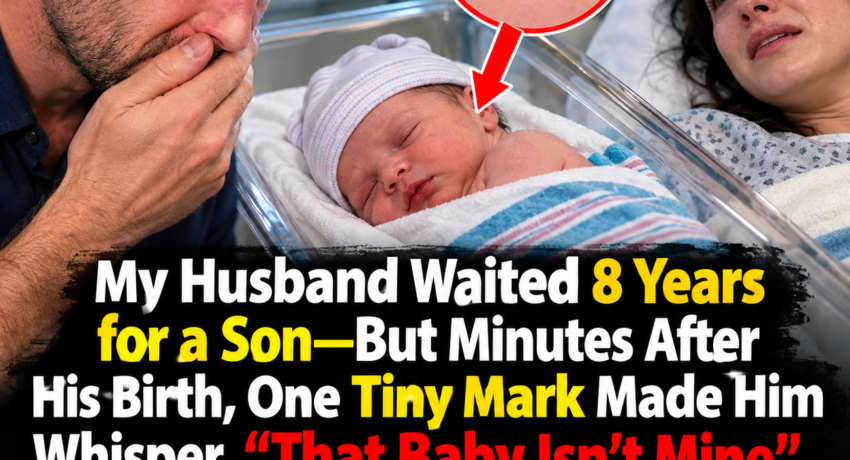
“That child cannot be mine.”
My husband’s voice was barely louder than a whisper.
Yet in the quiet hospital room, those six words seemed to explode.
I stared at him from the bed, certain I had misunderstood.
Less than ten minutes earlier, Michael had been standing beside me with our newborn son cradled against his chest. Tears had filled his eyes as he counted the baby’s fingers, studied his tiny face, and kissed the top of his head again and again.
For eight years, Michael had dreamed of having a son.
And now, suddenly, he was looking at that same child as though he were a stranger.
I had just endured almost twelve exhausting hours of labor. Every muscle in my body hurt. My hands were trembling from fatigue, and even lifting my head from the pillow took effort.
Outside the room, I could hear the squeak of hospital carts and the distant cry of another newborn.
Inside, everything had gone frighteningly still.
“Michael,” I whispered. “What did you just say?”
He didn’t answer immediately.
His eyes remained fixed on our baby’s lower back.
A nurse had come in moments earlier to change him. She had opened his tiny hospital onesie and uncovered a pale birthmark just above his waist.
It curved gently like a small crescent moon.
The nurse had smiled.
“Nothing to worry about. Just a birthmark.”
But Michael hadn’t smiled.
The color had drained from his face.
Now he looked at me with an expression I had never seen in all our years together.
Suspicion.
Fear.
And something worse.
Accusation.
“Ethan has that exact mark,” he said.
My stomach tightened.
Ethan.
Michael’s closest friend.
The man who had been standing beside our family for almost half our lives.
I suddenly understood what Michael was suggesting.
And the realization hurt more deeply than anything I had experienced during labor.
Michael and I already had four daughters.
Emma was eight, Chloe was six, Grace was five, and little Lucy had recently turned three.
Michael loved them.
I never doubted that.
He attended school performances, taught them to ride bicycles, carried them upstairs when they fell asleep on the couch, and spent Saturday mornings making pancakes shaped like animals.
But after every daughter’s birth, I had noticed something.
A fleeting disappointment.
He tried to hide it.
Usually he would kiss my forehead and say, “Maybe next time we’ll get our little boy.”
Next time.
After Lucy was born, I didn’t want a next time.
Four pregnancies had exhausted me.
My life was already a revolving door of lunches, laundry, homework, doctor’s appointments, scraped knees, midnight fevers, grocery bills, and forgotten permission slips.
I loved my girls more than anything.
But I was tired.
Michael, however, couldn’t let go of the idea of a son.
His mother frequently mentioned the family name.
His father, George, had made similar comments before his death.
“A man hopes somebody will carry his name forward,” he used to say.
Eventually, Michael began talking about another baby almost every week.
And little by little, I gave in.
At the time, I called it compromise.
Later, I realized I had often confused sacrifice with love.
When the ultrasound technician finally told us that our fifth baby was a boy, Michael nearly jumped from his chair.
Within weeks, he had transformed our spare bedroom.
The walls became deep blue.
A wooden sign reading NOAH appeared over the crib.
Tiny footballs, toy cars, jerseys, and miniature sneakers filled shelves before Noah had even entered the world.
Once, I laughed while folding baby clothes.
“What if he hates sports?”
Michael grinned.
“He’ll love them. He’s my boy.”
Something about the phrase stayed with me.
My boy.
Not our boy.
But I pushed the thought aside.
I had no idea how important those two words would eventually become.
One Tiny Mark
Noah was born on a rainy Thursday morning.
Michael cried when the doctor placed him in my arms.
Actually cried.
He took dozens of photographs and immediately sent them to our daughters, who were staying with my sister Hannah.
Emma had made a giant WELCOME HOME, NOAH sign.
Chloe had drawn five stick figures holding hands.
Grace wanted to know whether babies could eat birthday cake.
Lucy had apparently covered half her face with a green marker while everyone was distracted.
For a few precious minutes, everything felt complete.
Then the nurse changed Noah’s clothes.
And Michael saw the birthmark.
His entire expression changed.
“Ethan has one exactly like that,” he said.
I stared at him.
“So?”
“So?”
His voice rose.
“Claire, I’ve seen it. Same place. Same shape.”
“What are you saying?”
He gave a short, bitter laugh.
“Don’t do that.”
“Do what?”
“Pretend you don’t understand.”
Even through my exhaustion, anger began burning through me.
“Then say what you’re accusing me of.”
Michael looked at Noah.
Then at me.
“I don’t think he’s mine.”
For a moment, I couldn’t breathe.
Ethan had known Michael since high school.
He had been best man at our wedding.
He ate Thanksgiving dinner at our table.
When Michael worked late, Ethan sometimes picked up the girls from school.
During my pregnancy, when I could barely bend down without pain, he carried grocery bags into the house.
Once, when Chloe needed an emergency dental appointment and Michael couldn’t leave work, Ethan drove us.
He was family.
At least I had believed he was.
“You think I slept with Ethan?”
Michael said nothing.
His silence was an answer.
I pushed myself upright despite the sharp pain across my abdomen.
“Get a DNA test.”
He looked away.
“I don’t need one.”
“Yes, you do. If you’re going to accuse your wife of betraying you, then get the test. Today. Tomorrow. I don’t care what it costs.”
“I know what I saw.”
“No. You saw a birthmark.”
“I saw Ethan’s birthmark on that baby.”
That baby.
Not Noah.
Not our son.
Not even my son.
That baby.
I felt something break inside me.
Michael grabbed his jacket.
“When you’re discharged, go stay with Hannah.”
I stared at him in disbelief.
“You’re throwing me out?”
“I need time.”
“What about the girls?”
“They can stay there too.”
“And Noah?”
Michael looked toward the hospital crib.
His face hardened.
“I’m not bringing him into my house until I know the truth.”
My house.
The home where I had raised his four daughters had suddenly become his house.
Noah began crying.
I reached for him instinctively.
Michael walked out.
He never looked back.
And that was how the happiest day of my husband’s life became one of the loneliest days of mine.
The Test
Two days later, Hannah brought me and Noah home from the hospital.
But not to my home.
To hers.
She didn’t interrogate me when we arrived.
She simply took Noah’s carrier from my hands, wrapped one arm around my shoulders, and said, “Come inside.”
That kindness nearly destroyed me.
The girls were already waiting.
Emma immediately asked, “When is Dad coming?”
Chloe wanted to know why our suitcases were at Aunt Hannah’s house.
Grace carried the welcome-home sign they had made for Noah. It had been folded down the middle.
Then Lucy climbed into my lap and whispered:
“Is Daddy mad at the baby?”
I had survived labor without crying as hard as I did after hearing that question.
That evening, I called Michael again.
No answer.
I called twice more.
Nothing.
Near midnight, a message finally appeared.
My attorney may contact you. Let’s keep this private. I don’t want the family dragged into a scandal.
I read it three times.
Hannah took the phone from me.
Her expression became cold.
“Stop calling him.”
“He’s still my husband.”
“He left you in a hospital bed hours after you gave birth.”
“He thinks—”
“I know what he thinks. And instead of asking questions, he decided his imagination mattered more than your word.”
I didn’t want to hear it.
Mostly because I knew she was right.
The next morning, I arranged a DNA test myself.
Hannah went to our house and brought back Michael’s toothbrush.
I swabbed the inside of Noah’s cheek while he slept.
Then we submitted everything.
And waited.
Those days felt endless.
My body was recovering slowly.
Noah woke every two hours.
The girls asked about their father constantly.
And every diaper change forced me to look at the small crescent moon on my son’s back.
I began to hate that mark.
Not because there was anything wrong with it.
Because my husband had turned something innocent into evidence.
Four days later, Ethan came to Hannah’s door carrying a stuffed bear and a box of pastries.
He looked exhausted.
“Michael blocked my number,” he said. “What happened?”
I froze.
Ethan glanced toward the house.
“Is Claire okay? Is the baby okay?”
“We’re fine.”
He studied my face.
“You don’t look fine.”
I couldn’t meet his eyes.
Suddenly every favor Ethan had ever done for our family replayed in my mind.
Driving the girls.
Fixing a broken cabinet.
Carrying groceries.
Helping during my pregnancy.
Had Michael taken all those ordinary acts of friendship and rewritten them into something ugly?
“Did I do something?” Ethan asked.
“No.”
I hesitated.
“At least…I don’t think you did.”
Confusion crossed his face.
Hannah stepped forward.
“Ethan, this isn’t the right time.”
He looked at me for another moment.
Then he quietly placed the stuffed bear beside the door.
“All right. Call me if you need anything.”
He walked away.
I watched him from the window.
I didn’t know then that Ethan understood far more about Noah’s birthmark than either Michael or I could possibly imagine.
Proof
The DNA report arrived seven days after Noah’s birth.
I opened it at Hannah’s kitchen table.
My hands shook as I scrolled through the results.
Then I saw the sentence.
Probability of paternity: 99.99%.
Noah was Michael’s biological child.
For several seconds, relief washed over me.
Then it vanished.
In its place came rage.
I had known the truth from the beginning.
Why should a laboratory report feel more powerful than my own word?
I didn’t call Michael.
I didn’t write an explanation.
I forwarded the report.
Nothing else.
He arrived at Hannah’s house less than an hour later.
His beard was untrimmed. His eyes were swollen, and the shirt he wore looked like he’d slept in it.
“Claire…”
I stood in the doorway with Noah against my chest.
Michael swallowed.
“I was wrong.”
“Yes.”
“Completely wrong.”
“Yes.”
“I don’t know what happened to me. I saw the mark and…everything inside my head went crazy.”
“That doesn’t explain what you did.”
“I was angry.”
“No. You were cruel.”
He closed his eyes.
“I deserve that.”
For a moment, neither of us spoke.
Then Michael looked down at Noah.
“Can I hold him?”
My arms tightened automatically.
“He’s my son, Claire.”
I stared at him.
“That didn’t matter to you last week.”
His face crumpled.
“Please.”
I almost handed Noah to him.
Almost.
Then one question stopped me.
“If the test says Noah is yours,” I said, “why does he have the same birthmark as Ethan?”
Michael froze.
The color left his face again.
But this time, the suspicion wasn’t directed toward me.
He slowly pulled out his phone.
“Call him,” I said.
Michael dialed Ethan’s number.
Ethan answered after several rings.
Michael didn’t bother with a greeting.
“That mark on your back. The crescent-shaped one. Where did it come from?”
Silence.
A long, terrible silence.
Then Ethan asked quietly:
“Does Noah have it?”
Michael looked at me.
“Yes.”
Another pause.
When Ethan spoke again, his voice sounded different.
Older somehow.
Tired.
“Then I guess the secret has lived long enough.”
Michael gripped the phone.
“What secret?”
“Come to my house.”
“What are you talking about?”
“Both of you. Come here.”
“Ethan—”
“There’s something your father never told you.”
Michael stopped breathing.
Ethan continued.
“And I should have told you years ago.”
The Brother He Never Knew
The drive to Ethan’s house took twenty-five minutes.
It felt like hours.
Michael barely spoke.
I sat in the back beside Noah, staring through the window while hundreds of possibilities raced through my mind.
When we arrived, Ethan was waiting.
He didn’t invite us to the living room.
Instead, he led us directly to the dining table.
An old brown envelope lay there.
Ethan sat across from Michael.
“I need you to understand something before I show you this.”
Michael’s jaw tightened.
“Just show me.”
Ethan opened the envelope.
Inside were several old documents and a faded photograph.
He slid the photograph across the table.
Michael picked it up.
I leaned closer.
The picture showed George—Michael’s late father—as a young man.
He stood beside a woman I didn’t recognize.
She was holding a baby.
Michael frowned.
“Who’s she?”
Ethan stared at him.
“My mother.”
Michael looked from Ethan to the photograph.
“Why is my father standing with your mother?”
Ethan’s eyes filled with tears.
“Because he was my father too.”
Michael gave a short laugh.
It wasn’t amusement.
It was disbelief.
“No.”
Ethan pushed another document toward him.
“I wish there were an easier way to tell you.”
“No.”
“Michael—”
“My father was not your father.”
“He was.”
Michael stood so quickly his chair scraped against the floor.
“You’re lying.”
“I’ve been lying by staying silent. I’m not lying now.”
Slowly, painfully, the story emerged.
Long before George married Michael’s mother, he had been involved with Ethan’s mother.
Their relationship continued longer than George’s family approved of.
Then George became engaged to another woman—the woman who would later become Michael’s mother.
Around the same time, Ethan’s mother discovered she was pregnant.
George’s family feared disgrace.
Ethan’s mother left town and stayed with relatives until after the baby was born.
George never publicly acknowledged his first son.
Years passed.
Eventually, Ethan and his mother returned.
By an extraordinary twist neither boy understood at the time, fourteen-year-old Ethan ended up at the same school as Michael.
They became friends.
Then best friends.
Neither knew they were brothers.
Not until Ethan turned seventeen.
“My mother finally told me,” Ethan said. “I didn’t believe her either.”
Michael remained standing.
“What did you do?”
“I went to your father’s workshop.”
“And?”
“I confronted him.”
Michael’s voice became almost childlike.
“What did he say?”
“He didn’t deny it.”
Ethan hesitated.
“Then he noticed my birthmark.”
Michael sank back into his chair.
Ethan continued.
“He had one in almost the same place.”
My skin prickled.
“He told me his father had it too,” Ethan said. “Apparently it appears in some members of the family. Not everyone. But enough that when he saw mine, he knew immediately.”
Michael stared at the table.
“I don’t have one.”
“No.”
Ethan shook his head.
“But Noah does.”
Everything became clear.
Noah’s birthmark had nothing to do with Ethan being his father.
Ethan was his uncle.
Michael and Ethan shared the same father.
The mark had traveled through a bloodline hidden by decades of silence.
A Secret Carried for Half a Lifetime
Michael looked at Ethan with disbelief slowly turning into anger.
“You knew?”
Ethan lowered his eyes.
“Since I was seventeen.”
“And you never told me?”
“Your father begged me not to.”
Michael slammed his hand onto the table.
“For more than twenty years you’ve been standing beside me knowing you’re my brother?”
“I was seventeen when I learned!”
“So?”
“So I was a kid who had spent my entire life wondering why I didn’t have a father!”
Ethan’s voice cracked.
The room fell silent.
He wiped his eyes before continuing.
“When I finally met him, he told me he was sorry. He said if the truth came out, your mother would be devastated. He believed you’d hate him. He begged me to keep quiet.”
“And you agreed?”
“Yes.”
“How could you?”
Ethan stared at him.
“Because I wanted him to love me.”
That answer seemed to take all the anger out of the room.
Ethan looked down at his hands.
“I knew it was pathetic. I knew I was accepting scraps. But I was seventeen. Suddenly the man I’d spent my entire childhood imagining was standing in front of me. He said I could stay close. He said I could still be part of his life, just not publicly.”
His voice weakened.
“So I stayed.”
A memory returned to me.
George’s funeral.
Ethan had stood far behind the family.
He hadn’t walked beside Michael.
He hadn’t sat with Michael’s mother.
He hadn’t gone forward when relatives gathered around the coffin.
He had remained beneath a tree until nearly everyone else had gone home.
At the time, I thought he was giving the family privacy.
Now I understood.
“You stayed after the funeral,” I whispered.
Ethan looked at me.
“Yes.”
“Because you were saying goodbye to your father.”
His eyes filled again.
“Yes.”
Michael covered his face.
For years, Ethan had been welcomed into our home as Michael’s friend.
He had watched our daughters grow.
He had attended birthdays and barbecues and Christmas dinners.
Not because he wanted Michael’s family.
Because they were his family too.
Even if almost nobody knew it.
Ethan looked directly at his brother.
“And there’s one more thing you need to hear.”
Michael slowly raised his head.
“I never betrayed you with Claire.”
Michael flinched.
“Not once,” Ethan continued. “Not emotionally. Not physically. Never. Every time I helped her or the girls, I was helping my family. That’s all.”
Michael looked at me.
“Claire…”
I couldn’t answer.
Because the truth about Ethan had solved one mystery.
But it had created another problem.
One no DNA test could repair.
Michael had wanted proof that Noah was his son.
Now he had it.
But I had learned something about my husband too.
When given a choice between trusting me and trusting his fear, he had chosen fear without hesitation.
Some Wounds Need More Than an Apology
By the time we left Ethan’s house, darkness had settled over the neighborhood.
Michael followed me toward the car.
“Come home with me.”
I stopped.
“No.”
“Claire, please. We know what happened now.”
“I know.”
“It was a misunderstanding.”
I turned around.
“No. A misunderstanding is forgetting what time dinner starts. You accused your wife of sleeping with your best friend minutes after she gave birth.”
His face tightened.
“I made the worst mistake of my life.”
“You did.”
“I’ll do anything.”
“Anything?”
“Yes.”
“Then understand why I’m not coming home.”
Tears filled his eyes.
“I love you.”
“That isn’t the issue.”
“What is?”
I looked at him for a long moment.
“The problem isn’t that your conclusion was wrong.”
He waited.
“The problem is how easily you reached it.”
Michael said nothing.
“You needed no evidence to humiliate me,” I continued. “But you demanded evidence before you would believe I was telling the truth.”
His eyes dropped.
“I was terrified.”
“So was I.”
My voice broke for the first time.
“I had just spent twelve hours giving birth. I was exhausted. I was in pain. I was holding our newborn son. And the person who was supposed to protect me looked at a birthmark and decided I was a liar.”
“Claire…”
“You walked away.”
“I know.”
“You told me not to bring our baby home.”
He began crying.
“You made our daughters wonder why their father had disappeared.”
“I know.”
“You sent a message about lawyers while I was still recovering.”
He wiped his face.
“I know.”
I shook my head.
“No, Michael. I don’t think you understood until now.”
I placed Noah carefully into the car seat.
Michael stood beside the vehicle, shoulders shaking.
For once, I didn’t comfort him.
I had spent years soothing everyone else’s pain.
That night, I allowed him to carry his own.
The Daughters Who Had Always Been Enough
The next several weeks changed all of us.
I didn’t tell the girls the entire story.
Some truths belong to adults until children are old enough to understand them.
I told them only that their father and I were dealing with a serious problem.
I reassured them again and again that Noah was their brother, their father loved them, and none of what was happening had anything to do with them.
One evening, Emma sat beside me while I fed Noah.
She had always noticed more than we realized.
“Mom?”
“Yes?”
“Did Dad think Noah wasn’t really his?”
My throat tightened.
“Your father made a very painful mistake.”
Emma looked down.
“Did he say sorry?”
“Yes.”
“Are you going to forgive him?”
I looked at my newborn son.
“I don’t know yet.”
Michael did apologize.
Not once.
Repeatedly.
He apologized to me.
To the girls.
To Noah, even though Noah was far too young to understand.
And eventually, he apologized to Ethan.
That conversation between the two brothers was not beautiful or easy.
There were tears.
Raised voices.
Long silences.
Questions neither could answer.
Michael struggled with the knowledge that the father he had admired had hidden another son for decades.
Ethan struggled with resentment over being asked to remain invisible.
Yet slowly, they began talking.
Not as childhood friends.
As brothers.
Michael also began therapy.
And during those sessions, another uncomfortable truth surfaced.
His obsession with having a boy hadn’t begun with him.
It had been passed down through generations.
His father had talked constantly about carrying on the family name.
His mother had repeated the idea.
Michael had absorbed it without ever questioning what it communicated to his daughters.
One afternoon, he went into Noah’s carefully decorated nursery.
He stood among the expensive sports decorations, personalized furniture, and shelves of things bought for a child who couldn’t even sit up yet.
Then he noticed Lucy’s bed across the hall.
It was old.
We had planned to replace it months earlier.
But we had postponed buying one because Michael wanted to finish Noah’s nursery.
That realization devastated him.
He removed most of the unnecessary decorations and used the money he had been saving for more nursery furniture to give Lucy the bed she needed.
When he told me, I felt two things.
Pride that he was beginning to understand.
And shame that I had allowed the imbalance to exist.
Michael was responsible for the cruel things he had done.
But I had my own truth to confront.
I had continued having children when my body and heart were asking me to stop.
I had smiled politely when relatives said, “Maybe this one will finally be a boy.”
I had allowed my daughters to hear those words.
Without meaning to, we had taught four beautiful little girls that our family was still waiting for something.
Someone.
A son who would somehow make us complete.
But Emma had been enough.
Chloe had been enough.
Grace had been enough.
Lucy had been enough.
Our family had never been incomplete.
We simply hadn’t been wise enough to see it.
What Forgiveness Really Means
Three months after Noah was born, Michael came to Hannah’s house.
This time, there were no flowers.
No expensive gifts.
No dramatic promises.
He brought a folder.
Inside were notes from therapy, information about couples counseling, a parenting schedule, and a list of practical changes he had already made.
“I didn’t come here to ask you to forget,” he said.
I studied him.
He looked different.
Not dramatically.
Just quieter.
“I know saying I’m sorry isn’t enough,” he continued. “And I know I don’t get to decide how quickly you forgive me.”
Noah was sleeping nearby.
Michael glanced toward him.
“I want to be his father. But more than that, I want to become a better father to all five of them.”
I said nothing.
“And I want to be someone you can trust again.”
“That may not happen.”
“I know.”
“You might become a wonderful father and still lose your marriage.”
His face tightened.
“I know.”
That mattered.
Months earlier, Michael believed wanting something badly enough gave him the right to demand it.
A son.
My forgiveness.
Our marriage.
Now he seemed to understand that love did not work that way.
“There may be a future where you become the father our children deserve,” I told him.
Hope appeared in his eyes.
“And you and me?”
I looked toward Noah.
Then back at him.
“I don’t know.”
Michael began crying.
But he didn’t ask me to reassure him.
He didn’t reach for my hand.
He simply nodded.
For the first time, he allowed uncertainty to exist without demanding that someone else fix it.
The Mark That Told the Truth
Life did not suddenly become simple.
Real families rarely receive neat endings.
The girls gradually began laughing more.
Michael rebuilt his relationship with them slowly and carefully.
He stopped treating Noah as the fulfillment of some lifelong dream and started treating him like what he actually was:
A baby.
A fifth child.
A little boy no more or less valuable than his sisters.
Ethan remained part of our lives.
But everything had changed.
He was no longer Uncle Ethan simply because he was Dad’s best friend.
He really was their uncle.
Sometimes Michael seemed grateful to have discovered a brother.
Other times, looking at Ethan reminded him of his father’s deception.
Ethan had complicated feelings too.
He had finally gained the brother he’d secretly known about for decades.
But he had also lost the story he’d told himself about why silence had been necessary.
Healing between them was not a straight line.
Neither was healing between Michael and me.
People like endings.
They want to know whether I divorced him.
Whether I forgave him.
Whether I went home.
Whether our marriage survived.
I understand why.
A clean ending feels satisfying.
But life isn’t always satisfying.
Sometimes the important question isn’t whether two people remain married.
Sometimes it’s whether they learn anything from what nearly destroyed them.
I still don’t know exactly what the final chapter of Michael and me will look like.
Perhaps someday I will trust him again.
Perhaps forgiveness will come without reconciliation.
Perhaps we will rebuild something entirely different from the marriage we had before.
But there is one thing I know with absolute certainty.
Noah entered this world with a tiny crescent-shaped birthmark on his back.
Michael thought that mark proved I had betrayed him.
It didn’t.
The mark revealed a betrayal committed decades before I ever met him.
It exposed George’s hidden relationship.
It revealed a son who had spent most of his life standing beside his own brother while pretending to be only a friend.
It explained why Ethan had remained at the back of George’s funeral until everyone else had left.
It connected Noah to a grandfather he would never meet and an uncle whose place in the family had been hidden for years.
But the birthmark revealed something else too.
Something far more personal.
It showed me how fragile trust can become when fear is allowed to speak louder than love.
For years, I believed keeping my family together was my responsibility.
So I compromised.
I endured.
I gave more.
I became pregnant again when I was already exhausted.
I ignored comments that made my daughters seem less valuable because they weren’t boys.
I convinced myself that sacrifice was simply what a devoted wife and mother did.
Noah’s birth changed that.
Not because he was the son Michael had always wanted.
Because on the day he was born, I finally understood what I wanted my children to learn from me.
I want my daughters to know that love should never require them to surrender their dignity.
I want Noah to grow into a man who understands that trust is not something a woman must continually prove she deserves.
I want all five of my children to know that apologies matter—but changed behavior matters more.
And I want them to understand that forgiveness and reconciliation are not the same thing.
You can forgive someone and still require distance.
You can love someone and still demand accountability.
You can hope another person changes without sacrificing yourself while waiting for that change.
Most importantly, I want my children to know something I should have understood years earlier.
Our family was never waiting for Noah to become complete.
Emma completed it.
Chloe completed it.
Grace completed it.
Lucy completed it.
And when Noah arrived, he didn’t fill an empty place.
He simply added another heart to a family that had already been whole.
Maybe one day, when Noah is old enough, I will tell him the story of the small crescent moon on his back.
I won’t tell him it nearly destroyed his parents’ marriage.
I’ll tell him something better.
I’ll tell him that sometimes the smallest mark can uncover the biggest truth.
His birthmark revealed a secret buried for decades.
But for me, it revealed an even more important truth:
Love is not proven by how much pain you are willing to tolerate.
Real love must have trust.
It must have respect.
And it must leave room for your truth to be heard before fear decides the story for you.
That is the lesson I will carry with me, whatever happens next.
And it is the lesson I intend to give my children.