Part 1 — The Woman Waiting Beside My Daughter’s Grave
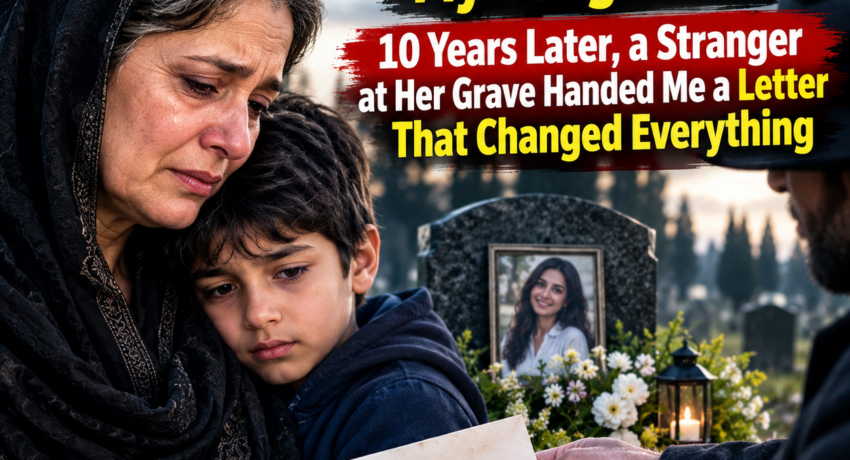
“I made your daughter a promise. Now it’s time you knew the truth.”
The woman standing beside Teagan’s grave held out a sealed envelope.
For several seconds, I only stared at it.
Then I saw the handwriting across the front.
My name.
Written the way only one person had ever written it—with the capital E leaning slightly too far to the right and the last two letters almost running together.
My daughter’s handwriting.
My breath caught somewhere in my throat.
Teagan had been gone for ten years.
I looked from the envelope to the stranger’s face.
“Where did you get that?”
“She gave it to me.”
The cemetery seemed to fall silent around us.
Even the breeze moving through the trees suddenly felt distant.
“When?”
My fingers tightened around the bouquet I was holding.
The woman’s eyes dropped.
“A long time ago.”
Something in her expression made my stomach turn.
“How long?”
She hesitated.
“Ten years.”
I actually took a step backward.
“You’ve had a letter from my daughter for ten years?”
“Yes.”
Before I could demand an explanation, a familiar voice rang out from the bottom of the hill.
“Grandma! I found it!”
I turned.
Lucas was jogging toward us from the parking area, waving the birthday card he had accidentally left in the car.
Every year, on Teagan’s birthday, he made her one.
At ten years old, he knew his mother mostly through photographs, stories, and the small traditions I had built to keep her present in his life.
He never got to hear her laugh.
Never knew how she sang completely off-key while washing dishes.
Never saw the way she bit the inside of her cheek when she was trying not to cry.
All he had were pieces of her that I had carried forward.
The woman beside me glanced at Lucas.
Her face changed.
“Don’t open the letter in front of him.”
I turned sharply toward her.
“Who are you?”
“My name is Trudy.”
“That tells me nothing.”
She swallowed.
“I was a nurse at the hospital when Teagan gave birth.”
My heart seemed to miss a beat.
Lucas was getting closer.
Trudy quickly pressed the envelope into my hand.
“My phone number is written on the back.”
“Wait.”
But she was already moving away.
“Trudy.”
She stopped only long enough to look back.
Then she said softly, “I’m sorry, Elizabeth.”
And walked down the hill.
I stood beside my daughter’s grave holding a letter that had somehow survived ten years longer than she had.
“Grandma?”
Lucas reached me, slightly out of breath.
“Who was that?”
I slid the envelope into my coat pocket.
“Someone who knew your mom.”
His whole face brightened.
“Really?”
I nodded.
“What did she say?”
I looked toward the woman disappearing between the rows of headstones.
“Not enough.”
Part 2 — The Question Teagan Never Answered
Teagan had been eighteen when she told me she was pregnant.
I remember the exact expression on her face.
Not defiant.
Not ashamed.
Terrified.
At the time, I thought I understood what frightened her.
She was eighteen.
Still finishing school.
Still leaving cereal bowls in the sink and forgetting to put gas in the car until the warning light had been glowing for two days.
Of course she was afraid.
So I immediately did what frightened mothers sometimes do when they believe they are helping.
I started asking questions.
“Does the father know?”
Teagan looked down.
“Mom, please.”
“What’s his name?”
“I can handle this.”
“You shouldn’t have to handle it alone.”
Her eyes flashed.
“Then stop making it harder.”
We had variations of that same argument for months.
I kept believing that if she would simply tell me who he was, I could fix something.
Call him.
Call his parents.
Demand responsibility.
Make a plan.
Teagan kept refusing.
And eventually, we stopped having real conversations about it because every conversation became the same fight.
Then Lucas was born.
I sat in the hospital waiting room with my hands clasped so tightly together that my fingers ached.
A doctor came toward me.
I stood before he even reached my chair.
Something in his face told me not to ask.
I asked anyway.
“My daughter?”
He sat beside me.
“I’m so sorry. We did everything we could.”
For a moment, the words had no meaning.
I looked past him toward the hallway.
“The baby?”
“He’s alive.”
Then, gently, almost painfully, he added:
“He’s going to need you.”
That was how my life changed.
My daughter never came home.
Her son did.
For ten years, Lucas and I became our own small family.
He loved baseball, pancakes on Sunday mornings, science projects that somehow took over the entire kitchen table, and asking questions at precisely the moment I was least prepared to answer them.
The hardest question was always the same.
“Grandma, who was my dad?”
And every time, I gave him the only answer I had.
“I don’t know.”
I had believed that answer for ten years.
Now Teagan’s letter was sitting in my coat pocket.
And for the first time, I wondered whether the truth had been much closer to me than I ever realized.
Part 3 — The Letter Teagan Meant Me to Read
When we got home from the cemetery, I put the envelope in the kitchen drawer.
I told myself I would open it after dinner.
Then after Lucas finished his homework.
Then after I cleaned the kitchen.
Really, I was postponing the moment because ten years had taught me how dangerous Teagan’s handwriting could be.
A grocery list could make me cry.
A note that said, Mom, we’re out of milk, could ruin an entire afternoon.
A letter written in the final weeks of her life felt almost unbearable.
Lucas dropped his backpack beside the table.
“Who was that woman again?”
“Her name is Trudy.”
“And she knew Mom?”
“Yes.”
“From where?”
“The hospital.”
His eyes sharpened immediately.
“Did she know my dad?”
My hand was still resting on the drawer handle.
“I don’t know.”
Lucas sighed.
Not dramatically.
Just tiredly.
“You always say that.”
I turned toward him.
“Because I’ve always told you the truth, sweetheart. I really don’t know.”
He went quiet.
Teagan used to do exactly the same thing.
She would stop arguing and disappear inward.
Sometimes seeing her mannerisms in Lucas felt like a gift.
Other times, like that evening, it felt like being haunted by a second chance I had no idea how to use.
After he went to bed, I returned to the kitchen.
The house was silent.
I opened the drawer.
For a long time, I simply held the envelope.
Then I broke the seal.
A photograph slipped onto the counter.
Teagan stood beside a teenage boy.
I recognized him.
He had been at our house twice while she was pregnant.
Quiet.
Polite.
Uncomfortable.
Both times, I had barely spoken to him.
In the photograph, a worn baseball glove was tucked beneath his arm.
My pulse began to quicken.
I unfolded the letter.
Mom,
I know you think I won’t tell you because I don’t trust you.
That isn’t why.
I stopped.
Already, tears were blurring the page.
Then I continued.
He knows about the baby.
My breath left me.
Teagan wrote that the boy had wanted to stay.
But his family believed having a baby at eighteen would ruin his plans.
College.
His future.
Everything they had imagined for him.
And he was frightened enough to listen.
Teagan had told him not to return merely because he felt guilty or pressured.
If he came back, she wanted him to come because he had made the choice himself.
Then I reached a sentence I had to read three times.
You kept asking me who he was, but you never asked why I was scared.
I lowered the letter.
The kitchen blurred around me.
And suddenly, a memory came back.
One I had not thought about in years.
Teagan standing in the kitchen doorway late one evening.
“Mom, can I ask you something?”
I had been tired.
Bills were spread across the table.
I was already angry because we had argued about the baby’s father earlier that day.
Without looking up, I had said, “If this is about avoiding the father question again, Tee, I can’t do this tonight.”
Silence.
Then:
“Never mind.”
For ten years, I had remembered that moment as another example of Teagan refusing to let me in.
Now I saw something different.
Maybe she had been trying.
Maybe I had been so focused on getting the answer I wanted that I failed to hear the question she was finally ready to ask.
I picked up my phone and called Trudy.
She answered after several rings.
“You kept this letter for ten years.”
“I know.”
“Don’t say I know as though that makes any of this acceptable.”
She fell silent.
I looked down at Teagan’s photograph.
“Meet me.”
Part 4 — “He Came to the Hospital”
Trudy was waiting in a back booth of a small diner the next morning.
I sat across from her and placed the photograph on the table.
“You took care of my daughter?”
“For part of that day.”
“Then tell me why she gave you this.”
Trudy folded her hands.
“She was scared.”
My anger flared.
“She was dying.”
“No.”
The firmness of Trudy’s answer stopped me.
“She didn’t know she was going to die, Elizabeth.”
I stared at her.
“She was eighteen, frightened, and about to give birth. She asked me to hold the letter in case something happened and the boy didn’t come.”
Something about that hurt even more.
For years, I had imagined Teagan somehow sensing the end.
But she hadn’t.
She had expected tomorrow.
She had expected diapers, sleepless nights, arguments, school, work, motherhood.
She had expected time.
“She described him to me,” Trudy continued.
I tapped the photograph.
“This boy?”
“I believe so.”
“Do you know his name?”
“No.”
I felt frustration burn through me.
“Then what exactly do you know?”
Trudy looked toward the window.
Then back at me.
“He came.”
Everything inside me went still.
“What?”
“A young man showed up near the maternity floor asking about Teagan.”
My voice came out thin.
“You saw him?”
“Yes.”
“You spoke to him?”
“No. At first I didn’t understand who he was. Then I looked at him properly and realized he matched what Teagan had told me.”
I leaned forward.
“What happened?”
“He saw you.”
“Me?”
“You were leaving with Lucas.”
My stomach tightened.
“And then?”
Trudy’s voice became almost inaudible.
“He left.”
I stared at her.
“You watched the father of my grandson walk out of that hospital?”
“Yes.”
“And instead of giving me Teagan’s letter, you let him disappear?”
Tears filled her eyes.
“I thought you had suffered enough.”
“You thought.”
“I know.”
“No, Trudy. You don’t get to say that so easily.”
My voice shook now.
“You made a decision for me when I had just lost my child.”
She lowered her head.
“And you made a decision for Lucas before he was old enough to know what had been taken from him.”
“Yes.”
The anger inside me became strangely cold.
“Why now?”
Trudy wiped at her face.
“I retired several months ago.”
I waited.
“For years, I told myself I was protecting Teagan’s privacy. Protecting you. Protecting Lucas.”
Her voice cracked.
“But after I stopped working, I couldn’t hide behind being her nurse anymore.”
She looked at me.
“I finally had to admit I wasn’t protecting anyone. I was avoiding what I had done.”
I stood.
“Ten years is a long time to call cowardice protection.”
Then I left.
Part 5 — What Teagan Had Been Planning
The next afternoon, I pulled a storage box from the back of my closet.
I had not opened it in years.
Teagan’s things were inside.
School programs.
Photographs.
Receipts.
A cheap silver bracelet she had worn so often the clasp had bent.
I sat on the floor surrounded by pieces of the daughter I had known.
Then I found another photograph.
The same boy.
The same baseball glove.
Beneath it was a torn piece of notebook paper.
Teagan’s handwriting again.
Buy diapers.
Finish thank-you cards.
Ask Mom about night classes.
Tell Mom.
My hand covered my mouth.
She had meant to tell me.
Not someday in an abstract future.
It had been on her list.
Beside diapers and school.
Something she planned to do because she assumed she would still be there tomorrow.
“Grandma?”
I turned.
Lucas stood in the doorway.
His eyes moved over the open box.
“Is that Mom’s stuff?”
“Yes.”
He sat beside me.
I handed him a school photograph.
He smiled.
“I really do look like her.”
“You have her eyebrows.”
He touched his face.
“And?”
“Her nose.”
He grinned.
Then his gaze moved toward the photograph in my lap.
“Who’s that?”
Fear answered before love could.
“Nobody.”
Lucas looked at me.
“Then why did Mom keep his picture?”
I closed my eyes briefly.
He was ten.
But he was not foolish.
“That lady at the cemetery told you something, didn’t she?”
“Yes.”
“About my dad?”
I looked at him.
“I’m still trying to understand what happened.”
His expression tightened.
“When you do, will you tell me?”
“Yes.”
“All of it?”
The promise frightened me.
Still, I nodded.
“All of what you’re ready to know.”
Lucas looked down at his mother’s photograph.
“You tell me not to hide things because I’m scared.”
The words struck harder than he intended.
“I know.”
“Are you hiding something because you’re scared?”
I swallowed.
“Yes.”
He looked surprised by my honesty.
“I need a little time,” I said. “But I won’t make you spend your life wondering because I was too afraid to tell you.”
He didn’t smile.
He didn’t say it was okay.
He only nodded.
And that was enough to remind me that I had no right to keep standing still.
Part 6 — The Man Who Waited Ten Years Too Long
An old school program finally gave me the boy’s first name.
From there, after several wrong searches, I found him.
I sent one message.
My name is Elizabeth. I’m Teagan’s mother. I need to speak with you.
His reply arrived two hours later.
One word.
Lucas?
I stared at the screen.
He knew his son’s name.
The next morning, we met.
He was already sitting at a small table when I arrived, turning his coffee cup slowly between his hands.
That nervous habit sparked another memory.
The same boy sitting at my kitchen table ten years earlier.
Except now he was a man.
I sat down.
“You knew his name.”
“Yes.”
“Teagan told you?”
He nodded.
“So you knew about him.”
“Yes.”
“Why didn’t you come?”
His eyes lifted.
“I did.”
My pulse jumped.
“To the hospital?”
“Yes.”
Trudy’s story suddenly became real in front of me.
“You were there.”
He looked down.
“My parents were against everything from the beginning. They kept saying a baby would destroy my future.”
“And what did you believe?”
“I didn’t know what to believe.”
His voice was rough.
“I loved Teagan. But I was eighteen and scared enough to let everyone else tell me what my life was supposed to be.”
“That explains why an eighteen-year-old boy hesitated.”
I leaned closer.
“It doesn’t explain ten years.”
His face tightened.
“Teagan told me not to come back unless I was willing to choose for myself.”
“And eventually?”
“I chose.”
“After she died.”
“I didn’t know she was dead when I left home that day.”
“But you knew when you reached the hospital.”
He nodded.
“And you saw me leaving with Lucas.”
Another nod.
“I panicked.”
I held his gaze.
“What happened the next morning?”
He said nothing.
“The next week?”
Silence.
“The next year?”
He looked away.
I felt anger rise in me, but beneath it was something else.
Sadness.
Not for him exactly.
For all the years Lucas had asked me questions while this man somewhere in the world already knew the answers.
“You weren’t eighteen for ten years.”
His eyes filled.
“I know.”
“Why didn’t you contact us?”
“I kept telling myself I had waited too long.”
“And every year you waited made that excuse easier.”
“Yes.”
There was no defense in his answer.
I appreciated that more than I wanted to.
“Does Lucas know about me?”
“He knows he has a father.”
“Can I see him?”
“No.”
His head lifted immediately.
“I’m his father.”
“You’re the man who fathered him.”
My voice stayed calm.
“What happens next depends on whether you’re prepared to become something more than that.”
He swallowed.
“What do you want me to do?”
“Write him a letter.”
“A letter?”
“Tell him who you are.”
I leaned back.
“Tell him why you weren’t there. Tell him why you stayed away long after you were old enough to make your own decisions.”
He nodded.
“And do not make Teagan responsible for your absence.”
“I won’t.”
“You don’t get praised for appearing ten years late.”
“I know.”
“But you do have a choice now.”
I looked at him.
“The same choice Teagan wanted you to make then.”
Part 7 — The Question I Had Carried for Ten Years
Two days later, an envelope appeared on my porch.
Lucas’s name was written across the front.
I hated opening something addressed to him.
But he was ten.
I was the adult responsible for protecting him without hiding his own life from him.
So I read it.
One sentence stayed with me.
I was scared when I was eighteen, but being scared does not explain ten years.
There was no demand for forgiveness.
No attempt to blame his parents.
No suggestion that Teagan had kept him away.
Just responsibility.
Before giving it to Lucas, I called Trudy.
“I need to see you again.”
She sounded startled.
“I thought you’d never want to speak to me.”
“I didn’t say I forgave you.”
“I understand.”
“This isn’t about you.”
We met the following afternoon.
This time, I did not go there searching for Lucas’s father.
I went there as Teagan’s mother.
I sat across from Trudy and asked the question I had avoided for a decade.
“Was she scared?”
Trudy’s face softened.
“Yes.”
My eyes filled instantly.
“Was she alone?”
“No.”
I looked away.
People had been with her.
That simple fact broke something open inside me.
“Did she ask for me?”
“Yes.”
My throat tightened.
“Did she think I had left?”
“No. She knew you were waiting nearby.”
I pressed my fingers against my lips.
“What did she say?”
Trudy smiled faintly through her tears.
“She was worried she hadn’t bought enough diapers.”
A laugh escaped me.
Wet and broken.
“That sounds exactly like her.”
“She talked about you too.”
I looked up quickly.
“What did she say?”
Trudy’s smile deepened.
“She said your pancakes were always too thick.”
I laughed again.
“She was right.”
“She said you refused to admit it.”
“That sounds like her too.”
Then my smile disappeared.
“There’s something I need to know.”
Trudy waited.
“Was she angry with me?”
“No.”
“She had reasons to be.”
“Maybe.”
I stared at the table.
“I kept asking about Lucas’s father. I was so desperate to solve that problem that I stopped listening to what my daughter was actually afraid of.”
Trudy was silent for a moment.
Then she said, “That may be true.”
I looked up.
“But that wasn’t what she talked about with me.”
My voice barely worked.
“Did she know I loved her?”
Trudy answered immediately.
“Yes.”
No hesitation.
No qualification.
Just yes.
For the first time since meeting Trudy, something she gave me did not feel like another piece of bad news.
It felt like mercy.
Not absolution.
I would always wish I had listened better.
But Teagan had known she was loved.
And after ten years of wondering what she had felt in those final hours, that mattered more than I could explain.
Part 8 — Telling Lucas the Truth
That evening, Lucas found the photograph on the kitchen table.
He picked it up.
“This is him, isn’t it?”
Every frightened instinct inside me told me to take the photograph away.
To wait.
To protect him.
Instead, I turned off the faucet and dried my hands.
Then I sat across from him.
“Yes.”
He lowered himself into the chair.
“Did he know about me?”
“Yes.”
Lucas stared at me.
“Then why wasn’t he here?”
There was no version of the truth that would not hurt.
So I gave him the truth without making it crueler than necessary.
“He was young and afraid. His parents told him that having a baby would ruin the life they expected him to have.”
Lucas looked down at the photograph.
“And he listened?”
“Yes.”
“Did Mom want him here?”
“She wanted him to come because he chose you himself. Not because somebody forced him.”
Lucas was quiet.
“Did he?”
My heart ached.
“Not when he should have.”
He rubbed one finger along the edge of the photograph.
“Do you hate him?”
The question surprised me.
“I thought I did before I knew who he was.”
“And now?”
“I understand more than I did.”
I paused.
“But understanding someone isn’t the same thing as forgiving them.”
Lucas nodded as though he needed to think about that.
Then he looked at me.
“Do I have to meet him?”
“No.”
Relief crossed his face.
Then curiosity followed.
“But can I?”
I felt fear rise immediately.
For ten years, Lucas and I had been each other’s constants.
I knew his moods.
His friends.
His favorite cereal.
The exact way he liked his sandwiches cut.
I had been there for fevers, first days of school, nightmares, scraped knees, missing teeth, baseball games, and every birthday his father had missed.
What if this man came in and hurt him?
What if Lucas loved him?
What if he didn’t?
What if the two of us were no longer enough?
Then Teagan’s words came back.
You never asked why I was scared.
I looked at Lucas.
My fear was mine.
I would not turn it into his cage.
“Yes,” I said.
“If you want to meet him, you can.”
Part 9 — The Baseball Glove
Lucas chose the place.
A public baseball field.
His father was already waiting when we arrived.trg
And in his hand was the old leather glove from Teagan’s photographs.
Lucas stopped walking.
“That’s the glove.”
The man looked down at it.
“Yeah.”
“You kept it?”
“I kept a lot of things I probably didn’t have the right to keep.”
Lucas glanced at me.
Then stepped closer.
“I’m Lucas.”
The man’s face changed.
I saw ten years of regret move across it in a single second.
But he did not rush forward.
He did not hug him.
He simply said, “I know.”
Lucas pointed toward the field.
“Are you any good?”
A nervous laugh escaped him.
“Not really.”
“You had a glove.”
“Having a glove and knowing what you’re doing are two different things.”
Lucas smiled.
It was small.
But it was real.
They began throwing the ball.
Awkwardly at first.
One throw went far too high.
Lucas missed it and kicked at the dirt.
“Sorry,” the man said immediately. “That was on me.”
“I should’ve caught it.”
“No. I threw it badly.”
Something about the exchange made my chest tighten.
Maybe because it was ordinary.
Ten years of unanswered questions had led to two people arguing over whose fault a bad throw was.
I stood several yards away.
After a while, Lucas asked something I couldn’t hear.
His father crouched beside him.
My body moved before my mind did.
One step forward.
Protection.
Habit.
Fear.
Then I stopped.
Lucas looked at him.
The man answered.
And I stayed where I was.
One afternoon did not make him Lucas’s father in any meaningful sense.
Blood could explain their connection.
Trust would have to be built differently.
So I watched.
The first week, he called once.
The next week, twice.
He never arrived without asking.
He never pressured Lucas to use the word Dad.
When Lucas didn’t feel like talking one evening, he accepted it.
No guilt.
No wounded performance.
Just, “Okay. Tell him I’ll call another time.”
I noticed every detail.
Not because I trusted him.
Not yet.
But because if he wanted a place in Lucas’s life, I needed to see whether he understood that showing up once was not the same thing as staying.
Part 10 — The Future Teagan Never Got to See
Three weeks after their first meeting, Lucas sat at the kitchen table eating Sunday pancakes.
They were too thick.
They had always been too thick.
Apparently Teagan had taken that complaint to the grave with her.
Lucas poured syrup over the stack and said casually, “He wants to come to my game Saturday.”
I set the syrup bottle down.
“Do you want him there?”
Lucas nodded.
“Yeah.”
“Then he should come.”
He studied my face.
“You won’t be mad?”
“No.”
He looked uncertain.
“He’s still not my dad-dad.”
My heart squeezed at the phrase.
“You don’t have to decide what to call him.”
“Ever?”
“Not until you want to.”
He nodded and cut another piece of pancake.
I reached across the table and straightened his napkin.
A habit I had never been able to break.
For ten years, I had raised Lucas by trying to give him everything Teagan could not.
Safety.
Love.
Routine.
Stories about his mother.
A place where he would never wonder whether he belonged.
But somewhere along the way, I had started believing protecting him meant keeping every uncertain thing outside the door.
Teagan’s letter had forced me to see the danger in that.
She had been scared.
Her boyfriend had been scared.
Trudy had been scared.
I had been scared.
And all of us, in different ways, had made choices because fear felt easier than uncertainty.
Teagan had wanted one thing from Lucas’s father.
Not perfection.
Choice.
She wanted him to show up because he decided to.
Ten years too late, he finally had.
That didn’t erase what he had missed.
It didn’t make him a hero.
It didn’t mean Lucas owed him forgiveness, affection, or a particular name.
It only meant the door was no longer locked.
What happened beyond it would depend on what he did next.
And on what Lucas wanted.
As for Trudy, forgiveness came more slowly.
I eventually understood why she had done what she did.
But understanding did not return those lost years.
Some choices leave marks even after apologies.
Still, she had given me one thing I would carry for the rest of my life.
Teagan knew I loved her.
For ten years, I had replayed every argument.
Every impatient answer.
Every question I wished I had asked differently.
I had spent so much time imagining what I failed to give my daughter that I sometimes forgot what I had given her.
A home.
A mother who worried too much.
Pancakes she considered tragically thick.
Someone sitting only a few rooms away while she brought Lucas into the world.
Love, imperfectly expressed but never absent.
I could not return to that kitchen and answer Teagan differently when she asked, “Mom, can I ask you something?”
That moment was gone.
But Lucas was still here.
And when he asked difficult questions, I could listen.
When he was afraid, I could ask why.
When I was afraid, I could make sure my fear did not become his burden.
That Saturday, Lucas’s father came to the baseball game.
He arrived early.
He stood near the fence instead of assuming he belonged beside me.
Lucas spotted him during warmups.
His entire face changed.
Not dramatically.
Just enough.
A small smile.
A little wave.
His father lifted one hand.
And I watched my grandson turn back toward the field.
I thought about Teagan.
About the future she had planned in that little notebook.
Diapers.
Thank-you cards.
Night classes.
Telling me the truth.
She never got to finish that list.
For years, that had felt like nothing but tragedy.
Now I understood that loving her also meant allowing life to keep moving beyond the point where hers had stopped.
Lucas was not only what I had left of Teagan.
He was his own person.
His own questions.
His own choices.
His own future.
Sunday morning came again.
I made pancakes.
Too thick.
Lucas left crumbs everywhere and put his plate crooked beside his elbow.
Normally, I would have straightened it without thinking.
That morning, I looked at the plate.
Then at him.
And left it exactly where it was.
Some things, I was finally learning, did not need to be controlled in order to be loved.