The Dress I Was Asked to Give Up
A week before my only son’s wedding, his fiancée called me with what sounded like a harmless request.
By the end of the wedding day, I would understand that it had never really been about a dress.
My son, Grant, had always been gentle by nature.
Even when he was little, conflict made him uncomfortable.
If two boys argued over a toy, Grant was the child standing between them, trying to convince one to share.
If someone raised their voice, he lowered his.
If he had the choice between proving he was right and keeping the peace, he almost always chose peace.
For most of his life, I considered that one of his best qualities.
He was thoughtful.
Patient.
Easy to be around.
He rarely held grudges and almost never said something in anger that he would later regret.
Then he met Vanessa.
Vanessa was nearly his opposite.
She was confident, direct, and unapologetic about what she wanted.
If a restaurant got her order wrong, she sent it back.
If a hotel room wasn’t what she’d reserved, she called the front desk.
If someone annoyed her, they usually knew within seconds.
At first, I thought that difference was good for them.
Grant softened Vanessa.
Vanessa pushed Grant to speak up.
Or at least that was what I believed.
About a week before the wedding, I was sitting at my kitchen table drinking coffee when my phone rang.
Vanessa’s name appeared on the screen.
“Hi, sweetheart,” I said.
“Hi, Joan. Do you have a second?”
“Of course.”
There was a brief pause.
Then she said, “I wanted to ask you something about the wedding.”
Something in her careful tone made me sit straighter.
“All right.”
“Could you please not wear blue?”
I glanced toward the chair where my dress bag was hanging.
Inside was the navy gown I had already bought.
Finding it had taken weeks.
I didn’t want anything flashy. I simply wanted something elegant, comfortable, and appropriate for my son’s wedding.
The navy dress had felt perfect.
“Oh,” I said. “Is there something wrong with the dress I showed you?”
“No! No, the dress is lovely.”
“Then why can’t I wear it?”
Vanessa hesitated.
“Blue is part of the wedding palette. I’m worried too much blue will look strange in the photographs.”
The explanation didn’t make complete sense to me.
Usually, if something was part of the wedding colors, people were encouraged to coordinate with it.
But weddings make otherwise reasonable people unusually particular.
Flowers matter.
Napkins matter.
Fonts on place cards somehow matter.
I told myself this was simply another detail Vanessa had been worrying about.
So I let it go.
“All right,” I said. “I’ll find something else.”
“Thank you, Joan. I really appreciate it.”
After we hung up, I looked at the navy dress again.
I was annoyed.
I’d spent good money on it.
And now, days before the wedding, I had to start over.
But this was Grant’s wedding.
I didn’t want a dress to become a source of tension.
So I went shopping again.
Eventually, I found another gown in a soft plum color.
It wasn’t the dress I had wanted.
But it was lovely enough.
And I convinced myself that making one small sacrifice to keep my son’s wedding peaceful was no sacrifice at all.
I had no idea how painfully ironic that thought would become.
The Women in Blue
The wedding day arrived bright and beautiful.
I got dressed slowly that morning.
I fixed my hair twice.
Changed earrings three times.
And stood in front of the mirror longer than I’d like to admit.
My son was getting married.
There are moments a mother imagines years before they happen.
Your child’s first day of school.
Graduation.
The first time they introduce you to someone and you realize this person may matter.
Then one day, somehow, you’re standing in formal clothes preparing to watch them begin a family of their own.
I was emotional before I ever left the house.
But mostly, I was happy.
Then I reached the venue.
And stopped.
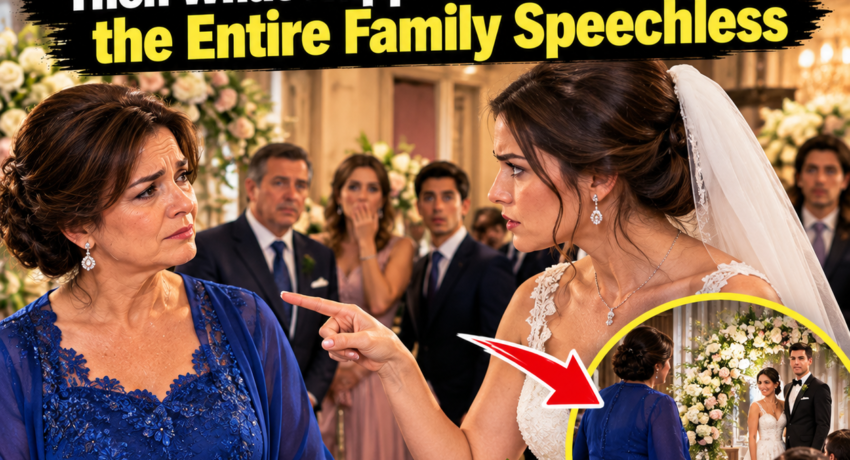
Near the entrance stood Vanessa’s mother.
She was wearing blue.
Not pale blue.
Not blue-gray.
Not a color someone might reasonably mistake for something else.
A beautiful, unmistakable blue gown.
For several seconds, I simply stared at her.
My first thought was almost laughably innocent.
Maybe Vanessa had forgotten to tell her.
Then another woman joined her.
Vanessa’s aunt.
Also wearing blue.
Then I noticed another aunt.
Blue again.
And each woman wore a small matching corsage.
My confusion turned instantly into something colder.
This wasn’t coincidence.
It had been coordinated.
I had bought an entirely new dress because Vanessa specifically asked me not to wear blue.
Yet several women from her family were standing around the room wearing the exact color I had been told to avoid.
“What on earth…” I whispered.
A relative came over to greet me, so I forced a smile.
I hugged people.
Accepted compliments.
Pretended everything was normal.
But beneath my smile, one question kept repeating.
Why me?
Why had Vanessa asked only me to change?
I tried telling myself there must be some reasonable explanation.
There was.
Unfortunately, it was worse than anything I had imagined.
“Blue Is for Family”
I found Vanessa shortly before the ceremony.
She was surrounded by bridesmaids, relatives, makeup artists, and people carrying flowers.
I didn’t want to create a scene.
So I waited until I could catch her attention quietly.
“Vanessa.”
She turned.
For one second, her eyes dropped to my plum-colored dress.
Then she looked back at my face.
“Yes?”
I kept my voice low.
“You told me people weren’t supposed to wear blue.”
Something flickered across her expression.
“Not exactly.”
My stomach tightened.
“What does that mean?”
She shifted her bouquet.
“I just asked you not to wear it.”
“I understand that.”
I glanced toward the room behind us.
“But your mother is wearing blue. So are two of your aunts.”
Before Vanessa could respond, her mother stepped toward us.
She had clearly heard enough of the conversation to understand the problem.
Her gaze swept over me.
Then she said, almost casually,
“Blue is for family.”
I stared at her.
For a moment, I thought I must have misunderstood.
“What?”
She repeated herself.
“Blue is for family.”
I looked down at my plum dress.
Then back at her.
A dull pressure formed behind my ribs.
“I’m the groom’s mother.”
Her lips curved into the smallest smile.
It wasn’t apologetic.
It wasn’t embarrassed.
It was the sort of tight smile people give when they know they’ve said something rude but expect you to accept it anyway.
Before I could answer, Grant appeared nearby.
Relief rushed through me.
Surely he would hear what had happened and immediately understand why I was hurt.
“Grant?”
He looked at me.
Then at Vanessa.
Then at her mother.
And finally at the floor.
“Mom,” he said quietly. “Please. Not now.”
Three words.
That was all.
But they hurt far more than anything Vanessa’s mother had said.
Not now.
I wasn’t asking him to cancel the wedding.
I wasn’t demanding a confrontation.
I only wanted him to look at me and acknowledge that what had happened was wrong.
Instead, he wanted me to swallow it.
To keep the peace.
Again.
Something inside me sank.
Still, I nodded.
“All right.”
It was his wedding day.
I wasn’t going to create a scene.
So I stepped away.
I smiled when guests greeted me.
I took my seat.
I told myself that the blue dresses were ridiculous wedding politics and nothing more.
But once I noticed the first small exclusion, I began noticing others.
And by the time the ceremony ended, I could no longer convince myself that it was only about a color.
The Photograph We Never Took
After the ceremony, the photographer began organizing family portraits.
Couples.
Bridesmaids.
Groomsmen.
Parents.
Grandparents.
Vanessa’s relatives moved easily in and out of the photographs.
Her mother stood proudly in the middle of several groups, surrounded by the other women in blue.
I stayed where I was told.
Smiled when asked.
Moved when instructed.
Then Grant came over.
“Mom.”
I turned.
His expression softened.
“Can we get one of just us?”
That single question warmed something in me.
“Yes,” I said immediately.
Of course I wanted one.
I had imagined having that photograph for months.
Just my son and me on his wedding day.
One frame I could put on the mantel and look at years later.
Grant turned toward the photographer.
“Could we do one with just my mom and me?”
Before the photographer could answer, Vanessa stepped in.
“We don’t have time.”
Grant frowned.
“It’ll take thirty seconds.”
“We’re already behind.”
The photographer glanced between them.
Grant looked at me.
“Maybe just one—”
“Grant.”
Vanessa’s voice sharpened.
“We have a schedule.”
And just like that, he went quiet.
I forced a smile before he could see how badly it hurt.
“It’s okay,” I said. “We’ll take one later.”
But we both knew there probably wouldn’t be a later.
He nodded.
“Okay.”
Then followed Vanessa toward the next group.
I watched him go.
The blue dress had made me angry.
That moment made me uneasy.
Because this wasn’t about me anymore.
It was the way Grant’s entire expression changed whenever Vanessa corrected him.
The way he immediately stepped back.
The way his voice disappeared.
For the first time that day, I wondered whether my son’s peaceful nature had stopped being a strength inside his relationship.
Maybe peace was costing him more than I realized.
The Smile He Put On for Everyone Else
Dinner confirmed it.
Grant was talking to his uncle about the honeymoon.
He sounded genuinely excited for the first time all afternoon.
“We’re going to spend a few days—”
Vanessa interrupted him.
“No, honey. That’s not what we’re doing anymore, remember?”
Grant stopped.
Several people at the table laughed lightly.
Vanessa smiled.
Grant laughed too.
But I saw his face.
The color rose into his cheeks.
His mouth smiled.
His eyes didn’t.
It was the laugh of a man trying to convince everyone that the joke didn’t hurt.
I knew that laugh.
I’d heard Grant use versions of it since childhood.
He used it whenever someone embarrassed him and he didn’t want to make them feel bad.
I waited until dinner ended.
Then I caught him near a hallway where the music from the reception softened enough for us to talk.
“What is going on?”
He frowned.
“Nothing.”
“Forget the dress.”
“Mom—”
“No. I’m not talking about your wedding colors anymore. I’m talking about you.”
His eyes shifted toward the reception room.
“I don’t know what you mean.”
“Yes, you do.”
I lowered my voice.
“I’ve watched Vanessa shut you down all day.”
“She’s stressed.”
“Grant.”
“It’s our wedding day. Everything’s been crazy.”
“Look at me.”
He didn’t.
“Grant.”
Slowly, he raised his eyes.
My heart tightened.
There was exhaustion there.
Embarrassment.
Something close to anger.
And beneath all of it, something I couldn’t quite name.
“Are you happy?”
The question seemed to strike him.
His lips parted.
For one brief second, the polished wedding-day mask disappeared.
He looked like my son again.
Not the groom.
Not the peacekeeper.
Just Grant.
And I knew he was about to tell me something.
Then Vanessa appeared.
“There you are!”
Grant’s face closed immediately.
She walked toward us.
“Seriously? I’ve been looking everywhere. We have things to do.”
Then she looked at me.
Her expression brightened into a teasing smile.
“And Joan, could you stop stealing my groom?”
A couple standing nearby laughed.
I didn’t.
Grant didn’t either.
Vanessa took his hand.
He followed her without saying another word.
And I remained in that hallway, watching him disappear back into the reception.
For the first time in my life, I wondered whether my son’s kindness had made him vulnerable to someone who had learned that he would always be the one to bend.
The Groom Stands Up
I returned to my table.
For the next twenty minutes, I said very little.
Across the room, Vanessa laughed with her family.
Her mother sat among the women in blue.
They looked perfectly comfortable.
Perfectly included.
Perfectly sure of their place.
Grant sat beside Vanessa.
When someone spoke directly to him, he answered.
When someone raised a glass, he smiled.
But whenever he thought nobody was watching, his expression disappeared.
His shoulders remained rigid.
His jaw tightened.
Every instinct I had as his mother was telling me that something had gone badly wrong.
Then I heard a spoon tap sharply against a champagne glass.
Once.
Twice.
Conversation faded.
I looked toward the sound.
Grant was standing.
Vanessa looked up at him in surprise.
“I’d like to say something.”
People smiled.
Someone raised a phone to record him.
They probably expected a sweet groom’s speech.
A few jokes.
A thank-you to the guests.
Something about loving his bride.
Then Grant looked directly at me.
My stomach dropped.
I knew my son’s face.
And I had never seen that expression before.
His tie was loosened.
His cheeks were flushed.
His hand was wrapped so tightly around the champagne glass that his knuckles had gone pale.
Grant was furious.
Not irritated.
Not embarrassed.
Furious.
And suddenly I understood.
Every time he’d gone silent that day, the anger hadn’t disappeared.
It had collected.
Piece by piece.
The dress.
The photos.
The interruptions.
The jokes.
All of it.
I stood so quickly my chair scraped across the floor.
“No!”
My voice was far louder than I intended.
Every head turned toward me.
Grant froze.
Vanessa stared.
“What?” she demanded.
I looked only at my son.
“Don’t say something in anger that you’ll regret tomorrow.”
The entire reception hall seemed to hold its breath.
Grant slowly put the champagne glass down.
Then he looked at me.
“I’m not angry because of one thing, Mom.”
His voice was quiet.
That frightened me more than shouting would have.
Vanessa stood.
“Grant, what are you doing?”
He turned toward her.
“Talking.”
Her eyes narrowed.
“Then let’s talk somewhere private.”
“No.”
One word.
Softly spoken.
But it changed the atmosphere in the entire room.
Grant glanced around.
“I’ve been doing everything privately for two years.”
My stomach tightened.
Vanessa reached for his arm.
“Grant.”
He stepped away.
And then my son finally began telling the truth.
“The Other Mother”
“I knew about the dresses,” Grant said.
I stared at him.
Vanessa’s mother stopped smiling.
“What do you mean?” I asked.
“I found out three days ago.”
My heart sank.
“Then why didn’t you tell me?”
“Because Vanessa said she’d fix it.”
Vanessa immediately shook her head.
“That isn’t what happened.”
Grant gave a short laugh.
There was no humor in it.
“You told my mother blue was part of the wedding color scheme so she’d buy another dress.”
People began shifting uncomfortably.
Grant continued.
“Then your mother and your aunts all showed up in blue because you decided blue was for family.”
Vanessa’s mother crossed her arms.
“It was a tradition.”
Grant looked at her.
“No. It became a tradition about a month ago.”
Silence.
Vanessa’s face tightened.
“This is ridiculous.”
Grant reached into his pocket.
“I saw the messages.”
Vanessa went pale.
Her mother looked sharply toward her.
“What messages?”
Grant held up his phone.
“You left your tablet open at home.”
“Grant,” Vanessa whispered.
He looked at her.
“You called my mother ‘the other mother.’”
The words hit me physically.
I actually felt my chest go cold.
Vanessa lowered her eyes.
Grant continued.
“You wrote that you didn’t want her matching the people who would be in the ‘real family pictures.’”
No one laughed.
No one moved.
I looked at Vanessa.
Suddenly, the dress made perfect sense.
The blue hadn’t simply been a color.
It had been a boundary.
A visual line.
Her family on one side.
Me on the other.
Her mother finally spoke.
“That message is being taken out of context.”
I turned toward her.
“What possible context makes that sentence better?”
Her mouth opened.
Nothing came out.
Grant looked at me.
And then he said,
“I’m sorry.”
Those words hurt more than the messages.
Because he sounded ashamed.
“Grant,” I said softly, “you didn’t do this.”
“I let it happen.”
His eyes filled.
“I knew three days ago, Mom.”
“You believed she would fix it.”
“I should’ve told you.”
His voice cracked.
“I should’ve said something.”
Vanessa touched his shoulder.
“Can we stop now?”
Grant immediately pulled away.
“No.”
She stared at him.
And for the first time that day, he didn’t lower his eyes.
“That right there is the problem.”
“What problem?”
“You decide when conversations are finished.”
Vanessa’s expression hardened.
“That isn’t fair.”
“You decide where we go.”
“Grant—”
“You decide when plans change.”
“Because you never make plans.”
“You decide who gets invited. What we tell people. What happens if I disagree.”
Her face flushed.
“I do not.”
“You changed our honeymoon without asking me.”
“We discussed it.”
“You told me after you booked it.”
Vanessa folded her arms.
“Because you never make decisions.”
Grant went still.
Then, unexpectedly, he nodded.
“You’re right.”
She blinked.
“I don’t.”
For a second, even Vanessa seemed unsure how to respond.
Grant looked down at the table.
Then back at her.
“I don’t make decisions because every time I disagree with you, you make me feel like an idiot.”
Her face softened.
“Grant…”
“No. Let me finish.”
And this time, she did.
“Somewhere Along the Way, I Disappeared”
Grant drew a shaky breath.
“I thought keeping the peace made me a good partner.”
His voice was becoming steadier.
“I thought compromise meant that if something mattered more to you than it did to me, I should let you have it.”
Vanessa’s eyes began to fill.
Grant continued.
“So I gave in on restaurants.”
He looked down.
“Then trips.”
Another pause.
“Then friends.”
His throat moved as he swallowed.
“Then holidays.”
The room was completely still.
“And eventually, I stopped knowing when I was compromising and when I was just disappearing.”
My throat tightened.
There it was.
That was what I had been seeing all day.
It wasn’t simply that Grant was timid.
He had spent so long avoiding conflict that he had slowly begun removing himself from his own life.
He looked at me.
“When you asked whether I was happy…”
His voice broke.
“I wanted to tell you no.”
My hand flew to my mouth.
Vanessa stepped backward.
“What are you saying?”
Grant turned toward her.
“I’m saying I should’ve answered my mother.”
Her face crumpled.
“We literally just got married.”
“I know.”
“So what? You’re humiliating me in front of everyone?”
Grant looked around the reception hall.
For the first time, embarrassment seemed to reach him.
He exhaled.
“No.”
Then he looked at me.
“I shouldn’t have started this like some kind of toast.”
I gave him a small nod.
“No, you shouldn’t have.”
A faint, sad smile touched his mouth.
Then he turned back to Vanessa.
“But I’m also not pretending anymore.”
For the first time all day, Vanessa didn’t look angry.
She looked frightened.
“Are you leaving me?”
Grant was silent for several seconds.
“I don’t know.”
Her eyes widened.
“I don’t know what happens next,” he repeated.
There was something painful but deeply honest about that answer.
“We need help.”
Vanessa wiped her cheek.
“Counseling?”
“Something.”
Grant nodded.
“But I also need to stop saying yes just because I’m afraid you’ll be upset.”
Vanessa’s mother started toward her.
“Vanessa—”
Vanessa lifted her hand.
“Mom. Please.”
Her mother stopped.
That surprised everyone.
Maybe Vanessa most of all.
Vanessa looked back at Grant.
“I didn’t realize you felt this way.”
His expression tightened.
“I’ve tried to tell you.”
She lowered her head.
Then, after several seconds, she whispered,
“I know.”
The admission seemed to cost her something.
Then she looked at me.
Her eyes dropped briefly to my plum dress.
“I’m sorry.”
I remained silent.
“For the dress,” she continued.
“I shouldn’t have done that.”
Her mother frowned.
“Vanessa.”
Vanessa turned toward her.
“No, Mom.”
Her voice trembled.
“It was cruel.”
Something in the room shifted.
It didn’t repair what she had done.
But it was the first moment all day when Vanessa seemed to understand that being challenged wasn’t the same as being attacked.
I looked at her.
“The dress was never really the problem.”
She nodded slowly.
“I know.”
The Wedding That Ended Before the Marriage Began
The reception never returned to normal.
How could it?
People spoke quietly.
Some guests avoided eye contact.
Others left earlier than planned.
The music eventually resumed, but hardly anyone danced.
Grant and Vanessa went outside alone.
They stayed there nearly an hour.
I did not follow.
Every part of me wanted to.
I wanted to protect my son.
Ask what she was saying.
Make sure he wasn’t being talked back into silence.
But he had spent too much of his life letting other people make emotional decisions for him.
I wasn’t going to become another one.
So I stayed inside.
Eventually, Grant returned.
His tie was gone.
His eyes were swollen.
But something about him looked different.
His shoulders weren’t as tight.
He looked exhausted.
Heartbroken, even.
But lighter.
“Mom?”
“Yes?”
He stopped in front of me.
“I’m going home with you tonight.”
I didn’t ask for details.
I didn’t say I told you so.
I simply nodded.
“Okay.”
Vanessa was standing several feet behind him.
She looked as drained as he did.
“We’re going to take some time apart,” she said.
There was no sharpness in her voice.
No control.
No command disguised as a suggestion.
Grant looked at her.
“We’ll talk tomorrow.”
She nodded.
Then Vanessa did something I wasn’t expecting.
She walked toward me.
For a moment, neither of us spoke.
Then she said quietly,
“I’m sorry I made you feel like you weren’t part of the family.”
I studied her face.
She looked sincere.
But some wounds are too deep to disappear because someone finally acknowledges them.
“I am part of the family,” I said.
“I know.”
“If you and Grant decide to work through this, remember that.”
“I will.”
I believed that she meant it in that moment.
Whether she could actually live by it was something only time would reveal.
I didn’t hug her.
Not yet.
Forgiveness isn’t always immediate.
And reconciliation requires more than regret.
Sometimes the most respectful thing you can offer another person is the truth:
I’m listening.
But I’m still hurt.
The Ride Home
Grant and I left the reception together.
The night air felt cool after the warmth of the crowded room.
Neither of us spoke until we reached my car.
Then Grant stopped.
He looked back toward the glowing reception hall.
Guests still moved behind the windows.
Decorations Vanessa had planned for months were still hanging.
Flowers still sat on tables.
The cake was probably still half uneaten.
Everything looked like a wedding.
But nothing felt like one anymore.
Grant shoved his hands into his pockets.
“Do you think I ruined my wedding?”
I unlocked the car.
“No.”
He looked at me.
I turned toward him.
“I think you finally showed up for it.”
His face crumpled.
Then, unexpectedly, he laughed.
“So much for being the calm one.”
I smiled.
“Being calm isn’t the same thing as being silent.”
Grant stood very still.
Then nodded.
For the first time that day, I recognized him completely.
Not the little boy who always tried to stop everyone from arguing.
Not the groom trying to satisfy his wife.
Not the son trying to protect his mother.
Just Grant.
A grown man beginning to understand that kindness doesn’t require surrender.
We got into the car.
For the first several minutes, we drove in silence.
Then Grant said,
“I’m sorry about the picture.”
I glanced at him.
“What picture?”
“Our photo.”
My throat tightened.
“I really wanted one with you.”
“So did I.”
He looked out the passenger window.
“I should have insisted.”
“Maybe.”
I reached over and touched his hand.
“But there will be other pictures.”
He looked at me.
“Even after today?”
“Especially after today.”
He smiled faintly.
And that was when I realized something.
I had spent the entire day thinking the blue dresses were meant to send me a message.
You don’t belong.
You aren’t part of this family.
You stand outside the circle.
But in the end, those dresses had done something Vanessa never intended.
They had finally forced Grant to see how far he had been pushed outside his own life.
The problem wasn’t one color.
It wasn’t one photograph.
It wasn’t one changed honeymoon or one badly timed joke.
It was a pattern.
A thousand small moments in which Grant had decided someone else’s comfort mattered more than his own voice.
And perhaps I had helped teach him that.
Not intentionally.
But every time I praised him for being “the easy one,” every time I admired how rarely he argued, maybe I had unknowingly reinforced the idea that goodness meant never making anyone uncomfortable.
That realization stayed with me.
Because kindness is valuable.
Compromise is necessary.
Peace matters.
But peace purchased by constantly shrinking yourself isn’t peace at all.
It’s disappearance.
I don’t know what eventually happened between Grant and Vanessa after that night.
At that moment, neither did they.
Maybe counseling would help them learn to speak and listen differently.
Maybe time apart would show them they weren’t right for each other.
Maybe Vanessa would genuinely confront the way she had treated him.
Maybe Grant would learn that setting a boundary didn’t make him cruel.
There were no easy answers waiting in the parking lot.
Only a beginning.
As we pulled away from the venue, I glanced at Grant.
He was watching the lights disappear behind us.
Then he exhaled deeply and leaned back against the seat.
I thought again about the navy dress hanging unused in my closet.
A week earlier, I’d been irritated that I’d wasted money because Vanessa didn’t want me wearing blue.
Now the whole thing seemed almost absurdly small.
Because I finally understood.
The dresses were never really about determining who counted as family.
Family isn’t a color someone assigns.
It isn’t a place in a photograph.
It isn’t matching corsages or seating arrangements or whose relatives appear closest to the bride.
Family is where you are allowed to exist fully.
Where your voice does not become inconvenient simply because someone disagrees with it.
Where love doesn’t demand that you become quieter, smaller, or less yourself just to keep another person comfortable.
Vanessa’s family had worn blue to make their circle visible.
But the message they intended for me had reached my son instead.
And for the first time in years, Grant finally stepped across the line they had drawn.
Not toward me.
Toward himself.