The House Across the Street
The apple pie hit the porch before I realized I had let go of it.
The ceramic dish broke at my feet, sending crumbs and warm cinnamon across the steps. I barely noticed. I was staring at the girl standing halfway down the staircase inside the house across the street.
She had dark hair falling over one shoulder. She was thin, quiet, and about the same height my daughter had been the last time I held her hand.
For one terrible, beautiful second, grief changed the girl’s face.
“Ava?”
The name escaped me like a cry.
The woman who had opened the door immediately moved in front of the child. The girl stopped, her eyes widening as she looked from me to the broken pie.
“I’m sorry,” I whispered. “I thought you were someone else.”
The girl shook her head. “I’m Maisie. Not Ava.”
She was not Ava. I knew that. Her cheeks were rounder, her chin softer. Still, she had the same dark eyes and the same small smile that had once turned my kitchen bright. Then she pushed her hair behind her left ear, and my breath caught.
It was Ava’s gesture. The exact one she made whenever she was thinking hard.
The woman looked at me with an expression that seemed almost like recognition.
“You must be Aurora,” she said.
My hands went cold.
I had never met her. I had never told her my name.
Four months earlier, my eleven-year-old daughter had died in a car accident. Since then, I had learned that grief could make ordinary things dangerous. A song in a grocery store. A pink sweater on a stranger. The sound of small feet running down a hallway.
Now it had placed a girl who looked like my dead child in the house across the street.
And somehow, the woman at the door already knew who I was.
The Daughter We Lost
Ava died on a gray afternoon in early spring.
Ryan had picked her up from school and was driving her home when another car crossed into their lane. He survived the collision. Ava did not.
People told me that sentence gently, as if a soft voice could make it less impossible. It never did.
I remember sitting beside Ryan’s hospital bed while a doctor explained what had happened. Ryan’s face was bruised, his arm was strapped to his chest, and his eyes kept searching the doorway.
“Where is she?” he asked.
No one answered him at first.
I wanted to believe there had been some mistake. I wanted a nurse to appear with good news, or Ava to walk into the room complaining that everyone was making too much fuss. Instead, the silence grew until it became the answer.
Our younger daughter, Gabriella, was five. Ava had been her favorite person in the world. She brushed Gabriella’s hair before school, read her stories at night, and let her sit beside her while she practiced new songs on the piano.
Gabriella followed Ava everywhere. She copied the way Ava folded her sleeves, the way she crossed her ankles, and the way she pushed her hair behind her ear when she was concentrating.
After the funeral, Gabriella asked the same question every morning.
“When is Ava coming home?”
At first I answered honestly. Then I tried simpler words. Then I found myself standing in the kitchen with my mouth open, unable to explain death to a child who still believed that every separation ended at bedtime.
Eventually, Gabriella stopped asking.
That frightened me more than the questions had. Her silence did not mean she understood. It meant she had learned that asking hurt me.
The house became unbearable. Ava’s room remained exactly as she had left it, with a sweater hanging over the back of her chair and a book open beside her bed. I could not bring myself to pack anything, but I could not walk past the room without feeling as though I had abandoned her a second time.
Ryan was the one who suggested moving.
One night, he stood in the doorway of our bedroom, pale and exhausted.
“I can’t keep walking past her room,” he said. “Every hallway ends there. Please, Aurora. We need somewhere we can breathe.”
I wanted to disagree. I wanted to say that leaving would feel like leaving Ava behind. But I had already begun making mistakes. One morning, I bought the cereal Ava liked and did not realize what I had done until I placed the box in the cart.
I sat in the parked car and cried until a stranger knocked on the window to ask whether I was all right.
Ryan found listings in a city three hours away. He handled most of the search because I barely had the strength to look at photographs of other people’s kitchens.
“This one has a yard for Gabby,” he said, showing me a picture of a small white house.
I nodded.
“Choose whichever one you think we can survive in.”
We sold the old house. We packed Ava’s belongings into boxes. We drove away from the only place where both of our daughters had ever lived, and I tried to believe a different street might teach us how to keep going.
The Girl in the Window
For the first few days, the new house felt almost peaceful.
The walls did not know Ava’s name. No one had to pass her bedroom to reach the bathroom. The silence belonged to the house itself instead of to the absence inside it.
Then, on a Tuesday morning, I found Gabriella standing at her bedroom window in one sock.
“Gabby, where are your shoes?” I asked.
She pointed across the street.
“Mom, I saw my sister in the window. She lives in the house across the street.”
I stopped beside her.
The house opposite ours looked closed up. The curtains were usually drawn, and I had not seen anyone enter or leave. I had assumed it was empty.
“What did you say?”
“Ava lives there.”
Gabriella spoke with complete certainty. She did not sound frightened. She sounded relieved.
I knelt in front of her and took both of her hands.
“Sweetheart, Ava cannot be living across the street.”
Her mouth trembled. “But she is.”
“You may have seen another girl.”
“You didn’t see her.”
There was no answer to that. I had not seen the girl. I had only seen the hope in my daughter’s eyes.
I pulled Gabriella against me. She pressed her face into my shoulder.
“Why won’t she come over?” she asked.
I closed my eyes.
“Because she isn’t Ava.”
The next afternoon, Gabriella came running into the kitchen while I was putting dishes away.
“Mommy, she’s there again.”
I dropped the dish towel.
“Show me.”
Gabriella seized my hand and pulled me upstairs. By the time we reached the window, the opposite room was empty. She pressed both palms against the glass.
“She was right there.”
Ryan appeared behind us.
“What is going on?”
Gabriella pointed toward the house. “Ava is over there.”
Something flickered across Ryan’s face. It was gone so quickly that I might have imagined it, but his expression had changed before he turned to our daughter.
“Maybe we should let this go for today,” he said.
“She’s grieving,” I answered.
“I know.”
Gabriella folded her arms. “I saw her.”
Ryan reached for her hand. “Come downstairs with me.”
She followed him, but I stayed at the window.
“Ryan.”
He stopped at the door.
“Have you met the people in that house?”
“No.”
The answer came too quickly.
That night, after Gabriella fell asleep, I carried a chair into her room and sat beside the window. I told myself I was only trying to find the child she had mistaken for Ava.
Near midnight, the curtain across the street moved.
A girl stepped into the upstairs window. Her hair was dark. Her height was close to Ava’s. She turned her head, and then she saw me.
For several heartbeats, we stared at each other through the distance.
The girl pulled the curtain shut.
I remained in the chair until morning, listening to the house breathe around me.
The Welcome Pie
The next morning, I made an apple pie.
It was an old habit. Whenever we had new neighbors, Ava used to help me press the crust into the dish. She always made the edges uneven and insisted that the pie tasted better that way.
I rolled the dough across the counter when Ryan entered the kitchen.
“Who are you baking for?” he asked.
“The family across the street.”
His coffee cup stopped halfway to his mouth.
“Why?”
“Gabriella has seen the girl twice. I saw her last night. I thought it was time to introduce myself.”
Ryan set the cup down.
“Maybe don’t go today.”
I looked at him. “Why not?”
“You don’t need to walk over there because Gabby saw someone through a window.”
“I saw her too.”
His jaw tightened.
“Let me take the pie when it’s ready.”
I stopped smoothing the dough.
“You told me you had never met them.”
“I haven’t.”
“Then why are you so eager to go in my place?”
He looked toward the sink. “I’m trying to make things easier.”
The pie baked for twenty minutes. Ryan watched me wrap it, his hands opening and closing at his sides.
“Aurora, please.”
I lifted the dish.
“If there is something I should know before I cross that street, tell me now.”
The color drained from his face.
“Just don’t go over there angry.”
I had not been angry when I started baking. I had been confused. I had been afraid of what my eyes were showing me.
By the time I reached the opposite porch, anger had filled every empty space.
A woman who looked to be in her late fifties opened the door.
“Hello,” I said. “We just moved into the house across the street. I’m Aurora. I brought you something.”
Her smile appeared, but it did not reach her eyes.
“Of course. I’m Nina.”
I held out the pie.
“My daughter keeps noticing someone in your upstairs window. We lost her older sister a few months ago, and she has become convinced your granddaughter is Ava. I wanted to explain before it became uncomfortable.”
Nina’s fingers tightened around the door.
“I’m very sorry for your loss,” she said.
Before I could answer, a young voice called from inside.
“Grandma, who is it?”
Nina turned toward the stairs.
“Stay upstairs for a moment, Maisie.”
But footsteps were already descending.
The girl appeared behind her.
The pie slipped from my hands.
“Ava?”
Maisie froze.
Nina stepped in front of her. “Her name is Maisie.”
Up close, I could see all the ways she was different from my daughter. Her face was rounder. Her nose was smaller. She had a faint freckle near her cheek that Ava had never had.
But then Maisie pushed her hair behind her left ear.
I could not breathe.
“I’m Maisie,” she repeated softly. “I am not Ava.”
“No,” I managed. “You aren’t.”
Nina asked the girl to go upstairs. Maisie obeyed, though she kept looking back as if she believed she had done something wrong.
When she disappeared, I faced Nina.
“You recognized my name.”
Nina’s shoulders lowered.
“You must be Aurora.”
“How do you know me?”
She glanced at the stairs.
“Ryan never told you.”
Behind her, on a small table, I saw a framed photograph. Ryan stood beside Maisie, one hand resting lightly on her shoulder.
The picture was recent.
“How long has my husband known your granddaughter?”
Nina looked down.
She did not need to answer. Her silence had already changed the question in my mind.
I was no longer wondering why Maisie looked like Ava.
I was wondering why Ryan had moved us into the house directly across from her.
The Secret in Our House
Ryan was in the kitchen when I returned. His eyes went straight to my empty hands.
“Did they like the pie?” he asked.
I closed the door behind me.
“Who is Maisie to you?”
His face went blank, then white.
“Aurora…”
“How long have you known?”
He sat down slowly.
“Since after the accident.”
“Is she your daughter?”
He nodded.
The room seemed to tilt. I placed one hand on the counter to keep myself upright.
“Her mother wrote to me,” he said. “Maisie had started asking questions about her father. She said she would agree to a DNA test if I wanted proof. The test confirmed it.”
“And you knew before we moved?”
“Yes.”
“Did you choose that house because Maisie lives across the street?”
He stared at the floor.
That was enough.
“You told me we were moving for Gabriella,” I said. “You showed me a yard and talked about a fresh start. All the while, you were bringing us into your secret.”
“I didn’t know how to tell you.”
“You knew how to choose the city. You knew how to choose the house. You knew how to arrange meetings with her. You simply decided I was the last person who deserved the truth.”
His expression broke.
“I’ve seen her four times since we arrived.”
I stared at him.
“We have been here less than two weeks.”
“I went over while you were unpacking.”
My mind went to the boxes stacked in the hallway, to Ava’s clothes folded in tissue paper, to the photographs I had not been able to open.
“While I was sorting through our dead daughter’s room, you were across the street meeting another daughter.”
Ryan covered his face.
“I couldn’t save Ava.”
The words stopped me. Not because they excused him, but because I knew the shape of that guilt. He had carried it from the hospital to the funeral, from the funeral to the new city, and now into a secret relationship with a girl who had his eyes.
“I hear the crash every night,” he continued. “Then I learned I might have another daughter. I saw Maisie’s photograph, and I recognized myself in her. I had missed eleven years of her life. I didn’t know how to stand in front of her without feeling ashamed.”
“You had already missed eleven years,” I said. “But somewhere in all of this, you also forgot that I was your wife.”
“I thought I was protecting you.”
“You were protecting yourself from having to watch me react.”
He flinched.
I asked whether Maisie knew about Ava.
“Yes.”
“Did you show her pictures?”
“Yes.”
“What did you tell her about us?”
“That I had a wife and two daughters.”
I felt something inside me collapse.
“You spoke about Ava as though she were still living.”
“I didn’t know how to tell Maisie that she had a sister who died.”
“By telling her the truth. Ava was your daughter. Maisie deserved to know who she was, and she deserved to meet you without being pulled into a story you had rewritten.”
Ryan rubbed his eyes.
“I wasn’t ready to say it aloud.”
“You were ready to move our whole family three hours away.”
For a long moment, he said nothing.
Then I asked the question I had been afraid to hear answered.
“Did you ever look at Maisie and wish she were Ava?”
“No.”
I waited.
His eyes dropped.
“Once,” he admitted. “She laughed, and for a second it sounded like Ava. I hated myself as soon as I thought it. Maisie is her own person. I know that.”
There had been mornings when Gabriella’s footsteps made me turn toward the hall because they sounded like Ava’s. I understood how grief could distort a moment.
Understanding it did not make the lie smaller.
“Maisie cannot be your chance to save Ava,” I said.
Ryan began to cry.
“I don’t know what I’m doing.”
“For once, we agree.”
What Nina Knew
I returned to Nina’s house because I needed the part of the story Ryan had kept from me.
She opened the door cautiously.
“Did Maisie know I had no idea about her?” I asked.
“No,” Nina said. “She believed Ryan had told you.”
That hurt in a different way. Maisie had not been helping him deceive me. She had been walking through the situation with the same missing information I had.
“Tell me everything from the beginning.”
Nina explained that her daughter had always known Ryan was Maisie’s father. Years earlier, when Ryan and I had separated for six months, he and Nina’s daughter had shared a brief relationship. She became pregnant and later decided that Maisie did not need a father who had not chosen to stay.
But as Maisie grew older, she began asking questions her mother could no longer answer for her.
She wanted to know where she came from. She wanted to meet Ryan.
Her mother wrote to him before the accident.
“Ryan knew she might be his?” I asked.
“He knew there was a possibility,” Nina said. “He hadn’t answered the letter when your daughter died. Afterward, he contacted my daughter. They arranged the test.”
The details did not lessen the betrayal. They did, however, make the timeline clear. Ryan had not gone searching for another child while abandoning Ava. He had learned about Maisie before Ava died, then confirmed the relationship after grief had torn away whatever defenses he had left.
I could understand his panic now.
I still could not accept what he had done with it.
“Did you tell him moving across the street was a bad idea?”
“Several times. He thought being close would help him build a relationship with Maisie. I told him he was putting everyone in an impossible position.”
A floorboard creaked above us.
Maisie stood on the stairs.
“Grandma? Is Dad in trouble?”
I looked at her. She seemed younger than she had on the porch, suddenly uncertain inside a conversation she had never meant to enter.
“Yes,” I said.
Her face fell. “Because of me?”
I crossed the room and knelt in front of her.
“No. Your father made choices without telling me. Those choices belong to him.”
Maisie swallowed.
“I thought you knew about me. He showed me a picture of Ava. I didn’t want Gabriella to think I was her.”
“You don’t have to be Ava,” I told her. “You don’t have to resemble her, act like her, or make anyone feel better about losing her. You only have to be Maisie.”
Her eyes filled.
“I wasn’t trying to take her place. I only wanted to meet my dad.”
That sentence reached the place in me that anger could not protect.
“You deserved to meet him as yourself,” I said. “And you deserved the truth about the family you were walking into.”
Three Girls to Protect
When I returned home, Ryan was standing beside an open suitcase on our bed.
“Before you say anything,” I told him, “I need to know about Maisie’s mother.”
He explained that their relationship had happened during the months we had been apart. It had ended before Ryan and I reconciled, and he had not heard from her again until the letter.
I listened, then pointed toward the suitcase.
“You need to stay somewhere else for a while. A motel nearby. Your brother’s house. I don’t care where, as long as it isn’t here.”
He nodded, then hesitated.
“What about Maisie?”
“Maisie is not the person who lied to me.”
Relief crossed his face, but I stopped him before he could mistake it for forgiveness.
“I’m trying to protect three girls,” I said. “Gabriella cannot spend another day wondering whether Ava has somehow come back. Ava’s memory cannot be turned into a doorway another child is expected to walk through. And Maisie cannot be treated as if she arrived to fill an empty chair.”
Ryan looked down.
“I never wanted that for her.”
“I believe you. But grief explains why you panicked. It does not give you the right to make every decision for everyone else.”
He sat on the edge of the bed.
“Can we repair our marriage?”
I looked at the man I had loved for years, the father of both my living memories and my deepest wound.
“I don’t know.”
“Aurora…”
“You chose the city. You chose the house. You chose the moment I learned the truth. You don’t get to choose my answer too.”
That night, Gabriella climbed into my bed. I had explained what I could without giving her more than a five-year-old heart could carry.
“Where is Daddy staying?” she asked.
“Somewhere else for now.”
She was quiet for a while.
“Are you mad at Maisie?”
“No.”
Gabriella rested her cheek against my arm.
“Good. She didn’t make Daddy lie.”
I kissed her hair.
“No, sweetheart. She didn’t.”
Her Own Place
The next morning, I opened one of the boxes I had avoided since the move.
Inside was a photograph of Ava and Gabriella covered in flour. Ava was laughing at something outside the frame, while Gabriella stood beside her with white powder on her nose.
Gabriella found me holding it.
“Can I keep that one in my room?”
“Yes.”
We placed the picture on her dresser. It was the first time I had put one of Ava’s photographs somewhere visible since we left our old house.
Then Gabriella took my hand.
“Can we visit Maisie?”
We crossed the street together.
Maisie answered the door with Nina behind her. She looked at me carefully, as if she still expected to be blamed for a secret she had never known existed.
“Gabriella wanted to see you,” I said.
Maisie glanced at her. “Are you sure?”
I nodded.
“I’m sure of this much. You are Maisie, and you are welcome to be exactly that.”
Three months later, Ryan and I were still trying to decide whether our marriage could survive the truth. Some days we talked. Some days we sat in separate rooms. Nothing was hidden anymore, but honesty did not rebuild trust overnight.
Ryan saw Maisie openly. He answered her questions. He began telling her about Ava in a way that did not pretend death had never happened. I was not ready to call him forgiven, but I was no longer willing to let his dishonesty decide what kind of family the girls could have.
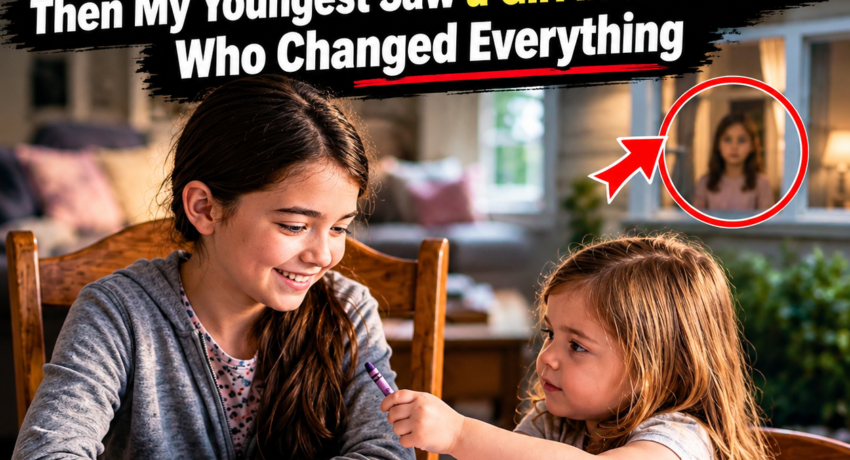
One afternoon, Gabriella and Maisie sat at the dining table coloring.
“Ava hated purple,” Gabriella announced.
Maisie laughed.
Gabriella looked up.
“You laugh differently.”
Maisie held the purple crayon above the page. “Different from Ava?”
“Yes.”
Gabriella studied her for a moment, then held out the crayon.
“That’s okay. You can use it.”
Maisie accepted it.
I watched her bend over the paper, her dark hair slipping over one shoulder. For a heartbeat, the old fear rose in me. Then I saw the way she held the crayon, the way she leaned closer to the page, the way her smile belonged only to her.
Maisie was not standing in Ava’s place.
She was making a place of her own.
For a long time, I had believed honoring Ava meant keeping every space around us empty. I thought moving forward might look like betrayal.
I understand now that Ava did not need another child to disappear for her memory to remain safe. She needed us to remember her honestly.
And Maisie needed the freedom to live without being mistaken for someone she had never tried to replace. That was the first real peace our new house gave me.