Part One: The Backpack
The lawyer waited exactly forty minutes before he came to find me. I remember because I counted the ceiling tiles instead of counting the minutes — because looking at numbers felt safer than looking at the bed where my husband had just stopped breathing.
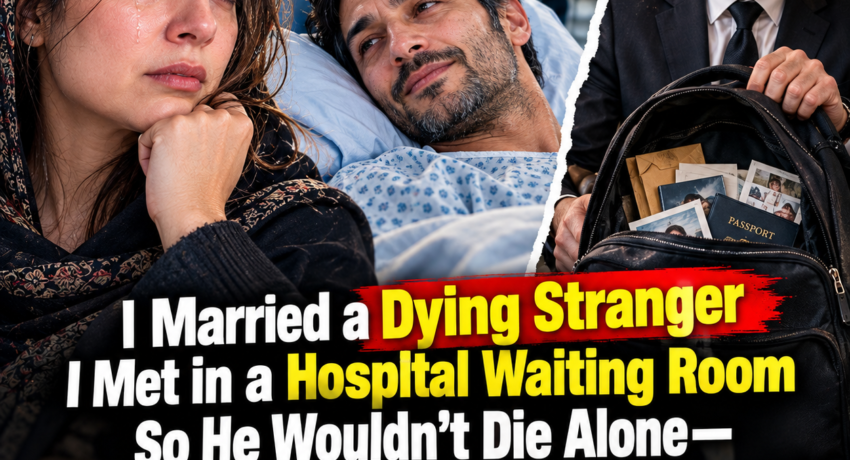
“Sarah.” His voice was careful, the way people talk to something breakable. He set a scuffed green backpack in my lap, the same one that had rested against Thomas’s foot every day I’d known him. “He wanted you to have this. He said… he said you’d understand him better once you looked inside.”
I stared at the zipper pull instead of his face. “Understand him how? We were married for seven days. I thought I already—”
“He wasn’t who you thought he was,” the lawyer said. Not cruelly. Almost like an apology. Then he left me alone with the pillow that still held the shape of Thomas’s head, the untouched peppermint tea going cold on the tray table, and a soda-can tab circling my finger — light as a joke, heavy as a vow.
I unzipped the backpack with hands that wouldn’t stay still.
No money fell out. No legal documents, no letter demanding I keep some promise. Just envelopes — dozens of them, each one labeled in Thomas’s small, deliberate handwriting. Bus Stop. Grocery Store. Airport. Laundromat. Park Bench. Waiting Room. Hospital Chapel. At the very bottom, wedged beneath all of it, sat a notebook with corners gone soft from handling.
I picked up Bus Stop first, because it was the only word small enough for me to hold onto that night.
Inside was an old train ticket, its edges worn thin as tissue. Written on the back, in the same tired hand: She finally went. That was all. No name. No date. I turned it over twice, as if the front might explain the back. It never did.
I should tell you how a woman ends up married to a man she’d known for three weeks — a man twice her age, dying of something the doctors had stopped naming out loud.
I was twenty-nine when I met Thomas, though grief had been aging me faster than my birthdays could keep up. My mother had died the winter before, and instead of falling apart the way people expect, I had simply gone quiet. I went to work. I paid the electric bill. I answered texts with the little smiling face that means nothing. Then I started volunteering at the hospital, because the first time I watched someone die with nobody beside them, something in me refused to let that happen again on my watch. I held cups of water to cracked lips. Read the newspaper aloud to people who’d stopped listening. Learned which rooms were always freezing and which nurses hummed to themselves when the shifts ran long.
People called that generous. It wasn’t. I was hiding in the one place where my own grief made sense next to everyone else’s.
Thomas noticed that about me before I noticed it myself.
He was seventy-two, all hollow cheeks and a smile that looked tired even when it meant something, that green backpack always propped against his foot like a dog that wouldn’t leave his side. I’d find him by the cardiac wing some mornings, by the vending machines other times — he swore the coffee was terrible but at least it was honest — and some afternoons in the back pew of the chapel, sitting the way you sit when you’re waiting for someone who might still walk through the door.
He never talked like a dying man. He talked like a man keeping a ledger of everyone else’s lives. “Did the cafeteria lady’s grandson pass his driving test?” he asked me once, out of nowhere.
“I don’t know.”
“He was taking it Tuesday.”
“You remember that?”
He only shrugged, like it wasn’t a thing worth remarking on. “She mentioned it.”
Another day, a housekeeper came in humming while she tied off the trash bag. “Morning, Lila,” Thomas said. “Still that same song?”
She laughed without looking up. “My mama loved it, Tom.”
“I know.”
She stopped what she was doing. “You remembered?”
He just smiled and let her wonder.
That was the man I thought I’d married. Kind. Lonely. Running out of time and spending what was left of it noticing strangers.
Then, on an ordinary Thursday, with a cup of ice chips sweating in my hand, he asked me to marry him.
“Marry me, Sarah.”
I nearly dropped the cup. “Thomas—”
“I know how it sounds.”
“You’re very sick.”
“Yes.”
“We’ve known each other three weeks.”
He looked at me for a long time before he answered — long enough that I felt seen in a way I hadn’t been in over a year. “I know enough. I know you’re the kind of person who stays when it would be easier to leave. My last wish is to go out as somebody’s husband. Not as a nameless chart at the end of a hallway.”
Two days later, a hospital chaplain married us in that same narrow room. I wore a yellow sweater because Thomas said the color made the walls look less like a waiting room for death. He wore his cardigan with the missing button, the one he refused to let anyone replace. A nurse pulled me aside beforehand and asked, gently, if I was certain — Thomas was old enough to be my grandfather, she reminded me, as if I hadn’t noticed. I told her yes. My heart had already answered before my mind got a vote.
When the chaplain asked for rings, Thomas worked the tab loose from his soda can with fingers that shook more than they used to, and slid it onto my finger. It was too big. He laughed, soft and a little breathless. “We’ll just tell people your finger is shy.”
For seven days, I was his wife. I filled out forms with his name and mine linked together for the first time. I smoothed blankets that never stayed smooth. I smuggled in tea that was better than what the hospital allowed. I sat beside him on the nights his breathing turned shallow and counted his breaths instead of sleeping. Near the very end, his eyes opened once, clearer than they’d been in days, and he said, “Don’t mistake stillness for peace.”
“What does that mean?”
His smile was already fading into something else. “You’ll know.”
Then he slept. And this time, he didn’t wake up.
Which is how I ended up sitting on my kitchen floor at midnight with a dead man’s backpack open beside me, and a first envelope in my lap that told me nothing except that somewhere, sometime, a woman named nothing at all had finally gone.
Part Two: Seven Envelopes
For nearly two hours, I only walked circles around that backpack. My apartment held its breath with me. My mother’s mug still sat by the sink, a year old and untouched, because some part of me still wasn’t ready to admit she wasn’t coming back to use it. I understood, suddenly, why Thomas had kept so many small things instead of throwing anything away.
At midnight, I opened the second envelope. Airport. Inside was a boarding pass, nine years expired. On the back: He called his daughter from Gate 14.
A daughter. Thomas had never once mentioned a daughter.
I opened Grocery Store next. A faded receipt for two cans of tomato soup and a loaf of bread, the ink gone soft with age. On the back: She accepted the soup.
Then Laundromat — a single dryer sheet, folded into a small, careful square, tucked inside like something worth preserving. We both waited for the blue blanket. She said it still smelled like home.
I opened Park Bench and found an old Polaroid: Thomas, younger, sitting beside a man in a worn brown coat, both of them looking at something just outside the photograph’s edge. On the back: He smiled before I left.
None of it made sense yet. Each envelope handed me a fragment and then closed its fist around the rest.
I kept going anyway. A child’s crayon drawing, folded into eighths. A coffee shop receipt with no note at all. A cocktail napkin with a phone number crossed out so hard the pen had torn through the paper.
By the time I reached Waiting Room, my hands had finally gone still. My chest hadn’t. Inside was a hospital visitor’s sticker, the adhesive long gone brittle, dated almost a year back. On the back: She said her mother laughed like she was trying not to.
I went cold all over, because that was me. That was the exact thing Thomas had asked me on the very first day we met — not how my mother had died, not how long I’d been grieving, but “What did she laugh like?” I’d almost walked away from the strangeness of the question. Instead I’d sat down next to him and answered honestly. “Like she was trying not to.”
He’d smiled at that. “Those are the best ones,” he’d said, and I hadn’t understood what he meant. I still wasn’t sure I did.
I spread every envelope across the table until they covered it edge to edge — bus stop, grocery store, airport, laundromat, park bench, waiting room, chapel. Seven ordinary places. Seven unfinished stories, none of them mine, and yet somehow all of them were about me too.
Morning came before I noticed the sky had changed. I’d slept maybe an hour, curled sideways in a kitchen chair. The backpack sat open, emptied of everything except the one thing I’d been avoiding since the lawyer first set it in my lap.
The notebook.
I finally picked it up.
Part Three: What He Had Really Been Collecting
The first page held only two sentences, written so plainly they felt less like a diary entry and more like something Thomas had needed to remind himself of daily: People think loneliness is the absence of company. Most of the time, it’s the absence of being noticed.
I read it three times. It felt familiar in a way I couldn’t place — like something I’d heard Thomas say, except I was certain he never had, not in those words.
I turned the page expecting a memoir. What I found instead were fragments — dozens of them, no names attached, no dates, just single ordinary moments recorded like field notes.
A young father outside the delivery room kept checking his watch every thirty seconds. He wasn’t tracking the time. He was trying not to cry in front of his own father. At the bottom, in Thomas’s small hand: He finally hugged him.
Another: An elderly woman stood in the soup aisle for almost twenty minutes. She wasn’t deciding what to buy. She was deciding whether anyone would notice if she stopped coming next week. Below it: She accepted the soup.
Another: Teenage boy at the bus stop. Missed three buses on purpose. He wasn’t waiting for a ride. He wasn’t ready to go home yet. Below it: He boarded the fourth.
Page after page followed the same quiet shape. A veteran sitting alone on a park bench long after the joggers had gone home. A widow eating breakfast in a silence so complete it had its own weight. A little girl who wouldn’t walk into her grandfather’s ICU room. Thomas never wrote about fixing a single one of them. He barely appeared in his own notebook at all. Every entry ended the same way — one small, unremarkable movement forward.
She laughed.
He slept.
She called her sister.
He went inside.
Something in my chest loosened as the pattern finally came into focus. Thomas hadn’t spent his life collecting memories. He’d spent it collecting the exact moment when someone chose, quietly and without ceremony, that life was still worth walking back into.
I looked over at the backpack, empty now except for its own shape. For the first time since the lawyer had set it in my lap, it didn’t feel heavy. It felt full.
Over the following days I found myself replaying every small conversation we’d shared, the way you replay a song once you finally understand the lyrics. The nurse whose husband had taken up baking sourdough to cope with a bad diagnosis. The volunteer whose grandson had passed his driving test on the second try. The cafeteria worker who slipped Thomas an extra peppermint every afternoon because she’d noticed — of course she had noticed, everyone around him eventually did — that he always gave his first one away to whichever visitor looked most afraid.
He remembered everyone. I’d asked him about it once. “How do you keep track of all these people?”
He’d smiled the way he always did when a question amused him. “I don’t.”
“You clearly do.”
“No.” He’d looked out the window instead of at me. “I just try to pay attention while they’re talking.”
I’d laughed at the time, thinking it was modesty. Now I understood it had been the truest thing he ever told me. Paying attention had been his entire way of loving people — mine included.
Three days after the funeral, I went back to his attorney’s office, a narrow room above a bookstore that smelled like old paper and burnt coffee. I set the green backpack down beside my chair, lighter now than it had ever been in Thomas’s hands.
“I read the notebook,” I told him.
He nodded, unsurprised. “I thought you might, eventually.”
“I still don’t understand why he married me. Out of everyone he must have met in that hospital.”
He was quiet long enough that I thought he wouldn’t answer. Then: “What did Thomas ever actually ask you for?”
I blinked. “What do you mean?”
“Think about it carefully.”
So I did. He’d never asked for money. Never asked me to stay one hour longer than I wanted to. Never asked me to cancel a single plan, or promise him anything about the life I’d live once he was gone. Finally I said, quietly, “Nothing. He never asked me for anything.”
The attorney’s smile turned sad. “Exactly.” He opened a folder on his desk and slid a yellowed newspaper clipping toward me. In the photograph, a much younger Thomas stood outside a squat brick building, a hand-lettered sign reading COMMUNITY COUNSELING CENTER behind him. The headline read: “Local Grief Counselor Retires After Forty Years of Service.”
I stared at it until the letters stopped making sense. “A grief counselor.”
“For four decades. He sat with families right after the worst day of their lives, over and over, for longer than you’ve been alive.”
“He never told me that. Not once.”
“He almost never told anyone. He believed people opened up more honestly when they didn’t feel like they were being handled.” The attorney folded the clipping closed. “You weren’t a patient to him, Sarah. You were the only person in years who sat with him the same way he’d spent his whole life sitting with everyone else.”
I cried without bothering to hide it, because it sounded exactly like something Thomas would engineer from a hospital bed, quietly, without ever once explaining himself.
Part Four: After Tuesday
Just as I reached for the backpack to leave, the attorney opened his desk drawer. “One more thing. I almost let you walk out without it.” He set a final envelope on the desk between us. Two words were written across the front: “After Tuesday.” “He made me promise not to give this to you until after the funeral. He was very specific about the timing.”
I didn’t open it in that office. I carried it, unread, to the small park across the street from my apartment, and sat down on a bench before I let myself break the seal.
It wasn’t a letter. It was a list, written in the same unhurried handwriting as everything else:
Botanical Garden
Farmers’ Market
Ice cream from Oakridge Street
Feed the ducks, even if they ignore you
At the very bottom, one last line: Ordinary Tuesdays are where life quietly hides.
I laughed before I even noticed I was crying, both at once, which felt about right for how the last two weeks had gone. Around me, the park carried on as if nothing had happened — because nothing had happened to it. Children chased pigeons across the grass. Someone’s golden retriever dozed in a patch of sun. An elderly couple argued cheerfully over a crossword, the way people do when arguing is just another form of company. The world hadn’t paused for any of this. Only I had.
So the following Tuesday, I went to the botanical garden, alone, and let myself notice things the way Thomas would have — the particular green of new leaves, an old man feeding sparrows from a paper bag. Afterward I wandered the farmers’ market and bought more peaches than I could possibly eat, because they smelled like a version of summer I hadn’t let myself enjoy in over a year. Then I drove to the ice cream stand on Oakridge Street and ordered vanilla without thinking twice, and only afterward remembered that vanilla was the flavor Thomas had guessed for me during our second week of knowing each other — and gotten exactly right.
On the way home I stopped by the lake and fed the ducks, who ignored me completely, exactly as promised. I laughed out loud at that, loud enough that a jogger glanced over. For once, I didn’t care what anyone thought of the sound.
It’s been months now. I won’t pretend I’ve learned how to fix grief, because Thomas never claimed to have fixed it either — he’d spent forty years sitting inside other people’s grief without once promising he could end it. What he taught me instead was smaller, and somehow larger for being so small: that the greatest kindness we’re capable of isn’t finding the right words for someone else’s pain. It’s simply making sure they never have to carry it alone.
I still have the backpack. It sits by my own front door now, empty of envelopes, full of everything else.