Part 1 — The Candle No One Else Saw
For eighteen years, I had celebrated two birthdays and mourned a third on the same day.
That afternoon, our backyard was overflowing with teenagers.
Music drifted through the open kitchen windows while Riley and Rex laughed with their friends beside the grill. Someone had started a water-balloon fight even though I had specifically asked them not to. Every few seconds, another burst of shouting rose above the music.
It should have been one of the happiest days of my life.
My surviving sons were eighteen.
Adults, technically.
Though watching Rex chase Riley across the lawn with a garden hose made that difficult to believe.
I stood at the kitchen counter spreading chocolate frosting over their birthday cake when Watson came up behind me and kissed my temple.
“You holding up okay?”
I kept my eyes on the cake.
“I’m okay.”
He knew I wasn’t.
Beside the cake sat two large number candles—a one and an eight.
But hidden behind a ceramic flour jar was another candle.
Small.
White.
Plain.
The kind people put on children’s cupcakes.
The kind I had lit every year for Rowan.
Watson noticed where I was looking.
“We’ll light his after everyone goes home,” he said quietly.
I nodded.
That had become our tradition.
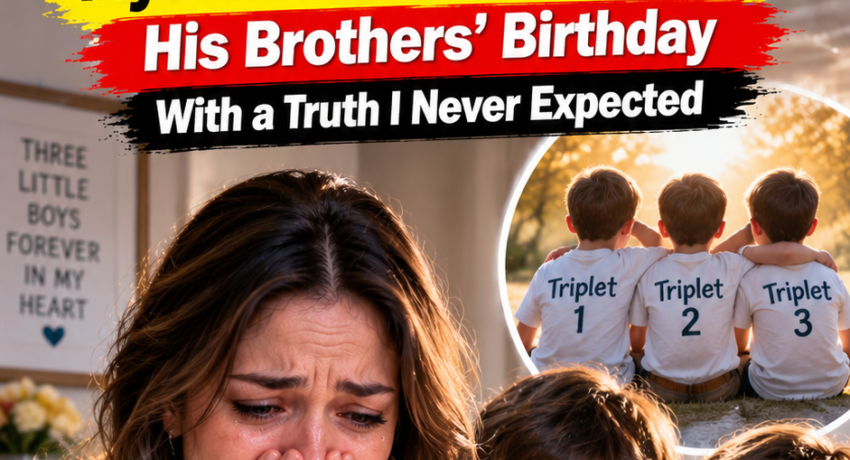
Riley and Rex had grown up knowing they were triplets.
Rowan had never been erased from our family.
There were photographs of the three of them as newborns tucked inside albums. His name had always been spoken. His birthday had always been remembered.
For eighteen years, I had believed that was all I had left of him.
A name.
A few hospital photographs.
A tiny hand I barely got to touch.
And a grief that had learned to live quietly inside my chest.
Doctor Jefferson had told us Rowan died after his condition worsened shortly after birth.
He had been the weakest of the three.
I remembered machines.
Nurses.
Bright lights.
My mother’s arms around me.
And someone telling me that my baby was gone.
For nearly two decades, I had built my life around that truth.
Then the doorbell rang.
“I’ll get it,” I told Watson.
He glanced toward the backyard.
“Probably one of their friends who can’t figure out how to use the side gate.”
I smiled faintly and wiped frosting from my fingers.
I expected to find another teenager carrying a gift bag.
Instead, the porch was empty.
No person.
No delivery truck.
No footsteps disappearing down the sidewalk.
Only a small cardboard box sitting on our welcome mat.
There was no postage.
No return address.
Across the lid, someone had written five words in thick black marker.
Happy Birthday, Brothers.
My heart seemed to stop before it started pounding.
“Dawn?” Watson called. “Who is it?”
I couldn’t answer immediately.
I bent down and picked up the box.
Something shifted softly inside.
“Dawn?”
“No one,” I finally said.
Watson appeared behind me.
The moment he saw the words, the color changed in his face.
“Maybe the boys ordered something.”
“They wouldn’t write that.”
He didn’t argue.
We both knew why.
Brother was not an ordinary word in our house.
Not that day.
Not when two sons were celebrating and a third was supposed to have been gone for eighteen years.
I held the box tightly against my chest.
“I’m taking this upstairs.”
Watson followed me with his eyes.
“If it’s some kind of joke—”
“Then Riley and Rex don’t need to see it.”
I walked into our bedroom and locked the door.
For nearly a minute, I simply stared at the box.
Then I lifted the lid.
And the life I thought I understood began to collapse.
Part 2 — “Don’t Trust Grandma”
A folded piece of paper lay on top.
My hands were already trembling when I opened it.
The first line made my blood run cold.
Dawn, please read everything before you tell anyone. And whatever you do, don’t trust Grandma.
Grandma.
There was only one person that could mean.
My mother.
Peggy.
I read the sentence again.
Then again.
Beneath the note was a hospital bracelet.
Tiny.
Yellowed with age.
The plastic had become slightly brittle around the edges.
I lifted it carefully.
And saw the name.
Rowan.
The room tilted.
“No…”
I turned the bracelet over as if the name might change.
It didn’t.
Underneath it lay a photograph.
A young man stood beside a lake, his hands tucked awkwardly into the pockets of a gray sweatshirt.
He looked about eighteen.
Tall like Rex.
The same shape of mouth as Riley.
Watson’s jaw.
And my eyes.
My eyes.
I knew them.
I had looked into those eyes in my own mirror for forty-five years.
A sound escaped me.
Not quite a sob.
Not quite a scream.
Watson knocked immediately.
“Dawn?”
I couldn’t move.
“Dawn, open the door.”
My fingers barely managed the lock.
Watson stepped inside.
Then he saw my face.
“What happened?”
I held out the bracelet.
His eyes dropped to the printed name.
For a moment, he didn’t understand.
Then he stumbled backward and sat on the edge of the bed.
“No.”
I handed him the photograph.
His mouth fell open.
“Dawn…”
“There’s a letter.”
He looked terrified of it.
“Read it,” I whispered.
“I don’t think I can.”
“Watson, please.”
His hands shook as he unfolded the pages.
He read the first paragraph aloud.
“My name is Rowan. I was raised believing my biological parents kept my brothers but couldn’t—or wouldn’t—keep me.”
Watson stopped.
His breathing became uneven.
I took the pages from him because I couldn’t bear waiting.
The letter continued.
Rowan explained that his adoptive parents had never treated him badly.
They had loved him.
They had given him a good childhood.
But several months earlier, while helping them clean out a storage room, he discovered a locked folder.
Inside were placement documents.
A newborn bracelet.
Medical paperwork.
And forms carrying our signatures.
He had spent months wondering what they meant.
Had we willingly given him away?
Had we chosen Riley and Rex over him?
Had we decided three babies were too many?
He wrote that he didn’t want money.
He didn’t want revenge.
He didn’t even know if he wanted a relationship with us.
He simply needed to know one thing before carrying his anger into adulthood:
Was I really unwanted?
I lowered the letter.
My entire body was shaking.
“I never gave him away.”
Watson’s eyes filled.
“I know.”
“I would never have given him away.”
“I know, Dawn.”
“I mourned him every day.”
“I know.”
My voice rose.
“Then why does he have papers with our names on them?”
Watson stared at the floor.
Then something shifted in his expression.
“I remember signing something.”
The room went silent.
I turned toward him slowly.
“What?”
“At the hospital.”
He pressed both hands against his face.
“Your mother brought me a clipboard.”
My stomach clenched.
“Peggy?”
“She told me you had already signed everything.”
“Signed what?”
“She said it was medical paperwork. Something about Rowan’s condition. She told me there were decisions that had to be made quickly.”
He looked at me helplessly.
“You were barely conscious half the time. You’d lost so much blood. She said you couldn’t handle another conversation with the doctors.”
I could barely hear him over the pounding in my head.
“What exactly did she say?”
Watson swallowed.
“She said Rowan was suffering. She said you’d agreed that we shouldn’t prolong it.”
I felt sick.
“I never agreed to that.”
“I know that now.”
“Did you read what you signed?”
His silence answered me.
He began crying.
“Dawn, I thought I was signing something you had already approved. Your mother kept saying I had to be strong because you couldn’t be.”
I stood abruptly.
The box nearly slid from the bed.
For eighteen years, I had remembered my sons’ birth through fragments.
The beeping monitors.
Doctor Jefferson’s solemn expression.
My mother’s hand smoothing my hair.
Medication making the ceiling drift above me.
A voice telling me Rowan hadn’t survived.
Peggy whispering that I shouldn’t see him afterward because the memory would destroy me.
The tiny sealed coffin.
The framed photograph resting on top.
I had trusted my mother because I was too broken to do anything else.
Now one thought tore through me.
I had never seen Rowan’s body.
Part 3 — The Missing Death Certificate
“I need the hospital folder.”
Watson stared at me.
“Now?”
“Right now.”
We went to the hall closet.
Behind winter blankets and old photo albums sat a plastic storage bin containing documents from the boys’ birth.
I carried it into our bedroom and emptied everything onto the floor.
Medical bills.
Riley’s discharge paperwork.
Rex’s feeding instructions.
Cards from relatives.
Insurance forms.
A receipt for funeral services.
I searched faster.
Watson dropped to his knees beside me.
“What are you looking for?”
I looked at him.
“Rowan’s death certificate.”
His hands stopped.
Neither of us spoke.
We searched the entire bin again.
Nothing.
I remembered asking my mother about it years earlier when I needed birth records for insurance paperwork.
She had told me she kept Rowan’s documents in her fireproof box because she didn’t want me reopening old wounds.
At the time, I had been grateful.
Now I felt foolish.
“No death certificate,” I whispered.
Watson closed his eyes.
Then I found an old business card wedged beneath a stack of condolence notes.
Doctor Jefferson’s card.
There was handwriting on the back.
I recognized it immediately.
I hope someday you find peace with the decision made for Rowan.
I stared at the word.
Decision.
Not loss.
Not death.
Decision.
Watson read it over my shoulder.
His voice was barely audible.
“What decision?”
I looked at the hospital bracelet on the bed.
Then at the photograph of my living son.
“We’re going to ask him.”
Part 4 — The Doctor Who Wouldn’t Look at Me
Doctor Jefferson’s office had changed.
The walls were painted a different color.
The furniture looked newer.
But the smell brought everything back.
Antiseptic.
Paper.
Coffee.
Hospitals and medical offices had always made me uneasy after the boys were born.
That day, I walked in carrying eighteen years of grief in one hand and Rowan’s bracelet in the other.
The receptionist tried to tell me the doctor was booked.
I placed the bracelet on the counter.
“Tell him Dawn Mercer is here about the newborn he told me died eighteen years ago.”
She stopped speaking.
A few minutes later, Doctor Jefferson opened his office door himself.
He had aged.
His hair was thinner.
His shoulders stooped slightly.
But I recognized his face.
And when he saw the bracelet, fear crossed it before he could hide it.
That was when I knew.
Before he said anything.
Before Watson and I sat down.
Before I placed the copied forms in front of him.
I knew.
“Where did you get that?” he asked.
“From Rowan.”
He stared at me.
“My son,” I added. “My living son.”
The doctor sank into his chair.
I didn’t.
“I want his complete medical record.”
“Dawn, there are privacy procedures—”
“I’ll sign anything required.”
“You’ll need to submit—”
“Fine.”
I leaned across his desk.
“But while those forms are being processed, answer one question.”
He looked at me.
“Did Rowan die?”
His gaze dropped.
“Rowan was extremely fragile.”
“That is not what I asked.”
He swallowed.
“His condition improved after he was transferred.”
I gripped the edge of his desk.
Watson made a strangled sound behind me.
For a moment, no one spoke.
Eighteen years.
Eighteen birthdays.
Eighteen Christmases.
Eighteen nights every year when I took out his hospital photograph and wondered who he might have become.
All while he was somewhere in the world becoming that person without me.
“You told me my baby was dead.”
Doctor Jefferson rubbed his forehead.
“I was under the impression you understood the arrangement.”
“What arrangement?”
“The placement.”
My voice shook.
“I never discussed adoption with you.”
“Your mother told us—”
“My mother.”
He stopped.
There it was.
I sat down because my knees suddenly felt weak.
“What did Peggy tell you?”
“That you and Watson had concluded caring for three newborns—especially one requiring intensive medical follow-up—would be overwhelming.”
Watson stood.
“We concluded nothing.”
Doctor Jefferson looked toward him.
“Mr. Mercer—”
“No. Don’t.”
Watson’s voice cracked.
“We held a funeral.”
The doctor closed his eyes.
“My understanding was that Peggy arranged a private memorial because you had agreed not to have a viewing.”
Dizziness rolled through me.
“Was there a body in that coffin?”
Doctor Jefferson said nothing.
“Answer me.”
“I wasn’t involved in the funeral arrangements.”
That answer was enough.
I felt my grief changing shape inside me.
For eighteen years, it had been sorrow.
Now there was rage inside it.
Not wild rage.
Something colder.
Sharper.
“Did you ever ask me privately whether I wanted Rowan placed with another family?”
“No.”
“Did you ask Watson?”
“No.”
“Did you personally explain the placement forms to either of us?”
He hesitated.
“No.”
Watson turned away and covered his mouth.
I looked at the doctor.
“You accepted the word of my mother while I was medicated, recovering from childbirth, and grieving what I had been told was the death of my son.”
Doctor Jefferson’s shoulders sagged.
“At the time, I believed Rowan needed stability.”
“He had parents.”
“I know that now.”
“No,” I said. “You knew it then. You simply decided someone else’s judgment mattered more than ours.”
He looked devastated.
I couldn’t care yet.
Maybe someday.
Not then.
I picked up the bracelet.
“I want every record.”
“You’ll receive whatever can legally be released.”
“And every note containing my mother’s name.”
He nodded.
“After that, I’m speaking to an attorney.”
His eyes lifted.
“I understand.”
“You will.”
As Watson and I reached the door, he asked the question I had been afraid to ask.
“Do you know where Rowan lives?”
Doctor Jefferson shook his head.
“The adoptive family moved years ago.”
I pulled out the photograph.
“He already found us.”
Part 5 — The Boy on My Porch
The party was still going when we returned home.
Music.
Laughter.
Teenagers shouting beside the pool.
Normal life continuing as if ours had not just split open.
My mother’s car was parked near the curb.
The sight of it made my hands tighten around the steering wheel.
Watson touched my arm.
“Let me talk to her first.”
“No.”
“Dawn—”
“You’re standing beside me.”
He nodded.
We walked toward the porch.
Then I saw someone near the railing.
A tall young man.
Gray sweatshirt.
Dark hair.
Hands shoved into his pockets.
The boy from the photograph.
He looked ready to run.
For one impossible second, I was twenty-seven again, staring through the plastic wall of an incubator.
Then he looked at me.
My knees nearly gave out.
“I’m sorry,” he said quickly. “I left the box and drove away. Then I came back.”
His voice trembled.
“I heard people in the backyard. I guess I wanted to hear what my brothers sounded like.”
Brothers.
My throat closed.
“Rowan.”
He flinched slightly at hearing his name from me.
His eyes filled.
“I don’t know what I’m supposed to call you.”
Pain pierced me.
Not because he hadn’t said Mom.
Because he felt he had to apologize for it.
“You don’t have to call me anything you’re not ready to call me.”
He looked toward Watson.
“Are you angry with me?”
Watson’s face crumpled.
“At you?”
He stepped forward, then stopped himself.
“Never.”
Rowan looked at me again.
“I just needed to know.”
“Know what?”
His jaw tightened.
“Whether you really didn’t want me.”
I wanted to grab him.
To hold him.
To somehow push eighteen missing years backward through time.
Instead, I forced myself to stay where I was.
“You were wanted.”
His eyes flickered.
“Every second,” I said.
I lifted one hand.
“May I touch you?”
He hesitated.
Then nodded.
I placed two fingers against his cheek.
Warm.
Alive.
My child.
Not a photograph.
Not a candle.
Not a name whispered in the dark.
My son.
“You were wanted every moment of your life,” I whispered.
His face twisted as he tried not to cry.
And then the patio door opened.
Part 6 — “You Knew There Were Three”
My mother walked onto the porch carrying two brightly wrapped gifts.
“There you are,” she said. “I’ve been looking everywhere. I brought Riley and Rex—”
She saw Rowan.
The gift bag slipped several inches in her hand.
Her face became completely white.
“Dawn…”
I stepped between them.
“Who are the gifts for, Mom?”
She stared at me.
“What?”
“You said you brought gifts for the boys.”
I pointed toward the bags.
“Which boys?”
“Dawn, don’t do this here.”
“Answer me.”
Her eyes moved toward Rowan again.
I had never seen my mother look afraid of me before.
“You bought presents for Riley and Rex,” I said. “Because you knew exactly which two sons would be here.”
Watson came up beside me.
“You told us Rowan died.”
My mother glanced toward the backyard.
Teenagers had begun noticing the tension.
The music was lowered.
Riley appeared in the patio doorway.
Rex was behind him.
“Mom?” Riley asked.
I looked at my two sons.
Then at the third son standing beside me.
There was no gentle way to say it.
Watson’s voice broke first.
“Boys…”
He wiped his face.
“This is Rowan.”
Rex stared.
Riley looked at Rowan, then at me.
“Our Rowan?”
Rowan lowered his eyes.
“I didn’t come here to mess up your birthday.”
Neither boy moved.
“I don’t want anything from you,” Rowan continued. “I just… needed answers.”
Riley took a slow step forward.
“You’re our brother.”
Rowan’s eyes filled.
“I think so.”
“No,” Rex said quietly.
He wiped his face with the heel of his hand.
“You are.”
Rowan let out a shaky breath.
My mother began crying.
“Dawn, you have to understand what it was like.”
I turned.
“What was like?”
“You were barely functioning.”
Her words tumbled over one another.
“You had two babies who needed constant care. You were exhausted. Watson was terrified. There were bills everywhere. Rowan needed specialists. Machines. Appointments. I thought—”
“You thought what?”
“That I couldn’t handle my own child?”
“I thought you might not survive losing yourself trying to save everyone!”
Rage flashed through me.
“So you made the choice for me?”
“I found him a wonderful family.”
Rowan stiffened.
My mother looked at him desperately.
“They were good people. They desperately wanted a baby. They had resources you didn’t have.”
“You told them we didn’t want him,” Rowan said.
Peggy froze.
He stepped forward.
“My parents showed me the placement paperwork.”
His voice shook.
“They were told my biological parents had decided three children were too much. They were told I was the one you couldn’t afford.”
My mother’s face collapsed.
“I was trying to make the transition easier.”
“For whom?” Rowan asked.
She had no answer.
I felt something inside me break cleanly.
Not my heart.
That had broken years ago.
This was trust.
“Tired mothers are still mothers,” I said. “Overwhelmed mothers are still mothers. Scared mothers are still allowed to make decisions about their children.”
Peggy cried harder.
“I thought you’d eventually understand.”
“I buried a coffin.”
“I didn’t want you to see—”
“There was nothing to see!”
My voice echoed across the porch.
“You told me Rowan was too fragile for an open viewing. You put his baby picture on that coffin and let me say goodbye to an empty box.”
Watson turned away, shoulders shaking.
Then he faced her.
“We stood over a grave grieving our son while he was alive.”
Peggy reached toward Rex.
“Sweetheart—”
He stepped back.
“Don’t.”
Her hand fell.
“Rex…”
“You knew we had another brother.”
She cried.
“I loved all three of you.”
Riley’s face hardened.
“Then why didn’t we know him?”
No answer.
No explanation could survive that question.
I pointed toward the driveway.
“Go home.”
“Dawn, please.”
“Any further contact with us goes through an attorney until I know exactly what happened.”
Her expression shifted from grief to disbelief.
“You’re keeping me from my family?”
I stared at her.
“No.”
My voice was quiet now.
“You made that decision eighteen years ago.”
Part 7 — Three Candles
After my mother left, no one knew what to do.
How could they?
There was no etiquette for discovering a brother who had been mourned for eighteen years.
Rowan lingered near the porch railing.
He looked ready to disappear again.
Riley finally broke the silence.
“So…”
Rowan glanced at him.
Riley gestured toward the backyard.
“Do you like chocolate cake?”
A laugh escaped Rowan before he could stop it.
“I’ve mostly had vanilla.”
Rex stared at him in horror.
“Eighteen years without proper cake?”
Rowan smiled.
Rex shook his head.
“This family reunion is already a disaster.”
That made Riley laugh.
Then Rowan.
Then Watson.
And somehow, through my tears, I did too.
It was not healing.
Not yet.
But it was the first crack through which healing might someday enter.
I went into the kitchen.
The cake was still where I had left it.
The frosting had softened slightly in the warm room.
The two large candles sat beside it.
One.
Eight.
I looked behind the flour jar.
At Rowan’s small white memorial candle.
For eighteen years, it had represented everything I had lost.
That night, I carried it outside.
Then I found two more small candles.
I placed all three in the cake.
One for Riley.
One for Rex.
One for Rowan.
When I lit them, my hands shook so badly that Watson had to steady my wrist.
The boys stood together.
Not naturally.
Not yet.
There were spaces between them.
Years between them.
Different childhoods.
Different memories.
But they were standing beneath the same light.
Watson whispered, “Make a wish.”
I stared at my sons.
For years, my impossible wish had been simple.
Just one more minute.
One more chance to hold Rowan.
One chance to tell him I had loved him.
Now he was standing ten feet away.
Alive.
I swallowed.
“I think mine already came true.”
Rowan looked at me.
I continued quietly.
“Now we just have to learn what to do with it.”
Part 8 — The Eighteen Years Between Us
Later, after most of the guests had left, Rowan sat beside me on the porch steps.
Riley and Rex were inside arguing over which movie the three of them should watch.
Three of them.
I still couldn’t think the words without feeling something twist inside my chest.
Rowan stared across the dark yard.
“I don’t want you to hate my parents.”
“I don’t.”
He looked surprised.
“They loved me.”
“Then I’m grateful they did.”
His shoulders loosened slightly.
“They didn’t know?”
“I don’t think so.”
He shook his head.
“They genuinely believed you had chosen adoption.”
“Then they were deceived too.”
He looked toward the house.
“Mom—my adoptive mom—was terrified when I found the folder. She thought I’d stop loving her.”
“Did you?”
“No.”
“Good.”
I meant it.
The truth was complicated enough without asking Rowan to erase the people who had raised him.
I wanted a place in his life.
I did not want to steal someone else’s.
After a long silence, I said, “I’m not asking you to pretend I raised you.”
He looked down.
“And I’m not asking you to call me Mom.”
His mouth trembled.
“I don’t know what I want yet.”
“You don’t have to.”
“What if I’m angry?”
“You’re allowed.”
“What if I don’t want to come here sometimes?”
“You’re allowed.”
“What if I want to know you and then it gets weird?”
Despite everything, I smiled.
“It will definitely get weird.”
He laughed softly.
Then grew serious again.
“I spent my whole life thinking I was the one baby nobody could keep.”
My heart tightened.
I turned toward him.
“No, Rowan.”
He looked at me.
“You were the child other people made decisions about without asking the people who should have had the right to choose.”
A tear slipped down his cheek.
I wanted to wipe it away.
I didn’t.
He deserved control over his own space after a lifetime shaped by other people’s choices.
After a moment, he reached out himself.
He placed his hand on my forearm.
“Thank you for fighting for me, Dawn.”
Dawn.
Not Mom.
The name hurt.
But it was honest.
And honesty was more precious to me than a title I hadn’t yet earned in his life.
“I should have been fighting eighteen years ago,” I whispered.
“You didn’t know.”
“No.”
I looked at him.
“But I know now.”
Part 9 — What Came After the Truth
The next morning, I began making calls.
Attorneys.
Hospital records departments.
State agencies.
Anyone who could help us reconstruct exactly what had happened.
I wanted every document connected to Rowan’s birth.
Every medical note.
Every consent form.
Every placement record legally available to us.
I wanted to know who had spoken to my mother.
Who had approved the paperwork.
Who had accepted signatures from two exhausted parents without speaking to us directly.
Doctor Jefferson sent what records he could release and cooperated with the formal process that followed.
Some questions were answered quickly.
Others took months.
Some may never be answered completely.
But one truth never changed:
Watson and I had never knowingly chosen to give Rowan away.
My mother had convinced herself she was solving a problem.
She believed money, medical care, exhaustion, and fear gave her the right to decide what kind of family we should have.
Perhaps that was how she survived living with what she had done.
I couldn’t.
Not anymore.
I did not immediately forgive her.
I didn’t even know what forgiveness would mean.
Forgiveness, I learned, was not the same as pretending something had never happened.
It did not require giving someone immediate access to the people they had hurt.
It did not erase consequences.
For a long time, there was distance.
Necessary distance.
Meanwhile, Rowan began visiting.
At first, he stayed an hour.
Then two.
Sometimes he spent most of the afternoon with Riley and Rex.
They discovered they had inherited the same terrible habit of leaving cabinet doors open.
All three hated olives.
Rex and Rowan liked the same old action movies.
Riley and Rowan both rubbed the back of their necks when nervous.
The first time I saw all three of them laughing around the kitchen table, I went into the laundry room and cried where they couldn’t see me.
Not because I was sad.
Not entirely.
I was grieving the years that should have looked like that.
First birthdays.
First words.
School concerts.
Lost teeth.
Scraped knees.
Teenage arguments.
Eighteen Christmas mornings.
No legal document could return them.
No apology could recreate them.
That grief would always exist.
But grief was no longer all I had.
Now I also had Tuesday dinners.
Text messages.
Awkward hugs.
New photographs.
Questions.
Stories about Rowan’s childhood.
The chance to know the man my baby had become.
Part 10 — My Son Was Never Gone
Several weeks after the birthday, I opened the kitchen cabinet and found Rowan’s old memorial candle.
I held it for a long time.
For eighteen years, I had lit it because I believed my son had died before he had the chance to live.
Now I knew he had been living all along.
Laughing.
Learning.
Growing.
Being loved by another family.
Wondering why we had not loved him enough to keep him.
That last part still hurt the most.
I carried the candle outside.
Rowan was sitting with Riley and Rex on the back steps.
The three of them were arguing about music.
Rex insisted Rowan’s playlist needed “serious intervention.”
Rowan told him anyone who willingly listened to Rex’s favorite band had no authority to judge another human being.
Riley was laughing so hard he could barely breathe.
I stopped in the doorway.
For a second, none of them noticed me.
And I allowed myself to simply look.
Three sons.
All eighteen.
All alive.
All under the same roof.
Watson came up behind me.
“You okay?”
It was the same question he had asked on their birthday.
But the answer had changed.
“No,” I said.
Then I smiled through my tears.
“But I think someday I will be.”
He put an arm around me.
I looked down at the little white candle.
Then I placed it in a drawer.
I didn’t throw it away.
The woman I had been for eighteen years deserved compassion too.
She had loved Rowan the only way she believed she could—by remembering him.
But I didn’t need a memorial candle anymore.
My son was not a memory.
He was outside complaining that his brothers had terrible taste in music.
He was learning our family one conversation at a time.
He still called me Dawn most days.
Sometimes that hurt.
But occasionally he would begin with, “Hey, D—” and hesitate.
I never finished the word for him.
I never pushed.
I had learned what happens when adults take choices away from someone because they think they know what is best.
So this time, Rowan would choose.
His pace.
His boundaries.
His relationship with us.
Everything.
Eighteen years had been stolen from our family.
Nothing could change that.
But those missing years were no longer going to steal the years ahead of us too.
That was the promise I made to myself as I watched Rowan get up and follow his brothers into the house.
Peggy had turned him into a secret.
The hospital had turned him into paperwork.
For years, grief had turned him into an empty chair in my imagination.
But he was none of those things.
He was Riley’s brother.
Rex’s brother.
Watson’s son.
My son.
And for the first time since the day he was born, all three of my boys were exactly where they should have been.
Together.
Home.