Part 1 — The Woman Standing in the Rain
The night Emily Carter came back into my life, she was standing on my front porch with rainwater dripping from the brim of a faded baseball cap.
She had no idea who I was.
I knew her before she even lifted her face.
For a few seconds, I simply stood there with one hand resting on the open door, unable to move.
Twenty years had passed.
Twenty years since I had last seen those warm brown eyes.
Twenty years since she had smiled at me under cheap silver decorations in a high school gym and made a seventeen-year-old boy believe, for one impossible evening, that maybe he wasn’t as worthless as everyone had made him feel.
Now she stood before me wearing a dark delivery jacket, holding a paper bag against her chest.
“Mr. Bennett?”
Her voice almost knocked the air out of me.
I swallowed.
“Yes.”
“Your order.”
She held the bag toward me with both hands.
The rain had soaked through the shoulders of her jacket. Strands of brown hair clung to her cheeks. There were faint shadows beneath her eyes, and although she was still unmistakably beautiful to me, life had changed her.
Not ruined her.
Changed her.
There was a tiredness in her face that hadn’t been there when we were teenagers.
“Thank you,” I said.
She gave me a professional smile.
“You’re welcome, sir. Have a good night.”
Sir.
Not Nathan.
Not even a moment of hesitation.
Nothing in her expression suggested she recognized me.
I shouldn’t have been surprised.
At seventeen, I had weighed nearly a hundred pounds more than I did now. I walked with a limp, wore oversized shirts, kept my hair long enough to hide my face, and rarely looked anyone in the eye.
At thirty-seven, I looked like an entirely different person.
Years of exercise had reshaped my body.
Success had changed the way I dressed.
Time had changed my face.
But some foolish part of me had still hoped that Emily would somehow look into my eyes and remember.
She didn’t.
I glanced past her toward the driveway.
“You’re soaked. Would you like to come in for a minute? I can get you some water. Coffee?”
Her expression softened, but she shook her head.
“I can’t. My brother’s waiting at home.”
“Your brother?”
“Adam.”
The name brought another wave of memories.
Emily continued, “He’s not feeling well tonight. I’m his main caregiver now.”
She adjusted the delivery bag beneath her arm.
“After our mother passed, it became just the two of us.”
There was something in the way she said it.
No self-pity.
Just exhaustion disguised as acceptance.
“I’m sorry,” I said.
“Thank you.”
Then she smiled again—the same little dimple appearing near the corner of her mouth.
My chest tightened.
“Goodnight, Mr. Bennett.”
“Nathan,” I said before I could stop myself.
She blinked.
“You can call me Nathan.”
“All right.”
She smiled politely.
“Goodnight, Nathan.”
Then she turned and walked into the storm.
I stood in the doorway long after she reached her car.
It was an old red Mustang, faded enough that the paint looked almost pink beneath the streetlamp.
Emily climbed inside and turned the key.
Nothing happened.
She tried again.
Still nothing.
Then a third time.
The engine coughed but refused to start.
Through the rain-streaked window, I saw her lower her forehead onto the steering wheel.
At first, I thought she was merely frustrated.
Then her shoulders began shaking.
She was crying.
Something inside me broke.
I dropped the food onto the hallway table, grabbed my keys, and headed outside.
But before I reached the porch steps, the Mustang sputtered to life.
Emily quickly wiped her face.
She backed away from the curb and disappeared into the storm.
I remained beneath the porch light, watching the empty road.
Twenty years earlier, Emily Carter had seen me crying when everyone else was laughing.
And she had stepped toward me.
That night, I realized I had just watched her do the same thing I used to do.
Hide her pain until nobody could see it.
And suddenly, twenty years disappeared.
Part 2 — Before Emily Chose Me
I wasn’t always the boy everyone made fun of.
Before I was sixteen, I had been fairly ordinary.
I played basketball badly.
I loved old science-fiction movies.
I complained about homework.
I argued with my father about curfews and rolled my eyes when my mother reminded me to take a jacket.
I thought my parents would always be there.
Then, one November night, everything changed.
We were driving home from a family gathering when another vehicle lost control on a rain-slick highway.
I remember headlights.
My mother’s scream.
Metal folding.
Glass breaking.
Then silence.
I woke up in a hospital.
My parents never did.
For weeks, I asked the same questions in different ways, as though changing the words might change the answers.
Eventually, reality stopped waiting for me to understand it.
My aunt Martha and uncle George took me into their home.
They were kind people.
Patient people.
They never made me feel like a burden.
But grief doesn’t disappear simply because people love you.
My leg had been badly injured in the crash.
For months, walking hurt.
I used crutches.
Then a cane.
Eventually I managed without either, though I still limped when I was tired.
I stopped playing sports.
Stopped calling friends.
Stopped caring what I looked like.
Food became the easiest comfort I could find.
It filled quiet rooms.
It gave my hands something to do.
It softened evenings when everyone else seemed to have somewhere to belong.
By the time I returned to school full-time, I had gained so much weight that several people genuinely didn’t recognize me.
The jokes started quickly.
Teenagers can sense insecurity with frightening accuracy.
They called me names in hallways.
Whispered when I passed.
Made whale sounds in the cafeteria.
One boy once tossed a candy bar onto my desk and said, “Emergency supplies.”
Everyone laughed.
I laughed too.
That was how I survived.
If I laughed first, maybe it hurt less.
It didn’t.
By senior year, I had perfected the art of making myself invisible.
I sat near classroom doors.
Ate lunch in the library whenever possible.
Avoided assemblies.
Avoided mirrors.
And when prom season arrived in spring, I never even considered going.
Prom was for people who belonged in photographs.
People who expected someone to want to stand beside them.
I was neither.
Then one afternoon, everything changed because Emily Carter stopped beside my locker.
Part 3 — “He’s Going With Me”
Emily was the kind of girl everyone knew.
She was captain of the cheer team.
She volunteered with the student council.
She had long brown hair, an effortless smile, and a warmth that made teachers remember her years after she’d left their classrooms.
Half the boys in school wanted to date her.
The other half claimed they didn’t only because they knew they had no chance.
I had spoken to her perhaps six times.
Mostly about class assignments.
Once about a vending machine that stole my dollar.
That was the extent of our relationship.
So when three boys were teasing me beside my locker one afternoon, Emily Carter was the last person I expected to intervene.
Prom was two weeks away.
One of the boys nodded toward a poster hanging above the hallway.
“You going, Nate?”
His friends laughed.
I tried to shut my locker.
“No.”
“Come on. Maybe someone will ask you.”
Another boy grinned.
“Maybe if she’s blind.”
Their laughter echoed against the lockers.
I kept my face down.
Then a girl’s voice said behind them,
“She isn’t blind.”
The boys turned.
So did I.
Emily stood several feet away wearing her cheerleading uniform and carrying two textbooks against her chest.
One boy smirked.
“What?”
Emily walked closer.
“He isn’t going to prom with someone who’s blind.”
She looked directly at me.
“He’s going with me.”
The hallway seemed to stop.
I actually looked behind myself.
Emily laughed softly.
“Yes, Nathan. I’m talking to you.”
My ears burned.
I assumed I had misunderstood.
Then I assumed it was a prank.
“Why?”
It came out harsher than I intended.
Emily’s smile faded.
“Why what?”
“Why would you ask me?”
The boys were still standing there.
Watching.
Waiting.
I hated them for seeing how badly I wanted her answer to be real.
Emily stepped closer.
“Because I want to.”
I shook my head.
“You don’t have to feel sorry for me.”
Her expression changed.
Not angry.
Serious.
“My brother has Down syndrome.”
I knew about Adam, although I had never met him.
Emily continued.
“I’ve spent my whole life watching strangers decide who he is before he gets a chance to speak. I’ve watched kids avoid him because he’s different. I’ve watched adults talk about him like he can’t hear them.”
She glanced toward the boys.
“So I know what it looks like when people decide someone’s value based on what they see.”
Then she looked back at me.
“You’re kind, Nathan.”
I couldn’t speak.
“You helped Mrs. Alvarez carry her boxes when she changed classrooms. You tutor freshmen in chemistry even though nobody knows about it. You sit with Mr. Jensen at lunch sometimes because you noticed he eats alone.”
Mr. Jensen was our elderly janitor.
I had never told anyone that.
Emily smiled.
“I notice things.”
Then, right there in the middle of the hallway, she reached out and took both of my hands.
I nearly forgot how to breathe.
She turned toward the boys.
“Nathan is my prom date.”
One of them muttered something.
Emily raised an eyebrow.
“And before anybody asks—no, I’m not blind.”
For the first time, they had nothing to say.
Then she turned back to me.
“Saturday. Seven o’clock?”
I nodded.
She squeezed my hands.
“Good.”
Then she walked away.
I stayed frozen beside my locker until the bell rang.
That afternoon, Aunt Martha took one look at my face when I came through the door.
“What happened?”
“I think…”
I couldn’t stop smiling.
“I think I’m going to prom.”
Uncle George nearly dropped his coffee.
“With a girl?”
Martha smacked his arm.
“George!”
“What? I’m gathering information.”
I laughed.
It was the first real laugh I’d heard come out of myself in months.
Part 4 — The Night I Became Visible Again
Aunt Martha helped me choose a charcoal suit.
Uncle George insisted I needed a proper tie.
He tied it three times before he was satisfied.
“Your father would have been proud,” he said quietly.
The words almost undid me.
When we pulled up outside Emily’s house that Saturday evening, my hands were trembling.
Then the front door opened.
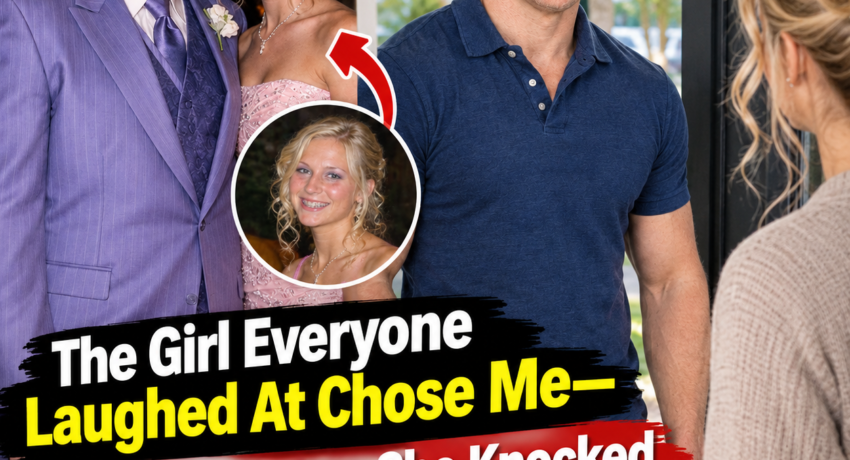
Emily stepped onto the porch wearing a pale blue dress.
For several seconds, I forgot every sentence I had practiced.
She smiled.
“You look handsome.”
“You…”
My voice cracked.
Uncle George laughed from the driver’s seat.
“Take your time, son. We’ve only got all night.”
Emily laughed.
I managed, “You look beautiful.”
“Thank you.”
Then she slipped her hand through my arm.
At school, people stared.
Of course they did.
Some whispered.
A few boys looked irritated.
But Emily acted as though none of them existed.
She introduced me to her friends.
Pulled me into photographs.
Brought me punch when my leg began hurting.
And when the music started, she took my hand.
I hesitated.
“I don’t really dance.”
“Neither does half the room.”
“They’ll laugh.”
Emily looked around.
“Then they’ll waste a perfectly good song.”
She pulled me onto the floor.
At first, every muscle in my body was stiff.
I was convinced everyone was staring at the size of my stomach.
My limp.
My awkward hands.
But gradually I stopped looking at them.
I looked at Emily.
She wasn’t embarrassed.
She wasn’t performing charity.
She was having fun.
With me.
Later, during a slow song, I finally asked the question that had been haunting me.
“Why did you really ask me?”
Emily rested one hand lightly on my shoulder.
“I already told you.”
“I know. But you could’ve gone with anyone.”
She studied my face.
Then she said something I would remember for the next twenty years.
“You looked like you needed someone to choose you out loud.”
I stared at her.
She continued softly.
“Sometimes people care about someone privately, but they’re too scared to show it when other people are watching. I didn’t want you to wonder.”
My eyes burned.
I looked away.
“Nathan?”
“Yeah?”
“You matter.”
Three words.
That was all.
But at seventeen, those words reached somewhere inside me that nothing else had reached since my parents died.
At the end of the night, Uncle George drove Emily home.
Before she went inside, she stood with me beneath the porch light.
“I had a really good time.”
“You don’t have to say that.”
She frowned.
“Nathan.”
“Sorry.”
“You really need to stop deciding what other people mean before they finish saying it.”
I smiled.
“Okay.”
“I had a really good time.”
“So did I.”
She hugged me.
For one unbelievable second, I thought she might kiss me.
Instead, she whispered,
“Don’t disappear again.”
Then she went inside.
On the drive home, Uncle George gave me a sideways glance.
“So when are you asking her out?”
I stared through the windshield.
“She’s just being nice.”
George groaned.
“Young people are exhausting.”
I never asked Emily out.
Part of me wanted to.
A larger part couldn’t believe someone like her could genuinely want someone like me.
Then graduation came.
Emily moved to Chicago with her mother and Adam. She had been offered a chance to pursue modeling.
I left for college in Canada.
We exchanged a few messages.
Then fewer.
Then none.
Life moved forward.
But I never forgot her.
Part 5 — Twenty Years of Becoming Someone Else
College gave me something high school never had.
A fresh start.
Nobody knew the nickname people had given me.
Nobody knew what I used to look like.
Nobody knew I was supposed to be the boy everyone laughed at.
I began walking every morning.
Then jogging.
Then going to a gym.
At first, I did it because I hated my body.
Eventually, I did it because exercise made me feel alive.
There is a difference.
Over several years, the weight came off.
My confidence returned more slowly.
I studied computer engineering, then helped launch a software platform with two classmates.
We failed once.
Then again.
Our third company survived.
By thirty, we were doing well.
By thirty-five, we were doing better than I had ever imagined.
I bought a house.
Travelled.
Spoke at conferences.
Appeared in business magazines.
People began calling me successful.
Women who wouldn’t have noticed me at seventeen suddenly found me interesting.
I dated.
I tried.
Some relationships were good.
One lasted nearly two years.
But I always held some invisible part of myself back.
Uncle George noticed.
One Christmas, after my girlfriend had left early, he sat beside me on the porch.
“You know what your problem is?”
“I own a company. I have several.”
“You compare every woman you meet to Emily Carter.”
I laughed.
“That was twenty years ago.”
“So?”
“We went to one prom.”
George took a sip of coffee.
“Some people spend years with us and leave almost nothing behind. Some people change us in one night.”
I didn’t answer.
Because he was right.
Emily had not merely taken me to a dance.
She had reached into one of the darkest periods of my life and shown me another version of myself.
The boy she saw that night eventually became the man I spent years trying to become.
I searched for her online once or twice.
Her accounts were private or inactive.
Eventually, I stopped.
I assumed she had built the extraordinary life everyone expected of her.
A husband.
Children.
Some glamorous career.
Perhaps a house filled with photographs.
I never imagined she would come back carrying takeout in the rain.
Part 6 — What Had Happened to Emily Carter?
The morning after Emily delivered my dinner, I couldn’t concentrate.
Her face kept appearing in my mind.
The exhaustion.
The shaking hands.
The way she had cried alone in that broken-down car.
By afternoon, I had made a decision that was either sentimental or ridiculous.
Possibly both.
I ordered from the restaurant again.
Then I called.
“I’d like the same delivery driver from last night, if possible.”
The manager sounded amused.
“You have a favorite driver?”
“Something like that.”
I added a note to the order.
You forgot something. Please come back.
The following evening, the doorbell rang.
Emily stood there looking terrified.
“Did I leave something here?”
Her voice rushed forward before I could answer.
“I’m so sorry. If something was missing from your order, I can replace it. Please don’t complain to the manager. I really need this job.”
My heart sank.
“Emily.”
She froze.
I had used her name.
“How do you know—”
“Come inside.”
She took a step backward.
I realized how strange this must look.
“I’m not going to hurt you. I promise. There’s something I want to show you.”
After several seconds, she cautiously stepped inside.
I led her toward the living room.
Aunt Martha and Uncle George had kept boxes filled with old photographs for decades. That afternoon, I had found the prom pictures and arranged several framed copies along the mantel.
There we were.
Seventeen.
Laughing beside the punch bowl.
Standing near the gym entrance.
Dancing.
One photograph showed Emily leaning into me while I looked at her as though I’d somehow wandered into a dream.
Emily stopped walking.
Her hand flew to her mouth.
“No.”
I said the nickname only her family and closest friends had used in high school.
“Em.”
Her head snapped toward me.
I smiled.
“It’s me.”
Her eyes moved slowly over my face.
“Nathan?”
I nodded.
She took one step toward me.
Then another.
“Oh my God.”
Her eyes filled instantly.
“Nathan Bennett?”
“The former owner of the world’s worst prom haircut.”
She let out a broken laugh.
Then she started crying.
“I didn’t recognize you.”
“I know.”
“I delivered food to you and called you sir.”
“I noticed.”
She laughed through her tears.
Then she covered her face.
“I can’t believe this.”
I moved closer but stopped before touching her.
“What happened, Emily?”
She lowered her hands.
“What do you mean?”
“When you left, you were going to conquer the world.”
Her smile faded.
“I tried.”
We sat down.
And for the next hour, Emily told me about the twenty years I had imagined completely wrong.
She had moved to Chicago and found some modeling work.
Catalogues.
Local advertising.
Small runway jobs.
Then her mother became ill.
Emily began spending more time at home helping with Adam.
Jobs became harder to accept.
Travel became almost impossible.
There had also been a minor car accident that left a scar along her upper arm, but she laughed bitterly when mentioning it.
“People think the scar ended the modeling.”
She pushed up her sleeve.
A pale line crossed her skin.
“It didn’t.”
“What did?”
“Life.”
Her mother needed treatment.
Adam needed stability.
Medical bills accumulated.
Emily worked as a waitress.
A receptionist.
A cleaner.
A grocery clerk.
Anything that fit around caregiving.
“Every year, I told myself I’d go back,” she said. “Then Mom would have another bad month. Adam would need something. Rent would go up.”
Her fingers twisted together.
“Then Mom died.”
“I’m sorry.”
Emily nodded.
“I thought after that I’d finally have more time. Which sounds horrible, doesn’t it?”
“No.”
“I loved her.”
“I know.”
“I just thought maybe life would open again.”
She looked toward the prom photographs.
“But grief takes time too.”
Her voice broke.
“And Adam had just lost our mother. I couldn’t leave him alone.”
“So you stayed.”
“I stayed.”
She gave me a small smile.
“One year became five. Five became ten. Then suddenly I looked in the mirror and realized I was thirty-six and still telling myself everything was temporary.”
I listened.
No judgment.
No solutions.
Because I knew what it was like to lose years while surviving something nobody else could see.
Part 7 — The Truth I Had Never Told Her
Eventually, Emily glanced around my house.
“So what happened to you?”
“Nothing dramatic.”
She laughed.
“Nathan, you look like someone who appears in advertisements for watches normal people can’t afford.”
I laughed too.
Then I told her about college.
The company.
The failures.
The success.
The years between.
She smiled.
“I knew you’d do something big.”
“You did?”
“Of course.”
“I didn’t.”
Her expression softened.
I looked toward the photographs.
“Actually, there was something I never told you.”
“What?”
“That night changed my life.”
She looked uncertain.
“Nathan…”
“I’m serious.”
I leaned forward.
“Before prom, I hated walking into school. I hated being seen. After my parents died, I already felt like half of me had disappeared. Then people started making fun of my body, and eventually I began believing that was all anybody saw when they looked at me.”
Emily’s eyes filled again.
“You took my hands in a hallway full of people.”
I swallowed.
“You didn’t whisper that I was a good person privately. You chose me publicly.”
She looked down.
“And for the first time since the accident, I thought maybe there was still something about me worth choosing.”
“Nathan…”
“You once told me I mattered.”
I smiled.
“I built a lot of my life trying to become the person you seemed to think I already was.”
A tear slipped down her cheek.
I reached over and wiped it away with my thumb.
“You saved me before either of us was old enough to understand what saving someone meant.”
She shook her head.
“I just asked you to prom.”
“No.”
I smiled.
“You made a lonely kid feel human again.”
For several moments neither of us spoke.
Then Emily whispered,
“I wish my life looked better when you found me.”
My chest tightened.
“What?”
She looked embarrassed.
“You became all this.”
She gestured around the room.
“And I showed up wearing a delivery jacket with a car that barely starts.”
I leaned closer.
“Emily, look at me.”
She did.
“You gave up opportunities to care for people you loved.”
“That isn’t impressive.”
“It is to me.”
Her mouth trembled.
“You survived things no one applauded you for. That doesn’t make your life small.”
She stared at me for a long time.
Then she whispered,
“You still do that.”
“Do what?”
“See people differently.”
I almost laughed.
“No.”
I shook my head.
“You taught me how.”
Part 8 — Not a Rescue
I didn’t kiss Emily that night.
I wanted to.
But twenty years of memory can make people confuse nostalgia with love.
I didn’t want that for us.
More importantly, I didn’t want Emily to believe I had appeared to rescue her.
So we started slowly.
Coffee.
Dinner.
Phone calls.
I met Adam again.
He remembered my name after Emily showed him our prom pictures.
“Blue dress!” he shouted proudly the first time I came over.
Emily laughed.
“Yes, Adam. I wore the blue dress.”
He pointed at me.
“Nathan was bigger.”
I nearly choked on my coffee.
Emily covered her face.
“Adam!”
“What?” he asked innocently.
I laughed harder than I had in years.
“Yes, buddy. I was.”
Adam became one of my favorite people almost immediately.
Over the following weeks, I learned more about Emily than I ever had at seventeen.
She loved crossword puzzles.
She hated mushrooms.
She still hummed when nervous.
She could fix almost anything because years of being unable to afford repairmen had forced her to learn.
She was stubborn about accepting help.
Especially from me.
When I offered to replace her car, she refused.
“I am not becoming your charity project.”
“You aren’t.”
“It feels like it.”
So instead, I helped her find reliable transportation she could afford herself.
When I offered her a job at my company, she refused that too.
“I don’t want to wake up every day wondering whether I earned it.”
I respected that.
Eventually, through one of her own contacts, she found administrative work with a nonprofit supporting families with disabled adults.
The work suited her.
More importantly, she chose it.
One evening after dinner, we walked beside the river.
Emily slipped her hand into mine.
It felt so familiar that I stopped walking.
She looked up.
“What?”
“Nothing.”
“Nathan.”
I smiled.
“I’ve remembered this for twenty years.”
Her eyes softened.
“Holding hands?”
“Your hand in mine.”
She stepped closer.
“You really never forgot prom?”
“Not one minute.”
She looked at me for a long time.
Then she smiled.
“Neither did I.”
I blinked.
“What?”
“You think you were the only one scared?”
“You were Emily Carter.”
“What does that mean?”
“You could have dated anyone.”
She shook her head.
“You were the first boy I ever asked out.”
I stared at her.
“Why didn’t you tell me?”
“Why didn’t you ask me out afterward?”
We both went silent.
Then we laughed.
Twenty years of misunderstanding collapsed in seconds.
Emily rested her forehead against my chest.
“We were idiots.”
“Teenagers.”
“Same thing.”
Then I lifted her chin.
This time, when I kissed her, there was no dramatic music.
No audience.
No string lights.
Just a quiet riverside walkway and two people who had spent half their lives becoming themselves.
She kissed me back.
And somehow, that was enough.
Part 9 — The Question I Should Have Asked Twenty Years Earlier
Six months later, Aunt Martha invited us to dinner.
Uncle George opened the door, saw Emily beside me, and threw both hands into the air.
“Finally!”
Emily laughed.
“What?”
He pointed at me.
“I’ve spent twenty years telling this fool he should’ve asked you out.”
“George,” Martha warned.
“No. The truth must be documented.”
Over dinner, Martha brought out the old photograph album.
Emily sat beside Adam turning pages.
There were prom photographs.
Graduation pictures.
Pictures of me before the accident.
Pictures of my parents.
At one point, Emily stopped on a photograph of seventeen-year-old me smiling beside her.
“He looks happy,” she said.
Martha looked at me.
“He was.”
I reached under the table and took Emily’s hand.
Later, after everyone went to bed, Emily and I sat alone on the back porch.
She leaned against my shoulder.
“You know what scared me most when I recognized you?”
“What?”
“That you’d remember the girl I used to be and be disappointed by the woman I became.”
I turned toward her.
“I was afraid of the opposite.”
She frowned.
“I thought maybe you had only liked me because I needed saving.”
Emily took my face in both hands.
“Nathan, I asked you to prom because you were gentle when the world had given you every excuse not to be.”
My throat tightened.
“And I love you now for exactly the same reason.”
That was the first time either of us said the word.
Love.
I didn’t answer immediately.
Not because I doubted it.
Because after twenty years, I wanted to remember the moment exactly.
Then I whispered,
“I love you too.”
A month later, I asked Emily to marry me.
Not at a restaurant.
Not on vacation.
Not somewhere designed for photographs.
I took her back to our old high school.
The gym had been renovated, but part of the original hallway remained.
We stood near the lockers where she had once taken my hands in front of everyone.
Emily looked around.
“Why are we here?”
I smiled.
“Because there’s something I should have asked you twenty years ago.”
Her eyes widened.
I lowered myself onto one knee.
Emily covered her mouth.
“Emily Carter, you chose me when I had forgotten how to choose myself.”
She was already crying.
“You’ve spent your entire life taking care of everyone around you. I don’t want to rescue you. I don’t want you to owe me anything. I just want to stand beside you while we build whatever comes next.”
I opened the ring box.
“Will you marry me?”
She was nodding before I finished.
“Yes.”
Then she laughed through her tears.
“Yes, Nathan.”
When I stood, she wrapped both arms around my neck.
From somewhere down the hallway came a loud cheer.
I looked over her shoulder.
Aunt Martha.
Uncle George.
Adam.
All three had been hiding around the corner.
Emily stared at me.
“You brought an audience?”
“George insisted.”
Uncle George shouted,
“Somebody had to make sure he didn’t wait another twenty years!”
Part 10 — What Choosing Someone Really Means
Emily and I were married the following spring.
Adam walked her down the aisle.
Uncle George cried harder than Aunt Martha and denied it afterward.
Our wedding wasn’t extravagant.
Emily didn’t want extravagant.
She wore a simple ivory dress.
Near the reception tables, we displayed one photograph from our high school prom.
In it, seventeen-year-old Nathan Bennett stood beside Emily Carter looking as if he couldn’t believe he had been invited into his own life.
Sometimes I study that picture.
I want to tell that boy so many things.
I want to tell him that his parents’ deaths will always hurt, but grief will eventually stop being the only thing he feels.
I want to tell him that the people laughing in the hallway will disappear into distant memory.
That his body will change.
That confidence will return.
That success will come.
But more than anything, I want to tell him this:
The girl holding his hand isn’t saving him because he is weak.
She is reminding him that cruelty doesn’t get to decide who he is.
Emily once believed that her own life had somehow become less valuable because it didn’t follow the glamorous path people expected.
She thought missed opportunities meant failure.
She thought caregiving had made her fall behind.
It took time for her to understand what I had learned because of her all those years ago.
A person’s value is not determined by the room they walk into, the job printed beneath their name, the size of their bank account, their body, their clothes, or whether strangers consider their life impressive.
Sometimes the most important things a person ever does are invisible.
Emily spent years showing up for her mother.
She stayed beside Adam when leaving would have been easier.
She worked jobs that exhausted her because people she loved depended on her.
Nobody gave her awards.
Nobody wrote articles about her.
Nobody cheered.
But none of that made those years wasted.
And my own success didn’t make me more worthy than the boy she took to prom.
That boy was already worthy.
I simply didn’t know it.
Emily did.
One Sunday morning, not long after our wedding, I found her standing in the living room holding the old prom photograph.
She smiled when I entered.
“You kept this all those years.”
“I did.”
“Even through all those girlfriends?”
I laughed.
“Especially then.”
She narrowed her eyes playfully.
“That’s slightly concerning.”
“George says it’s romantic.”
“George also thinks potato chips count as dinner.”
“Fair.”
She looked at the photograph again.
“Why did you really keep it?”
I walked over and wrapped my arms around her waist.
“Because when I looked at it, I remembered that there had been at least one person in the world who saw something good in me when I couldn’t.”
Her eyes filled.
I touched the photograph.
“You didn’t make me popular.”
“No.”
“You didn’t magically fix my grief.”
She leaned into me.
“No.”
“You didn’t change what those kids said.”
“No.”
I looked at her.
“You did something more important.”
“What?”
“You refused to let them have the final word.”
Emily reached up and held my face.
Then she said almost exactly what she had said twenty years earlier.
“You still matter, Nathan.”
I smiled.
“So do you.”
She kissed me.
From the kitchen, Adam shouted,
“Are you two kissing again?”
Emily burst out laughing.
“Yes, Adam.”
“Gross!”
“You’re the one who asked!”
He appeared around the doorway carrying a cereal bowl.
“I didn’t ask. I investigated.”
I looked at Emily.
She was laughing so hard she had tears in her eyes.
And suddenly I remembered another Emily.
Seventeen years old.
Pale blue dress.
Standing beneath a porch light.
Telling me not to disappear.
For years, I thought our story was about a beautiful girl who took pity on an overweight boy.
I had been wrong.
It was never about pity.
It was about courage.
At seventeen, Emily had the courage to choose kindness when cruelty was easier.
Twenty years later, I had the chance to return that gift—not by rescuing her, but by reminding her of what she had once taught me.
That people are more than the hardest season of their lives.
That being overlooked doesn’t mean being unworthy.
That losing your way doesn’t mean your story is finished.
And that sometimes a single act of kindness keeps traveling through a person’s life long after the person who gave it has forgotten.
Emily thought she was only taking a lonely boy to prom.
She didn’t know she was giving him a memory strong enough to survive twenty years.
She didn’t know that one day, when she was the person standing in the rain feeling exhausted, embarrassed, and invisible, that same boy would recognize her.
Not because she still looked like the prettiest girl in school.
Not because he owed her.
And not because she needed someone wealthy to rescue her.
I recognized Emily because underneath the exhaustion, she was still the woman who had taught me what it meant to see another human being fully.
And this time, I got to choose her out loud.
Not for one dance.
Not for one night.
For the rest of our lives.