Part 1 — The Moment Everything Changed
Nurse Sarah moved so quickly that for one terrifying second, I didn’t understand what I was seeing.
She reached into my newborn daughter’s bassinet, lifted Ivy into her arms, and spun toward the door. The pink hospital blanket slipped from Ivy’s tiny body and crumpled onto the floor.
“Call neonatal!” Sarah shouted.
The sharp command cut through the cheerful noise in my recovery room.
My husband, Tom, stopped mid-sentence. He was standing beside the window with our newborn son, Mason, cradled proudly against his chest.
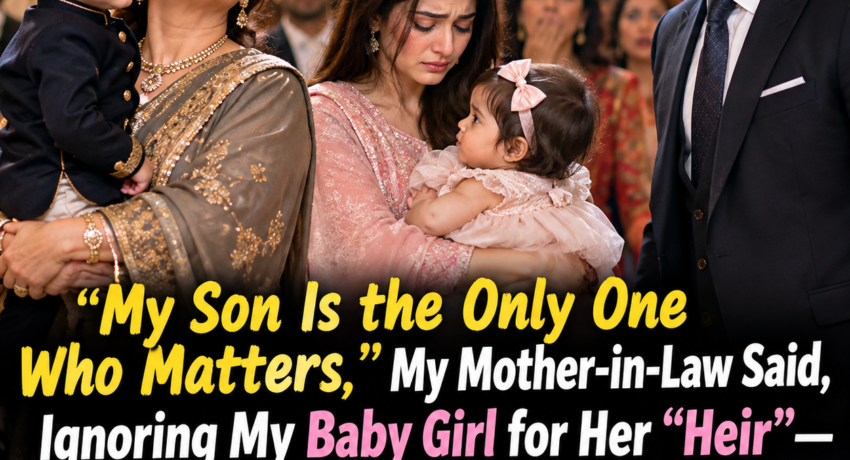
His mother, Margot, had been leaning over Mason only moments earlier, admiring his nose, his fingers, the shape of his chin—trying to decide which Waverly ancestor he resembled most.
Now everyone stared at Sarah.
“What’s wrong?” I asked.
My voice barely sounded like mine.
Sarah didn’t answer immediately.
She lowered Ivy onto the mattress, placed two fingers against her tiny chest, then tilted her head carefully.
“I need oxygen in here. Now!”
Another nurse rushed through the doorway pushing a cart. A doctor appeared seconds later.
The room that had been filled with flowers, congratulations, photographs, and laughter suddenly became a place of controlled panic.
Someone pulled the curtain partially around Ivy’s bassinet.
But they didn’t close it completely.
Through the gap, I could see my daughter’s feet.
They were blue.
I tried to sit upright.
Pain ripped across my abdomen.
I had been in labor for thirty-six hours. I had lost too much blood during delivery. My body felt as though someone had emptied it of everything except fear.
“What’s happening to her?” I cried.
Tom quickly placed Mason into the nearest crib and stepped toward the medical team.
Sarah held out one arm.
“Please give us room.”
“Is she breathing?” Tom demanded.
“Not well enough.”
The doctor pressed a stethoscope against Ivy’s chest.
His expression changed.
“Respiratory distress. Heart rate is dropping.”
My vision blurred.
That couldn’t be right.
Both babies had cried when they were born.
I remembered it.
Mason first, loud and angry.
Then Ivy, smaller but unmistakable.
I had heard both of my children announce themselves to the world.
Now there was no sound coming from my daughter.
Only the hiss of oxygen.
“We need to move her,” the doctor said.
Sarah raised the sides of the bassinet.
“No!” I reached toward them. “Please. Let me see her first.”
Sarah hesitated for half a second, then brought Ivy close enough for me to touch.
I reached out and wrapped one trembling finger around my daughter’s hand.
Her skin felt cold.
“Stay with me, Ivy,” I whispered. “Please, sweetheart. Stay with me.”
We had chosen her name months before.
Margot had disliked it immediately.
She had called it delicate.
Weak.
Not the sort of name, she said, that belonged in the Waverly family.
At that moment, I would have given anything just to hear Ivy cry.
Sarah squeezed my shoulder.
“We’re taking her to the NICU.”
And then my daughter disappeared through the doorway.
I tried to get out of bed.
My legs collapsed before my feet were properly underneath me.
Tom caught me.
“Kris, stop.”
“Go after her.”
“I’m not leaving you like this.”
“Tom.”
I grabbed his arm.
“Go with our daughter.”
He looked toward the hallway.
Then he looked across the room.
At his mother.
Margot was standing beside Mason’s crib.
Her hands rested protectively on the clear plastic sides.
She hadn’t followed the doctors.
She hadn’t asked whether Ivy would survive.
She was still watching the boy.
Tom noticed it too.
Something shifted in his face.
“Mom.”
Margot turned toward him.
“You should stay here with the boy,” she said calmly.
Tom stared at her.
“My daughter can’t breathe.”
“The doctors are taking care of her.”
“Her name is Ivy.”
Margot’s lips tightened.
“This is hardly the time, Thomas.”
Tom’s expression hardened.
“No. I think this is exactly the time.”
He turned toward the hallway.
Margot caught his sleeve.
“The family is downstairs waiting to meet your son.”
Tom looked at her hand.
Then slowly pulled his arm away.
“Get out.”
Margot blinked.
“What did you say?”
“Leave the hospital.”
For once, the woman who always seemed to know exactly what to say had nothing ready.
Then her face changed.
Coldness replaced surprise.
“You’re upset.”
“My daughter almost died while you were moving her bassinet away from everyone.”
“I did nothing of the sort.”
“You moved her.”
“She was in the way.”
The words sliced through the room.
She was in the way.
My daughter was less than a day old, fighting to breathe somewhere down the hall, and her grandmother had just described her as an inconvenience.
Tom pointed toward the door.
“Get out.”
Margot gave a quiet laugh.
I knew that laugh.
We both did.
It was the sound she made whenever someone temporarily forgot who held the money.
She had laughed like that at our wedding when my father questioned why she had selected the venue without asking either of us.
She had laughed the same way when Tom once mentioned leaving the family business.
And she used that laugh whenever she reminded us that the down payment on our house had come from the Waverly estate.
“You don’t mean that,” she said.
Tom walked to the door and opened it.
“I do.”
“Your grandfather is downstairs.”
“He can go too.”
“Thomas.”
“Don’t call me that.”
Her eyes hardened.
“If I leave now, don’t expect me to come back.”
Tom held the door wider.
“Then don’t.”
Margot stood motionless for several seconds.
Then she collected her expensive handbag.
Before leaving, she looked once more at Mason.
Not at me.
Not toward the hallway where Ivy had disappeared.
Not even at the empty space where my daughter’s bassinet had been.
Only Mason.
Then she walked out.
Tom closed the door.
And the moment the latch clicked, my husband leaned against the wall and started crying.
“I didn’t notice,” he whispered.
I stared at Ivy’s empty bassinet.
“Neither did I.”
“You had just given birth.”
“I’m her mother.”
“You were barely conscious.”
“I should have seen her.”
Tom shook his head.
“No. I should have.”
He dropped into the chair beside me.
“I was taking pictures of Mason.”
His name sounded strange.
Not because I loved my son any less.
I loved him fiercely.
But for hours, every conversation in that room had revolved around him.
Mason’s eyes.
Mason’s hair.
Mason’s future.
The Waverly heir.
The boy who would carry the family name.
No one had asked whether Ivy looked pale.
No one had noticed that her movements were growing weaker.
No one had realized that she had stopped making noise.
Except Sarah.
The nurse everyone had barely noticed had been the only person paying attention to the child everyone else had forgotten.
Forty minutes later, a doctor entered my room.
His name was Dr. Patel.
When he pulled a chair close to my bed instead of standing, fear flooded me all over again.
Then he said the words I had been desperately waiting to hear.
“Ivy is stable.”
I exhaled so hard my entire body shook.
Tom grabbed my hand.
“What does stable mean?”
“She’s breathing with assistance, and her oxygen levels have improved.”
“What happened?” I asked.
Dr. Patel folded his hands.
“We found a congenital heart defect. There is a narrowing near her pulmonary valve that is restricting blood flow to her lungs.”
I stared at him.
My mind struggled to understand the words.
“Does she need surgery?”
“Yes.”
My chest tightened.
“When?”
“Within the next twenty-four hours.”
I closed my eyes.
I had known my daughter for less than one day.
Now someone was telling me that surgeons needed to operate on her heart.
Tom immediately began asking questions.
Success rates.
Complications.
Recovery.
Long-term effects.
Dr. Patel answered patiently.
Then he looked at me.
“Nurse Sarah recognized Ivy’s distress very early. That was extremely important.”
I swallowed.
“If Sarah hadn’t noticed…”
He paused.
Doctors are careful with words when the truth is frightening.
“If the oxygen decline had continued much longer without intervention, the outcome could have been very different.”
Different.
That word followed me for hours.
How much longer?
Five minutes?
Ten?
The amount of time Margot had spent posing for photographs beside Mason while Ivy slowly turned blue?
I would never know.
But I knew one thing.
My daughter had almost disappeared in a room full of people.
And almost no one had seen her.
Part 2 — The Family Heir
Later, Tom pushed me in a wheelchair toward the NICU.
When I saw Ivy, my heart shattered all over again.
She looked impossibly small beneath the medical equipment.
Tubes surrounded her.
Wires crossed her tiny chest.
A machine assisted each breath.
I wanted to rip every piece of equipment away and hold her against me.
At the same time, I was terrified to touch her.
I slid my hand through the opening in the incubator and pressed one fingertip into her palm.
Her tiny hand closed around it.
That was when I broke.
“I’m sorry,” I whispered.
Tom crouched beside the wheelchair.
“Kris.”
“I was right there.”
“So was I.”
“Everyone was looking at Mason.”
“I know.”
His voice cracked.
“I let my mother convince me that it was normal.”
He didn’t need to explain.
Margot’s beliefs had been part of our marriage long before Ivy and Mason were born.
When we found out we were expecting twins, Margot’s first question wasn’t whether the babies were healthy.
She wanted to know their sexes.
At the gender-reveal dinner, blue confetti fell first.
Margot screamed so loudly everyone laughed.
Then came the pink.
Her response was two polite claps.
“Well,” she announced, “at least we know the family name is safe.”
Tom rolled his eyes.
I laughed uncomfortably.
That was what we always did with Margot.
We translated cruelty into humor.
We renamed control as tradition.
We dismissed insults as personality.
We called threats jokes because confronting them would have made family gatherings unpleasant.
The Waverlys owned farmland, rental properties, and a packaging company Tom’s grandfather had started forty years earlier.
Margot controlled much of the family trust.
She had helped pay for our wedding.
She had contributed the down payment on our home.
And all Tom’s life, she had promised that the company would eventually become his.
Every gift looked generous.
Every gift also came with an invisible rope attached to it.
Sometimes the rope was loose enough that you could pretend it wasn’t there.
Other times, it tightened around your throat.
That evening, Margot called seventeen times.
Tom ignored every call.
On the eighteenth, he answered.
Then he put the phone on speaker.
Margot didn’t say hello.
“Has the girl stabilized?”
The girl.
Tom’s entire face went still.
“Her name is Ivy.”
“I’m aware of her name.”
“Then say it.”
Margot sighed.
“I’m trying to discuss what happens next.”
“Our daughter is about to have heart surgery.”
“That is precisely why you need to think practically.”
I looked toward the phone.
“What does that mean?”
Silence.
She had clearly not realized I was listening.
“Kris,” she finally said, “you should be resting.”
“What does ‘practically’ mean, Margot?”
Another pause.
Then her voice became colder.
“It means Mason must be protected from unnecessary instability.”
Tom stood.
“What instability?”
“Hospital expenses. Follow-up treatment. Long-term medical care. Whatever limitations the girl might develop.”
Again.
The girl.
Margot continued before either of us could interrupt.
“The trust exists to preserve the family line. We cannot allow emotion to consume resources that were intended for the heir.”
The room seemed to tilt.
Tom spoke slowly.
“Are you saying the trust should support Mason but not Ivy?”
“I am saying extraordinary expenses must be evaluated rationally.”
“She is your granddaughter.”
“And Mason is the future of the estate.”
Tom ended the call.
Then he turned off his phone completely.
For a long time, neither of us spoke.
Finally, he sat beside me.
“My mother reviewed some trust documents with me last month.”
A strange feeling settled in my stomach.
“What did you sign?”
“An acknowledgment.”
“Of what?”
His eyes shifted toward the NICU doors.
“That Mason would eventually become the primary beneficiary after me.”
I stared at him.
“And Ivy?”
His silence gave me the answer.
“She wasn’t included?”
Tom lowered his eyes.
I felt physically sick.
“You signed something that excluded our daughter?”
“I thought it was ceremonial.”
“She spent months telling you only the boy mattered.”
“I thought it was just talk.”
“Because the talk never cost you anything.”
The second the words left my mouth, I saw the pain in his face.
Part of me wanted to take them back.
I didn’t.
Because they were true.
Tom had grown up as the only boy in his generation.
Margot had treated his existence like an accomplishment.
His female cousins were expected to smile while he received opportunities they were denied.
The best private school.
Summer internships.
Company shares.
Connections.
Tom sometimes called it unfair.
But he accepted every benefit.
It is easy to recognize discrimination when it wounds you.
It is much harder when it keeps opening doors.
“I’ll fix this,” he said.
“How?”
“I’ll call the attorney.”
“Your mother’s attorney?”
He looked down.
That was all the answer I needed.
Part 3 — The Choice
Ivy’s surgery lasted four hours.
Four hours can become an entire lifetime when your newborn child is inside an operating room.
During the first hour, I prayed.
During the second, I stopped knowing what to pray for.
During the third, I imagined every possible future.
During the fourth, I simply stared at the doors.
Then, during the second hour, Sarah entered the waiting room.
Her expression told me something was wrong before she spoke.
“Your mother-in-law is at reception.”
My stomach tightened.
“Tell her to leave.”
Sarah hesitated.
“She says she has legal documents for your husband.”
Tom stood.
“I’ll deal with it.”
I grabbed his wrist.
“Do not sign anything.”
“I won’t.”
He kissed my forehead and walked away.
Twenty minutes passed.
Then thirty.
Then forty.
Every minute made me more afraid.
I imagined Margot reminding him about the company.
The trust.
Our mortgage.
The lifestyle he had grown up expecting.
The future she had spent decades designing for him.
Then Tom finally returned.
He was carrying a cardboard box.
Inside were framed photographs from his office, his laptop, and the bronze nameplate that had once sat proudly on his desk.
I stared at it.
“What happened?”
“My mother gave me a choice.”
My stomach dropped.
“The company or us?”
Tom shook his head.
“Worse.”
He looked toward the operating-room doors.
“The company or Ivy.”
I couldn’t speak.
“She said Mason’s inheritance could remain protected if I signed an agreement limiting how much family money could be used for Ivy’s medical care.”
I felt cold.
“What did you do?”
“I resigned.”
I stared at the box again.
His whole career seemed to be sitting inside it.
“She fired you?”
“No.”
A strange, almost bitter smile crossed his face.
“I quit before she had the chance.”
Then he reached inside his coat and removed an envelope.
“I also surrendered my interest in the trust.”
For a moment, I genuinely forgot how to breathe.
“Tom, the mortgage—”
“We can handle it.”
“Your salary—”
“I’ll find another job.”
“We have two newborns.”
“Yes.”
His eyes filled with tears.
“And they have two parents.”
He sat beside me.
“My mother spent my entire life teaching me that protecting the family meant protecting the name, the business, the property.”
His eyes moved toward the operating room.
“I almost let that lesson cost me my daughter.”
“You didn’t cause her heart condition.”
“No.”
His voice became quieter.
“But I helped create a room where everyone thought it was acceptable not to see her.”
That hurt because it was true.
And there was no comforting sentence powerful enough to make it less true.
Just before midnight, the doors opened.
Dr. Patel walked toward us.
This time, he was smiling.
“The procedure went well.”
Tom bent forward with both hands covering his face.
I started sobbing.
Our daughter had survived.
Everything else could wait.
Part 4 — Equal in the Frame
Three days later, I was finally allowed to hold Ivy again.
She weighed just over six pounds.
Mason was nearly seven.
Margot would probably have taken that small difference as evidence that he was naturally stronger.
But Ivy had undergone heart surgery before she was seventy-two hours old.
I knew what strength looked like now.
I placed Ivy beside Mason.
For several seconds, they lay quietly.
Then Mason turned slightly toward his sister.
His hand opened.
Ivy’s fingers found his.
Tom lifted his phone.
For a moment, I tensed.
Then I realized what he was doing.
He wasn’t taking a picture of the heir.
He wasn’t documenting Mason’s first days for the family album.
He was photographing both children.
Side by side.
Equal in the frame.
Margot never returned to the hospital.
She did, however, send flowers.
The card was addressed:
Thomas and Son.
Sarah intercepted them.
She threw the entire arrangement away before I ever saw it.
When she confessed, I loved her even more.
We took Ivy and Mason home, and for a few precious weeks, life became diapers, bottles, sleepless nights, cardiology appointments, and learning how to be parents.
Then Margot sued us.
She demanded repayment of the money she had given us for our house deposit.
She suddenly claimed it had always been a loan.
It hadn’t.
Tom’s grandfather contacted us soon afterward.
He offered to make the lawsuit disappear under one condition.
Tom had to apologize.
“For what?” I asked.
His grandfather looked uncomfortable.
“For embarrassing the family.”
Tom was holding Mason.
Ivy was asleep against my chest.
“My daughter nearly died.”
“And she survived,” his grandfather replied.
Tom stared at him.
“That doesn’t erase what happened.”
The older man sighed.
“You are willing to sacrifice generations of work because of an emotional misunderstanding.”
Tom slowly shook his head.
“No.”
He looked at our children.
“I’m ending one.”
Part 5 — Walking Away From the Waverly House
We sold our house before the lawsuit ever reached court.
Not because Margot had won.
Because I could no longer look around that beautiful home without seeing invisible strings attached to everything.
The kitchen island she had helped us choose.
The large backyard she had praised because it was “appropriate for a Waverly family.”
The staircase where she had once told me Mason would someday run down carrying the family name into another generation.
I didn’t want my children growing up inside a gift Margot believed gave her ownership over us.
So we left.
Our new house was smaller.
Three bedrooms.
A narrow kitchen.
A modest backyard with an apple tree that looked half dead.
The first time I saw it, I nearly cried.
Not from disappointment.
From relief.
Every wall belonged to us.
Every room was ours without conditions.
Tom found another job.
The salary was lower.
The prestige was lower.
His mother’s name couldn’t open doors there.
But the hours were better.
He came home for dinner.
He learned which bottle Ivy preferred.
He knew when Mason was overtired before Mason did.
He went to every cardiology appointment he could.
Most importantly, he stopped waiting for someone else to tell him what kind of father he was allowed to be.
The lawsuit eventually collapsed.
One of Tom’s cousins came forward and testified that Margot had given her a similar financial “gift,” then demanded repayment after she married someone the family disapproved of.
Once one woman spoke, another found courage.
Then another.
Stories that had been whispered privately for years started coming into the open.
Scholarships promised to daughters and later withdrawn.
Women in the family business paid less than men doing similar work.
Property placed only in sons’ names.
Opportunities reserved for boys because boys were considered “the future.”
Margot called it tradition.
Other people began calling it what it really was.
A pattern.
For years, Margot’s power had depended partly on everyone believing their experience with her was private.
The moment people compared stories, that power began to fracture.
Part 6 — The Scar on Ivy’s Chest
Ivy is eleven months old now.
A thin scar runs down the center of her chest.
It has faded from angry red to pale pink.
Whenever I see it, I remember Sarah’s voice cutting through the hospital room.
I remember Ivy’s blue feet.
I remember how close we came to losing a child no one was watching.
Mason started crawling first.
Ivy hasn’t yet.
Her cardiologist says that isn’t unusual.
Her body has already spent enormous energy healing.
“She may simply need more time,” he told us.
Once, those words might have terrified me.
Now I understand that more time is not failure.
More time is something we are lucky to have.
Margot sent Mason a silver rattle for Christmas.
There was nothing for Ivy.
Tom didn’t call her.
He didn’t argue.
He simply returned the package unopened.
A week later, another parcel appeared on our doorstep.
Inside were two wooden boxes.
One had MASON engraved across the top.
The other had IVY.
They were from Tom’s grandfather.
There was no long letter.
No dramatic apology.
Just one sentence.
I should have noticed sooner.
Tom read it several times.
Then he placed both boxes in the closet.
Forgiveness is complicated.
So is healing.
Tom still mourns the mother he once believed he had.
Sometimes he talks about childhood memories and stops halfway through because he suddenly sees them differently.
A gift that was actually leverage.
A compliment that contained a warning.
A family rule that only seemed normal because he had never questioned who benefited from it.
I still become angry sometimes when I remember him standing in that hospital room while everyone gathered around Mason.
I still remember the trust document he signed without asking why his daughter had been excluded.
Love did not erase those things.
But love changed because of what happened afterward.
Sometimes relationships survive because one person forgives another.
Other times they survive because the person who failed finally stops making excuses for the failure.
Tom never told me I was overreacting.
He never defended Margot.
He never said, “That’s just how she is.”
He never asked me to forget.
He admitted what he had ignored.
Then he changed.
Not once.
Repeatedly.
That mattered.
Part 7 — The Woman Who Saw Her
Last Sunday, Sarah came to Ivy’s first birthday celebration.
Technically, we held it early.
The anniversary of Ivy’s surgery has become almost more meaningful to us than the date she was born.
Her birth was the day she entered the world.
Her surgery was the day the world almost lost her—and she stayed.
We invited a small group of friends.
There were balloons in the living room and food covering every available inch of the kitchen counter.
The cake had two tiny figures on top.
A little boy holding a blue balloon.
A little girl holding a red heart.
When Sarah arrived, I nearly cried before she even crossed the doorway.
She laughed when she saw me.
“No crying. I’m off duty.”
“That’s not how this works.”
She hugged me.
Then she went straight to Ivy.
My daughter reached for Sarah’s hospital badge even though Sarah wasn’t wearing one.
Apparently, some memories live in babies too.
Later, Sarah lifted her into her arms.
Ivy immediately grabbed the name tag Sarah had clipped to her sweater and tried to put it in her mouth.
Sarah laughed.
“Still causing trouble?”
“Constantly.”
Across the room, Tom was kneeling beside Mason, helping him destroy wrapping paper around a gift.
Then he looked toward us.
He saw Sarah holding Ivy.
He set Mason’s toy down and walked over.
“Can I have her?”
Sarah smiled and placed Ivy in his arms.
“Of course.”
Tom held his daughter against his chest.
Ivy rested her head beneath his chin.
I watched his hand move gently over her back.
For months after the hospital, Tom asked before picking her up.
Even when she was crying.
Even when he was standing closer than I was.
“Can I hold her?”
“Do you want me to take her?”
“Is it okay if I give her the bottle?”
I never required him to ask.
He required it of himself.
I think part of him believed every moment with Ivy had to be earned.
Every touch needed to become a conscious choice.
Every act of love had to answer for the day he had once failed to see her.
Eventually, I told him something I think he needed to hear.
“You’re her father. You don’t have to earn permission to love her.”
He looked at Ivy for a long time.
“No,” he said quietly. “But I do need to remember that love means noticing.”
That sentence stayed with me.
Because that was the real lesson.
Not the inheritance.
Not the lawsuit.
Not the house.
Not even Margot.
Noticing.
Seeing the child who isn’t demanding attention.
Listening for the voice that suddenly becomes quiet.
Questioning traditions that make one person feel important by making someone else feel smaller.
Understanding that love cannot simply be declared.
It has to pay attention.
Part 8 — What a Family Really Means
Margot believed Mason mattered more because he carried the Waverly name.
She believed the boy represented continuity.
The estate.
The company.
The future.
She believed Ivy was secondary because our daughter would one day possibly marry and carry another name.
For Margot, family was something that could be inherited on paper.
I understand family differently now.
A name is just a collection of letters people repeat.
A family is made of the people you protect.
That afternoon in the hospital, Mason was surrounded by adults celebrating everything he represented.
He was healthy.
He was male.
He carried a name generations of people had been taught to worship.
Phones were pointed toward him.
Relatives were waiting downstairs to meet him.
His grandmother hovered over his bassinet as if he were something precious she had personally ordered from the universe.
And only a few feet away, Ivy was losing oxygen.
Quietly.
She wasn’t screaming.
She wasn’t demanding anyone’s attention.
She was simply slipping away while everyone else was busy celebrating her brother.
The person who saved her wasn’t the richest person in the room.
It wasn’t the person controlling the family trust.
It wasn’t the heir.
It wasn’t the woman who considered herself the guardian of the Waverly legacy.
It was a nurse.
A woman who had no inheritance to protect and no family politics to consider.
Sarah simply looked at my daughter.
Really looked.
She noticed Ivy’s color.
Her breathing.
Her stillness.
She saw what everyone else had failed to see.
And because she saw her, Ivy lived.
Sometimes I think about what might have happened if Sarah had been distracted for another few minutes.
I try not to.
That road leads nowhere good.
Instead, I look at my daughter.
At the scar on her chest.
At the way she laughs when Mason crawls too close and steals her toys.
At the way her fingers still close around mine.
At Tom carrying both babies upstairs at bedtime because he refuses to make two trips.
At our little house with its cramped kitchen and struggling apple tree.
At everything we lost.
Then at everything we gained.
Margot thought leaving the Waverly money behind would destroy us.
Instead, it taught us something money had prevented Tom from learning his entire life.
Security and love are not the same thing.
Neither are tradition and goodness.
And an inheritance is worthless if accepting it requires you to teach one child that they were born more valuable than another.
We couldn’t change what happened during Ivy’s first hours.
We couldn’t erase our silence.
We couldn’t pretend we had all recognized Margot’s cruelty immediately.
We hadn’t.
For too long, we had laughed at it.
Excused it.
Benefited from it.
Allowed it.
But after seeing what that silence nearly cost us, we made a decision.
No one would ever look past our daughter again.
Not in our family.
Not in our home.
And certainly not while we were standing beside her.
Because Mason matters.
Ivy matters.
Not because of the names they carry.
Not because of money waiting in an account.
Not because of which one was born first, which one crawled first, or which one fits someone else’s idea of an heir.
They matter because they are our children.
And that should have been enough from the very beginning.
Could you forgive a relative who treated one of your children as though they were worth less than the other?