Part One: The Fishing Trips We Could Afford
When my father turned seventy-two, I began thinking about all the things he had given me without ever having much to give.
For years, I had believed one of his greatest regrets was that he had never taken me on a real fishing trip when I was a child.
We didn’t have much money back then. Other children spent their summers at amusement parks, beach resorts, or expensive camps. My father and I took simple day trips. Many of my clothes had already belonged to someone else.
But I never considered myself unhappy.
My father worked maintenance at a manufacturing plant. He often left before sunrise and returned long after dinner. His hands were usually stained with grease, and his back hurt so badly that he lowered himself into a chair with a tired sigh.
Still, on certain Saturday mornings, he never failed to wake me before dawn.
“Daniel, get up.”
I would pull the blanket over my head.
“Just five more minutes.”
“Not possible. The fish are already waiting.”
“How do you know?”
“Fish have responsibilities too.”
His explanations never made sense, but I was eight years old, and I believed almost everything he said.
He packed peanut butter sandwiches, two cans of soda, and whatever chips happened to be on sale. Then we loaded his old fishing rods into our station wagon and drove nearly forty minutes to a lake outside town.
There was a marina at the lake, filled with beautiful boats tied neatly along the docks.
We never rented one.
Instead, Dad and I walked past the marina, followed a narrow dirt trail, and settled beneath two enormous oak trees along the shore.
That was our place.
He would unfold two old lawn chairs, hand me a fishing rod, and pretend to inspect my technique.
“Let’s see if you’ve improved since last Saturday.”
“I caught more fish than you last time.”
“You caught a tree branch.”
“It was a very large branch.”
“A powerful branch,” he admitted.
I loved those mornings. I loved the cool air, the mist floating above the lake, and the way Dad insisted breakfast tasted better before eight o’clock because “fishing followed different rules.”
Sometimes he pointed toward the distant northern end of the lake.
“That’s where the serious fishing happens,” he would say.
“Can we go there?”
“You need a boat.”
“Then we should buy one.”
He would laugh. “Excellent idea. You paying?”
I didn’t understand the joke then.
Eventually, I did.
Part Two: The Surprise I Thought He Wanted
More than thirty years passed.
Dad retired. I built a life of my own. Somehow, I became almost the same age he had been during most of my childhood memories.
We still spoke often and visited each other regularly, but our fishing trips had quietly disappeared from our lives.
Then one evening, I came across an advertisement for a private fishing charter at the same lake.
The boat would travel to the northern point, the place Dad had mentioned so many times when I was young.
The trip was expensive. It probably cost more than he had spent on all our childhood fishing outings combined.
I booked it anyway.
Then I called him.
“Keep next Saturday open.”
“What are we doing?”
“I’m taking you fishing.”
There was a short silence.
“Fishing?” he asked.
“Just like the old days.”
His voice changed immediately. He sounded younger.
“All right,” he said. “I’ll find my hat.”
When I picked him up before sunrise, he stepped outside wearing the same battered green fishing hat he had owned throughout my childhood.
I stared at it.
“That thing is still alive?”
Dad climbed into the passenger seat. “It was made properly.”
“It has holes in it.”
“Those are air vents.”
“It smells like your garage.”
“That’s called character.”
He closed the car door, slapped the dashboard, and nodded toward the road.
“Let’s move.”
During the drive, he retold stories I had heard countless times. He reminded me about the day I dropped his tackle box into the lake and the morning I became convinced a turtle was following us.
“It followed me for twenty minutes,” I insisted.
“It was sitting on a log.”
“It was watching me.”
Dad laughed so hard that he began coughing.
As we drove beneath the fading streetlights, I glanced at him. His hands looked thinner than I remembered. His shoulders had begun to curve. His face carried the quiet weariness of someone who had spent a lifetime working hard.
A strange heaviness settled in my chest.
I wanted that day to be perfect.
More than that, I wanted to give him something in return for everything he had once given me.
Part Three: The Captain’s Strange Question
When we turned into the marina parking lot, Dad immediately frowned.
“This isn’t where we used to park.”
“I know.”
“Our trail is on the other side.”
“I know.”
He turned toward me.
“What have you done?”
“Just come with me.”
His eyes narrowed. “Daniel, what are you hiding?”
“It’s a surprise.”
Dad muttered under his breath but followed me toward the docks.
The morning was quiet. A pale blue sky was spreading across the lake, and the water reflected the first light of day.
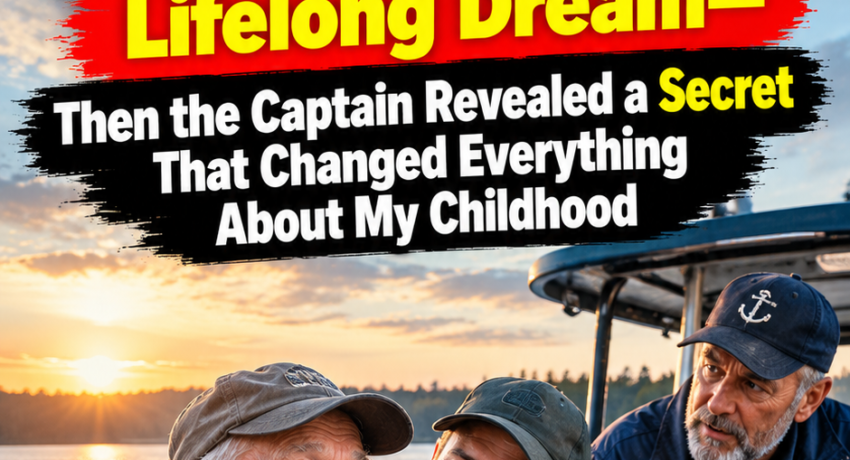
A man in his late fifties stood beside a large white fishing boat, checking the equipment. When he saw us, he called out.
“Daniel?”
“That’s me.”
“I’m Rick.”
We shook hands. Then Rick looked at my father.
His gaze settled on the old green hat.
For a moment, his expression changed.
“Sir,” he said carefully, “have you spent much time at this lake?”
Dad glanced toward the water.
“A long time ago.”
Rick continued staring at him. Then he looked at me.
“Could I speak with you for a moment?”
He led me a few steps away.
“He has no idea, does he?”
I smiled, assuming he was talking about the charter.
“No. I kept the whole thing secret. He thinks we’re just returning to our old fishing spot.”
Rick glanced back at Dad.
“What exactly did you keep from him?”
“The charter. We’re going to the northern point for the entire day.”
Rick’s face became serious.
“You booked the northern point?”
“Of course. Dad talked about it my entire childhood. I wanted to take him there properly.”
Rick looked at my father again.
“And he doesn’t know?”
“No.”
Rick gave a quiet nod.
“I see.”
I should have asked what he meant. Instead, I went back to help load the equipment.
Dad barely spoke.
At first, I assumed he was overwhelmed. Then I realized he wasn’t studying the boat at all. He was staring toward the far edge of the marina, where an old dirt path disappeared among the trees.
“Dad, are you all right?”
“I’m fine.”
“You don’t look excited.”
“I am excited.”
“You look like you’re waiting for a dentist.”
He gave me a weak smile.
Then Rick began untying the boat.
Dad suddenly turned toward him.
“Could we go somewhere else?”
I stared at him.
“What?”
“I know you planned this,” Dad said. “And I’m grateful.”
“Then why don’t you want to go?”
He looked toward the trees.
“I’d rather fish from the bank.”
“The bank?”
“Our old place.”
I felt my excitement collapse.
“Dad, this is the northern point. You talked about fishing there for years.”
He gave a small, embarrassed laugh.
“Maybe I made it sound more important than it was.”
“What does that mean?”
His smile faded.
“I never said I wanted to go there.”
Part Four: What My Father Had Never Told Me
Dad walked over to a wooden bench near the dock and sat down.
“Come here,” he said. “There’s something you should know.”
I sat beside him while Rick remained near the boat, pretending to inspect the ropes.
Dad watched the sunlight move across the lake.
“Do you remember asking me why we never rented one of these boats?”
“Of course.”
“You asked me several times one morning. You were probably seven.”
“That sounds like me.”
Dad smiled, but the expression quickly disappeared.
“After you went back to the water, I came over here and asked the man running the marina how much it cost to rent a boat for half a day.”
I said nothing.
“He told me the price. I knew immediately that I couldn’t afford it.”
My stomach tightened.
Dad rubbed his hands together.
“I explained that I had a son who saw all those boats and probably wondered why his father never took him out on one. I thought he might believe I simply didn’t care enough.”
“Dad, I never thought that.”
“You were a child. You didn’t have to say it. I could imagine it all by myself.”
He looked toward the trail.
“But that man didn’t give me money. He didn’t offer me a discount. I’m glad he didn’t.”
I turned toward him.
“What did he do?”
“He walked me to our spot under the oak trees. He told me which bait to use and what time of day the fish came closest to the shore.”
Dad’s eyes softened.
“Then he said something I never forgot. He told me that you wouldn’t remember whether I had taken you out on a boat. You would remember whether I had gotten up before sunrise to spend time with you.”
Behind us, Rick stopped moving.
Dad didn’t notice, but I did.
“Did you believe him?” I asked.
“Not immediately.”
Dad looked down at his hands.
“For years, I still felt as though I wasn’t giving you enough. When you talked about another child’s new bicycle or a family vacation, I felt embarrassed. I thought I was failing you.”
“You weren’t.”
“I know that now.”
He turned to me.
“Do you know why?”
I shook my head.
“Because every time I woke you up, you were usually standing near the door before I finished making the sandwiches.”
“You took forever to make those sandwiches.”
“I was trying to get the peanut butter exactly right.”
I laughed.
Dad’s eyes became moist.
“You talked the entire drive to the lake. You talked about school, animals, dinosaurs, girls, God, and every strange thought that entered your mind.”
“That sounds exhausting.”
“It was,” he said, smiling. “But I loved every minute of it.”
He turned back toward the old trail.
“Eventually, I understood what that man had been trying to tell me. I wasn’t failing to give you a better childhood. I had already given you what mattered most.”
He looked at me.
“And you had given me the same thing.”
For a moment, neither of us spoke.
Then a quiet voice came from behind us.
“His name was Walter.”
Dad slowly turned.
Rick had walked closer.
“The man who spoke to you that day,” Rick continued. “His name was Walter.”
Dad stared at him.
“How do you know that?”
Rick swallowed.
“Because he was my father.”
Part Five: Walter’s Son
Dad looked at Rick more closely.
“You’re that boy?”
Rick smiled.
“You remember me?”
“You used to sweep the docks.”
“I had several important jobs,” Rick said. “Sweeping was only one of them.”
Dad glanced toward the marina office, then back at Rick.
“My goodness.”
The two men shook hands. Then Rick pulled Dad into a long hug.
When they stepped apart, Rick’s eyes were shining.
“My father remembered you,” he said.
Dad looked confused.
“Why?”
“He talked about you for years. He saw plenty of fathers come here with expensive boats and expensive equipment. Some of them barely spoke to their children.”
Dad lowered his gaze.
“But he never forgot the maintenance worker who couldn’t afford a boat and still brought his son to the lake before sunrise.”
Dad shook his head.
“I was only doing my best.”
“I know,” Rick replied. “That was exactly what he admired.”
For the first time that morning, Dad had no joke ready.
Neither did I.
I looked at the white charter boat. Then I looked at the narrow trail leading between the trees.
“Rick?”
“Yes?”
“Can we cancel the trip?”
Dad immediately frowned.
“You already paid.”
“I don’t care.”
“You should care. That boat isn’t cheap.”
I turned toward him.
“Do you still have those old lawn chairs?”
Dad’s mouth lifted slightly.
“They’re in my garage.”
“Of course they are.”
“They’re good chairs.”
“They’re older than I am.”
“That proves their quality.”
Rick laughed.
“I’ll take care of the charter,” he said.
He went into the marina office and returned a few minutes later with a small paper bag.
Dad looked inside.
“What’s this?”
“Bait.”
Dad examined it.
“The same kind?”
Rick nodded.
“My father never changed his recommendation.”
Dad held the bag carefully, as though it were something precious.
Then we drove back to his house, collected the old chairs, and returned to the lake.
Part Six: The Place That Had Always Been Ours
The trail looked different after all those years.
The trees had grown thicker, and the path had narrowed beneath the branches. But the two great oak trees were still standing.
So was our old fishing spot.
Dad unfolded the chairs while I unpacked the sandwiches I had prepared.
He looked at them suspiciously.
“What happened to the peanut butter?”
“I decided to make turkey and cheese.”
“I don’t remember asking for an upgrade.”
“You’re welcome.”
He shook his head and sat down.
We cast our lines into the quiet water.
For a while, neither of us spoke. The sun climbed higher. Birds moved through the reeds, and somewhere behind us, a boat engine rumbled to life at the marina.
I didn’t think about the charter anymore.
I didn’t think about the northern point.
I was exactly where I wanted to be.
A few minutes later, Dad’s fishing line jerked.
He sat up.
“I think I’ve got one.”
“It’s probably another branch.”
“Don’t ruin this moment.”
He began reeling in the line while I stood beside him, laughing as he complained that I wasn’t being supportive.
The fish was small, barely ten inches long.
Dad held it up proudly.
“Look at that.”
“It’s tiny.”
“It’s respectable.”
“It looks embarrassed.”
Dad lowered the fish toward the water.
“Don’t listen to him,” he whispered.
Then he released it.
We settled back into our chairs, and I handed him a sandwich.
He took one bite and looked disappointed.
“Peanut butter would have been better.”
“Maybe next time.”
Dad looked at me.
“Next time?”
“Of course.”
He nodded slowly.
“All right.”
We sat beside the lake in those two worn-out chairs, eating sandwiches beneath the oak trees.
The expensive boat was still waiting at the marina.
I didn’t miss it.
Walter had been right all those years ago. My father and I had never needed a beautiful boat, expensive equipment, or a perfect fishing location.
We only needed a quiet morning, two old chairs, and enough time to sit beside each other.
That had been Dad’s gift to me all along.
And now, finally, I understood that it had never been a small gift.