Part One: The Fan That Wouldn’t Clear
I found the camera because of a fan that wouldn’t do its job.
For three mornings in a row, steam sat on our bathroom mirror long after my shower ended, curling against the vent like it had nowhere else to go. On the fourth morning, I climbed onto the vanity in my socks, unscrewed the grille with a butter knife, and reached inside to check the motor.
My fingers found something that wasn’t part of any fan.
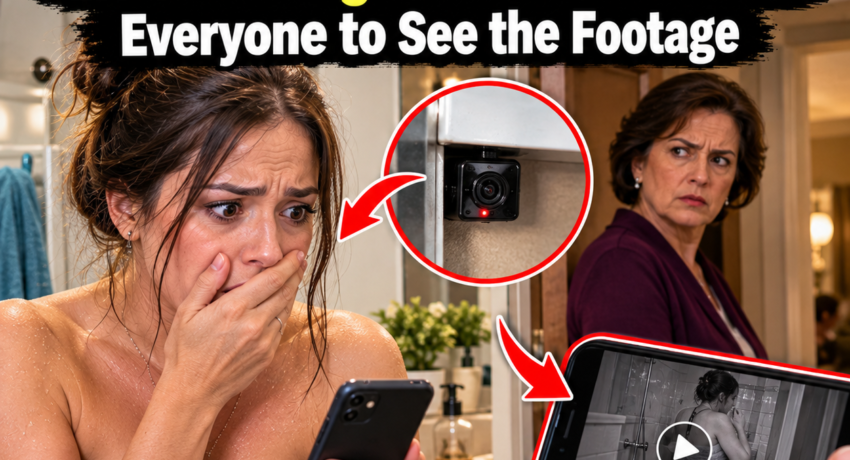
Behind the slats, wedged into the ductwork, a small black lens caught the bathroom light and stared straight back at me.
I didn’t scream. I didn’t even move for almost a full minute. I just crouched there on the vanity, one hand still on the grille, staring at a piece of hardware that had no business being in my bathroom.
My mother-in-law, Sandra Colby, had insisted on “helping” when my husband Derek and I gutted the house eighteen months ago. She’d picked the contractor herself—a guy named Wes who’d done work on her own place. She’d stopped by twice a week to “check the wiring.” And when we moved in, she’d kept a spare key “for emergencies,” the same way she’d kept a key to Derek’s college apartment and, before that, his childhood bedroom door.
Whenever I mentioned that Sandra let herself in without knocking, Derek laughed it off over dinner.
“Mom’s nosy, Maren. She’s not dangerous.”
I didn’t call him that afternoon. I already knew, almost word for word, what he’d say.
Instead, I photographed the camera exactly where it sat, wrote down its serial number on the back of a grocery receipt, and pulled it loose with a pair of dish gloves, careful not to smudge whatever prints might still be on the casing.
I didn’t know it yet, but that fan, and the woman who’d installed something behind it, were about to teach me more about my marriage than eleven years together ever had.
Part Two: The House I Thought I Was Building
I’d spent nine years working digital forensics for a hospital network outside Columbus, tracing data breaches, recovering deleted records, testifying about chain of custody in rooms that smelled like burnt coffee. It was quiet work. Careful work. The kind where you learn that the truth is almost always sitting in a log file somewhere, waiting for someone patient enough to read it.
I brought that same patience home, which is probably why I’d spent two years excusing things I should have questioned.
My father had died a little over two years earlier, and the one thing he’d left me outright—not through a will lawyers could argue over, but through an irrevocable trust he’d set up himself—was the house on Buckeye Lake where I’d learned to swim, to fish, to sit still on a dock and just breathe. Derek called it “your dad’s place” in a tone that never quite decided whether that was affectionate or resentful.
What I wanted, if you’d asked me back then, was simple: a finished house, a peaceful family, a husband who backed me up when his mother crossed a line. What I actually needed—though it took me years to say it out loud—was to stop mistaking my own silence for patience.
I kept a running note on my phone titled “Sandra Things,” a private list nobody else ever saw: the time she’d rearranged my spice cabinet, the time she’d shown up while I was still in a bathrobe and stayed anyway, the time she’d asked our contractor for a key “just to leave paint samples.” I never confronted her about any of it. I just wrote it down, the way you’d log a symptom you weren’t ready to name yet.
That list had forty-one entries by the morning I found the camera.
Derek used to tease me about the note. “You’re building a case file on my mother,” he’d say, and I’d laugh like it was a joke, because it was easier than admitting he was exactly right. I told myself I kept the list so I’d remember to bring it up someday, calmly, over coffee, the way reasonable adults handled family friction. I never once imagined I’d need it as evidence.
What I actually wanted, underneath the finished kitchen and the new roof and the quiet Sunday dinners, was to feel like the marriage I’d built was mine—not something Sandra had a standing invitation to redecorate whenever she felt like it. I just hadn’t found the nerve to say that plainly, not to Derek, not even to myself.
I didn’t know it then, but I was about to start a new list. This one wouldn’t stay private for long.
Part Three: What the Numbers Told Me
I didn’t confront Sandra. I didn’t confront Derek either.
Instead, I did what nine years of forensics had trained me to do: I documented everything before I touched anything else. Photographs first. Serial number second. Then I opened my laptop and traced the camera’s last known connection.
It had been running on our guest Wi-Fi network—the one we gave contractors and visiting family—and quietly uploading footage to a private cloud storage account. Whoever installed it had hidden the hardware carefully. They just hadn’t secured the software at all.
That night, I told Derek I had a work deadline and drove forty minutes to an electronics store on the other side of town, paying cash so there’d be no card statement for anyone to notice. I mounted my replacement in the exact spot the original had occupied, angled so it recorded nothing of the bathroom itself—just the dark, empty cavity behind the vent. It would show no one anything private. But it would log every login attempt, every command, every IP address that came looking for a view it was never going to get again.
I sealed the original camera in a freezer bag, labeled it with the date and time the way I’d label evidence at work, and drove it to Priya Anand, an attorney I’d worked with twice before on hospital privacy cases. Her office smelled like printer toner and peppermint tea. She turned the bag over twice in gloved hands before she even asked me to sit down.
“Someone spent real money hiding this well,” she said. “Which tells me they were confident nobody would ever go looking.”
“Someone did.”
“Don’t tell your husband yet,” she said. “Not until we know exactly who’s on the other end, and what they’re planning to do with what they see.”
I signed a retainer agreement, gave her copies of everything, and drove home with my hands tight on the wheel the entire way, rehearsing a version of dinner where I said nothing unusual at all.
By midnight, Priya called with our answer. The cloud account had been accessed from two separate devices that same week.
Sandra’s tablet.
And Derek’s laptop.
I sat in my car in Priya’s parking lot for a long time after that, not crying, just breathing, the way you do when a number on a screen changes everything you thought you knew about the person sleeping in your bed.
Part Four: Six Nights of Nothing, Then Everything
The next afternoon, Sandra let herself in through the side door—she still had that spare key—carrying a plate of lemon bars and her usual bright, unbothered smile.
“I made extra,” she said, setting the plate on my counter like she did every other week. “You look tired, though. Are you taking something?”
“Just working late,” I told her, keeping my voice as flat as I could manage while she was still holding my kitchen towel, refolding it the way she thought it should be folded.
Her eyes flicked toward the hallway—toward the bathroom—for less than a second. It was such a small thing. Six months earlier, I might not have caught it at all. But I’d spent nine years learning to notice small things, and that glance told me the camera wasn’t there just because Sandra liked to be nosy. She was expecting it to have caught something specific, and she was checking whether it had.
She stayed for forty minutes, asked twice whether Derek and I had “settled on a due date for anything,” and left without ever once looking directly at me again.
For six nights, my replacement camera logged repeated login attempts to the bathroom feed. Six nights of someone trying to see something that simply wasn’t there anymore. All they got was darkness.
On the seventh night, a new folder synced to the same cloud account, and this one wasn’t from my bathroom at all. It was recordings from Sandra’s own dining room, apparently caught by a camera she’d forgotten was still running from some earlier project.
In one clip, Derek sat across the table from his mother. Between them lay a property deed I’d never seen before, with a signature on it that wasn’t mine.
They were talking about my father’s lake house.
“Once the family sees the bathroom video,” Sandra said, tapping the deed with one manicured nail, “everyone will believe she’s unstable. You file for emergency control of her assets before she even understands what’s happening, and the house is ours.”
Derek lifted his glass like they were toasting a job well done. “At the reunion. Big audience. No way for her to explain herself before it’s already decided.”
I sat at my kitchen table and watched my husband smile at a plan to destroy me.
Another clip explained something that had confused me for weeks: why Derek had suddenly, casually, started asking whether I’d updated the password on my father’s trust portal. He hadn’t been curious. He’d been checking whether the door was still locked.
I copied every file that night, logged each checksum the way I would for any case at work, and drove the originals to a safe-deposit box neither Sandra nor Derek knew existed.
Long after Derek had gone to bed, I sat alone in the dark kitchen and played the dining-room clip a third time, then a fourth, until the words stopped sounding like something a person could say about her own son’s wife.
Two days later, an invitation arrived in my email. **Colby Family Reunion — Saturday Night, 7 p.m. Please bring a side dish!**
I read the exclamation point four times, like it might explain itself.
Then I clicked “Accept,” and started a folder on my laptop labeled, simply, “Saturday.”
Part Five: The Choice With a Price Tag
Priya wanted me packed and out of the house within the week. “You don’t owe them the courtesy of staying,” she said.
I wanted the evidence secured first. If I left too early, I risked losing the one advantage I had: they still believed I didn’t know anything.
We spent the next ten days building a case instead of a suitcase. We made forensic copies of the original camera and its firmware. We got a signed affidavit from Wes, the contractor, who admitted—once Priya explained exactly what “accessory to unlawful surveillance” meant—that Sandra had paid him four hundred dollars cash to leave gaps in the wiring behind that vent. We filed an emergency preservation request with the cloud provider before they could delete anything.
A detective named Reyes opened a file on the case but warned me to stay quiet until the provider’s records came back. “If they know you’re onto them,” she said, “they’ll destroy what we need.”
Meanwhile, Derek turned almost tender. He brought home flowers on a Tuesday, for no occasion. He cooked dinner twice that week, something he hadn’t done since our anniversary. Every gesture felt like a hand quietly checking my pockets.
Here’s what I learned, once Priya walked me through the footage frame by frame: the “bathroom video” they planned to show forty relatives wasn’t what I feared. It showed me unlocking a small medical case and injecting myself with prescribed hormones, the way I had every evening for three weeks before an egg-retrieval procedure Derek and I had planned together, quietly, hoping for a baby. Sandra intended to tell the family the syringe held something illegal. Derek had already drafted an emergency petition claiming I was a danger to myself, financially incapacitated, unfit to manage my own affairs.
What neither of them understood was that my father’s lake house sat inside an irrevocable trust with an independent trustee. Derek couldn’t reach it through divorce. He couldn’t reach it through guardianship. Their forged deed was worthless paper.
But their plan to humiliate me publicly, to make an entire family believe I was unraveling—that wasn’t worthless at all. That was going to work exactly as designed, unless I stopped it myself.
Three days before the reunion, the cloud provider’s records came back. The account belonged to Sandra. Derek’s laptop had connected to it thirty-one times.
And buried in the same archive, we found something worse: bathroom recordings from two other houses Sandra had once helped renovate.
One belonged to Derek’s cousin, Bethany, who Sandra had blackmailed into repaying a debt she’d never actually owed.
The other belonged to Sandra’s own sister, Carol, filmed while recovering from surgery, blackmailed for twelve thousand four hundred dollars to keep the footage quiet.
I called them both that same night. Bethany cried for almost five minutes before she could speak. Carol went so silent I thought the line had dropped.
Finally she said, “Tell me what you need.”
“Come Saturday,” I told her. “And be ready to tell the truth.”
Part Six: What the Television Showed Instead
Saturday evening, Sandra’s house glowed under strings of white lights she’d hung along the porch railing. Nearly forty relatives filled the lawn and the great room, balancing paper plates of potato salad and pulled pork.
Sandra wore silver silk and moved through the crowd like she was already accepting a toast. Derek kept one hand at my back, steering me gently toward the living room television every time I drifted more than a few feet away.
Carol hugged me at the door and pressed a thumb drive into my palm without a word—the blackmail call Sandra had made to her, the one demanding twelve thousand four hundred dollars for silence.
I added it to the encrypted file Priya had already prepared. Detective Reyes waited two streets over with a signed warrant, needing just one thing before she could move: proof that someone accessed the illegal footage again, live, so the transmission itself could be confirmed.
At nine o’clock, Sandra tapped a spoon against her wine glass.
“Family should protect family,” she announced to the room, “even when the truth is uncomfortable.”
The room quieted. Derek slipped his phone from his pocket and turned toward the front door, sliding the deadbolt without quite looking at anyone.
My monitoring app buzzed once against my hip.
Remote access confirmed.
Sandra leaned close enough that I caught her perfume. “Tonight,” she said softly, “everyone finally sees who you really are.”
The television clicked on behind her.
But the screen didn’t show me in my bathroom.
It showed Sandra, sitting at her own dining table, holding the very camera she’d hidden in my vent, coaching Derek on what to say.
“Tell them she came at you when you tried to help her,” her recorded voice instructed. “People always believe the calmest person in the room.”
Forty relatives turned to look at her. Sandra’s smile didn’t just fade—it emptied out completely.
I stepped away from Derek and lifted the remote myself.
“You’re right,” I said. “Tonight, they will.”
The next clip showed the forged deed. Then the access logs—dates, login records, a photograph of the camera exactly where I’d found it behind the vent. We played none of the footage of Bethany or Carol; Priya had built the whole presentation specifically so we could expose what Sandra had done without exposing the two women all over again. The last clip was simply audio: Sandra’s voice, demanding twelve thousand four hundred dollars from her own sister in exchange for silence.
Bethany stood up first, her chair scraping the floor. “You did that to me too.”
Sandra lunged for the laptop cable. Carol stepped in front of her without saying a word.
Derek moved toward me for the remote, his jaw tight, and for one second I thought he might actually grab it out of my hand. But before he reached me, his father, Walter, stepped between us and simply put a hand flat against his son’s chest.
“That’s enough, Derek,” Walter said. “Sit down.”
Derek stood there, breathing hard, and then he sat.
Sirens rose outside a moment later. Sandra’s voice went very small. “Maren, we can explain.”
“Explain it to Detective Reyes,” I said.
The officers came in carrying the warrant. They left with Sandra’s tablet, Derek’s phone, the television’s streaming adapter, and two hard drives hidden in the bottom drawer of Sandra’s desk.
I didn’t smile while they walked Sandra and Derek out to separate cars. I just watched Derek realize, a little too late, that the door he’d locked to trap me inside had actually locked an entire room full of witnesses in with us.
Everyone had seen exactly who he was.
Part Seven: What It Cost, and What It Bought Back
The consequences arrived slowly, which somehow made them harder for anyone to wave off as ordinary family drama.
Derek eventually accepted a plea agreement on charges of unlawful surveillance, conspiracy, and attempted fraud. He served four months in county custody, followed by two years of supervised probation. He wrote me one letter from the county facility. I read the first paragraph, in which he explained that he’d “gone along with it” because Sandra had convinced him the lake house was rightfully his too, and I never finished the second page.
Sandra faced those same charges plus additional counts tied to Bethany and Carol. She served twenty months and was ordered to pay full restitution to both women, plus a civil settlement to me that covered most of what I’d spent on Priya’s fees and the private investigator we’d hired to track the archive’s full history. Wes, the contractor, lost his license and cooperated fully with investigators in exchange for a reduced charge; he called me once, unprompted, just to apologize.
My divorce took eight months to finalize. Derek’s attorney tried, briefly, to argue for a share of the lake house as marital property. But my father’s trust, the original deed, and Sandra’s own recordings made short work of that claim in about eleven minutes of hearing time. I kept the house on Buckeye Lake. I sold the place outside Columbus for $312,000, a number that felt strange to see printed on a closing statement for a house I’d once imagined growing old in.
I used part of what was left—about $40,000—to help fund counseling and legal aid for the other women investigators eventually traced through Sandra’s account. Five in total, including Bethany and Carol. One of them I never met in person; she asked to stay anonymous, and Priya made sure she could.
Walter, my former father-in-law, still calls me every few months. He and Sandra divorced the year after her sentencing. “I should have asked more questions a long time ago,” he told me once, and I believed him, because he’d been the one person that night who’d actually done something instead of just watching.
I still keep the “Sandra Things” note on my phone. I never added a forty-second entry. I didn’t need one anymore.
Part Eight: The Only Camera I Trust Now
A year later, I moved into my father’s house on Buckeye Lake for good, into the same bedroom where I used to fall asleep listening to the dock creak against the water.
I converted the old boathouse into a small workshop where, twice a month, I teach a rotating group of eight or ten women how to secure their devices, spot hidden hardware, and preserve evidence the right way if they ever need to—without putting themselves in more danger in the process. Priya comes out to speak on the legal side once a season. Detective Reyes has stopped by twice, off the clock, just to answer questions.
Carol drives up most Sundays and stays for dinner, usually bringing a pie that’s better than anything I could make. Bethany brings her kids out to swim every other weekend, and they’ve claimed the end of the dock as theirs, towels and all, the same way I once claimed it as a kid.
People sometimes ask if playing those recordings in front of forty relatives was about revenge.
It wasn’t. Revenge would have ended the moment Sandra’s smile disappeared from her face, and I would have gone home with nothing but a quiet, ugly satisfaction that didn’t fix a single thing.
What I built afterward was steadier than that, and it took longer, and it was worth it. These days, the only camera in my house is the one I installed myself, mounted on the boathouse eave, facing outward, toward the water. It watches for raccoons getting into the trash, not for anything I need to hide. Some nights I sit on the dock and watch the little green light blink on the screen in my hand, and it doesn’t make my stomach drop the way it used to. It just tells me the water’s calm, and nobody’s out there but us.