PART 1 — THE LAST THING MOM MADE FOR ME
The moment my stepmother walked into my senior prom wearing a near-perfect copy of my dress, the entire room seemed to tilt beneath my feet.
For several seconds, I couldn’t move.
People around us glanced from her to me, confused. A few even smiled, apparently assuming the matching dresses were some cute mother-daughter idea.
They had no idea.
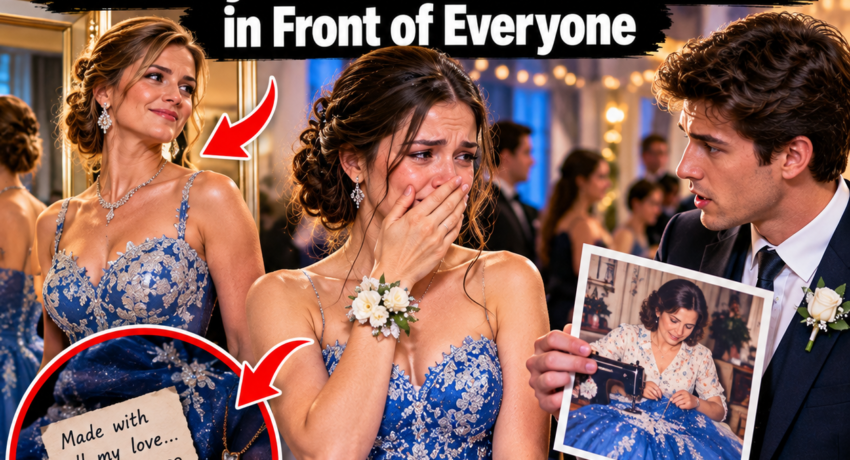
Shirley stood beneath the lights in dusty pink satin, wearing the same fitted bodice, the same delicate neckline, even the same tiny flowers that decorated my dress.
My dress.
The one my mother had made with her own trembling hands before she died.
Shirley looked directly at me and smiled.
It wasn’t an embarrassed smile.
It was the satisfied expression of someone who had been waiting for this exact moment.
Beside her, my father lowered his eyes.
My chest tightened.
I couldn’t breathe.
I turned toward the gym doors.
I had taken only two steps when Gary caught my arm.
“Don’t disappear, Delilah.”
I froze.
Not because of Gary.
Because I had heard those exact words before.
From my mother.
A year earlier, Mom had been sitting upright in bed with several yards of dusty pink fabric spread across her lap.
By then, Kathy—my mother—was already very sick.
There were mornings when lifting a glass of water exhausted her. Some days her fingers shook so badly that threading a needle took several attempts.
But whenever I suggested that we buy a prom dress instead, she refused.
“This one is yours,” she would say.
One afternoon, I found her trying to sew another tiny fabric flower onto the neckline.
Her hands were trembling.
“Mom, please.” I sat beside her. “Let me finish those.”
She shook her head.
“The flowers are mine.”
“You’ve already done most of the dress.”
“Exactly. I’m not surrendering at the flowers.”
I laughed, although tears were already gathering in my eyes.
We both understood why finishing that dress mattered so much to her.
Neither of us wanted to say it aloud.
Mom probably wouldn’t be there when I finally wore it.
She knew.
I knew.
And pretending otherwise had become exhausting.
When the dress was nearly complete, she rested it across my shoulders and studied me.
For a moment, she looked less like someone who was sick and more like the woman from my childhood—the woman who danced while cooking dinner, sang the wrong lyrics to songs on purpose, and embarrassed me by cheering too loudly at school events.
Then she touched my cheek.
“When you wear this to prom, promise me something.”
“What?”
“Don’t spend the entire night hiding in a corner.”
I smiled weakly.
“You know I don’t dance.”
“Then learn.”
“Mom.”
“I’m serious.”
I rolled my eyes, but she kept looking at me.
Her smile softened.
“I didn’t make this dress so you could disappear, Delilah.”
Something in her voice made my throat tighten.
“Promise?”
I nodded.
“I promise.”
Eight days later, she was gone.
After the funeral, our house stopped feeling like a home.
Dad became quiet.
I became quieter.
Mom’s favorite blue mug remained on the kitchen shelf, and every morning I would touch the handle when I passed it.
It probably sounds ridiculous.
It was just a mug.
But grief changes the meaning of ordinary things.
A mug can become proof that someone once stood in your kitchen.
A sweater can still seem to hold the shape of someone’s shoulders.
A photograph can make a hallway feel less empty.
For a while, Dad and I existed around those small reminders without discussing them.
Then he married Shirley.
Shirley had been one of Mom’s closest friends.
Everyone seemed to think that should comfort me.
“She knew your mother so well.”
“She understands what you’ve been through.”
“Kathy would probably be happy knowing someone she trusted is helping take care of you.”
Maybe they meant well.
But they didn’t live in our house.
They didn’t see what happened after Shirley moved in.
Mom’s blue mug disappeared first.
I noticed immediately.
“Where is it?”
Shirley didn’t even look up from wiping the counter.
“I threw it away.”
I stared at her.
“You what?”
“It was chipped.”
“It wasn’t chipped.”
Dad sighed from the dining table.
“Delilah, please.”
“That was Mom’s mug.”
“It was a cup,” he said.
I looked at him.
“No. It was Mom’s cup.”
He returned his attention to whatever he had been reading.
That hurt more than Shirley throwing it away.
A week later, one of Mom’s framed photographs vanished from the hallway.
Then another picture was turned facedown on a shelf.
A scarf disappeared from the coat rack.
A decorative bowl Mom loved suddenly wasn’t on the table anymore.
Whenever I protested, Shirley had an explanation.
She was decluttering.
She was reorganizing.
She was trying to help Dad move forward.
And whenever I became upset, she would give me that calm, almost pitying smile.
“You’re very emotional, Delilah.”
One afternoon she studied my face after an argument.
“You look exactly like Kathy when you’re angry.”
I didn’t answer.
Then she added quietly:
“That must be difficult for your father.”
That was when I finally understood.
Shirley wasn’t simply cleaning out the house.
She was slowly removing my mother from it.
And somehow, she had convinced Dad that erasing Mom was the same thing as healing.
Eventually, Shirley started coming into my bedroom.
I caught her there one afternoon.
She was standing beside my closet.
Mom’s prom dress hung inside a protective garment bag.
The zipper was halfway open.
“What are you doing?”
Shirley turned calmly.
“Checking for moths.”
“In my closet?”
“Clothes can be damaged anywhere.”
Her eyes shifted toward the dress.
“Your mother wouldn’t want all that work ruined.”
Something inside me snapped.
“Don’t talk about what my mother would want.”
For the first time, Shirley’s pleasant expression slipped.
She looked at me for several seconds.
Then she said:
“You really do think you’re some little replacement for her, don’t you?”
I stared at her.
“Get out.”
“Delilah—”
“Get out of my room.”
She left.
That evening, I told Dad.
I expected that invading my room—and especially touching Mom’s dress—would finally be enough.
Instead, he rubbed his forehead.
“Shirley was probably trying to help.”
“She opened the garment bag.”
“She lost Kathy too.”
I couldn’t believe what I was hearing.
“She lost a friend, Dad. I lost my mother.”
He closed his eyes.
“I can’t do this tonight.”
That sentence changed something between us.
Because I realized that if protecting Mom’s memory required effort, Dad was no longer willing to make it.
I was on my own.
Two weeks before prom, one of the little flowers Mom had sewn onto the neckline came loose.
I found it hanging by a single thread.
I burst into tears.
Not because a flower couldn’t be repaired.
Because grief isn’t logical.
That loose thread suddenly felt like another piece of Mom slipping away.
Gary found me crying over it.
He had been my friend long before he became my prom date, and he understood enough not to tell me I was overreacting.
Instead, he drove me to Mrs. Howard’s alteration shop.
Mrs. Howard was an older woman with silver hair, careful hands, and the kind of voice that immediately made you trust her.
When I explained who had made the dress, she became especially gentle.
“I’ll make sure you can’t even tell the flower was loose.”
“Thank you.”
She examined the neckline.
Then she stopped.
Her expression changed.
“Delilah?”
“Yes?”
“Has anyone else brought this dress into my shop?”
I frowned.
“No.”
“Are you certain?”
“Absolutely.”
She looked at Gary, then back at me.
“What about photographs?”
My stomach tightened.
“What do you mean?”
Mrs. Howard slowly lowered the dress.
“About a month ago, a woman came here with photographs of a dress that looked almost exactly like this one.”
Gary leaned forward.
“What did she want?”
“An exact copy.”
The room went silent.
“She wanted it completed before prom,” Mrs. Howard continued. “She was very specific about every detail—the fabric, the flowers, the neckline.”
“What did she look like?” Gary asked.
Mrs. Howard thought for a moment.
“Tall. Blonde. Mid-forties, perhaps. Expensive handbag. Not particularly patient.”
I didn’t need to say Shirley’s name.
Gary’s expression told me he had reached the same conclusion.
Mrs. Howard had refused the job because she didn’t feel comfortable recreating what appeared to be another person’s handmade design.
But clearly Shirley had found someone else.
My hands went cold.
Then, while repairing the flower, Mrs. Howard lifted a small section of the lining.
“Oh,” she murmured.
“What?”
She turned the fabric toward me.
There, stitched into the inside seam with blue thread, was one tiny letter.
K.
My breath caught.
Kathy.
Mom had signed the dress.
I ran my fingertip over the small blue stitch.
She had hidden her name where almost no one would ever see it.
I began crying again.
Gary stood beside me silently.
And for the first time, I understood exactly why Shirley had photographed the dress.
She wasn’t admiring it.
She wasn’t preserving Mom’s work.
She was copying it.
I just didn’t yet understand how far she intended to take it.
PART 2 — PROM NIGHT
On prom night, I almost broke my promise to Mom before I even left the house.
I stood in front of my mirror wearing the finished dress and wondered whether I could simply tell Gary I felt sick.
The dusty pink fabric fell perfectly.
Mom’s tiny flowers circled the neckline.
And hidden inside was that little blue K.
I looked at my reflection.
For a split second, I saw Mom in my face.
Same eyes.
Same chin.
Even the same nervous expression she used to make before important occasions.
I pressed my fingers against the place where her initial was stitched inside the lining.
“I won’t disappear, Mom.”
Then I went downstairs.
Dad was waiting in the living room.
When he saw me, he stopped moving.
His face went pale.
“You look just like your mother.”
For one hopeful second, I thought something had finally reached him.
Then Shirley’s voice drifted in from the kitchen.
“Let’s just hope she doesn’t spend the whole evening crying like Kathy would have.”
Dad visibly flinched.
I stared at him.
“Say something.”
He looked toward the kitchen.
“Shirley, please.”
That was it.
Two words.
No anger.
No defense.
No boundary.
Just please.
I looked away before he could see how badly that disappointed me.
A few minutes later, the doorbell rang.
Gary stood outside in his suit.
When he saw me, he smiled.
Not a polite smile.
Not the exaggerated reaction teenagers sometimes give each other before formal dances.
He simply looked at me and said:
“You’re beautiful.”
For the first time that evening, I believed I might actually enjoy myself.
The prom was held in our school gym, although you could barely recognize it beneath the lights, decorations, flowers, and fabric draped across the walls.
At first, I kept expecting something to go wrong.
But slowly, I relaxed.
Friends complimented my dress.
Whenever someone asked where I’d bought it, I told them the truth.
“My mom made it.”
Most of them knew she had died.
Their expressions changed immediately.
Some hugged me.
Others simply said the dress was beautiful.
For once, talking about Mom didn’t feel like being dragged backward.
It felt like bringing a piece of her with me.
Gary handed me a cup of punch.
“She’d be proud of you.”
I looked down at the dress.
“I hope so.”
“I know so.”
Then the doors opened.
The parent chaperones had begun arriving.
I instinctively looked for Dad.
Instead, I saw Shirley.
The plastic cup slipped from my hand.
It hit the floor.
I barely noticed.
She was standing just inside the entrance wearing dusty pink.
At first my mind refused to understand what I was seeing.
Then she stepped farther into the light.
Same color.
Same silhouette.
Same neckline.
Same clusters of tiny flowers.
It wasn’t Mom’s original dress.
But it was close enough that my stomach turned.
Someone nearby whispered:
“Is that Delilah’s mom?”
Another person answered:
“No. That’s her stepmom.”
Whispers began spreading.
Shirley walked directly toward me.
She looked delighted.
“Oh, Delilah!”
She opened her arms slightly as though expecting me to laugh.
“Look at us. We match!”
I could barely speak.
“You copied Mom’s dress.”
She leaned closer.
Her smile remained, but her voice dropped low enough that only I could hear.
“You don’t own grief, sweetheart.”
I stared at her.
“How could you do this?”
Her eyes hardened.
“You thought wearing Kathy’s dress tonight was going to make you special.”
I felt sick.
She continued:
“I thought you should understand something. You’re ordinary.”
For a moment, I couldn’t hear anything around me.
Not the music.
Not the conversations.
Not the hundreds of students standing nearby.
I searched for Dad.
He stood several feet behind Shirley.
“Tell her to stop.”
Dad glanced around nervously.
“Not here, Delilah.”
“She copied Mom’s final gift to me.”
“Please lower your voice.”
That hurt even more than Shirley’s words.
She had attacked something precious to me.
And Dad’s first concern was whether I was making a scene.
I couldn’t stay.
I turned toward the doors.
Then Gary caught my elbow.
“Don’t disappear.”
My entire body went still.
Mom’s voice returned to me with startling clarity.
I didn’t make this dress so you could disappear.
My eyes filled.
“Everyone is staring,” I whispered.
Gary looked around the gym.
“Good.”
I frowned.
“Good?”
“Let them see what she did.”
“I can’t fight her in front of all these people.”
“You don’t have to.”
Before I could ask what he meant, Gary walked toward Mrs. Chen, our senior adviser.
That was when I realized something was happening that I knew nothing about.
Gary had already spoken with her.
After our visit to Mrs. Howard’s alteration shop, he had apparently told Mrs. Chen what we suspected.
And Mrs. Chen had known Mom.
Years earlier, Mom had volunteered with school theater productions, helping repair costumes and sew pieces for performances.
Mrs. Howard was also at the prom that night, helping organize a small display honoring former school volunteers.
Gary hadn’t arranged some cruel public ambush.
He had simply made sure the people who knew the truth were in the same place.
Now Shirley had walked directly into it.
PART 3 — THE TRUTH IN FRONT OF EVERYONE
Gary approached Shirley with an expression so polite that for a moment I wondered whether he had changed his mind.
“You look incredible tonight,” he said.
Shirley straightened immediately.
“Thank you.”
“We’re doing parent recognition before the tribute presentation. Would you come onto the stage?”
I almost laughed.
Gary had chosen the perfect word.
Recognition.
Shirley loved recognition.
She touched one of the copied flowers on her neckline.
“Well, if you insist.”
Then she walked toward the stage as confidently as if she were about to receive an award.
Gary took the microphone.
The conversations around the gym faded.
“Before we continue,” he said, “there’s someone here who can explain why one particular dress in this room matters.”
The curtain shifted.
Mrs. Howard stepped forward carrying a folder.
Shirley’s expression changed instantly.
Her lips parted.
“You.”
Unfortunately for her, she was standing near the microphone.
Everyone heard it.
Mrs. Howard remained calm.
She explained that several weeks earlier, a woman had visited her alteration shop carrying detailed photographs of a dusty pink handmade dress.
The customer had requested an exact duplicate.
Shirley laughed.
“I have no idea what you’re talking about.”
Mrs. Howard opened the folder.
“I kept the intake photographs from the consultation.”
The large screen behind the stage lit up.
The first image appeared.
My bedroom mirror.
Then my closet.
Then Mom’s garment bag.
Then close-up photographs of the flowers, neckline, seams, and fabric.
A murmur moved through the gym.
My hands began shaking.
Those weren’t random pictures of my dress.
They had been taken inside my bedroom.
While I wasn’t there.
Shirley looked around desperately.
“This is ridiculous. It’s only a dress!”
Mrs. Chen stepped onto the stage.
“No,” she said quietly.
“It isn’t.”
The screen changed.
A photograph of Mom appeared.
She wasn’t sick in the picture.
She was standing inside the school auditorium years earlier, laughing while holding fabric from a theater costume.
Seeing her like that nearly broke me.
Alive.
Happy.
Still completely herself.
Mrs. Chen explained that Kathy had volunteered at the school for years.
Then she explained that during the final months of her life, she had sewn one last special dress for her daughter to wear to senior prom.
My dress.
The room became completely silent.
Now everyone understood.
Shirley hadn’t accidentally chosen the same color.
She hadn’t simply admired the design.
She had entered my bedroom, photographed a dying mother’s last gift to her daughter, and deliberately commissioned a copy.
And she had worn it to my prom specifically to make that gift feel less special.
Shirley’s face turned red.
“This is cruel!” she shouted. “You’re humiliating me!”
A woman’s voice from near the dance floor answered before anyone onstage could.
“You copied a dead woman’s dress to hurt her daughter.”
Several people murmured in agreement.
Shirley spun toward my father.
“Thomas!”
Dad stood frozen.
“Do something!”
Every face in the room turned toward him.
Mine did too.
I knew that expression.
I had seen it for months.
The exhaustion.
The avoidance.
The desperate wish that every uncomfortable situation would disappear if he stayed quiet long enough.
For one awful moment, I expected him to defend her again.
Or worse, to ask everyone to calm down.
Instead, Dad walked toward me.
He removed his jacket and placed it around my shoulders.
Then he looked at Shirley.
“Nobody humiliated you.”
His voice shook.
“You did this yourself.”
Shirley stared at him.
“I’m your wife.”
Dad swallowed.
“And Delilah is my daughter.”
My eyes filled instantly.
He looked at me.
Something seemed to collapse in his face.
“I forgot what that meant.”
His voice cracked.
“I’m not forgetting again.”
I wiped my cheeks.
Part of me wanted to run into his arms.
Another part of me was too angry.
Too hurt.
Too tired.
“I needed you to remember before two hundred people had to show you what she was doing.”
He closed his eyes.
“I know.”
That didn’t repair everything.
One sentence couldn’t undo months of silence.
It couldn’t bring back Mom’s mug.
It couldn’t erase every time Dad had told me I was being too emotional.
But something had finally changed.
The pretending was over.
Dad admitted that after Mom died, looking at her belongings had become unbearable for him.
Every photograph reminded him of what he’d lost.
Every object seemed to reopen the wound.
So when Shirley began removing those reminders, he allowed it.
At first, he thought she was helping him survive.
What he hadn’t wanted to see was that Shirley wasn’t only removing Mom’s belongings.
She was using Dad’s grief to isolate me from Mom’s memory.
Dad looked directly at her.
“You don’t get to punish my daughter because she looks like Kathy.”
Shirley said nothing.
Mrs. Chen finally asked her to leave.
Shirley stormed from the gym, furious, still insisting that everyone had turned against her over “a dress.”
But by then, everyone understood that the dress had never been the real issue.
It was about what it represented.
Love.
Memory.
A mother’s final act of care.
And someone’s deliberate attempt to destroy its meaning.
After Shirley left, Mrs. Chen approached me.
“You don’t have to stay, Delilah.”
I looked toward the doors.
Honestly, going home sounded wonderful.
I was exhausted.
My makeup was probably streaked.
Half the school had just witnessed the worst family confrontation of my life.
Then I looked at the screen.
Mom’s photograph was still there.
She was laughing.
And suddenly I remembered her sitting in bed with dusty pink fabric across her lap.
I don’t even dance.
Then learn.
I didn’t make this so you could disappear.
I took a breath.
“No.”
Mrs. Chen waited.
I straightened my shoulders.
“Mom made this dress for prom.”
I looked at Gary.
“I’m staying.”
His smile returned.
“Good.”
Then he held out his hand.
“Because I still don’t know how to dance.”
Despite everything, I laughed.
“Neither do I.”
“Perfect.”
I took his hand.
And we danced badly.
Very badly.
But I stayed.
That was the important part.
I stayed beneath the lights.
I stayed in Mom’s dress.
I stayed when grief told me to hide.
I stayed when embarrassment told me everyone was staring.
I stayed because Mom had spent some of the last strength she had left creating that dress for a night she knew she would never see.
Leaving would have given Shirley exactly what she wanted.
Staying belonged to Mom and me.
Later that night, Dad put Mom’s photograph back in the hallway.
Not a new photograph.
The same one Shirley had removed.
He stood in front of it for a long time.
Then he told me Shirley wouldn’t be returning to the house until he’d spoken to an attorney and figured out what came next.
I didn’t ask what that meant for their marriage.
For once, I didn’t need answers immediately.
Before I went upstairs, Dad stopped me.
“Delilah?”
I turned around.
His eyes were red.
“Can we start over?”
I looked at him.
Then I looked at Mom’s photograph hanging behind him.
“No.”
His face fell.
I continued before he could speak.
“We can’t start over.”
Too much had happened.
Mom was still gone.
Dad had still failed me when I needed him.
Shirley had still spent months trying to make my mother’s memory disappear.
Pretending none of that happened wouldn’t heal us.
“But,” I said, “we can start with the truth.”
Dad nodded slowly.
“I’d like that.”
That night, I hung Mom’s dress carefully inside my closet.
Before closing the garment bag, I lifted the lining one last time.
There it was.
A tiny K stitched in blue thread.
Kathy.
Mom hadn’t put her name somewhere obvious.
She hadn’t needed everyone to know she made the dress.
That wasn’t why she had sewn it.
She had made it for me.
A final gift from a mother who knew she couldn’t stand beside her daughter on prom night but wanted, somehow, to be there anyway.
I pressed my fingers against the little blue letter.
Shirley had walked into prom hoping to prove that Mom’s dress could be duplicated.
Technically, she was right.
Someone could copy the fabric.
They could recreate the flowers.
They could match the neckline, color, seams, and shape.
But standing in that gym beneath Mom’s photograph, I finally understood something Shirley never had.
You can copy a dress.
You cannot copy the love stitched into it.
Shirley had wanted me to feel ordinary.
She wanted me to look at her matching gown and believe that nothing about Mom’s final gift belonged uniquely to me.
Instead, nearly two hundred people witnessed the truth.
And for the first time since Mom died, I didn’t feel like I had to fight to keep her from disappearing.
She was there in the photograph.
She was there in that tiny blue K.
She was there in the promise I had finally kept.
And when I looked into the mirror that night, I didn’t see Shirley’s cheap imitation.
I saw myself.
Still standing.
Still wearing my mother’s final gift.
Still her daughter.
And I hadn’t disappeared.