Part 1 — The Face I Never Expected to See Again
Every Tuesday, I pushed the same squeaky paperwork cart down the pediatric oncology hallway, checking room numbers against the names on my clipboard.
After three years of volunteering there, I knew the sounds of the floor almost as well as I knew my own home.
The steady beeping of monitors.
The whisper of nurses outside patient rooms.
The squeak of rubber-soled shoes against polished floors.
The soft voices of parents trying to sound stronger than they felt.
And beneath everything, that unmistakable hospital smell—clean, sharp, antiseptic.
I understood those halls in a way many volunteers didn’t.
Long before I ever wore a volunteer badge, I had been a patient myself.
At fifteen, cancer entered my life and stripped away nearly everything that had once made me feel normal.
My routines.
My confidence.
My sense of control.
And eventually, my hair.
That Tuesday, I stopped outside Room 214.
A new patient had been admitted.
I knocked gently before stepping inside.
A teenage girl was asleep beneath a thin blanket, a scarf resting loosely around her head. Beside her bed sat a man in a stiff plastic chair, leaning forward with one hand resting protectively near hers.
“Excuse me,” I said quietly. “I’m one of the volunteers. I just wanted to introduce myself.”
He looked up.
For a moment, I forgot how to breathe.
The clipboard shifted in my hands.
Twenty-five years disappeared in a heartbeat.
The gray at his temples hadn’t been there before. His face had aged, naturally, and exhaustion had carved shadows beneath his eyes.
But I knew that face.
I knew that smile.
I knew him.
Noah.
My best friend from childhood.
The boy who had stood beside me during the worst year of my life.
The boy I had lost touch with decades ago.
“Hi,” he said, offering me a tired but friendly smile. “Thanks for stopping by. She finally fell asleep.”
There was kindness in his eyes.
But no recognition.
None.
“Of course,” I managed. “How is she doing?”
He glanced toward his daughter.
“Some days are better than others.”
His voice softened.
“She’s tougher than I am.”
A graduation announcement sat beside her water cup.
My eyes returned to Noah.
I searched his face for something—anything—that might tell me he remembered the fifteen-year-old girl whose hand he had once held through hospital appointments.
Nothing came.
“You look like you haven’t slept,” I said.
He let out a quiet laugh.
“I slept here. You eventually stop expecting hospital chairs to be comfortable.”
That smile hit me harder than I expected.
At fifteen, that same smile had met me across a classroom after I returned to school terrified that everyone would stare.
That same smile had appeared beside my hospital bed while I cried because another clump of hair had come loose in my hand.
“Has she been sick long?” I asked.
“A few months.”
He rubbed the back of his neck.
“You think you understand fear until it’s your kid lying in the hospital.”
“I understand more than you might think,” I said softly.
He nodded politely.
He thought I was simply trying to comfort him.
“People here have been incredible,” he continued. “The nurses, doctors, volunteers… It helps when people actually see you instead of just seeing the illness.”
Something tightened in my chest.
“It does,” I said. “Sometimes being seen changes everything.”
He didn’t hear the history beneath those words.
Why would he?
To Noah, I was just another volunteer.
Then he frowned slightly.
“I’m sorry. I didn’t catch your name.”
“Sarah.”
He went still.
For one second, his eyes lingered on mine.
My heart jumped.
“Sarah,” he repeated.
I waited.
Then the moment disappeared.
He extended his hand.
“Noah. And that’s my daughter.”
The ache that went through me was surprisingly sharp.
I smiled anyway.
“It’s nice to meet you, Noah.”
And I shook the hand I had once clung to during some of the most frightening days of my life.
He still didn’t know who I was.
Part 2 — The Boy Who Refused to Let Me Hide
I left Room 214 and walked several steps before stopping against the hallway wall.
My chest felt strangely hollow.
Twenty-five years.
Of course he hadn’t recognized me.
We had both changed.
My hair had grown back decades ago. My face had matured. Life had carried us into completely separate worlds.
Still, some small part of me had imagined that if Noah and I ever stood face-to-face again, recognition would be immediate.
Because I had never forgotten him.
Especially not what he had done for me.
When chemotherapy began taking my hair, I tried to pretend I didn’t care.
At first, I wore hats.
Then scarves.
Then I stopped wanting to leave the house altogether.
Losing my hair shouldn’t have seemed like the worst part of cancer.
There were needles, medications, exhaustion, nausea, and fear.
But at fifteen, your reflection matters.
I would stand in front of the mirror and barely recognize the girl looking back.
Going to school became unbearable.
I imagined whispers everywhere.
I imagined eyes following me down hallways.
I imagined everyone seeing me as sick before they saw me as Sarah.
Noah never treated me differently.
Then, one day, he started growing his hair long.
It was unusual enough that people noticed.
As the months passed, the comments became jokes.
Some were harmless.
Others were cruel.
Noah always shrugged them off.
Whenever someone asked why he didn’t just cut it, he would smile.
“I like my new style.”
That was all he ever said.
He endured it for nearly a year.
Then one day he came to school with short hair.
He found me carrying a box.
Inside was a wig.
His hair.
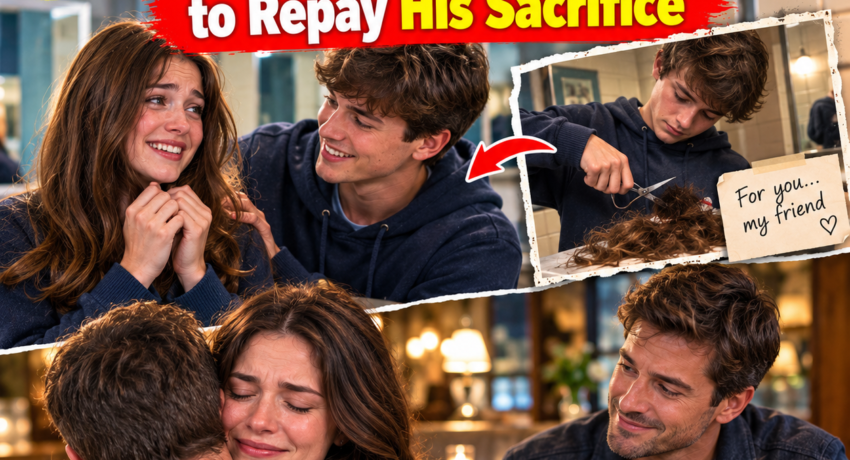
Noah had arranged for a professional wig-maker to turn the hair he had spent months growing into something I could wear.
For me.
I remember staring at that wig, unable to speak.
He didn’t make a speech.
He didn’t expect gratitude.
He simply didn’t want me to feel alone.
I wore that wig through some of the hardest months of my life.
Eventually, treatment ended.
My hair returned.
Life moved forward.
College happened.
Jobs happened.
Years passed.
Noah and I drifted apart the way childhood friends sometimes do—not because of anger, but because life quietly places distance between people before they realize how much time has passed.
Yet I kept the wig.
Through every move.
Every cleaning spree.
Every moment when common sense told me there was no reason to keep it anymore.
I kept it anyway.
Because it wasn’t really hair to me.
It was proof that once, when I was terrified the world would reject me for looking different, someone had willingly made himself look different so I wouldn’t have to stand alone.
And now that same boy—now a father—was sitting beside his own sick child.
Over my next few volunteer shifts, I found myself watching Noah from a distance.
He barely left his daughter’s room.
He brought her ice chips.
Fixed her pillows.
Read aloud when she didn’t feel like talking.
Tried to get her to eat.
One afternoon, I heard him say, “You need to eat something, sweetheart.”
“I’m not hungry, Dad.”
“The doctor said—”
“I know what the doctor said.”
There was frustration in her voice.
Noah didn’t react.
He simply gave her that same patient, stubborn smile I remembered.
And suddenly I knew I couldn’t keep walking past his room pretending we were strangers.
That night, I went home and opened the closet in my bedroom.
Behind several winter coats sat an old box.
I hadn’t opened it in years.
My hands trembled slightly as I lifted the lid.
There was the wig.
Still carefully wrapped.
Still carrying a lifetime of memory.
But beneath it was something else.
Something I knew Noah would recognize.
I sat on the floor for a long time, holding both objects in my lap.
Twenty-five years earlier, Noah had given me exactly what I needed when I had no idea how to ask for it.
Maybe now it was my turn.
Part 3 — “Oh My God… It’s You”
The next morning, I carried the box into the hospital.
I didn’t let myself overthink it.
If I did, I knew I might lose my nerve.
I walked directly to Room 214 and knocked lightly.
Noah looked up.
“Sarah?”
“Could I borrow you for a minute?”
He glanced at his sleeping daughter before following me into the hallway.
I held the box toward him.
Confusion crossed his face.
“What is this?”
“Open it.”
He studied me.
“Why?”
“Please.”
He finally took the box.
For a moment, neither of us spoke.
Then he lifted the lid.
The color drained from his face.
He lowered himself into a nearby chair.
I waited for recognition.
Instead, he stared at the contents and asked something I didn’t understand.
“Wait. Did my daughter tell you?”
I frowned.
“Tell me what?”
“About graduation.”
His eyes moved toward the hospital room.
“About what those kids did.”
“No.”
I slowly reached into the box.
“I’m not sure what happened at school.”
I lifted out the wig.
Noah stared at it.
Then I placed it on my head.
His expression changed.
“I don’t know exactly what your daughter is going through,” I said, “but I know what it’s like to be sick and watch your hair disappear.”
He didn’t move.
I looked directly into his eyes.
Then I said the words I had remembered for twenty-five years.
“You told everyone you liked your new style.”
Silence.
Noah’s lips parted.
His eyes widened.
Then I watched recognition move across his face like sunrise.
“Oh my God.”
His voice was barely audible.
He stared at me.
“Oh my God… it’s you.”
My eyes filled.
“It’s me, Noah.”
He covered his mouth with one hand.
For a moment, he looked fifteen again.
“I can’t believe this.”
He laughed, but tears were already forming.
“I looked for you after college. I tried to find you. And you’ve been standing here this whole time?”
“Not the whole time.”
“You know what I mean.”
His eyes returned to the wig.
“You kept it?”
“All these years.”
“Sarah…”
“I couldn’t throw it away.”
His expression crumpled.
“I don’t even know what to say.”
“You don’t need to say anything.”
He shook his head.
“I didn’t recognize you.”
“You had more important things on your mind.”
He looked toward his daughter’s room.
His face changed.
The joy of our reunion was replaced by something heavier.
“She’s a lot like you were,” he said quietly. “Scared. Stubborn. Pretending she’s handling everything when I know she’s falling apart.”
Before I could answer, a voice came from the doorway.
“Dad?”
We turned.
His daughter stood there holding her IV pole.
She looked from Noah to me.
Then at the wig on my head.
“What’s going on?”
Noah quickly wiped his face.
“Nothing, honey. We were just talking.”
Her eyes narrowed.
“I heard you say graduation.”
Noah went still.
“I told you I’m not going.”
And suddenly his strange question about the box made sense.
Part 4 — The Photograph Beneath the Wig
Noah approached his daughter carefully.
“Sweetheart, you’ve worked too hard to miss graduation because of them.”
Her face tightened.
“Stop saying that.”
“You deserve to walk across that stage.”
“You don’t understand!”
Her voice cracked so sharply that several people farther down the hallway glanced toward us.
She lowered it, but the pain remained.
“They already ruined it.”
Noah’s shoulders dropped.
“Honey…”
“They took a picture of me.”
Her hand rose instinctively toward her head.
“Without my hat.”
Her eyes filled.
“They sent it around school. People laughed.”
I felt something old and painful stir inside me.
Not because the details were identical to what I had experienced.
They weren’t.
But I knew the humiliation of feeling that your appearance had become public property.
I knew the fear of entering a room and wondering whether people were staring.
Noah’s jaw tightened.
He looked like a father desperate to repair something that couldn’t be repaired with words.
“People will forget,” he said gently.
“No, they won’t.”
She shook her head.
“You don’t know what it’s like. You’ve never had everyone laugh at you because of the way you look.”
Noah flinched.
Before he could respond, I spoke.
“Actually, your father understands more than you realize.”
She looked at me.
“Who are you?”
“My name is Sarah.”
She glanced at the wig.
“And why are you wearing that?”
“Because I wanted to show your father something.”
I looked at Noah.
“May I tell her?”
He nodded.
I reached back into the box and removed the second object.
An old photograph.
Its edges were faded and soft from age.
I handed it to her.
She stared down.
In the picture were two teenagers.
One was me.
Thin.
Tired.
Smiling carefully beneath the very wig I was wearing now.
Beside me stood Noah.
His newly cut hair looked slightly uneven, and he was grinning as if nothing in the world could embarrass him.
“That’s me,” I said. “I was about your age.”
She looked closer.
“I had cancer too.”
Her expression softened slightly.
“And this is the same wig.”
Then I pointed to the boy beside me.
“Look at him.”
She frowned.
“What about him?”
I glanced at Noah.
He had turned his face away.
“That boy is your dad.”
Her head snapped up.
“What?”
She stared at the photograph again.
Then at Noah.
Then back at me.
“No way.”
“He grew his hair for almost a year,” I said. “People at school made fun of him constantly.”
Noah closed his eyes.
“He never told them why. Every time they asked, he just said he liked his hair that way.”
She was completely silent now.
“When it was long enough,” I continued, “he cut it off and had it made into this wig.”
I touched the hair gently.
“For me.”
Her eyes widened.
“Dad?”
Noah looked at her.
Tears were running openly down his face now.
“You never told me that.”
He swallowed.
“It wasn’t something I did so I could tell people about it later.”
“But they made fun of you?”
He gave a small shrug.
“Yeah.”
“For a whole year?”
“Pretty much.”
She stared down at the photograph.
Her thumb moved slowly over the faded image of her teenage father.
After a long silence, she whispered, “That’s amazing.”
Then her expression tightened again.
“But it doesn’t change what happened to me.”
“No,” I said.
She looked up, surprised.
I continued.
“It doesn’t.”
Her eyes stayed on mine.
“People may stare when you go back. Some might whisper. I can’t promise you they won’t.”
Noah looked at me, but he didn’t interrupt.
“And this wig didn’t magically make me fearless,” I told her. “I still hated looking in the mirror some days. I still wanted to hide.”
I paused.
“The wig itself wasn’t what changed me.”
I looked at Noah.
“What changed me was knowing that somebody cared enough to stand out himself so I wouldn’t have to feel like I was standing out alone.”
Her eyes filled again.
I nodded toward her father.
“When he’s telling you to be brave, he isn’t speaking from a place where nothing bad ever happened to him.”
I softened my voice.
“He knows what it feels like to walk through school while people laugh at the way you look.”
She stared at her father differently after that.
Not simply as Dad.
Not as the man telling her what she ought to do.
But as someone who had once been a teenager in a hallway full of whispers.
Someone who had chosen to endure them for a friend.
Noah held out his hand.
She looked at it.
Then she took it.
Tightly.
“Okay,” she whispered.
Noah barely breathed.
“Okay?”
“I’ll go to graduation.”
Relief broke across his face.
Then she added quickly, “But you’re walking in with me.”
Noah laughed through his tears.
“Anywhere you want.”
She looked at me.
“And you too.”
My throat tightened.
I nodded.
“I’d be honored.”
Part 5 — Twenty-Five Years Later, the Gift Came Home
Before returning to her room, she carefully placed the photograph back inside the box.
Not carelessly.
Not like an old picture belonging to someone else’s past.
She handled it as though it had suddenly become part of her own history.
I stayed in the hallway after Noah followed her inside.
The wig rested in my hands.
For years, I had wondered whether I would ever be able to repay Noah.
As a teenager, I had thought repayment meant doing something equally grand.
Some gesture large enough to balance the scale.
But kindness doesn’t really work that way.
It isn’t a debt.
It moves.
One person carries you until you are strong enough to walk again.
Years later, perhaps you find yourself beside someone else who needs the same thing.
Noah had stood beside me when I couldn’t bear the thought of being seen.
Now his daughter was facing that same instinct to disappear.
And somehow, after twenty-five years, the thing Noah had given me had found its way back to him.
Not as hair.
Not even as a wig.
As proof.
Proof that he understood his daughter’s pain more deeply than she had known.
Proof that humiliation doesn’t have to become isolation.
Proof that sometimes the person beside you has already walked through a version of the road you’re afraid to take.
Over the following weeks, I visited them often.
Noah and I talked when his daughter rested.
We filled in pieces of the years we had missed.
But the past no longer felt like something lost.
Something new was beginning to replace it.
Not the childhood friendship we once had.
We could never return to fifteen.
But perhaps we didn’t need to.
We had found each other again exactly when it mattered.
Part 6 — The Next Step Was Hers
Several weeks later, I stood beside Noah outside the school auditorium.
His daughter stood between us in her graduation gown.
She had chosen not to wear the hat she had once used to hide.
One of her hands held Noah’s.
The other held mine.
“You ready?” Noah asked.
She gave him a look.
“No.”
He smiled.
“Fair enough.”
The auditorium doors opened.
The hallway beyond was already crowded with graduates, families, teachers, cameras, flowers, and voices.
Then people began noticing her.
A few heads turned.
She felt it immediately.
I knew because her hand tightened around mine.
Near the entrance, two girls stopped talking as we approached.
His daughter froze.
For half a second, she didn’t move.
Noah didn’t pull her.
I didn’t push.
That mattered.
This wasn’t a moment we could walk for her.
She had to choose it herself.
She looked at her father.
Noah simply stood beside her.
Then she turned toward me.
I squeezed her hand once.
And she took one step.
Then another.
Then another.
By the time we reached the auditorium entrance, applause had begun for graduates entering the room.
Her shoulders slowly straightened.
She released my hand.
Then Noah’s.
And walked forward on her own.
Later, when the announcer called her name, Noah jumped to his feet so quickly he nearly knocked into the person beside him.
I stood too.
She crossed the stage under bright lights.
People were looking at her.
Hundreds of them.
But this time, she wasn’t trying to disappear.
She smiled.
A real smile.
Not because every cruel memory had vanished.
Not because she suddenly believed nobody would ever whisper about her again.
She smiled because she had discovered something stronger than hiding.
She knew she wasn’t alone.
After the ceremony, she found us in the crowd and wrapped both arms around her father.
“You were right about one thing,” she whispered.
Noah laughed.
“Only one?”
She smiled against his shoulder.
“I didn’t have to do it alone.”
Noah lifted his eyes and looked at me.
For a moment, none of us spoke.
We didn’t need to.
Twenty-five years earlier, Noah had stood beside a frightened fifteen-year-old girl who wanted to hide from the world.
He had grown his hair while people laughed at him.
He had cut it off.
He had turned it into something that helped me face my reflection again.
For decades, I kept that wig because I believed it represented a kindness I could never repay.
I had been wrong.
Kindness isn’t always returned to the person who gave it in the same form.
Sometimes it waits.
Sometimes it travels through years and distance.
Sometimes it sits quietly in an old box at the back of a closet until the exact moment it is needed again.
Noah once gave me the courage to stop hiding.
Twenty-five years later, standing beside him and his daughter, I finally understood how to return what he’d given me.
I simply stood beside her until she was ready to take the next step herself.