Part 1 — The Man Beneath the Oak Tree
By the time I met Arthur, I had already learned how quietly a person could disappear while still being alive.
I was a widow with almost nothing to my name, living in the state-funded wing of a nursing home where every expense was measured carefully and every comfort felt borrowed.
My room was small and shared. The windows were thin enough that winter winds seemed to slip straight through the glass. The radiator rattled and hissed throughout the night, but it never produced enough heat to truly warm the room.
From my window, I could see another world.
Across the courtyard stood the expensive private suites reserved for residents whose families could afford luxuries I had long stopped imagining—private rooms, elegant furniture, special meals, and attentive staff.
Between those two worlds was a courtyard.
And in that courtyard stood an enormous old oak tree.
That was where I met Arthur.
He was eighty-two, always neatly dressed, with silver hair, steady hands, and the kind of posture that suggested he had spent most of his life expecting people to listen when he spoke.
The first afternoon I noticed him, he was arranging chess pieces on a small table beneath the tree.
As I walked past, he looked up.
“You look like someone who understands a good game.”
I smiled.
“I understand losing gracefully. That is what poverty teaches you.”
To my surprise, he laughed.
It was not a polite laugh. It was warm and genuine.
“Then sit,” he said, gesturing toward the empty chair. “I have not lost gracefully in years. I could use the practice.”
So I sat.
That first game lasted much longer than either of us expected.
At some point, someone from the private wing brought Arthur a pot of imported tea. He immediately asked for another cup for me.
I remember feeling painfully aware of my faded clothes and worn slippers as I lifted the delicate porcelain cup.
Arthur noticed.
“You keep looking at your shoes,” he said.
I gave an embarrassed shrug.
“They are all I have.”
He glanced beneath the table.
“Shoes carry people to interesting places.”
I laughed softly. “Mine have not carried me very far.”
He shook his head.
“They carried you here.”
Then he looked directly at me.
“That makes them valuable.”
Something about those words stayed with me.
Perhaps because it had been a long time since anyone had made me feel valuable.
After that day, Arthur and I began meeting beneath the oak tree almost every afternoon.
Sometimes we played chess.
Sometimes he brought a small portable player and we listened to old jazz recordings while leaves moved gently above us.
Sometimes we simply talked.
He told me about his late wife.
I told him about my husband.
He spoke about opportunities, mistakes, and regrets.
I admitted how much I had once wanted children.
“You never had any?” he asked.
I shook my head.
“No.”
Then I smiled faintly.
“But you have three.”
The change in his expression was immediate.
His fingers stopped above the chessboard.
“Yes,” he said quietly.
“Do they visit?”
Arthur stared at one of the pieces.
“Not because they miss me.”
I waited.
Finally, he sighed.
“They are waiting for me to die.”
I frowned.
“You cannot know that.”
“I know my son Gregory.”
There was something in Arthur’s voice that made me stop arguing.
“He is patient,” Arthur continued. “Polite when people are watching. Always reasonable. But he is planning something.”
He looked toward the expensive wing.
“I can feel it the way you feel a storm before it arrives.”
I did not know how to answer.
So I reached across the table and covered his hand with mine.
“Then today, we play chess,” I said. “We can worry about storms tomorrow.”
For the first time in several minutes, he smiled.
“You are the only person here who wants nothing from me.”
“That is not true.”
His eyebrows rose.
“I desperately want to beat you.”
Arthur laughed.
“That, you will have to earn.”
One afternoon, his daughter appeared near the courtyard.
Arthur immediately recognized her.
“Evelyn!”
She stopped.
For a moment, I thought she might come over.
Instead, she stood there with a complicated expression I could not understand.
Arthur motioned for her to join us.
She shook her head.
Then she walked away.
“Your daughter?” I asked.
“Yes.”
“She seems troubled.”
Arthur moved a chess piece slowly.
“Evelyn is not entirely like Gregory.”
“Then maybe there is hope.”
“Perhaps.”
He stared after her.
“But she has spent most of her life doing what her brother tells her.”
I looked at him.
“People change.”
Arthur gave a tired smile.
“Sometimes.”
Then he added quietly:
“Usually when changing costs them something.”
A few minutes later, the jazz record ended.
Arthur seemed suddenly smaller beneath the enormous tree.
“Whatever happens,” he said, “promise me something.”
“What?”
“Keep playing chess with me.”
I smiled.
“I promise.”
At the time, I thought it was a simple promise between two lonely old people.
I had no idea it would change both our lives.
Part 2 — “Marry Me”
As winter deepened, Arthur’s health began to decline.
At first it was only a cough.
Then the cough became constant.
Soon, walking to the courtyard exhausted him.
Eventually our chess games moved upstairs to his suite.
One morning, I sat beside his bed holding a cup of his favorite tea while he rested against the pillows.
Without warning, the door swung open.
A tall man entered first.
I knew immediately who he was.
Gregory.
Behind him came Evelyn and three sharply dressed men carrying expensive leather folders.
Gregory barely acknowledged me.
“Father, we need to discuss your care.”
Arthur’s tired eyes became sharp.
“My care?”
“This facility is costing too much.”
Arthur gave a dry laugh.
“My money is mine to spend.”
One of the men stepped forward and opened a folder.
“Mr. Arthur, your family has concerns regarding your ability to make medical decisions. They intend to petition the court for the appointment of your eldest son as guardian and medical agent.”
I was stunned.
“Arthur knows exactly what is happening,” I said. “He is perfectly capable of making his own decisions.”
Gregory finally looked at me.
His expression made me feel as though I were something unpleasant stuck to the bottom of his shoe.
“And who are you?”
Before I could answer, recognition flashed across his face.
“Oh. The woman from the state wing.”
His mouth twisted.
“This is a family matter. You should leave.”
“She stays,” Arthur said.
Gregory turned toward him.
Arthur’s voice weakened, but his words did not.
“She is the only person in this room who comes to see me because she actually wants to.”
Near the wall, Evelyn lowered her eyes.
Gregory ignored the remark.
“We found another facility,” he said. “Upstate. Quiet. Less expensive. Better suited to your condition.”
Arthur stared at him.
“Isolated, you mean.”
“Father—”
“Somewhere cheaper, where no one would notice how quickly I disappeared.”
Silence filled the room.
Even Gregory’s lawyers appeared uncomfortable.
Arthur’s hands trembled on the blanket.
“You don’t care whether I live comfortably,” he said. “You care about what remains after I die.”
Gregory’s jaw tightened.
“Sign a voluntary transfer of authority and we can avoid an embarrassing court proceeding.”
Arthur refused.
Gregory left with his lawyers.
Evelyn followed without saying anything.
The moment the door closed, Arthur reached for my hand.
“They will come back.”
“We will deal with them.”
“They will bring doctors and lawyers. They will convince a judge that I cannot make decisions for myself.”
His voice broke.
“Then Gregory will move me somewhere I cannot fight him.”
I squeezed his fingers.
“Tell me how I can help.”
Arthur stared at me for a long time.
Then he said two words I never expected to hear again in my lifetime.
“Marry me.”
For several seconds, I thought I had misunderstood him.
“Arthur…”
“If you become my wife, I can name you as my medical agent while I am still legally competent.”
I stared at him.
“People will think I married you for your money.”
“Let them.”
“You barely know me.”
Arthur smiled faintly.
“I know everything important.”
His voice softened.
“You sat beside me when I had nothing to offer you except a chessboard.”
My eyes filled with tears.
“You don’t have to love me,” he continued. “I am not asking for romance. I am asking you to protect me.”
I looked at the man who had become the brightest part of my days.
“I already do.”
Arthur’s eyes met mine.
“I have since the first game you let me win.”
For the first time that week, he laughed.
“I never let you win.”
“No?”
“You were always better.”
Three days later, we were married in his suite.
There were no flowers filling a church.
No expensive reception.
No crowd.
A chaplain performed the ceremony.
Mr. Vance, Arthur’s longtime lawyer, served as a witness.
When Arthur slipped the ring onto my finger, his hand shook.
Mine did too.
That afternoon, with witnesses present, Arthur signed a healthcare directive naming me as his medical agent.
Evelyn appeared at the doorway while the final documents were being signed.
She watched silently.
Then she disappeared before I could speak to her.
A week later, Gregory returned with his lawyers.
This time Mr. Vance met him before he could enter Arthur’s room.
“You are too late,” he told them.
Gregory’s expression darkened.
Mr. Vance continued.
“Arthur executed a valid healthcare directive naming his wife as his medical agent while legally competent. Everything has been witnessed and documented.”
Gregory’s face turned crimson.
He threatened lawsuits.
He accused me of manipulation.
He shouted in the corridor.
But he could do nothing.
That evening, Arthur lay back against his pillows and smiled.
“Now they cannot control my final days.”
And for the first time since I had known him, he looked peaceful.
Part 3 — Two Years I Never Expected
What began as a marriage of protection slowly became something far more meaningful.
For two years, Arthur and I shared his suite.
We read books aloud to each other.
We played chess whenever his hands were steady enough.
We listened to jazz in the evenings.
On warmer days, we returned to the oak tree where everything had started.
We never pretended we were young lovers.
We were something quieter.
Two people who had found companionship when both believed that chapter of life had already closed.
Sometimes Arthur would fall asleep while I read.
Sometimes I would wake in the middle of the night and hear him breathing beside me, and I would feel unexpectedly grateful simply because another person was there.
He never told me much about his money.
I never asked.
As far as I knew, he was simply a wealthy resident whose family had become obsessed with his estate.
What mattered to me was that he was safe.
Eventually, however, time took what it always does.
Arthur became weaker.
His voice softened.
His appetite disappeared.
And last week, with my hand around his, he took his final breath.
There was no dramatic final speech.
No grand revelation.
Only a quiet exhale.
And then silence.
After the funeral, I returned to the suite alone.
His chair remained beside the window.
His chessboard was still set up.
His glasses rested beside an unfinished book.
Grief is strange when you are old.
You think experience has prepared you for loss.
It has not.
I believed Arthur’s death was the final chapter of our story.
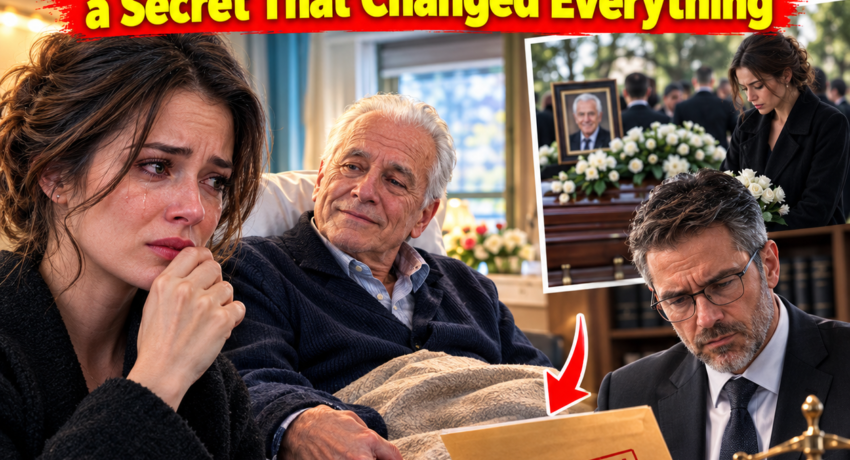
Then, one week after the funeral, Mr. Vance came to see me.
He carried a thick manila envelope.
The moment I saw his face, I knew something was wrong.
“Please sit,” he said.
I obeyed.
He placed the envelope on the table.
“I represented Arthur for more than thirty years.”
“I know.”
“He trusted me with many things.”
Mr. Vance rested one hand on the envelope.
“Including this.”
I stared at him.
“Whatever is inside, just tell me.”
His expression remained grave.
“This may be difficult to process.”
I almost laughed.
“Arthur is dead. What could possibly hurt more than that?”
Mr. Vance studied me.
“That is where you may be mistaken.”
He opened the envelope.
Then he placed several documents in front of me.
I tried to read them.
The language meant nothing.
Trusts.
Beneficiaries.
Property rights.
Ownership structures.
I finally looked up.
“I don’t understand any of this.”
Mr. Vance folded his hands.
“Arthur did not simply have a large bank account.”
I waited.
“He placed this entire nursing home into a trust.”
My heart seemed to stop.
“The nursing home?”
“The building.”
He paused.
“The land.”
I stared at him.
“And you are the sole beneficiary.”
For several seconds I could not speak.
Then I laughed nervously.
“That cannot be true.”
“It is.”
“Arthur was a resident.”
Mr. Vance shook his head.
“No.”
My confusion deepened.
“Arthur purchased this facility eleven years ago.”
I felt the room tilt beneath me.
“He owned it?”
“Every part of it.”
“But nobody treated him like the owner.”
“Because almost nobody knew.”
Mr. Vance leaned back.
“Arthur deliberately kept his ownership private. He wanted to live here as an ordinary resident.”
“Why?”
“Because he wanted to know who would treat him kindly without knowing what he could give them.”
Tears burned behind my eyes.
Mr. Vance continued.
“He was especially concerned about the residents in the state-funded wing.”
My old room flashed through my mind.
The cold radiator.
The worn floors.
The people who counted every coin.
“The people the world forgets,” Mr. Vance said softly.
Before I could respond, a woman’s voice came from behind me.
“He noticed you long before he introduced himself.”
I turned.
Evelyn stood in the doorway.
Part 4 — What Gregory Had Planned
For several seconds, neither of us spoke.
Then I asked the question that immediately came to mind.
“Evelyn, why are you here?”
She stepped inside and quietly closed the door.
“Because my father wanted you to know everything.”
She looked exhausted.
“And because I owe you the truth.”
My stomach tightened.
“What truth?”
Evelyn sat across from me.
“My father suspected Gregory had plans for this property.”
“What kind of plans?”
Her hesitation frightened me more than any immediate answer could have.
Finally, she said:
“He wanted to demolish the state-funded wing.”
I stared at her.
“What?”
“He already had preliminary plans. Investors. Architects.”
Her voice trembled.
“He wanted the land redeveloped into luxury condominiums.”
I thought of the people living down that corridor.
Women like me.
Men who had outlived their savings.
Widows.
Former laborers.
People without children.
People whose families could not afford expensive care.
“Where were the residents supposed to go?”
Evelyn looked down.
“He didn’t care.”
A terrible coldness filled my chest.
“Arthur knew?”
“He discovered Gregory’s plans.”
Her eyes filled with tears.
“It broke his heart.”
Mr. Vance spoke.
“That is why Arthur transferred the property into a trust.”
I looked at him.
“Why not simply leave it to me in his will?”
“Because Gregory would have contested the will immediately.”
Mr. Vance tapped the documents.
“He could have tied the estate up in litigation for years. Arthur wanted the building protected before he died.”
My hands began shaking.
“I thought I was protecting Arthur.”
“You were,” Evelyn said.
She reached for my hand.
“And all along, he was protecting you too.”
I looked at her.
“Why did you help him?”
The question clearly hurt her.
“Gregory is your brother.”
She lowered her head.
“For years, I stayed silent.”
Her voice became small.
“Gregory controlled every family decision. I convinced myself it was easier not to interfere.”
She swallowed.
“I watched him bully our father, and I did nothing.”
For the first time, I understood the strange expression she had worn whenever I saw her watching Arthur from a distance.
It had not been indifference.
It had been shame.
“When I discovered what Gregory planned to do here,” she continued, “I finally realized silence was a choice too.”
She looked at me.
“So I helped my father.”
Mr. Vance nodded.
“Everything was completed legally.”
I stared at the mountain of documents.
“I don’t know how to own a nursing home.”
“You won’t be doing it alone.”
“I have no money.”
“You own the property.”
“I don’t know how to fight Gregory.”
Mr. Vance’s expression became serious.
“You don’t need Gregory’s power.”
He pointed toward the documents.
“You have the law.”
Then Evelyn squeezed my hand.
“And you have us.”
For years, poverty had trained me to make myself small.
Do not complain.
Do not ask for too much.
Be grateful for whatever you are given.
But sitting there, thinking of the people in that cold state-funded wing, something inside me changed.
Because Arthur had not left me luxury for the sake of luxury.
He had left me responsibility.
And I knew Gregory would come.
I simply did not expect him so soon.
Part 5 — Gregory’s Last Attempt
The doors flew open.
Gregory entered with two lawyers behind him.
He did not knock.
He did not offer condolences.
He walked directly toward me and threw a folded document onto the table.
“Pack your belongings.”
I looked at the paper.
“What is this?”
“An eviction notice.”
He smiled without warmth.
“This suite belongs to the family estate. As Father’s eldest son, I have filed my claim.”
Mr. Vance remained perfectly calm.
Evelyn stepped in from the balcony.
“Sit down, Gregory.”
He spun toward her.
“I don’t take orders from you.”
I reached for the documents Arthur’s lawyer had just shown me.
My hands were no longer trembling.
“I think you should read something before you say another word.”
I pushed the papers across the table.
Gregory snatched them up.
At first he looked irritated.
Then confused.
Then alarmed.
The color slowly disappeared from his face.
“This is fake.”
No one answered.
Gregory looked at Mr. Vance.
“Father would never do this.”
Mr. Vance closed the folder in front of him.
“Your father owned this entire facility.”
Gregory stared at him.
“And he placed it into a trust naming his widow as sole beneficiary.”
Gregory turned toward me.
“You manipulated him.”
His voice rose.
“You found a sick old man, married him, and manipulated him into giving you everything.”
Before I could respond, Evelyn stepped forward.
“No.”
Gregory looked at her.
She held his gaze.
“I helped Father arrange it.”
For the first time, Gregory seemed genuinely shocked.
“What?”
“I was there.”
“You?”
“I signed documents as a witness. Father knew exactly what he was doing.”
Gregory’s face twisted.
“You went behind my back.”
Evelyn’s voice remained quiet.
“Someone had to.”
For several seconds, brother and sister stared at each other.
Then Evelyn added:
“He knew what you planned for the state wing.”
Gregory said nothing.
That silence told me everything.
Mr. Vance placed the remaining papers into his briefcase.
“There is nothing for you to claim here.”
Gregory looked toward his attorneys.
Neither seemed eager to argue.
“You’ll regret this,” he muttered.
Perhaps the old version of me would have been frightened.
The woman who had counted pension coins and apologized for worn slippers might have lowered her eyes.
But Arthur had trusted me with his final days.
Now he had trusted me with something even larger.
I looked straight at Gregory.
“I doubt it.”
He stood there for another moment.
Then he turned and walked out.
His lawyers followed.
The door closed behind them.
And just like that, the storm Arthur had predicted beneath the oak tree was finally over.
Part 6 — Arthur’s Real Legacy
In the weeks that followed, I began learning what Arthur had actually given me.
Not wealth.
Not really.
He had given me the ability to make choices for people who had rarely been given any.
The first thing I ordered was repairs to the state-funded wing.
Windows were replaced.
Heating systems were fixed.
Walls were repaired.
Rooms that had remained cold every winter finally became warm.
I walked through the corridor one afternoon as workers carried equipment from room to room.
A woman I had once shared meals with touched my arm.
“It’s warm,” she said.
Such a simple sentence.
But it nearly broke my heart.
Later that evening, I returned to the courtyard.
The old oak tree was still there.
So was the table where Arthur and I had played our first chess game.
I sat in my usual chair and placed my hand on the opposite one.
For a moment, I could almost hear his voice.
“Then sit. I have not lost gracefully in years.”
I smiled through my tears.
I remembered the first cup of imported tea.
The jazz records.
His laugh.
The way he had told me my worn shoes were valuable simply because they had carried me to him.
For most of my life, I believed wealth meant having enough money to stop worrying.
Arthur taught me something different.
Real wealth was having the power to protect someone and choosing to use it.
It was giving dignity to people who had been overlooked.
It was making sure an old woman did not spend another winter shivering beneath thin blankets.
It was refusing to let someone’s worth be measured by the size of their bank account.
I looked toward the newly repaired windows of the state-funded wing.
Warm yellow light filled rooms that had once seemed permanently gray.
“Arthur,” I whispered, “your dream is safe.”
The leaves moved gently overhead.
For the first time in years, the nursing home no longer felt like the place where I had been sent because there was nowhere else for me to go.
It felt like home.
And perhaps that was Arthur’s final gift.
He had not simply left me a building.
He had reminded me that even near the end of our lives, we can still find friendship.
We can still choose courage.
We can still protect someone.
And sometimes, when we think we are rescuing another person, we discover they have been quietly rescuing us too.