Part 1 — The Invitation
The groom was halfway through his vows when my youngest son tugged free of my hand and laughed.
It was a small, innocent sound.
But in the silence of that elegant garden, it carried all the way to the altar.
Adrian Whitmore stopped speaking.
His bride, Vanessa, was still holding both his hands. The minister waited patiently beside them. Nearly two hundred guests sat beneath white roses and strings of crystal lights.
But Adrian wasn’t looking at his bride anymore.
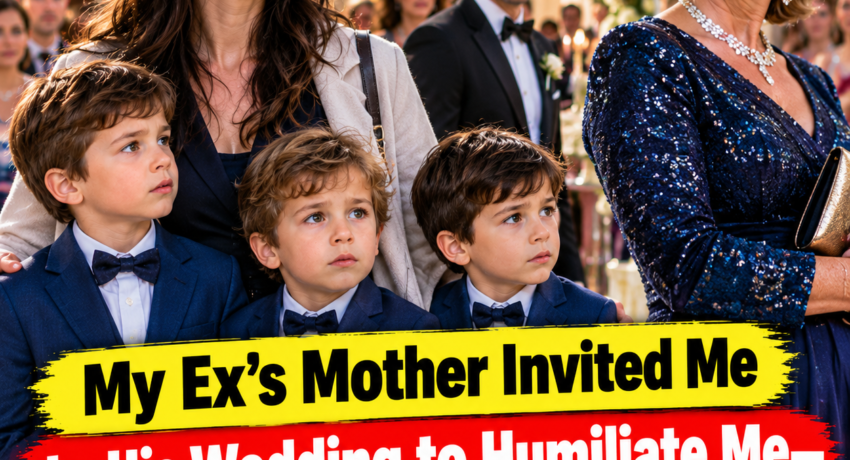
He was staring at the three little boys standing beside me.
Owen.
Miles.
Caleb.
All four years old.
All wearing matching navy-blue vests and bow ties because Miles had insisted that if we were going to “a fancy wedding,” they needed to look like “tiny businessmen.”
And all three had Adrian’s eyes.
Not similar eyes.
His eyes.
That unusual gray-blue color I had once loved waking up beside.
Adrian’s face went completely white.
Behind me, someone whispered, “Oh my God.”
Another guest turned around.
Then another.
Within seconds, half the wedding was staring at us.
But the person I watched most carefully was standing in the front row.
Eleanor Whitmore.
Adrian’s mother.
The woman who had sent me the invitation.
The woman who had included a handwritten note inside it.
I thought you might like to see what a woman truly suited for Adrian looks like.
I had read that sentence at least twenty times.
Four years had passed since Eleanor had made it clear that I was never going to belong in her world.
Apparently, that hadn’t been enough for her.
She wanted me to witness her victory.
So I came.
What Eleanor hadn’t known was that I wouldn’t be coming alone.
Her triumphant smile remained on her face for perhaps three seconds after she saw me.
Then she noticed the boys.
And for the first time since I’d known her, Eleanor Whitmore looked afraid.
Adrian released Vanessa’s hands.
“Claire?”
Hearing my name in his voice after nearly five years did something strange to my chest.
I had spent countless nights imagining this moment.
Sometimes I imagined yelling.
Sometimes crying.
Sometimes turning around and leaving without giving him the satisfaction of seeing me hurt.
But standing there with my three sons beside me, I felt surprisingly calm.
“Hello, Adrian.”
His eyes moved from me to Owen.
Then Miles.
Then Caleb.
Back to me.
“Who…”
He couldn’t finish.
Caleb leaned toward me and whispered much too loudly, “Mommy, why does that man look like us?”
A ripple passed through the guests.
Vanessa slowly turned toward Adrian.
Her expression had changed.
“Adrian?”
He didn’t answer her.
He stared at me.
And then he asked the question Eleanor had spent four years making certain he never would.
“Claire… are they mine?”
I looked directly at his mother.
Her face told me everything.
He truly didn’t know.
And suddenly, the wedding Eleanor had invited me to watch became the place where her oldest secret was about to explode.
But to understand how we reached that altar, you have to understand why I had once believed Adrian knew about his children—and had chosen to abandon them.
Part 2 — Before the Whitmores Decided I Wasn’t Good Enough
I met Adrian when I was twenty-seven.
And no, it wasn’t one of those stories where a billionaire walked into the little diner where I worked and fell hopelessly in love with the poor waitress.
I had a career.
I worked in event coordination for a nonprofit organization in Boston, mostly organizing fundraising dinners, charity auctions, and community programs.
Adrian’s family happened to donate to one of those programs.
He arrived late to a planning meeting wearing an expensive suit, carrying two coffees, and apologizing because he’d gotten on the wrong subway line.
I laughed.
He looked offended.
“You try growing up with a driver,” he said.
That made me laugh harder.
He smiled.
That was the beginning.
Adrian came from the kind of money I had only seen in magazines.
The Whitmore family owned commercial property, hotels, and investment companies across several states. Their family home wasn’t called a house.
It was called an estate.
The first time Adrian took me there, I spent ten minutes trying to figure out which fork I was supposed to use.
His father, Richard, was polite.
His younger sister, Julia, was warm.
Eleanor barely looked at me.
“So,” she said over dinner, “your parents own a business?”
“My dad was an electrician. My mom teaches third grade.”
Eleanor smiled.
Not kindly.
“I see.”
Those two words told me everything.
Adrian noticed.
Later, in the car, he squeezed my hand.
“Don’t let her get to you.”
“I’m not.”
I was lying.
Eleanor didn’t insult me openly.
She was too sophisticated for that.
Instead, she asked questions.
Had I attended boarding school?
No.
Did my family summer in Martha’s Vineyard?
No.
Did I ski?
Badly.
Which club did my parents belong to?
The YMCA.
Adrian nearly choked on his wine when I answered that one.
He loved that I didn’t pretend.
For almost two years, we were happy.
Real happy.
Sunday mornings in sweatpants.
Chinese takeout on the living-room floor.
Arguments about whose turn it was to buy groceries.
Long drives with no destination.
He proposed once without a ring while we were washing dishes.
“Marry me someday.”
I splashed him with water.
“Ask me when you’re not holding a dirty frying pan.”
He kissed me.
“I will.”
I believed him.
Unfortunately, Eleanor believed him too.
And that terrified her.
The pressure increased after that.
Family dinners became colder.
Invitations stopped arriving.
Eleanor began introducing Adrian to daughters of business associates while I was standing beside him.
One of those women was Vanessa Hart.
Beautiful.
Educated at Princeton.
Daughter of a respected investment banker.
Perfect, according to Eleanor.
Adrian barely noticed her.
At least then.
Then everything changed during a ten-day business trip.
Adrian was sent to Singapore to help negotiate a major hotel acquisition. We spoke the first two evenings.
On the third morning, I woke up nauseous.
By that afternoon, I had taken three pregnancy tests.
All positive.
I sat on the bathroom floor laughing and crying at the same time.
We hadn’t planned it.
But I loved that baby instantly.
I tried calling Adrian.
The call failed.
I texted.
No response.
He had warned me that meetings would be brutal, so I decided to wait until we could talk properly.
Then, two days later, I began bleeding.
Terrified, I went to the hospital.
The doctor examined me, performed an ultrasound, then stared at the screen.
“Well,” she said.
My heart stopped.
“Is something wrong?”
She smiled.
“Actually, there are three somethings.”
I thought she was joking.
She wasn’t.
Triplets.
I left the hospital with an ultrasound picture shaking in my hand.
And standing outside my apartment building when I returned was Eleanor Whitmore.
To this day, I don’t know how she found out I was pregnant so quickly.
But she knew.
And she had come prepared.
Part 3 — The Lie That Changed Five Lives
Eleanor didn’t come inside.
She stood beneath the awning outside my building as though entering my apartment might expose her to something contagious.
“I understand congratulations are in order,” she said.
I froze.
“Adrian told you?”
“No.”
That should have been my first warning.
She looked at the ultrasound picture in my hand.
“How far along?”
“I don’t think that’s any of your business.”
“Everything involving my son is my business.”
I tried walking past her.
She caught my arm.
“Claire.”
Something about her tone stopped me.
“Adrian and I have already discussed your relationship.”
My stomach tightened.
“What does that mean?”
“It means he understands that this has gone too far.”
I laughed nervously.
“You haven’t even spoken to him about the baby.”
“No. But we’ve discussed you.”
I wish I could say I immediately recognized what she was doing.
I didn’t.
I was twenty-nine, pregnant with triplets, frightened, exhausted, and in love.
That made me vulnerable.
Eleanor knew it.
She told me Adrian had been reconsidering our relationship for months.
She said he hadn’t known how to tell me.
She said Singapore had given him “perspective.”
I refused to believe her.
Then she handed me an envelope.
Inside was a document offering me money.
A lot of money.
Enough to buy a house outright.
Enough to make my hands shake.
“What is this?”
“A settlement.”
“I’m not suing anybody.”
“It’s to help you begin somewhere else.”
I stared at her.
“You’re offering to pay me to disappear?”
“I’m offering you security.”
“You can go to hell.”
I shoved the papers back at her.
For the first time, her composure cracked.
“You will never be accepted into this family.”
“I don’t need your acceptance.”
“Your children will.”
That hurt.
She saw that it hurt.
Eleanor leaned closer.
“You think love conquers everything because you’ve never had anything substantial to lose.”
“I love Adrian.”
“And Adrian has responsibilities that existed before you.”
I went upstairs and slammed the door.
For the next three days, I called Adrian repeatedly.
Nothing.
Then his number suddenly stopped working.
My emails received no response.
I went to his office after he returned from Singapore.
Security wouldn’t let me upstairs.
“I’m sorry, Ms. Bennett. Mr. Whitmore has requested that you not be admitted.”
Those words crushed me.
I didn’t know Eleanor had given that instruction.
I didn’t know she’d told Adrian that I’d accepted the money and left.
I didn’t know she’d shown him a copy of the settlement papers—with a forged signature at the bottom.
All I knew was that the man I loved had apparently ordered security to keep me away.
Two days later, Eleanor appeared again.
This time she handed me a letter.
It was typed.
Adrian’s name was at the bottom.
It said he’d been informed of the pregnancy.
It said he wasn’t prepared to be involved.
It said the financial arrangement offered by his family was “the best solution for everyone.”
I read it until the words blurred.
“He wrote this?”
Eleanor didn’t hesitate.
“Yes.”
“He knows there are three?”
“Yes.”
“And he doesn’t want them?”
She paused.
Then said quietly, “He doesn’t want this life.”
Something inside me broke.
I moved to Connecticut a month later to stay with my sister.
I never took Eleanor’s money.
I never signed anything.
And I never contacted the Whitmores again.
Why?
Because there comes a point when dignity is all you have left.
I could survive being rejected.
But I refused to spend my children’s lives begging someone to love them.
Owen, Miles, and Caleb were born seven weeks early.
Tiny.
Furious.
Perfect.
I built my entire life around them.
There were nights when all three cried at once and I sat on the nursery floor crying with them.
There were mornings when I went to work with two hours of sleep.
There were medical bills.
Day-care bills.
Fevers.
First steps.
First words.
Three high chairs.
Three car seats.
Three small voices yelling “Mommy!” from different rooms.
It was exhausting.
It was also the happiest I had ever been.
I never lied to them about having a father.
I simply told them he lived somewhere else and that when they were older, I would explain.
Then, four years later, an ivory envelope arrived.
The return address made my hands go cold.
Whitmore Estate.
Inside was Adrian’s wedding invitation.
And beneath it was Eleanor’s handwritten message.
I thought you might like to see what a woman truly suited for Adrian looks like.
She wanted me humiliated.
She wanted me reminded that she’d won.
I threw the invitation away.
Then that night, Owen found an old photograph I’d forgotten was tucked inside a book.
It was a picture of Adrian and me.
He studied it.
Then looked at me.
“Mommy?”
“Yes?”
He pointed at Adrian.
“Why does he have Caleb’s eyes?”
I didn’t sleep that night.
By morning, I had taken the invitation out of the trash.
Part 4 — The Wedding
I didn’t attend Adrian’s wedding intending to destroy it.
I know some people won’t believe that.
But I didn’t.
I wanted one thing.
To look Eleanor in the eye and show her that the three children she had called an inconvenience had grown into happy, loved little boys without a single dollar from her family.
Maybe that was pride.
Maybe it was anger.
Maybe part of me simply needed to close the door she’d slammed in my face four years earlier.
I bought myself a royal-blue dress.
The boys picked matching blue vests.
“We’re going to a castle?” Miles asked.
“Not exactly.”
“Will there be cake?”
“Probably.”
That was enough for him.
We arrived after the ceremony had begun.
I deliberately planned it that way.
I didn’t want attention.
Unfortunately, attention found us.
The ceremony was being held on the terrace behind a private country club overlooking the water.
I stood at the edge, planning to wait until it ended.
Then Caleb laughed.
Adrian looked up.
And everything stopped.
“Claire… are they mine?”
The question hung in the air.
I could have lied.
I could have said this wasn’t the place.
Instead, after four years of believing he’d rejected his sons, I needed the truth.
So I said, “You really don’t know?”
His face changed.
“What?”
Eleanor suddenly stood.
“This is inappropriate.”
Adrian turned toward her.
“Mother.”
“Not here.”
Vanessa was still beside him.
Her bouquet trembled slightly in her hand.
“Adrian,” she said carefully, “what is happening?”
He looked back at me.
“How old are they?”
“Four.”
His eyes shut for half a second.
He was counting.
Everyone was.
“When are their birthdays?”
“August eighteenth.”
Adrian staggered backward as if someone had struck him.
He knew.
There was no possible confusion now.
Our relationship had ended in December.
The boys had arrived the following August, premature.
The timing was unmistakable.
Eleanor walked toward me.
Her voice was low.
“Take those children and leave.”
Those children.
Something about hearing her say it unlocked every ounce of anger I had carried for years.
“They have names.”
Her mouth tightened.
“This is a wedding.”
“I noticed.”
“You’ve made your point.”
“I haven’t made any point. You invited me.”
People murmured.
Adrian’s head snapped toward his mother.
“You invited her?”
Eleanor said nothing.
Vanessa looked between them.
“You invited your son’s ex-girlfriend to our wedding?”
“It was a courtesy.”
I almost laughed.
“A courtesy?”
I opened my purse.
I still had the invitation.
I pulled out Eleanor’s note.
“I thought you might like to see what a woman truly suited for Adrian looks like.”
Vanessa went very still.
Adrian stared at his mother.
“You wrote that?”
“This is not the time.”
“No, Mother. Did you write that?”
Eleanor’s silence answered for her.
Then Adrian walked down from the altar.
He stopped several feet from the boys.
Owen moved closer to me.
Adrian noticed and stopped immediately.
He didn’t try touching them.
Didn’t call himself their father.
Didn’t make some dramatic speech.
He simply stared.
Caleb stared back.
Then Caleb whispered to Miles, “He’s doing our face.”
Despite everything, I nearly laughed.
Adrian covered his mouth.
His eyes filled with tears.
That was when I understood something terrible.
A man who had knowingly abandoned his children would not look like that.
“Claire,” he whispered, “I never knew.”
My stomach dropped.
Behind him, Eleanor whispered, “Adrian.”
He spun around.
“What did you do?”
Eleanor went pale.
And suddenly, I wasn’t the unwanted ex standing at a wedding anymore.
Eleanor was the one with nowhere to hide.
Part 5 — The Truth Comes Out
The minister suggested taking a short break.
That may have been the most optimistic sentence ever spoken at a wedding.
Guests were escorted toward the cocktail area.
No one wanted to go.
Everyone moved slowly, whispering, looking over shoulders, pretending they weren’t desperate to hear more.
Vanessa handed her bouquet to her maid of honor.
“I’m not going anywhere,” she said.
I liked her immediately for that.
We moved inside to a private library.
Me.
Adrian.
Vanessa.
Eleanor.
And Adrian’s sister Julia, who had followed us in with tears running down her face.
The boys stayed just outside with my sister Rachel, who had accompanied me.
Adrian stood across from me.
“Tell me everything.”
Eleanor interrupted.
“Adrian, think carefully before—”
“Mother, don’t speak.”
I’d never heard him talk to her like that.
Neither had she.
I took out my phone.
Years earlier, I’d photographed every document Eleanor gave me.
I still had them stored in a folder I almost never opened.
I showed Adrian the settlement agreement.
His face hardened.
“I’ve never seen this.”
Then I showed him the letter.
He read it slowly.
“No.”
“What?”
“I didn’t write this.”
I felt dizzy.
“Your name is on it.”
“I didn’t write it.”
He turned toward Eleanor.
“You told me she accepted money.”
Eleanor said nothing.
Adrian continued.
“You showed me a document with her signature.”
My breath caught.
“What?”
Now it was my turn.
“You told him I took the money?”
Adrian stared at me.
“Two hundred fifty thousand dollars.”
“I never received a cent.”
He ran a hand through his hair.
“She told me you were tired of the pressure. That you’d accepted the settlement and moved away.”
“I tried to see you.”
“I tried to find you!”
My anger surged.
“Security wouldn’t let me into your office!”
“I never told security to keep you out!”
We both turned toward Eleanor.
Vanessa closed her eyes.
Julia whispered, “Mom…”
Eleanor finally spoke.
“I was protecting my son.”
Adrian laughed once.
There was no humor in it.
“From what?”
“From throwing away his future.”
“On the mother of my children?”
“She wasn’t pregnant when this began.”
“I was,” I said. “You knew.”
Vanessa looked sharply at Eleanor.
“You knew she was pregnant?”
Silence.
Adrian’s expression changed again.
“You knew?”
Eleanor lifted her chin.
“I knew there was a pregnancy.”
“Three babies,” I said.
“Which made the situation even more complicated.”
Julia covered her mouth.
Adrian stared at his mother as though she were a stranger.
“You knew I had sons.”
“I knew Claire claimed—”
“Don’t.”
My voice came out sharper than I expected.
“Don’t do that. Don’t stand there and suggest I wasn’t sure who their father was. You knew exactly what you were doing.”
Eleanor looked at me.
For once, there was no smugness in her expression.
Only desperation.
“I believed Adrian would eventually understand.”
“Understand what?” he demanded.
“That marriage is not merely about emotion. Our family has responsibilities. Expectations. Your father spent his entire life building—”
“My father liked Claire.”
That silenced her.
Adrian stepped closer.
“You lied to me.”
Eleanor said nothing.
“You lied about the money.”
Nothing.
“You forged her signature.”
Nothing.
“You blocked her from my office.”
Nothing.
“And when she came here today, you already knew those boys might be mine.”
Eleanor finally looked away.
That was the answer.
Then Vanessa spoke.
Very quietly.
“Why did you invite her?”
Eleanor looked at her.
Vanessa’s voice shook now.
“Why would you invite Claire to our wedding?”
“I wanted closure.”
“No.”
Vanessa looked at the note in Adrian’s hand.
“You wanted to humiliate her.”
Nobody answered.
Vanessa removed her engagement ring.
Adrian saw.
“Vanessa—”
She held up her hand.
“I’m not blaming you for children you didn’t know existed.”
Her eyes were wet.
“But I’m also not getting married today while you discover that you have three sons.”
“Vanessa, I’m sorry.”
“I know.”
She took his hand and placed the ring in his palm.
“This isn’t something we solve during cocktail hour.”
Then she turned to Eleanor.
“And for what it’s worth, if becoming ‘worthy of this family’ means treating another woman like this, I’m relieved I failed.”
She walked out.
Eleanor looked like she’d been slapped.
For a second, no one moved.
Then the library door opened.
Owen stood there.
Rachel was behind him.
“I’m sorry,” she whispered. “He slipped away.”
Owen looked at Adrian.
Then at me.
“Mommy?”
“Yes, sweetheart?”
He pointed to Adrian.
“Is he our dad?”
There it was.
The question I’d spent four years preparing to answer.
Except now the man himself was standing ten feet away.
I looked at Adrian.
His eyes were full of fear.
Not fear of responsibility.
Fear that I’d say no.
So I crouched in front of Owen.
“I think he might be.”
Owen considered that.
Then asked the most important question in his four-year-old world.
“Does he like dinosaurs?”
Adrian laughed through his tears.
“I love dinosaurs.”
Owen’s eyes widened.
That was the first bridge between them.
But DNA would soon confirm what all of us already knew.
And afterward, Adrian asked me for something I wasn’t sure I could give him.
A chance to become their father.
Part 6 — Becoming Dad
The DNA results came back ten days later.
99.99 percent probability of paternity.
No surprise.
Still, seeing it printed on paper made everything real.
Adrian had three sons.
And my sons had a father.
He wanted to see them immediately.
I said no.
That surprised him.
“You said I could be involved.”
“I said we would figure it out.”
“They’re my children.”
“They’re also four-year-olds whose entire lives changed at a wedding.”
He went quiet.
I continued.
“You don’t get to arrive with a last name and money and suddenly become Dad. You become Dad by showing up.”
To his credit, he listened.
We started slowly.
One afternoon at a playground.
Then lunch.
Then a trip to the aquarium.
Adrian arrived twenty minutes early every time.
At first the boys called him Adrian.
Then Mr. Adrian because Miles decided adults needed titles.
Caleb called him “that dad guy” for almost a month.
Adrian accepted all of it.
He learned Owen hated tomatoes.
He learned Miles wouldn’t sleep unless his stuffed rabbit was tucked under his left arm.
He learned Caleb asked approximately nine hundred questions before breakfast.
He installed three car seats in his SUV and called me because he couldn’t figure out the straps.
I laughed so hard I had to sit down.
“You manage a company.”
“Companies have instructions.”
“The instructions are on the side.”
“I read them.”
“Apparently not.”
He sent me a photo twenty minutes later.
All three seats installed perfectly.
Slowly, something softened between us.
But trust was harder.
One evening, after the boys were asleep, Adrian stood in my kitchen while I loaded the dishwasher.
“I should have looked harder for you.”
I stopped.
“Yes.”
He seemed surprised I agreed.
“I thought you would tell me it wasn’t my fault.”
“It wasn’t your fault that your mother lied.”
I closed the dishwasher.
“But you believed I would take money and disappear without even saying goodbye.”
He looked down.
“You’re right.”
That mattered.
No excuses.
No blaming Eleanor for everything.
“I was angry,” he said. “I thought you’d chosen money over me. And maybe part of me was too proud to keep searching after I thought you’d rejected me.”
“While I thought you had rejected three babies.”
His eyes closed.
“I don’t know how to apologize for that.”
“You can’t apologize for what you didn’t know.”
“But I can apologize for not knowing you well enough to realize something was wrong.”
That was the first conversation we had that wasn’t about lawyers, schedules, DNA, or preschool.
It reminded me why I’d loved him.
But loving someone once doesn’t automatically mean you should love them again.
Meanwhile, Eleanor kept asking to meet the boys.
I refused.
She sent gifts.
I returned them.
She sent checks.
I mailed them back.
Finally she came to my house.
I opened the door and stepped outside so the boys wouldn’t hear.
“I want to meet my grandsons.”
“You don’t get to call them that yet.”
Her face tightened.
“I am their grandmother.”
“Biologically.”
“Claire—”
“You didn’t think of them as grandchildren when you tried to erase them.”
For once, Eleanor didn’t argue.
She looked older than I remembered.
“I made a terrible mistake.”
“No. A mistake is forgetting an appointment. You made decisions. Repeatedly.”
Her eyes lowered.
“I believed I was protecting Adrian.”
“You were protecting an image.”
She didn’t deny it.
After a moment, she said, “What do I have to do?”
I had expected demands.
Not that.
“Nothing.”
She looked confused.
“You don’t buy your way into their lives. You don’t pressure me. You don’t pressure Adrian. You don’t send presents.”
“Then how do I—”
“You wait.”
“For how long?”
“As long as necessary.”
She nodded.
Then she left.
Six months passed before I allowed her to attend one of the boys’ soccer practices.
She sat on the far side of the field.
She brought nothing.
No toys.
No envelopes.
No designer clothes.
When Caleb scored accidentally after the ball bounced off his knee, Eleanor stood and cheered louder than anyone.
Caleb looked at her.
“Who’s that lady?”
I hesitated.
Then said, “That’s your grandmother.”
He waved.
Eleanor burst into tears.
It wasn’t forgiveness.
But it was a beginning.
And strangely, as Eleanor slowly entered the boys’ lives, Adrian was finding his way back into mine.
Until one rainy November night, he said something that terrified me more than anything his mother had ever done.
“I never stopped loving you.”
Part 7 — The Second Chance I Didn’t Want
I stared at him across my kitchen.
“No.”
Adrian blinked.
“I haven’t even asked anything.”
“You were going to.”
“I was going to tell you how I feel.”
“I know how this works.”
He smiled faintly.
“Apparently you do.”
I wasn’t smiling.
“Adrian, don’t confuse gratitude with love.”
“I’m not grateful to you.”
“Excuse me?”
“That sounded terrible.”
“It really did.”
He rubbed his forehead.
“I mean, of course I’m grateful. But that’s not why.”
“Then maybe you’re romanticizing the past.”
“I’m not.”
“You lost four years. You’re trying to recreate something.”
“No.”
“Your wedding ended because I showed up with triplets. Your life exploded. You became a father overnight. You don’t know what you’re feeling.”
He let me finish.
Then he said, “Do you?”
That irritated me because I didn’t.
I still knew how Adrian took his coffee.
I still knew when he was pretending not to be nervous because his left thumb tapped against his palm.
I still laughed before I wanted to when he told terrible jokes.
And there were evenings when he put three sleeping boys into bed, walked downstairs with Caleb’s dinosaur sticker stuck to his expensive shirt, and looked so completely at home that my heart hurt.
But I had built a life without him.
A good life.
Letting him back in meant risking everything I’d learned to protect.
So I said, “I can’t do this.”
He nodded.
“Okay.”
That surprised me.
“Okay?”
“I told you how I feel. I didn’t ask you to answer tonight.”
“And if I never feel the same?”
“Then I still show up Saturday at nine for the boys.”
That answer stayed with me.
Weeks passed.
Nothing changed.
And everything changed.
Adrian didn’t push.
He didn’t flirt dramatically.
He didn’t use the children to reach me.
He just kept showing up.
Thanksgiving.
Preschool Christmas concert.
Miles’s ear infection at two in the morning.
Owen’s first loose tooth.
Caleb’s phase where he refused to wear anything that didn’t have a dinosaur on it.
He was there.
Then, one evening in February, we were cleaning the boys’ playroom.
I found the old wedding invitation in a storage box.
I hadn’t realized I’d kept it.
Adrian saw Eleanor’s handwritten sentence again.
His expression darkened.
“I hate that this brought us back together.”
I thought about it.
“It didn’t.”
He looked at me.
“It brought you back into the boys’ lives.”
“What’s the difference?”
“The rest happened afterward.”
For a moment, neither of us spoke.
Then I reached for his hand.
It was the first time I’d touched him that way in almost five years.
His fingers closed around mine.
“Claire.”
“Don’t make a speech.”
“I wasn’t going to.”
“You were.”
“I had an excellent one prepared.”
I laughed.
That was our second beginning.
Not a dramatic kiss in the rain.
Not a proposal.
Not a grand declaration in front of hundreds of people.
A messy playroom.
Plastic dinosaurs everywhere.
Three sleeping boys upstairs.
Two people admitting they might still have something worth saving.
We dated for almost a year.
Slowly.
Carefully.
Adrian kept his own apartment.
We went to counseling.
We talked about anger.
Trust.
Pride.
Family.
The ways both of us had failed to fight harder for each other.
And eventually, the past stopped being the only thing connecting us.
We became something new.
One spring evening, Adrian took me back to the nonprofit center where we’d first met.
He handed me two coffees.
“Do you remember this?”
“You brought me the wrong order.”
“I was nervous.”
“You said you drank black coffee.”
“I hate black coffee.”
I stared at him.
“You drank black coffee for six months.”
“You were impressed.”
“I thought you were insane.”
He laughed.
Then he reached into his coat.
I groaned.
“Adrian.”
“What?”
“If you pull out a ring—”
He pulled out a dirty frying pan.
I stared at him.
He looked ridiculously pleased with himself.
“You didn’t.”
“I did.”
Inside the frying pan was a small velvet box.
Years earlier, standing over a sink full of dishes, he’d told me to marry him someday.
I’d told him to ask again when he wasn’t holding a frying pan.
Apparently, he’d remembered.
He opened the box.
“Claire Bennett, I loved you when I was too young and proud to understand how easily love can be lost.”
My eyes filled.
“I love you now knowing exactly what it costs to protect it.”
I covered my mouth.
“And if you say yes, I promise never to let my mother organize the wedding.”
I laughed through my tears.
“That should have been your opening argument.”
“So?”
I looked at the man in front of me.
Then at the frying pan.
Then at the ring.
“Yes.”
Part 8 — The Wedding Eleanor Never Expected
We didn’t marry at the Whitmore estate.
We didn’t have two hundred guests.
There were no crystal chandeliers.
No society photographers.
No seating chart designed according to wealth or influence.
We got married in the backyard of the house Adrian and I bought together.
Thirty-eight people attended.
The boys were five.
They wore blue vests again because they remembered the “fancy wedding outfits.”
Owen carried the rings.
Miles carried flowers.
Caleb carried absolutely nothing because he’d announced that he was “management.”
Vanessa wasn’t there.
But six months after the disastrous wedding, she’d sent me a message.
I’d almost ignored it.
She wrote that she wanted me to know she didn’t blame me.
She had eventually met someone else and was happy.
Then she added:
For years, Eleanor told me I was exactly the kind of woman Adrian needed. I’ve realized that’s not something I should ever have considered a compliment.
I laughed for five minutes.
Eleanor attended our wedding too.
She sat in the second row.
Not the first.
That was her choice.
Our relationship would probably never be easy.
Some wounds leave scars even after they heal.
But she had changed.
Or at least she was trying.
She attended soccer games.
She learned to make peanut butter sandwiches without cutting them into perfect triangles because Caleb insisted triangles “tasted too fancy.”
She stopped introducing the boys as “Whitmore heirs.”
After Adrian corrected her, she simply called them her grandsons.
Most importantly, she never again tried to decide what was best for everyone else.
Before the ceremony, she found me alone in the kitchen.
For a second, neither of us knew what to say.
Then Eleanor handed me a small envelope.
My stomach tightened.
She noticed.
“No money.”
“Good.”
“No contracts either.”
“Even better.”
Inside was the original wedding invitation she had sent me.
The one with her cruel note.
But across the bottom, she had written something else.
I spent my life believing family was something you protected from outsiders.
You taught me that sometimes the person you’re keeping outside is the person your family needs most.
I looked up.
Eleanor’s eyes were wet.
“I’m sorry, Claire.”
Not I’m sorry you misunderstood.
Not I’m sorry things became complicated.
Not I’m sorry but I was trying to protect him.
Just sorry.
I folded the note.
“Thank you.”
She looked relieved.
“I don’t expect forgiveness.”
“I know.”
“Do you think someday—”
“Don’t ruin the moment, Eleanor.”
She actually laughed.
“I walked into that one.”
“Yes, you did.”
Outside, music began.
My three boys started shouting for me.
“Mom!”
“Mommy!”
“Mom, Dad says you’re supposed to come outside now!”
I stepped onto the patio.
Adrian was standing beneath an oak tree.
When he saw me, he smiled.
It was the same smile he’d given me years earlier when he’d arrived late to that first meeting carrying two coffees.
Only now there were laugh lines around his eyes.
And three little boys jumping around his legs.
I walked toward him.
This time, there was no shocked bride.
No whispering crowd.
No secret waiting to explode.
Just us.
When I reached him, he whispered, “You came.”
I raised an eyebrow.
“Apparently I have a habit of showing up at your weddings.”
He laughed so loudly the minister had to wait.
And yes, sometimes I still think about Eleanor’s first invitation.
She had sent it because she wanted me to see what victory looked like.
She wanted me sitting somewhere in the crowd while Adrian married a woman she considered worthy.
She wanted me to understand that I had been replaced.
Instead, I arrived holding the hands of three little boys.
Three children she’d tried to erase.
Three children Adrian had never known existed.
Three children whose faces made him forget, for one stunned moment, that he was standing at his own wedding.
Eleanor had invited me because she wanted to close a chapter.
Instead, she opened the truth.
And the strangest part?
If she had simply left me alone, Adrian might never have known.
The boys might have grown up believing their father had chosen not to know them.
Adrian might have spent the rest of his life believing I’d accepted money and disappeared.
And I might have carried my anger forever.
Eleanor’s cruelest gesture became the one mistake she couldn’t control.
Because the second Adrian looked into our sons’ faces, every carefully constructed lie collapsed.
Money couldn’t hide it.
Status couldn’t explain it away.
Pride couldn’t silence it.
The truth was standing right there in three matching blue vests.
Years later, Owen once asked me why his grandmother looked so frightened in the old wedding photos.
I told him there was a very simple explanation.
“Grandma had just realized she’d made a mistake.”
“What mistake?”
I looked across the yard.
Adrian was helping Miles fix a bicycle chain while Caleb gave completely unnecessary instructions.
Eleanor was sitting nearby, pretending not to spoil them while secretly handing Owen a cookie.
I smiled.
“She thought she could decide who belonged in a family.”
Owen frowned.
“That’s silly.”
“Very.”
“Family decides that.”
I kissed the top of his head.
“Exactly.”
And maybe that’s the part Eleanor never understood back then.
A family isn’t made worthy by money.
It isn’t made respectable by the right surname, the right schools, the right connections, or the right person standing beside you in a wedding photograph.
Family is built in ordinary moments.
It’s the person who answers the phone at two in the morning.
The person who learns how to install three car seats.
The person who sits through terrible preschool concerts and cheers anyway.
The person who admits when they were wrong.
The person who keeps showing up after the dramatic moment is over and nobody is watching anymore.
That’s how Adrian became their father.
That’s how we found each other again.
And strangely enough, that’s how Eleanor finally became their grandmother.
All because she mailed one invitation she thought would break me.
Instead, I walked through those doors wearing blue, holding the hands of three four-year-old boys who looked exactly like her son.
And the moment Adrian saw their faces, the wedding stopped.
But our family finally began.