Part 1 — The Day Our Old Life Ended
A few months have passed since my son’s graduation, but there are moments when I can still hear the silence that fell over that crowded gymnasium.
Hundreds of people were there that afternoon—parents holding phones, teachers calling names, students laughing nervously beneath their graduation caps.
But for a few unforgettable seconds, nobody seemed to breathe.
My son Noah was standing behind the microphone.
His father was sitting only a few rows away.
And after ten years of silence, Noah finally said the words I had never been able to say.
To understand why that moment mattered so much, you have to go back to when Noah was eight years old.
That was when our family changed forever.
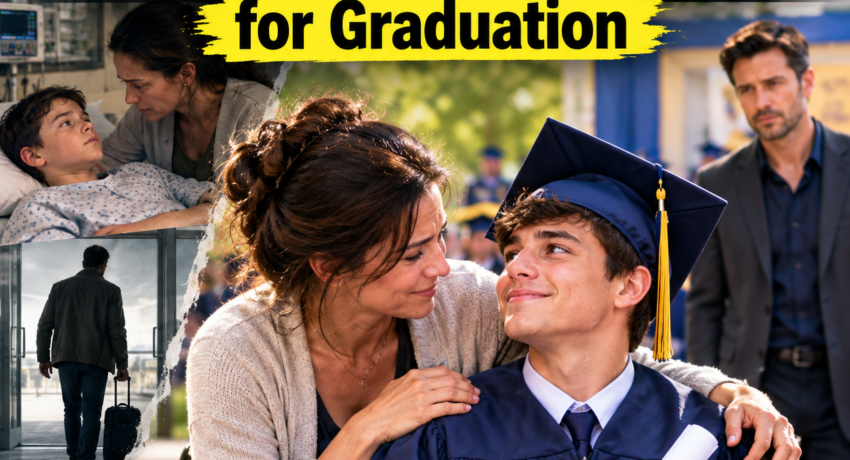
I can still picture the hospital room.
The smell of disinfectant. The low hum of machines. The pale afternoon light coming through the blinds.
Noah looked impossibly small beneath the hospital blanket.
I sat beside him, gripping his hand as if holding tightly enough could somehow protect him from whatever the doctor was about to say.
My husband, Ryan, stood near the window.
The doctor pulled a chair closer.
“The damage to Noah’s spine is significant,” he explained carefully.
My mouth went dry.
I looked at Noah, then back at the doctor.
“Will he be able to walk again?”
There was a pause.
That pause told me more than I wanted to know.
“We can’t guarantee that,” the doctor said. “You should prepare yourselves for the possibility that he may need a wheelchair permanently.”
For a moment, the room seemed to disappear.
Then the doctor added something else.
There was still a small possibility that long-term rehabilitation could help Noah regain some function.
Small.
That word became something I clung to.
Noah turned toward me.
“Mom?”
I immediately leaned closer.
“I’m here, sweetheart.”
“Am I going to be okay?”
Every instinct in me wanted to say, Of course you are.
I wanted to promise him that everything would return to normal.
But I couldn’t lie.
So I squeezed his hand and said, “We’re going to do everything we possibly can.”
And we did.
At least, Noah and I did.
Our lives became a calendar of specialists, rehabilitation sessions, insurance calls, exercises, medical appointments, and long drives.
I learned how to lift my son without making him feel helpless.
I learned how to load a wheelchair into a car while carrying groceries.
I learned how to smile while doctors used words that frightened me.
And I learned how much strength an eight-year-old boy could possess.
Ryan reacted very differently.
At first, I made excuses for him.
When my sister asked why Ryan wasn’t at Noah’s appointments, I always had an answer.
“He’s working.”
“He’s under a lot of pressure.”
“People handle these things differently.”
One afternoon, my sister looked at me and said quietly, “You’re under pressure too.”
I became defensive.
“He just deals with things differently.”
I believed that because I needed to believe it.
The alternative was admitting that while our son was fighting for his future, his father was slowly disappearing from our lives.
Whenever Noah needed to travel to another city for an appointment, I took time off work.
Whenever he had therapy, I drove him.
Whenever he woke in the middle of the night frightened or hurting, I sat beside him until he fell asleep again.
Ryan always seemed busy.
One evening, while I was helping Noah put on his socks, he suddenly asked, “Mom, does Dad hate hospitals?”
I looked at him.
“Why would you ask that?”
Noah shrugged.
“He never comes.”
The innocence of that answer broke something inside me.
“He works a lot,” I said.
Noah simply nodded.
The next morning, I confronted Ryan.
“Come to therapy with us today.”
“I can’t.”
“Why not?”
“I have work.”
“You always have work.”
He sighed impatiently.
“I’m busy.”
And that was the end of the conversation.
At least for him.
For me, it was the beginning of understanding that something had gone terribly wrong.
Part 2 — The Suitcase
Months passed.
Noah worked harder than any child should ever have to work.
Every tiny improvement became a victory.
One day, we drove three hours to see a specialist who had experience treating children with injuries similar to Noah’s.
On the way home, Noah was exhausted, but there was excitement in his voice.
“He said my left leg responded better today.”
“He did.”
“That’s good, right?”
I smiled.
“That’s very good.”
“So I’m getting stronger?”
“You are.”
He stared out the car window with a small smile.
That smile carried me through the entire drive home.
I remember thinking perhaps things were finally beginning to improve.
Then we walked into the house.
Ryan was in our bedroom.
There was an open suitcase on the bed.
He was packing.
I stopped in the doorway.
“What are you doing?”
He didn’t even look guilty.
“Please don’t turn this into some huge scene.”
My stomach tightened.
“Turn what into a scene?”
He closed the suitcase.
“I’m leaving.”
For a second, I couldn’t understand the words.
Noah was somewhere in the hallway behind me.
I stepped into the room and lowered my voice.
“What are you talking about?”
Ryan exhaled as though I were exhausting him.
“I’m thirty-six years old. I don’t want to spend the rest of my life like this.”
“Like what?”
“Doctors. Therapy. Hospitals. Every conversation is about appointments or Noah’s condition.”
I stared at him.
“He’s your child.”
“I know that.”
“Then start acting like his father.”
His expression changed.
“I’m allowed to want a life too.”
That sentence still makes my chest ache when I remember it.
Then he said another name.
“Lucille makes me happy.”
I froze.
“Lucille?”
His secretary.
Suddenly every late meeting, every weekend phone call, every unexplained absence fell into place.
“How long?”
He looked away.
“Does that really matter?”
“How long, Ryan?”
“A few months.”
He lifted the suitcase from the bed.
“She makes me feel alive again.”
I stared at the man I had married and barely recognized him.
“Your son almost lost everything.”
Ryan’s jaw tightened.
“And you think I didn’t lose anything?”
Something inside me became very still.
I had spent months begging him to participate.
Defending him.
Explaining him.
Forgiving him before he had even apologized.
But in that moment, I finally understood that I could not force someone to love his family enough to stay.
So I moved away from the doorway.
“Go.”
Ryan blinked.
“That’s all you’re going to say?”
“Go before Noah hears anything else.”
He picked up the suitcase.
Then he walked out.
But Noah had already heard enough.
That night, I sat beside his bed.
For a long time he said nothing.
Then came the question I had been terrified of hearing.
“Mom… did Dad leave because of me?”
My heart shattered.
“No.”
“But he said everything was about my doctors and therapy.”
I took his face gently in my hands.
“Noah, listen carefully. Your father made a decision because of the kind of person he chose to be. You did nothing wrong. Nothing.”
His eyes filled with tears.
“Is he coming back?”
That was one promise I couldn’t make.
“I don’t know.”
Ryan didn’t come back.
Not in any way that mattered.
Part 3 — The People Who Stayed
During the first year after Ryan left, there were occasional birthday messages.
A short text.
A card.
A phone call.
Then even those became less frequent.
Eventually, there was almost nothing.
Our lives didn’t stop simply because Ryan had walked away.
Bills still arrived.
Therapy still cost money.
Food still had to be bought.
The electricity still had to stay on.
Ryan contributed some child support, but it barely touched Noah’s medical expenses.
So I worked.
And worked.
And worked some more.
During the day, I had a job at an insurance office.
Some evenings, I cleaned a dental practice.
On weekends, I sometimes helped a friend with catering jobs.
There were weeks when I felt as though I existed only in cars, offices, waiting rooms, and laundry rooms.
When Noah was eleven, he walked into the kitchen late one night and found me asleep at the table.
My cheek was resting on an electricity bill.
“Mom?”
I jerked awake.
“What time is it?”
“Late.”
He looked at the papers scattered around me.
“You’re supposed to be sleeping.”
“So are you.”
He hesitated before asking, “Are we poor?”
I laughed.
Not because it was funny.
Because if I hadn’t laughed, I might have cried.
“We’re temporarily being very creative with money.”
He frowned.
“What does that mean?”
“It means if you leave a room, turn the lights off.”
That made him smile.
Then he came around the table and hugged me.
Noah never complained about what we couldn’t afford.
Instead, he concentrated on the one thing he could control.
His rehabilitation.
Progress came in measurements so small that most people wouldn’t have noticed them.
A little more balance.
A little more strength.
A movement that hadn’t been there the month before.
Then came standing.
Noah was thirteen when I rushed into one of his therapy sessions after getting stuck late at work.
His physical therapist, Frank, stood beside him at the parallel bars.
When Frank noticed me in the doorway, he immediately said, “Don’t distract him.”
So I froze.
Noah gripped the bars.
His arms trembled.
His knees shook violently.
For one second, I thought he was going to fall.
Then he straightened.
And stood.
Three seconds.
Maybe four.
It didn’t matter.
My son was standing.
I immediately began crying.
Noah glanced at me.
“Mom.”
I covered my mouth.
“I’m allowed.”
“You’re embarrassing me.”
Frank laughed.
“You might want to get used to that.”
Over time, Frank became one of the most important people in Noah’s life.
He never tried to be Noah’s father.
That was what made his presence so meaningful.
He simply showed up.
Again.
And again.
And again.
When I got stuck at work, Frank stayed late.
When Noah became discouraged, Frank pushed him.
When our insurance reduced the number of therapy sessions it would cover, Frank helped me find another program.
There were no grand speeches.
No promises.
Just consistency.
Years passed.
Noah’s wheelchair was eventually replaced by braces.
The braces eventually gave way to crutches.
And one day, the crutches gave way to a cane.
Noah wasn’t magically healed.
Some things would always be difficult for him.
But he walked.
Every step carried years of pain, frustration, discipline, and stubborn hope.
And somewhere along the way, Noah fell in love with engineering.
He once told me, “I like problems where you can look at everything that’s wrong and figure out how to make it work.”
I suspected he wasn’t only talking about engineering.
When his college acceptance letters came, we opened them together at the kitchen table.
Then came the letter neither of us expected.
He had been accepted into one of the country’s best universities.
With a scholarship.
I read the letter twice.
Then I cried.
Naturally.
Noah shook his head.
“You cry about everything.”
“I’ve earned the right.”
He smiled.
“Fair.”
Part 4 — Graduation Day
By the time graduation arrived, I thought I had cried every possible tear.
I was wrong.
Noah looked at me before the ceremony.
“You haven’t even heard my speech yet.”
“I know.”
“So maybe save some tears.”
“I make no promises.”
He had been chosen to speak at graduation, but he refused to tell me what he planned to say.
The gymnasium was packed.
Families crowded the bleachers.
Students wandered around in gowns, posing for photographs and calling to friends.
I was watching Noah when something across the room caught my attention.
A man was walking toward us.
For a moment, I didn’t recognize him.
Ten years changes a face.
Then he smiled.
My entire body went cold.
Ryan.
I stood immediately.
“What are you doing here?”
He barely acknowledged me.
Instead, he walked straight toward Noah and wrapped his arms around him.
“Son. Look at you.”
Noah’s body stiffened.
Ryan stepped back and studied him as though he had been following every milestone.
“I’m proud of you.”
Noah didn’t answer.
Ryan continued.
“I know your mother probably told you her side of what happened.”
My anger rose instantly.
“Ryan.”
He lifted one hand toward me.
“I just want my son to understand.”
His son.
After ten years, suddenly Noah was his son again.
Ryan turned back toward him.
“Your mother and I weren’t happy. Things were complicated. Lucille gave me something your mother couldn’t.”
I couldn’t believe what I was hearing.
Ten years.
Ten years without a therapy appointment.
Without a parent-teacher conference.
Without knowing which school Noah attended.
Without watching him struggle to stand.
And Ryan had arrived expecting his absence to become reasonable because he described our marriage as complicated.
Then he smiled at Noah.
“But you’re an adult now. Maybe we can have a relationship again.”
Noah looked toward the stage.
Then he turned back.
“Yeah, Dad.”
I looked at my son.
His face revealed absolutely nothing.
“I have to give my speech,” Noah said. “We can talk afterward.”
He walked away.
Ryan sat down beside me.
I immediately moved one seat farther away.
A few minutes later, Noah’s name was announced.
The room filled with applause.
He crossed the stage slowly, his cane touching the floor with each measured step.
I had seen him take thousands of steps by then.
But watching him cross that stage felt different.
I remembered the wheelchair.
The hospital room.
The parallel bars.
The nights he had cried.
The mornings he had started again.
Noah reached the microphone.
He thanked his teachers.
He thanked his classmates.
Then he paused.
“I want to say something about my father.”
My heart stopped.
Ryan straightened in his chair.
Noah looked directly toward our section.
“When I was eight years old, my life changed completely. There were days when simply getting from my bedroom to another room required planning. There were appointments, exercises, setbacks, and moments when improvement seemed impossible.”
Ryan nodded slowly.
Then Noah said, “My father taught me something very important during those years.”
Ryan smiled.
For one painful second, I think he truly believed Noah was about to thank him.
Then Noah continued.
“He taught me that becoming a father and acting like a father are not the same thing.”
Ryan’s smile disappeared.
Silence spread through the gymnasium.
A few people turned toward him.
Noah didn’t insult him.
He didn’t raise his voice.
He simply moved on.
“The man I actually want to recognize is Frank.”
I turned around.
Frank was sitting several rows behind me.
His face immediately filled with horror.
Noah smiled.
“Frank was my physical therapist. He never tried to replace my father. He didn’t need to.”
Then Noah looked directly at him.
“Frank, please stand.”
Frank shook his head.
A few people laughed softly.
Eventually, embarrassed, he stood.
Noah continued.
“He stayed late when my mom couldn’t get away from work. He came early when I needed more practice. When our insurance stopped covering enough sessions, he helped us find another program.”
Noah paused.
“He became important to me for one simple reason.”
His voice softened.
“He kept showing up.”
The applause began before Noah had finished.
Frank wiped at his eyes.
Then Noah looked toward me.
I knew immediately I was in trouble.
“There’s one more person.”
I was already crying.
“My mom worked more jobs than I can remember. Sometimes I’d wake up at night and find her asleep at the kitchen table beside a stack of bills.”
I covered my face.
“She thought I didn’t notice.”
He smiled.
“I noticed.”
Around me, people turned.
Ryan lowered his head.
Then Noah said the words I will carry for the rest of my life.
“Everything good that happened to me came from people who stayed when staying was difficult. I hope I become that kind of person too.”
The entire room rose in applause.
And for the first time in ten years, I didn’t feel angry at Ryan.
I felt free.
Part 5 — Strangers
After the ceremony ended, Ryan disappeared.
He didn’t wait to talk to Noah.
He didn’t say goodbye.
He simply left.
Later, I discovered how he had found us.
My sister had posted Noah’s graduation announcement online.
Ryan had seen it.
Two weeks later, Noah walked into the kitchen while I was making dinner.
“Dad messaged me.”
My hands stopped.
“What did he say?”
“He wants to know what he has to do.”
I studied Noah’s face.
“And what did you say?”
“I’m meeting him for coffee.”
I tried not to let my fear show.
“Do you want me to come?”
He shook his head.
“No. I need to handle it.”
Afterward, Noah told me what happened.
Ryan apologized.
He explained that Lucille had left him years earlier.
He said he had considered contacting Noah many times but had been too ashamed.
Noah listened.
Then he started asking questions.
“What was the name of my physical therapist?”
Ryan couldn’t answer.
“What high school did I go to?”
Ryan guessed.
Wrong.
“What am I going to study in college?”
Ryan had no answer at all.
Finally, Noah looked at him.
“You don’t miss me yet.”
Ryan frowned.
“What does that mean?”
“You’re lonely. That’s different.”
Ryan apparently sat there silently for a moment.
Then he said, “I’m still your father. I should be part of your life.”
Noah answered, “Biologically, yes.”
Those words hurt Ryan.
But Noah wasn’t trying to hurt him.
He was telling the truth.
“You don’t know me,” Noah continued. “I’m not saying you can never know me. But we can’t pretend the last ten years didn’t happen.”
Ryan asked quietly, “Then where do we start?”
Noah looked at him.
“Where we actually are.”
“And where is that?”
“Strangers.”
That was what Ryan had failed to understand when he walked into graduation.
One appearance couldn’t erase ten years.
One apology couldn’t replace thousands of missed days.
One hug couldn’t create a relationship that no longer existed.
If Ryan wanted to become Noah’s father again, he couldn’t begin where he had abandoned him.
He had to begin at the beginning.
Part 6 — Showing Up Is a Verb
Over the next few months, Ryan began sending Noah messages.
Noah answered some.
Others he ignored.
I didn’t interfere.
That relationship belonged to Noah.
One evening, Ryan asked about an engineering project Noah had mentioned.
A week later, he asked about it again.
This time, he remembered the professor’s name.
It sounds insignificant.
Maybe to most people it would be.
But Noah noticed.
Because remembering was a form of showing up.
Then came college move-in day.
I had spent the previous evening checking boxes, folding clothes, and pretending I wasn’t devastated that my son was leaving home.
That morning, Noah surprised me.
“Dad’s coming.”
I stopped folding a shirt.
“Are you sure about that?”
Noah shrugged.
“No.”
Then he smiled faintly.
“But I’m giving him a chance.”
Ryan arrived on time.
Frank came too.
There was no dramatic reunion.
No one ran into anyone’s arms.
Nobody declared that the family was whole again.
That wouldn’t have been truthful.
Ryan simply stood beside the car and looked at the mountain of boxes.
“Where do you need me?”
Noah pointed.
“Those need to go to the third floor.”
Then he gestured toward the elevators.
Ryan walked over and picked up the heaviest box.
Noah watched him for a second.
Then he grabbed another.
And together, they carried them inside.
That was all.
And somehow, it was enough.
Enough for that day.
Not forgiveness.
Not a repaired childhood.
Not ten missing years suddenly restored.
Just one man carrying a box because his son had finally made him understand something important.
Showing up isn’t something you say.
It’s something you do.
Again.
And again.
And again.
I don’t know what Noah’s relationship with Ryan will look like years from now.
Maybe they will become close.
Maybe they won’t.
That’s Noah’s decision.
What I do know is that my son grew up understanding something many people spend their entire lives trying to learn.
Family isn’t defined only by blood.
It isn’t repaired simply because someone returns and says, “I’m back.”
Family is built in hospital waiting rooms.
At kitchen tables covered with unpaid bills.
Beside parallel bars when someone’s legs are shaking.
In the extra hour a therapist stays after his shift.
In the parent who works another job and still manages to sit beside a frightened child at midnight.
In remembering the name of a professor.
In carrying a box to the third floor.
In staying when leaving would be easier.
Ten years ago, Ryan walked away because being a father had become inconvenient.
At graduation, Noah didn’t humiliate him.
He did something far more powerful.
He showed him what fatherhood actually looked like.
And then, instead of closing the door forever, he gave Ryan something Ryan hadn’t given him when he was eight years old.
A chance.
Not to erase the past.
Not to pretend it didn’t matter.
But to become better than the man who had walked away.