A note before this starts: I didn’t write the last part of this. My sister Margaret did — exactly the way I asked her to, because by the time it needed writing, I wasn’t going to be able to hold a pen. Everything before that is mine, in my own words, the way I lived it.
— Claire
PART 1
“…Claire doesn’t count. After twenty-two years, she’s still like a piece of furniture. Wherever you leave her, that’s where she stays.”
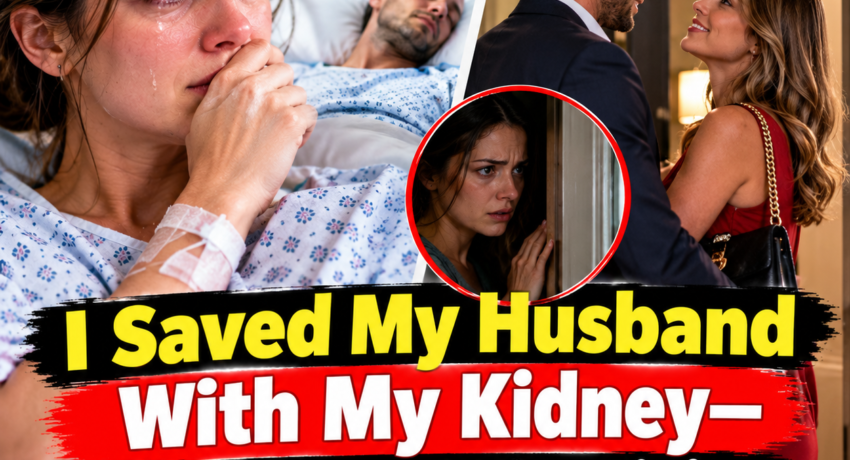
I was three days out of major surgery, lying behind a thin green curtain in a private hospital room in Boston, and that sentence was the first thing I heard clearly that morning. Not “good morning.” Not “how’s your pain today.” Just my husband’s voice, low and pleased with itself, handing our house to another woman like it was a party favor.
I didn’t move. I didn’t make a sound. I just listened.
Three days earlier, I’d been wheeled into an operating room to give Nathan one of my kidneys. He was sixty, a real estate developer, and he’d spent almost a year going back and forth to dialysis three times a week while his numbers got worse instead of better. I was fifty-eight, a retired elementary school teacher with thirty-four years in the classroom, and when the doctors told us we were a match, I didn’t hesitate for one second.
Apparently Nathan had been hesitating about something else the whole time.
“Vanessa, listen to me,” he said, his voice pitched low, clearly assuming the pain medication had me somewhere far away. “The house in Brookline is in Claire’s name, but I’ll take care of that. My notary can draw up a gift deed and it’s done. Three floors, the garden, the two-car garage. It’s the least you deserve after putting up with me for two years.”
I looked down at my left hand. My wedding ring, loose from the weight I’d lost in the last few months, slid off with almost no effort. I set it down quietly on the bedside tray.
On the other side of the curtain, Nathan laughed at something, then winced — the laugh had pulled at his incision.
“Guilty? Of what?” he said. “She gave me the kidney because that’s what she lives for, taking care of me. She doesn’t know how to do anything else.”
I didn’t cry. I want to be honest about that, because I think people expect me to say I fell apart, and I didn’t. Something in me went very still and very clear instead, the way a room goes quiet right before you make a decision you’ve actually already made.
At ten that morning, when the nurse came to check my blood pressure, I asked her, calmly, for my street clothes, a pen, and a blank sheet of paper. Then I asked to see my surgeon, Dr. Feldman.
“I want to sign myself out. Voluntary discharge.”
He thought at first that I was reacting to the pain medication, or the pain itself. He spent almost twenty minutes trying to talk me out of it. It had only been three days since the nephrectomy. They still needed to track my creatinine, my blood pressure, the incision site, watch for infection.
I let him finish. Then I asked one question.
“Is Nathan’s new kidney working?”
“Since the first hour,” he said.
I nodded. “Then I’ve already done what I came here to do.”
Before I left the floor, I walked over to Nathan’s bed one last time. He was asleep, his phone resting on his chest like he hadn’t even bothered to put it away after the call. I picked up my wedding ring off the tray and set it gently on top of his watch.
I didn’t leave a note.
That afternoon, I went back alone to our quiet three-story house in Brookline — the house, I now knew, that had a buyer waiting on it who wasn’t me. I packed one suitcase: old photographs of my parents, my identification, a small box of keepsakes, and a sealed envelope from a private oncology clinic I’d been hiding since December.
I didn’t touch Nathan’s clothes. I didn’t touch the furniture.
At 8:30 that night, I locked the front door for the last time and walked across the street to the bus stop. Sitting on the bench, I looked back at the lit windows of the house where I’d spent twenty-two years of my life.
By 10:00, I had already decided what I was going to do about it. It didn’t involve a single raised voice.
PART 2
At 9:17 p.m., an orange glow started climbing behind the living room curtains.
I want to be clear about something, because I’ve thought about it every day since: I made sure the house was empty. I checked twice. There was no one inside, and there was no one who could have been hurt. What happened that night was a terrible decision, and I’ve never once told myself otherwise. But it was mine, made with a clear head, not a fit of temper.
Neighbors started coming out into the street, calling for help, someone already dialing 911. I didn’t move from the bench. When the first sirens started up in the distance, I stepped onto the bus that had just pulled in, one hand resting carefully over my stitches.
I want to back up, though, because the fire isn’t where this really starts. It starts eleven months earlier, when Nathan’s kidneys began to fail for good and I became, without really discussing it with anyone, his full-time nurse. Three dialysis appointments a week. A strict renal diet with almost no salt, which I learned to cook without complaint. His blood pressure logged every single morning. Buttoning his shirts on the days his hands shook too badly to do it himself.
He took all of that as though it were simply what I was for.
I’d known about Vanessa since June. Bank transfers he didn’t bother to hide well. Hotel charges on a card I wasn’t supposed to see. A retainer payment to a divorce attorney that showed up on a statement mailed to the house by mistake. Nathan was never as careful with paper trails as he thought he was.
I hadn’t said a word about any of it. Not because I was afraid of him — I want to be honest here too — but because he was dying, and some part of me, the part that had spent thirty-four years teaching seven-year-olds how to be decent to each other, couldn’t make myself walk out on a man in kidney failure over a woman thirty years younger than him. I told myself I’d leave quietly once the transplant took. I’d already found a small one-bedroom apartment near the botanical garden. I planned to spend whatever time I had left reading, walking, and visiting my sister Margaret without watching the clock.
I say “whatever time I had left” because there’s something else I hadn’t told Nathan, either. In December, eleven weeks before his surgery, I’d started having pain under my ribs and a fatigue that didn’t lift no matter how much I slept. I went to an out-of-network clinic on my own, on a Tuesday when Nathan thought I was at a hair appointment. By the time the biopsy results came back, his transplant had already been scheduled.
Advanced cholangiocarcinoma. Cancer of the bile ducts. Terminal.
My donor evaluation had been completed back in October, before any of that started. My bloodwork was still technically within range. On the morning of the surgery, when the transplant coordinator asked if anything about my health had changed since my last screening, I looked her in the eye and said no.
I’ve thought about that lie more than almost anything else I’ve ever done. I still don’t fully know how to explain it, except that I knew if I told Nathan the truth, he would have stopped the whole thing, and some part of me needed him to live more than I needed him to know why.
So on the night the house burned, sitting on that bus with my hand over my stitches, I wasn’t thinking about revenge for the affair, not really. I was thinking about the fact that I had given a dying man a piece of my body so he could keep living in a house he was already planning to hand to someone else — and that I was not going to let Vanessa Cole spend whatever time I had left sleeping in my bed and calling it a happy ending.
PART 3
The next morning, I went back one more time.
I stood on the sidewalk long enough to take a few clear photographs of what was left — blackened chimney brick, a collapsed staircase, the garage reduced to a scorched frame. The lawn was covered in wet ash.
My neighbor Patricia came running over, her hand pressed to her mouth. “Claire — did you lose everything?”
I looked at what used to be my house.
“No, Patricia. I lost everything three days ago. In a hospital room.”
She didn’t understand what I meant. I didn’t explain it. I just got in a cab and went to start the rest of what I needed to do.
Nathan was discharged nineteen days after his transplant, carrying a bag of anti-rejection medication and a strict lab schedule, and completely certain I would eventually come back. He actually said as much to Vanessa, who was waiting for him in a car outside, dressed like they were headed somewhere worth celebrating.
“She always comes back,” he told her.
“Take me home first,” he told the driver.
Two blocks from the house, the smell of wet, burned timber hit the car. Nathan had the driver pull over before they even reached the address.
Vanessa stared at the ruins with her mouth open. “You told me it was a three-story luxury home.”
“It was,” Nathan said.
“What about the insurance?”
He hesitated just long enough for her to notice. “The policy’s in Claire’s name.”
She looked him over — the coat he’d buttoned wrong, his shaking hands, the bag of prescriptions he was going to need for the rest of his life.
“How much do those medications run you a month?”
“Between the co-pays and the lab work and the specialists — thousands. For the rest of my life.”
She stepped back toward the curb. “Nathan, I’m not a full-time nurse.”
“I never asked you to be.”
“No, but you promised me a life. A home. Travel. You told me Claire was going to sign the deed over to me.”
“She will sign,” he said, his voice cracking.
Vanessa pointed at the smoking wreck of a house behind him. “Sign what?”
She got in another cab and didn’t look back.
For the next several weeks, Nathan tried to find me. He went to Margaret’s building. He called old colleagues from my school district. He drove by the community center where I used to volunteer on weekends. Nobody had anything to tell him, mostly because I’d asked them not to.
Then he called the insurance company, expecting, I imagine, some kind of shared claim he could at least borrow against.
The house had been insured for $4.1 million, and the full payout had already gone out — to the sole policyholder. Me.
“I’m her husband,” he told the claims manager, according to what Margaret told me later, because apparently he’d started shouting into the phone in a parking lot.
“Sir, you’re not listed as a beneficiary on this policy.”
“Then where is that money right now?”
“That information can only be released to the primary account holder.”
He drove straight to Margaret’s building after that. She met him in the hallway and didn’t invite him past the doorway.
“Where is she, Margaret?”
She looked at him for a long moment before she answered.
“You honestly don’t know?”
PART 4
“I’ve been looking for her for weeks,” Nathan said.
“She canceled her phone contract,” Margaret told him. “She gave away almost everything she owned.”
“Gave it to who?”
“A transitional shelter in South Boston. Harbor House. It houses young people aging out of foster care — kids who turn eighteen with nowhere to go and nothing to their name.”
Nathan felt something cold settle into his stomach, or so he told me weeks later, sitting in a hallway that smelled like antiseptic, trying to explain himself to me one more time.
“And the insurance money?”
Margaret pressed her lips together. “That too.”
“All four million dollars?”
“Almost all of it. The shelter director cried when Claire signed the paperwork.”
Nathan leaned against the wall like his legs had stopped fully working. “Where is my wife, Margaret?”
Her voice dropped. “She didn’t leave to punish you, Nathan. She left because she’s dying.”
He stared at her. “What are you talking about?”
“She’s in a palliative care facility in Newton. Twenty minutes from the house that isn’t there anymore.”
At the facility, a doctor named Reyes handed him a folder an inch thick.
Diagnosis: advanced, terminal cholangiocarcinoma. Date of the first conclusive scan: December 9th.
Nathan went pale. “That’s not possible. Her donor surgery was three weeks ago.”
“She knew roughly eleven weeks before your transplant,” Dr. Reyes said. “She hid the new symptoms after her donor evaluation was already finished. She also refused cancer treatment beforehand, because starting it would have disqualified her from donating to you.”
“Why would she do that?”
The doctor glanced down the hall toward a closed door. “You’ll have to ask her that yourself, Mr. Whitmore. While she still has the strength to answer.”
Nathan started walking toward that door without any idea that what I was about to tell him would take apart everything he thought he understood about our marriage.
I was awake when he came in.
The room was simple — one window, a vinyl armchair, three sprigs of fresh flowers in a glass someone had brought from the gift shop, a wall clock, the steady hum of an oxygen concentrator.
Nathan froze in the doorway. I imagine I looked smaller than the wife he remembered — my skin had gone slightly yellow, my cheeks had hollowed out, and I’d pulled what was left of my hair into a short braid because it was easier than fighting with it.
I wasn’t surprised to see him. I’d known this conversation was coming since the morning I signed my discharge papers.
“Your coat’s buttoned wrong,” I said.
He looked down at himself. His hands were shaking. “Claire…”
“Sit down. You’ll get lightheaded standing there.”
He didn’t sit. He came closer instead.
“How long did you know?”
“Since December 9th.”
“And you never said one word.”
“No.”
“Why, Claire? Why?”
PART 5
I closed my eyes for a second, waiting for a wave of pain to pass before I answered him.
“Did you take your eight o’clock medication this morning?”
“I took it at 8:10.”
“That’s not eight o’clock.”
“Claire, please.”
He broke down right there, standing at the edge of my bed. “You were dying, and you still walked into an operating room to give me a piece of yourself.”
“Yes.”
“You could have died on that table.”
“So could you have. You didn’t let that stop you either.”
He lowered his voice, his chest still heaving. “The transplant board approved you. How does someone hide a terminal diagnosis from an entire surgical team?”
“My donor clearance was finished in October,” I told him, my voice weaker than I wanted it to be but steady enough. “When the fatigue and the pain started in December, I went to an out-of-network clinic on my own. By the time the biopsy came back, your surgery date was already set. I didn’t forge a single lab result. My bloodwork was still within range. I just didn’t mention the new symptoms. The morning of surgery, the coordinator asked if anything had changed. I said no.”
“You lied to an entire surgical team just to stay eligible.”
“Yes.”
“What if something had gone wrong on that table?”
“I left instructions with Margaret. I didn’t tell you beforehand because I knew you’d cancel the whole procedure.”
“It was my right to know! You had no right to decide that for me.”
I nodded, because he wasn’t wrong about that part. “On that point, you’re right.”
“You refused your own cancer treatment just to give me a kidney?”
“The oncologist told me chemotherapy might buy a few uncertain months. Not a cure. If I’d started it, the transplant would have been canceled immediately.”
He sank into the vinyl chair and put his face in his hands. For eleven months I had driven him to dialysis three times a week, cooked every meal around his restrictions, tracked his blood pressure like it was my own, buttoned his shirts on the mornings his hands wouldn’t cooperate. He had let all of it wash over him like weather, like something that simply happened to him rather than something I chose, every day, to keep doing.
“Why didn’t you let me decide?” he said, his voice cracking.
“Because you would have said no.”
“Of course I would have said no!”
“Exactly.”
“So you took away my chance to try to save you.”
I gave him the smallest, saddest smile I had left in me. “There was no saving me, Nathan.”
He covered his eyes with both hands. “I’m alive because part of you is inside me, and you’re lying here dying.”
“My illness wasn’t caused by you.”
“You could have bought yourself more time.”
“I chose how I wanted to spend the time I had.”
He lifted his head. “And did you also choose to burn our house down?”
I looked right at him. “Yes.”
That answer took the air out of him.
“That was our home for twenty-two years.”
“It was a house deeded solely in my name.”
“It was our life.”
“Our life ended the moment I heard you tell Vanessa I was nothing but a piece of furniture.”
He went completely still.
PART 6
“You… heard that call?”
“Every word,” I said. “The address. The garden. The garage. Your promise that the house would be hers.”
“I was on heavy pain medication! I wasn’t thinking straight —”
“You were thinking straight enough to explain that I only lived to take care of you, because I couldn’t do anything else.”
He had nothing to say to that.
I looked toward the window instead of at him. “I taught elementary school for thirty-four years. I helped hundreds of children learn to read. I took care of my parents while they were dying. I ran our home, paid our bills, and nursed you through kidney failure that would have killed you a year earlier without me.”
I turned back to him. “And you reduced all of that to a woman who brings you water.”
“Forgive me,” he choked out. “Claire, please.”
“That apology is a little late.”
“Is that why you burned it down? Revenge?”
I sat with that question for a moment, because I owed him an honest answer, even then.
“I didn’t want another woman sleeping in my bed, using my mother’s china, treating my death like a convenient door into a better life. What I did was dangerous and destructive, and I’m not proud of it. But I could not let the home I built become a trophy for the woman you were leaving me for.”
“You could have hurt someone.”
“I made sure the house was empty first,” I said quietly. “It was still a terrible decision. I’ve never told myself otherwise.”
He rubbed his forehead. “And the insurance money?”
“Paid out after the investigation cleared me.”
“You gave four million dollars away?”
“To Harbor House.”
“Why?”
“I volunteered there for years. Kids turn eighteen and get pushed out of foster care with no family, no savings, no laptop, not even a security deposit for an apartment. That endowment funds housing and schooling for a long time to come.”
He ran a shaking hand through his hair. “Did you leave anything for me?”
The question slipped out before he could stop it, and there was no anger left in me by then. Only something closer to pity.
“Yes,” I said quietly.
He waited.
“I left you a kidney.”
He made a sound I’d never heard him make before, something caught halfway between his throat and his chest.
“The car’s still in your name,” I went on. “You still have your accounts. Your business.”
“Vanessa left me.”
“I assumed she would.”
“She told me she wasn’t a nurse.”
I laughed, a small, tired sound. “At least she was honest with you from the start.”
“Don’t mock me, Claire.”
“I’m not mocking you. I’m just amazed she told you the truth faster than you ever managed to tell me.”
He lowered his head. “I was going to leave you.”
“I know.”
His head came back up fast. “How?”
“Bank transfers. Hotel reservations. A retainer to a divorce attorney,” I said. “You were never as careful as you thought.”
“How long did you know about Vanessa?”
“Since June.”
He stared at me. “Six months? And you stayed? You still drove me to dialysis three times a week?”
“You were dying of kidney failure, Nathan.”
“That makes no sense.”
“Not to you, maybe.”
PART 7
“Were you planning some kind of revenge that whole time?”
“No,” I told him. “I planned to leave quietly, once your transplant took. I’d already found a one-bedroom near the botanical garden. I wanted to spend whatever time I had left reading, walking, seeing Margaret without watching the clock.”
“So why did you change your mind?”
“Because hearing you talk about me like I was an object broke something in me that I couldn’t put back together.”
He stared at the floor. “Did burning it down make you feel better?”
I thought about that honestly before I answered. “For a few hours. After that, no.”
“Do you regret it?”
“I regret letting pain push me toward destruction,” I said. “I don’t regret making sure my home never became her reward.”
He rested his elbows on his knees. “I don’t even know who you are anymore.”
I looked directly at him. “That’s the truth of it, Nathan. You never bothered to find out.”
He started crying then, not quietly. Real, heaving sobs that shook his whole body.
“Claire, I’m so sorry. For Vanessa. For the house. For what I said about you on that phone call. For every year I treated what you did for me like it didn’t count for anything.”
I reached out my hand, as far as I could manage. He grabbed it with both of his.
“I forgive you,” I said.
“I don’t deserve it.”
“Forgiveness was never really about what you deserve,” I told him. “Sometimes it’s just refusing to carry hatred with you when you go.”
“Let me fix this,” he said. “Tell me what to do.”
“You can’t repair twenty-two years of marriage in one afternoon.”
“Then tell me how to start.”
“Take your medication on time.”
He let out a broken sort of laugh. “Claire…”
“I’m serious,” I said. “Eight in the morning. Eight at night. Not 8:10. Your whole life is going to depend on small, boring, repetitive things you don’t feel like doing.”
“Like me,” he whispered, tears still running down his face. “According to me.”
“Like me,” I said softly. “According to you.”
He looked down at my hand — the same hand that had graded thousands of spelling tests, cooked every dinner he ate for two decades, held his when he was sick, and signed the consent form that had kept him alive.
“Where’s your ring?”
“I left it on your watch, at the hospital.”
He reached into his coat pocket. He’d been carrying it with him this whole time.
He set it gently on my blanket. “Keep it,” I told him.
“Why?”
“So you remember that something small and light can carry an enormous weight.”
Dr. Reyes came in to check my oxygen levels, saw how worn out I’d become, and quietly signaled that Nathan should let me rest.
He leaned in close instead. “Are you scared?”
I looked up at the ceiling. “Yes.”
It was, I think, the first time in twenty-two years he’d ever heard me admit to being afraid of anything.
PART 8
“What do you do when you’re scared?” he asked.
“I think about my old students,” I told him. “The ones who struggled for months to read a single sentence, and then one day it just clicked. That always felt like a small miracle to me.”
“Do you think about me?”
I turned my head toward him. “Yes.”
“After everything?”
“After everything.”
He pressed his forehead against my knuckles. “I don’t know how to live with this guilt.”
“Learn.”
“I don’t know if I can.”
“You can,” I whispered. “It’s just that no one’s going to do it for you anymore.”
At 3:48 that afternoon, my breathing slowed in a way I could feel before he noticed it.
“Claire?” He stood up fast.
I opened my eyes one more time.
“Eight o’clock. Sharp.”
“Yes. I promise you.”
I lifted my hand and brushed my fingers against his cheek, wet with tears that weren’t mine.
Then I closed my eyes.
Dr. Reyes came back into the room at 3:52. Nathan understood before the doctor said a single word. He sat beside me and held my hand until the room went completely quiet.

PART 9
[This part, and the one after it, are mine — Margaret’s. Claire asked me to finish this for her, and I’ve tried to write it exactly as she would have, plain and without dressing it up.]
The memorial was held a week later. I was there, along with Patricia from next door, several of Claire’s old colleagues from the school district, and the director of Harbor House.
Four young adults Nathan had never met came together, sitting in the back row. One of them, eighteen, with a backpack he kept in his lap the whole service, came up to Nathan afterward.
“Mrs. Whitmore paid for my first semester of community college,” he said.
A young woman next to him explained that Claire’s endowment had set up a permanent housing stipend for kids aging out of foster care, so they’d have somewhere to land at eighteen instead of nowhere.
Nathan listened. He didn’t seem to know what to say back.
After the service, I handed him a plain envelope. There was no long letter inside, no dramatic goodbye. Just one sheet of paper in Claire’s neat, disciplined handwriting — the transplant center’s phone number, her nephrologist’s name, and one line underlined twice:
Do not skip your checkups out of pride.
He stared at that page for a long time. Even at the very end, my sister had been organizing the details of someone else’s survival.
That night, according to what he told me, he set two alarms on his phone and tucked the paper inside his weekly pill organizer.
PART 10
A few months later, Nathan sold the car that had survived the fire in the garage and used the money to cover his medical bills and what was left of his debts. He kept his business running, but scaled it down — shorter hours, and for the first time in his life, he learned to ask his staff for help instead of treating them like they existed to serve him.
Every Sunday night, he lays out his week of anti-rejection medication into a plastic organizer. At 7:58 every morning, an alarm goes off. He pours a glass of water. At exactly eight o’clock, not 8:10, he takes his dose.
In the noon compartment of that pillbox, where there’s never actually a pill, he keeps Claire’s wedding ring. He told me once that he holds the cold gold band in his hand for a few seconds most mornings before he closes the lid — not because he thinks it can bring her back, but because it took him until she was gone to finally understand something he’d spent twenty-two years refusing to see.
She was never a piece of furniture. She was the thing holding the whole house up — his health, his stability, in the end his life — and he only understood the cost of confusing love with servitude once there was no one left to confuse it with.
When people ask him now why he’s so rigid about a schedule for pills and checkups, he gives them the same quiet answer every time.
“Because the life I’m living didn’t start on the day of my transplant. It started on the day I finally understood, far too late, what someone had been willing to give me.”
Every morning, at exactly eight o’clock, he drinks that glass of water down to the last drop.
Somewhere inside him, my sister’s kidney is still doing its quiet work. Asking for nothing back. The same way she never did, for far too many years.