PART 1
There is a particular kind of heat that settles over our town in July, the kind that makes the sidewalk shimmer and turns a short walk to the mailbox into an ordeal. On days like that, most people peel off every extra layer they own. My husband put more on.
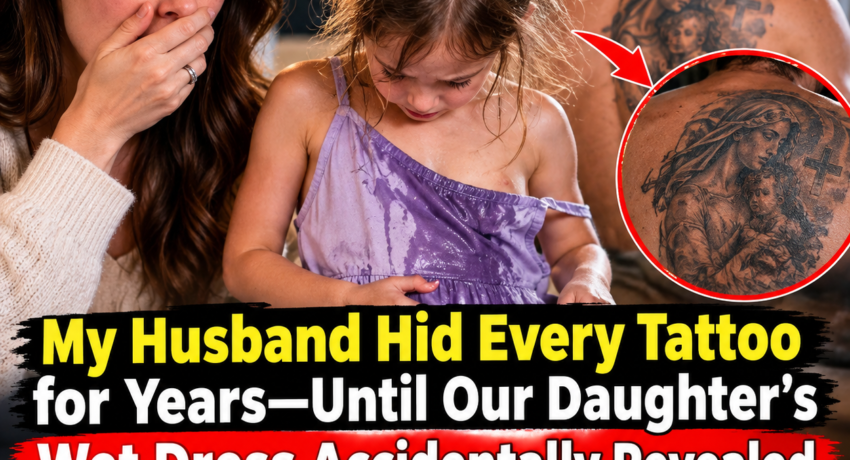
Brad wore thin cotton gloves in that heat. Long sleeves buttoned to the wrist. A collar he tugged just a little higher than it needed to be. At home, our three children knew every mark on his skin — they had traced the crooked lines and strange little shapes on his arms and hands so many times that Molly, our youngest, could probably draw the sunflower on his forearm from memory. But the moment he stepped outside our front door, all of it disappeared under fabric, no matter the season.
“Why is this petal so fat?” Molly asked him one morning, her small finger tracing the lopsided flower on his forearm while he tied his shoes.
Brad glanced down, unbothered, like this was a question he’d answered a hundred times before. “Artistic decision, sweetheart.”
“Whose?”
Something flickered behind his eyes. He pulled his sleeve down over it before I could name what it was.
“Ancient history,” he said.
His voice was light. Playful, even. But the way his hand moved to cover that tattoo — quick, practiced, almost defensive — told a different story than his tone did. I’d watched him do it a thousand times over the years and I still couldn’t tell you exactly what it was protecting.
Ten minutes later we were leaving for the park, and Brad had transformed himself into a man dressed for a cold he wasn’t feeling. Jeans. A long-sleeved button-down. The gloves, because some of the ink crept down onto the backs of his hands. It was eighty-six degrees outside.
That was just Brad. I’d asked him about it once, years earlier, back when I still thought I was owed an explanation simply because I loved him.
“I got them young,” he’d told me. “I regret them.”
When I suggested removal — laser sessions, something, anything — he always had the same answer. Never enough money. Never the right time. The explanation never quite fit the man I knew, a man who tracked every dollar of our budget with the precision of an accountant, but Brad was gentle with our children and steady with me, and somewhere along the way I decided that loving him meant not prying at a door he’d clearly shut. I told myself that respecting him meant looking away.
“But I like your pictures,” Molly complained as he opened the front door that afternoon, already sweating through his sleeves before we’d even reached the car.
“You have questionable taste,” he told her, and she giggled like it was the funniest thing she’d heard all week.
We spent the afternoon at the park the way we always did — Brad pushing Molly on the swings, our older two chasing each other around the jungle gym, me watching from a bench with a coffee going lukewarm in my hand. It was, in every way, an ordinary Saturday.
And then Molly found the one puddle in a hundred yards of dry playground and put both feet directly into the center of it.
She went down hard, hands first, the hem of her dress soaking through instantly, and for one long second she just sat there in shock before the crying started.
“Daddy, my dress is wet.”
Brad was already moving before she finished the sentence. “Emergency,” he said, scooping her up, and in one motion he’d unbuttoned his shirt and wrapped it around her shivering legs — without a single thought, without a single hesitation.
It was only after he’d already done it that I saw what he’d forgotten.
Underneath the button-down, he was wearing nothing but a short-sleeved undershirt. And for the first time in the eleven years I had known Bradley Callahan, his arms were completely, entirely bare in public.
I watched his own fingers catch at his empty sleeve out of pure muscle memory, as if some part of him thought he could stretch a shirt that was no longer there. He caught himself. Looked down at his own skin like it belonged to someone else. And then Molly shivered again, and whatever instinct had made him reach for cover lost to the much older instinct of a father protecting his daughter.
“We’ll buy you something dry,” he said, and lifted her onto his hip.
The nearest store was a five-minute walk. Five minutes in which my husband carried our soaked, sniffling daughter through a parking lot with his tattooed arms in full daylight for the first time since the day I’d met him — and nobody so much as glanced twice. Nobody stared. Nobody cared. I remember thinking, almost with relief, that maybe all those years of hiding had been for nothing. That the world was simply not as interested in Brad’s arms as Brad himself seemed to believe.
I was wrong. We just hadn’t reached the right aisle yet.
PART 2
The children’s clothing section was near the back of the store, past the registers, under fluorescent lights that made everything look slightly too sharp. Brad set Molly down long enough to reach for a sweater on a high shelf, his arm extended, sleeve rolled up from the heat, and that was when I heard it — a soft, heavy thud behind me.
A carton of something had slipped out of a woman’s hands and hit the tile.
She wasn’t looking at what she’d dropped. She was staring past me, straight at my husband. Not at him, exactly. At one specific spot on his arm.
The crooked sunflower.
“Bradley?”
His hand froze in midair, fingers still curled around the sweater he’d been reaching for. Slowly — too slowly — he lowered it.
“I’m sorry,” he said, in a voice I didn’t recognize. “You’ve mistaken me for someone else.”
The woman took a step closer instead of backing away. “No, I haven’t.”
Brad turned toward me with a brightness that didn’t reach his eyes. “Hailey, let’s get Molly some pants.”
“Bradley.” The stranger’s voice cracked on the second syllable of his own name. She lifted a hand and pointed, and I watched her finger tremble in the air. “You kept it.”
He went completely still.
I looked between the two of them, my pulse picking up for reasons I couldn’t yet name. “Kept what?”
“My sunflower,” she said, and something in the way she said my landed in my chest like a stone dropped into still water.
All the color drained out of Brad’s face. “Erin… stop…”
So he knew her name. Knew it well enough to say it like a plea.
The woman — Erin — pressed a trembling hand to her mouth. “I never thought I’d see it again.”
“Erin, please.” His voice had dropped to something barely above a whisper.
That was when she seemed to notice, for the first time, that he wasn’t alone. Her eyes moved from Brad to me, then down to Molly clutching a fistful of his now-useless button-down.
“Your family?” she asked.
Brad nodded once, like the word cost him something.
Erin’s eyes widened. “You never told them?”
“There wasn’t anything to tell,” he said quickly.
She let out a short, disbelieving laugh that had no humor in it at all. “Nothing?”
“Not here.” His jaw was tight enough that I could see the muscle working beneath his skin.
“Brad.” My own voice came out smaller than I meant it to. “What is she talking about?”
He wouldn’t look at me. Erin did.
“Your husband gave me his arm,” she said, “when I was learning to trust my hands again. That sunflower was the first tattoo I ever managed to finish, after I got sick.”
I don’t remember my knees deciding to buckle. One moment I was standing in a fluorescent-lit aisle holding a coffee cup that had gone cold hours ago, and the next I was on the floor, the tile shockingly cold through my jeans, and Molly’s small wet hand was pressed against my cheek while the woman in front of me blurred behind a sudden wall of tears I hadn’t given permission to fall.
“Mommy?”
“I’m okay, baby,” I managed, though I wasn’t entirely sure that was true.
Brad dropped to his knees beside me instantly. “Hailey.”
I stared past him, at the sunflower. I had seen that tattoo more times than I could count — traced by Molly’s finger that very morning, glimpsed across a pillow more nights than I could name. Brad had called it ancient history not two hours earlier, as casually as if it were a stray doodle from a bored teenager. And now a stranger was standing in a store aisle telling me it was the first thing she’d ever finished after her body had tried to take that ability away from her.
“She did that?” I asked, my voice barely holding together.
He nodded.
“Why?”
Before he could answer — if he was even going to — Molly tugged impatiently at his shirt. “Daddy, I’m still wet.”
Erin laughed through her own tears, a small broken sound. Brad closed his eyes like a man bracing for something.
“Right,” he said. “Pants.”
Ten minutes later, Molly emerged from the restroom in dry clothes, her ruined dress balled up in a plastic bag. Erin was still there. Waiting. And I understood, watching my husband’s shoulders, that he had been hoping she wouldn’t be.
“Hailey doesn’t need the museum tour,” Brad said, trying for lightness again and missing badly.
“Hailey absolutely needs the museum tour,” Erin said.
Molly’s hand shot into the air like she was in school. “I want to see Daddy’s secrets.”
Brad looked down at her with something between horror and affection. “Excellent. Betrayed by my own child.”
I looked at my husband — really looked at him, the man I had shared a bed with for eleven years, and realized I had no idea what I was about to learn.
“I want to understand,” I told him.
He held my gaze for a long moment. Then, finally, he sighed. “Fine. But Erin tells it better than I do.”
I had no idea yet how much better, or how much it would cost him to let her.
PART 3
Erin led us three blocks to a converted storefront with wide windows and the words ADAPTIVE ARTS CENTER painted across the glass in cheerful, uneven letters. Inside, the walls were covered in artwork — some of it careful and precise, some of it wobbling and raw, all of it clearly made with effort that mattered more than polish.
“I was training seriously in tattoo work before I got sick,” Erin told me as we walked, flexing the fingers of her right hand almost unconsciously, like she was checking they still worked. “My hand control changed. For a while, I couldn’t even manage a straight line.”
She described it plainly, without asking for pity — the months of rehabilitation, the adaptive grips, the hours spent practicing on synthetic skin that never once looked like it was going to become anything. Then, finally, an instructor at the tattoo studio the center partnered with had cleared her to attempt one small design on a real, willing volunteer, under close supervision.
Erin had refused.
“Why?” I asked.
She glanced at Brad before she answered me. “Plastic doesn’t flinch,” she said. “It can’t hurt. It can’t pull away. It can’t regret trusting me.”
Brad, she explained, had been working at the center back then doing maintenance and general support — fixing chairs, hauling supplies, the kind of unglamorous work nobody notices until it stops happening. He’d overheard her arguing with her instructor in the hallway. And instead of walking past, he’d rolled up his sleeve.
“Okay,” he’d said. “Do mine.”
Erin had assumed he was joking. He wasn’t.
With her instructor standing beside her the entire time, she had tattooed one small, imperfect sunflower onto the forearm of a man she barely knew. The stem wobbled. One petal came out crooked. An accidental dot of ink landed just beside it that was never supposed to be there.
“I thought I’d ruined it,” Erin said, her voice catching even now, years later.
Brad had looked down at his own arm, still bleeding slightly, still stinging, and said the only thing that mattered. “Looks like a sunflower to me.”
Erin’s eyes filled again as she told it. I looked over at my husband, who was suddenly, intently studying the floor, as if the story embarrassed him. Nothing about what I’d just heard made that reaction make sense to me — not yet.
Then Erin pulled a photograph down from the wall and pressed it into my hands.
A much younger Brad stood beside a worktable, hair too long, sporting a mustache so aggressively bad that I momentarily forgot the gravity of the moment entirely.
“Brad.”
He glanced over and winced at what I was looking at. “That mustache was a difficult period,” he muttered.
Molly rose up on her toes to see. “I like it.”
“You’re no longer in the will,” he told her, and she grinned like that was a prize.
But my eyes had already drifted lower in the photograph, to his rolled-up sleeve, to Erin sitting beside him with fierce concentration on her face while a licensed instructor watched over her shoulder. The sunflower in the photo was fresh, raw, crooked from the very first minute of its existence.
And he had never fixed it. Never covered it. Never once, in all our years together, taken a single step toward removing it.
He had kept it exactly the way a frightened, recovering woman had made it.
Erin moved to a second photograph. Brad again — this time a different man working carefully on a small geometric design near his elbow. A third photo: a woman laughing beside him over a crooked, lopsided moon.
“How many?” I asked, my voice barely above a whisper.
Brad rubbed the back of his neck, refusing to meet my eyes. “Not that many.”
“Brad.”
“Eight, maybe.”
“Nine,” Erin corrected.
“One barely counts.”
“Your skin disagrees,” Erin said, and despite everything, I felt the corner of my mouth twitch.
Over several years, it turned out, Brad had quietly become the person the center called whenever a recovering artist or nervous apprentice had finally been cleared for their first supervised piece on real skin — real skin that wouldn’t panic, wouldn’t judge, wouldn’t make the moment feel any heavier than it already was. Not everyone who passed through stayed in tattooing. One had become a graphic designer. One taught adaptive drawing classes now, two mornings a week. Another had simply decided art would remain something private, something for herself alone.
Brad talked about every one of them without a trace of hesitation. Almost proudly.
“He teaches now,” he said, tapping one photograph.
Erin smiled. “And complains constantly.”
“That’s how you know he’s happy,” Brad said, and for a moment he looked like the man I knew — warm, a little wry, entirely present.
I stood in the middle of that small, crowded room and looked at my husband’s bare arms in a way I never had before. For years I had believed every uneven line on his skin was evidence of a reckless youth he was desperate to erase. Instead, I was learning that some of those lines marked the exact moment a frightened person had tested, for the first time, whether they could trust their own hands again.
The tattoos weren’t mistakes. They had never been mistakes.
Which only made the next question impossible to avoid.
“If these meant this much to you,” I asked him quietly, “why did you tell me you regretted them?”
The warmth drained out of his face instantly. “Hailey.”
“You told me you wanted them removed.”
“It’s complicated.”
“What’s complicated?”
He pushed his hands deep into his pockets, a gesture I recognized as retreat. “Can we leave this alone?”
“No,” I said, and I meant it more firmly than I had meant almost anything in our marriage.
Erin’s eyes moved between us, and I saw the exact instant she realized there was something here she knew and I didn’t. Something Brad had never told me at all.
“Brad,” she said quietly.
“Don’t,” he said, and the single word landed hard enough that she actually stopped.
Something passed between them then — a look, a history, a shared knowledge I had no access to. Erin knew the answer to a question I hadn’t even asked yet. And my husband, the gentlest man I had ever known, was standing three feet away from me, quietly begging her not to say it.
“What am I missing?” I asked her directly.
She hesitated, glancing at Brad one more time, clearly torn between loyalty to him and the plain fact that I deserved to know.
“Has he ever told you,” she finally asked me, “which one is his?”
I frowned, confused. “They’re all his.”
“That’s not what I asked.”
I looked over every visible tattoo again, one by one, as if the answer might be written somewhere in the ink itself. The sunflower. The moon. The careful geometric lines near his elbow.
None of them, I was about to learn, were the one that mattered.
PART 4
“What does she mean?” I asked Brad, and I could hear my own voice shaking now.
“Nothing,” he said.
“Brad.”
Erin didn’t answer for him this time. She simply waited, the way you wait for someone to work up the courage to jump into cold water.
Finally, my husband reached up and pulled the collar of his T-shirt sideways, just far enough to expose the upper curve of his shoulder.
I knew that tattoo. I had slept beside it for eleven years without ever really looking at it — a plain black circle, no bigger than the base of a coffee mug, simple enough that I had never once thought to ask about it. Except now, for the first time, I noticed what I had somehow missed for over a decade.
The line didn’t close. It stopped just before the two ends could meet, leaving a small, deliberate gap.
I had always assumed it was unfinished by accident — a rushed job, a tattoo artist interrupted mid-line, something Brad simply never bothered to fix. I stepped closer.
“This one?”
Erin nodded. “That’s the only design Brad ever asked for himself. Every other tattoo on his body, someone else chose. This is the one he chose.”
My husband’s hand flew up and covered it again immediately, the same defensive motion I’d watched him make over the sunflower a thousand times.
I stared at him. “Why is it broken?”
His head snapped toward me. “It’s not broken.”
“Then what is it?”
He looked at Erin. Then at the photographs still lining the walls around us. Finally, after what felt like a very long time, he looked back at me.
“It’s unfinished,” he said.
“Why?”
He didn’t answer. But Erin’s face told me, without a single word, that whatever the answer was, it had nothing to do with tattoos at all. And suddenly the question I had been quietly carrying for years — why does my husband hide his ink — had transformed into something much harder to sit with. I no longer wanted to know why Brad covered his arms in public.
I wanted to know why the only mark he had ever chosen for himself was the one he had never let himself complete.
Brad stared at the photographs for a long moment, and when he finally spoke, his voice had lost every trace of its earlier lightness.
“I wanted to be an illustrator,” he said.
I waited, not daring to move.
“My dad got sick. Money got tight. I started working full-time to help my mom cover the gap, and art school became something I told myself I’d get back to later.” He gave a small, hollow shrug. “Later kept moving.”
“Why didn’t you tell me?” My voice cracked on the question.
“What was I supposed to say, Hailey? That I almost became somebody, and then I didn’t?”
“You did become somebody,” I said, my throat tight.
“You know what I mean.”
I did know. And that was the part that hurt the most — because I did understand, suddenly and completely, exactly what he meant. I thought of every half-finished drawing that had quietly vanished from our kitchen table over the years. Every crooked shelf he’d built and then dismantled rather than simply repair. Every recipe that hadn’t turned out quite right, thrown into the trash before either of us could even taste it.
Anything that didn’t become exactly what he’d pictured in his head, Brad made disappear. I had spent a decade thinking that was just a quirk of his personality. I hadn’t understood that it was a wound with a very specific shape.
I looked at his shoulder again. “The circle.”
He nodded, slower this time, like the admission cost him something physical.
“Erin asked me what I wanted, after everyone else had already put something on my skin that mattered to them.”
“I asked why he didn’t just close it,” Erin said quietly. “Make it a normal circle.”
Brad rubbed his thumb against his palm, a nervous habit I’d seen a hundred times without ever knowing what it meant. “I told her… I guessed I wasn’t finished either.”
Molly, who had been quietly listening this entire time with the particular seriousness only an eight-year-old can summon, frowned up at her father.
“But nobody’s finished,” she said. “I’m eight. And I have a lot of time left.”
Brad looked down at her. And then, to my complete surprise, he laughed — a sudden, helpless laugh that made him cover his own face with his hand.
Molly looked deeply offended. “What?”
“Nothing, peanut.”
“I don’t even have all my big teeth yet, Daddy.”
Erin laughed too, though her eyes stayed fixed on Brad the entire time, warm and a little sad. “You let all of us change direction,” she told him. “The tattoo artist who became a graphic designer. The apprentice who teaches now instead. Me. You never once called any of it a failure. You’re the only person in this room who still thinks changing course means you didn’t finish.”
Brad stopped laughing. His eyes moved slowly across every photograph on that wall — the tattoo artist, the graphic designer, the teacher who complained constantly and was happy anyway. Not one of them had ended up exactly where they’d once planned to be.
He had never called a single one of them a failure.
Only himself.
PART 5
On the way home, we stopped for ice cream, the way we always did after a long afternoon, except nothing about that afternoon had been ordinary at all. Brad reached automatically for his button-down, still tucked inside the plastic bag alongside Molly’s ruined dress.
His hand paused over the bag.
I said nothing. I had learned, in the last two hours, exactly how loud my silence could be.
He left the shirt where it was.
At the counter, an older cashier squinted at his bare forearm with open curiosity. “Is that an onion?”
Brad went rigid.
Before he could answer, Molly spoke up with total confidence. “It’s a moon.”
The cashier leaned in for a closer look, considering it seriously. “Oh,” she said. “Yeah. I can see it now.”
Brad stared at her for a long moment. And then he started laughing — really laughing, the kind that comes from somewhere low in the chest and catches you off guard. Nothing dramatic happened after that. Nobody learned his whole story in that ice cream shop. Nobody applauded his honesty. We simply bought our cones and walked back out into the sunlight, and somehow that was exactly enough.
That evening, Molly settled onto the couch beside her father and went right back to tracing the sunflower on his arm, the same as she did every night, except this time I understood exactly what her small finger was resting on.
I sat down on his other side. “Did you ever actually want them removed?”
Brad considered the question honestly, which was new. “Some days,” he admitted.
“And other days?”
“Most of those stories weren’t mine to tell by myself. Once people saw one tattoo, they wanted to know about all of them. It was easier to keep them covered than to explain nine different people’s worst and best days.”
“And the circle?”
He looked at me for a long moment before he answered, and I could see him deciding, in real time, to stop hiding at least this one thing from me.
“That story was mine,” he said. “Hiding it was easier than admitting why I never let myself finish it.”
And there it was — the whole shape of it, laid out plainly at last. I understood, finally, why he had hidden something he clearly loved by insisting for years that he hated it. And I understood, with a small ache, why I had believed him for so long. Brad had asked me, without ever saying the words out loud, not to look too closely at that particular door. And for eleven years, I had mistaken looking away for kindness.
I wasn’t going to force him into the open now, either. But I also wasn’t going to help him hide anymore.
Later that night, Molly dumped a box of crayons across the kitchen table with the enthusiasm only a child can bring to a school-night art project. “Daddy, draw a horse.”
Brad shook his head immediately. “Mom draws better.”
“I asked you, Daddy.”
He glanced over at me, hoping for an out. I kept drinking my tea and said absolutely nothing.
He sighed and picked up the brown crayon.
Five minutes later, Molly studied his finished creation with the withering judgment of a professional art critic. “That’s a dog.”
“It is absolutely a horse.”
“Dogs have those ears.”
“You have no respect for art, peanut.”
He reached for the paper, and I recognized the motion before he’d even finished it — the same one I’d watched for eleven years. Crumple. Trash. Gone, before anyone else could decide it wasn’t good enough.
His fingers stopped an inch from the page.
He left the drawing exactly where it was.
I found it still sitting there later that evening, except now it had enormous, lopsided purple wings that Molly had clearly added while no one was watching.
Brad came up behind me and stared at it for a long moment. “Why does my horse have wings?”
“Because it needed help,” I told him.
He picked the drawing up, and for one second I braced myself for the old reflex to win out after all. Instead, he crossed the kitchen, found a magnet, and stuck it to the refrigerator door in plain sight.
A crooked horse. Purple wings. Completely, permanently visible.
Molly glanced from the drawing to her father’s bare, uncovered arm resting on the counter beside it. “Can I color the onion tomorrow?”
Brad spun around so fast I nearly laughed out loud. “It’s a MOON.”
She took off running, giggling the whole way down the hall, and Brad stood there a moment longer, looking at the terrible, wonderful horse taped to our refrigerator. Then his eyes drifted to the unfinished circle on his own shoulder, still hidden beneath his shirt, still open at one small, deliberate point.
He didn’t reach for either one — not to fix the horse, and not to cover the circle.
For the first time in eleven years, he simply let both of them stay exactly as they were.