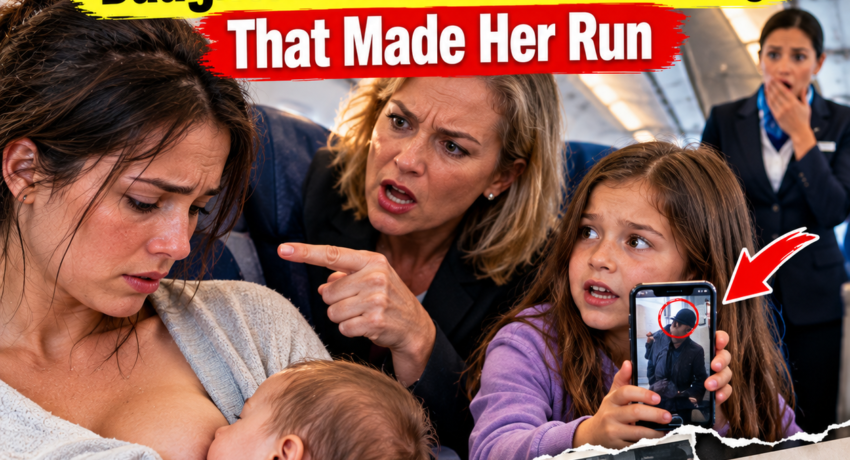
Five weeks after I buried my husband, a stranger on a six-hour flight told me to lock myself in the bathroom to feed my baby. “What kind of mother are you?” she asked, loud enough for the whole cabin to hear. My 8-year-old daughter offered to switch seats with me. Then she opened her tablet and asked the woman one quiet question—and the woman ran.
PART 1
“You should be ashamed of yourself.”
The woman’s voice carried over three rows. I felt my face go hot before I even looked up.
“Go lock yourself in the bathroom,” she said. “This is a public seat, not a nursery.”
My son Theo was five months old, and he was hungry, and I was thirty-two thousand feet over Nevada with a nursing cover draped over my shoulder and nowhere else to go. I opened my mouth to apologize — again — but before I could get a word out, my daughter Louise stood up in the row behind us.
“Mom,” she said, “why don’t you take my seat? I’ll sit next to this lady so she won’t feel uncomfortable.”
I didn’t understand why she wanted to trade. Not yet.
We switched seats in the narrow aisle, my elbow knocking a stranger’s shoulder, Theo fussing against my chest. I settled into row 19, and Louise slid into the seat I’d just left, next to the woman in the gray blazer who’d spent the last three hours making sure everyone around her knew she was suffering.
I watched my daughter reach into her backpack and pull out her school tablet.
She didn’t say anything cruel. She didn’t raise her voice. She just turned the screen toward the woman and asked one quiet question.
I couldn’t hear what Louise said. I only saw what happened next.
The woman’s face went white. Then red. She grabbed her purse, stood up so fast she hit her head on the overhead bin, and hurried down the aisle toward the back of the plane, past the flight attendant, past rows of passengers who were now openly staring.
I didn’t know it yet, but that moment — my eight-year-old, calm as still water, holding up a tablet screen — was the reason a stranger’s cruelty ended up being the smallest part of this story.
To understand what happened on that plane, you have to go back three days, to a folding chair in a funeral home in Springfield, Missouri, where I sat holding my son while forty people I barely remembered told me how sorry they were for my loss.
My husband, Daniel, died on a Tuesday afternoon in March. He was thirty-six. He’d complained about chest pressure for two days and blamed it on stress from work, and then his heart just stopped while he was loading the dishwasher. I was in the next room with Theo. Louise was doing homework at the kitchen table. By the time the paramedics got there, there was nothing left for them to do but be kind to us.
I don’t remember most of the five weeks after that. I remember signing papers. I remember a casserole dish someone left on my porch that I never returned. I remember my mother, Barbara, calling from Sacramento every single day, saying the same thing in a dozen different ways: Come stay with me. Let me help you breathe for a while.
I finally said yes on a Thursday night, three weeks after the funeral, when I found myself standing in Theo’s nursery at 2 a.m., unable to remember if I’d fed him or just imagined it.
I booked three tickets. Springfield to Sacramento, one layover in Denver, a flight full of strangers who had no idea what my family had just survived — and one of them was about to remind me why traveling alone with a newborn and a grieving eight-year-old felt like walking a tightrope with no net underneath.
PART 2
Packing for that trip took me four days, which made no sense, because it was only a carry-on and a diaper bag. But every decision felt enormous. Which onesies. Whether Theo’s pediatrician would want us to bring his growth chart. Whether Louise should take her stuffed rabbit, Mr. Buttons, or if an eight-year-old flying with a stuffed animal in public would embarrass her.
She wanted to bring him. She just held him a little lower in her backpack, so he wouldn’t be the first thing people saw.
Louise had been quiet since her father died. Not sad in the way people expect a child to be sad — she didn’t cry much in front of me — but watchful. She started checking on Theo constantly, adjusting his blanket, telling me when she thought he was too warm. I think she’d decided, somewhere in her eight-year-old mind, that if she paid close enough attention, nothing else in our family would be allowed to go wrong.
My outer goal on that trip was simple: get my children to my mother’s house in one piece. My inner problem was harder to name. I had spent five weeks being strong for two children because there was no one else left to be strong for them, and some quiet, exhausted part of me needed someone — anyone — to take that job off my hands for even a few days.
I hadn’t asked for help from a stranger. I hadn’t expected to need it.
At the gate in Springfield, a woman in a gray blazer sat two seats down from us, scrolling through her phone with the particular irritation of someone whose flight had already been delayed once. I didn’t think much of her. I was busy trying to keep Theo’s pacifier from hitting the floor of a terminal that a hundred other people had walked across that morning.
When they called our zone, I picked up the car seat, the diaper bag, and Theo, and Louise carried her own backpack and Mr. Buttons, whom she’d smuggled in after all.
The flight was full — a Tuesday afternoon flight from Springfield through Denver to Sacramento, packed with business travelers and families and one very unhappy man rebooking his connection at the gate desk. Because of the full flight, Louise couldn’t sit next to me. The gate agent, a tired-looking man named Curtis, apologized twice and put her one row behind, on the aisle, next to a college student wearing headphones.
I settled into 18C with Theo in my lap. And that’s when the woman in the gray blazer, the same one from the gate, sat down in 18B, right beside me.
She looked at Theo. She looked at me. She let out a breath through her nose like she’d just found out her seat was next to a leaking pipe.
“If your baby starts screaming,” she said, before we’d even pushed back from the gate, “I’m not going to sit here and listen to it. I’m warning you. You’ll have to do something about it.”
I said the only thing I could think to say, which was that I hoped he’d sleep the whole way. I even smiled, because five weeks of being watched by pitying relatives had trained me to smile at anything that felt like a threat.
Theo did sleep. For almost three hours, he slept against my chest while I stared out the window at clouds over Colorado and tried not to think about Daniel’s side of the closet, still full of his shirts, waiting for me back home.
I should have known three hours of peace on that flight was borrowed time.
PART 3
Somewhere over the Utah border, Theo woke up crying.
Not fussing. Crying — the real kind, the kind that meant something was wrong and he needed me right now, not in five minutes. I checked his diaper. Dry. I offered him his pacifier. He spat it out and cried harder, his small fists curling against my shirt.
He was hungry.
I reached for the nursing cover in my diaper bag, the same lightweight cotton one I’d used through eight months of Louise’s infancy and now five months of Theo’s. I draped it over my shoulder, positioned him underneath, and started to feed him the way I had done hundreds of times before, in coffee shops and church pews and once, memorably, in the middle of Daniel’s cousin’s wedding reception.
The woman beside me went rigid.
“Oh my God,” she said, loud enough that the man across the aisle looked up from his laptop. “I paid for this seat. I didn’t pay to listen to a baby scream, and now I have to watch you feed him too? Have some shame.”
“I’m sorry,” I said. My cheeks were burning. “I just need to feed him. He’s hungry, and it’s going to be six hours before we land.”
“People with babies like that should stay home,” she said. “What kind of mother can’t even calm her own child down?”
I felt the whole cabin’s attention settle on me like a weight. A woman two rows up turned around. The flight attendant, a young woman named Priya with a name tag and a tight, professional smile, paused her cart three rows away, clearly hearing every word but not yet sure whether to intervene.
I apologized again. I told her, as evenly as I could manage, that I needed to finish feeding my son, that he couldn’t go hungry for six hours in the air, that I was doing my best.
She gasped like I’d said something obscene.
“Then lock yourself in the bathroom and feed him there,” she snapped. “Why should I have to sit here and watch you do that? Have some shame.”
I didn’t say what I was thinking, which was that five weeks ago I had watched two men in dark suits carry my husband’s casket out of a church, and that “shame” was not a word I had the energy left to fear from a stranger on an airplane.
Before I could answer her at all, I heard the click of a seatbelt behind me.
Louise appeared in the aisle, her backpack straps still over her shoulders, Mr. Buttons’ ear poking out of the zipper.
“Mom,” she said, in the calm, deliberate voice she’d started using since her father died, the voice of a child who had decided someone in this family needed to stay steady, “why don’t you take my seat? I’ll sit next to this lady so she won’t feel uncomfortable.”
I looked at her, confused, exhausted, grateful for any excuse to move.
“Are you sure, sweetheart?”
“I’m sure,” she said.
I didn’t know then that Louise had spent the last twenty minutes staring at the back of that gray blazer, doing something on her tablet that had nothing to do with a game.
PART 4
We switched seats in the aisle, Theo still nursing under the cover, my knees bumping the tray table as I eased into row 19. Louise slid past me and sat down in 18B like she’d been assigned there all along.
For a moment, nothing happened. The woman glanced at Louise, clearly relieved to have traded a baby for a well-behaved-looking child, and went back to her phone.
I settled Theo against my shoulder to burp him, still shaking a little from the exchange, when I heard Louise’s voice, clear and unhurried, from the row ahead.
“Excuse me. Are you Diane Whitfield?”
I froze mid-pat on Theo’s back.
The woman lowered her phone slowly.
“I’m sorry?”
“Diane Whitfield,” Louise said again. “The author. We did a project on you at school last year. Ms. Reyes had our whole class read part of your book for Women’s History Month. Room for Grace.“
I leaned forward slightly, straining to see between the seats. The woman — Diane — had gone very still.
“I… yes,” she said. “That’s me.”
“I have a picture of you,” Louise said, and I heard the soft tap of her tablet unlocking. “From the assembly video. You came to a school near us two years ago, I think, for a book tour stop. Ms. Reyes showed us the recording.”
I hadn’t known that. Louise had never mentioned it, not once in the eighteen months since. But she remembered it now, in the exact moment it mattered, the way children remember the strangest, smallest things and store them away for reasons even they don’t understand yet.
“That’s a lovely story,” Diane said, her voice tightening, “but I don’t see what it has to do with—”
“I remember the quote you used,” Louise said. “It’s the last line of your book. Ms. Reyes made us write it on an index card and keep it in our desks. I still have mine.”
She turned the tablet screen toward Diane. I couldn’t see it from where I sat, but I heard Louise read it aloud, slow and clear, the way she’d been taught to read for class presentations.
“‘A good mother makes room for other mothers, even when it’s inconvenient.’ Page forty-two.”
The cabin around them had gone quiet in that particular way a room goes quiet when it senses something is about to happen.
“That’s out of context,” Diane said. Her voice had lost its earlier sharpness. “That book is about a very specific — that’s not the same thing as —”
“I just thought it was funny,” Louise said, not unkindly, not even sharply. Just factually, the way an eight-year-old states something she has genuinely puzzled over. “Because you wrote a whole book about making room for other mothers. And you just told my mom to lock herself in an airplane bathroom. Five weeks after my dad died.”
I felt something crack open in my chest. I hadn’t told Louise I’d say that detail out loud on this flight. She’d chosen it herself, and she’d chosen the exact moment it would land the hardest.
Diane Whitfield did not answer.
PART 5
I found out who Diane Whitfield really was two hours later, from a stranger three rows up.
His name was Frank Delgado, a retired middle school principal from Sacramento, and after we landed and the cabin had emptied out enough for people to talk, he leaned over the seat back and introduced himself.
“I used to bring authors in for assemblies every year,” he said. “Whitfield came to my school twice, years ago, before she got big. Wrote that memoir about being a young single mom, working three jobs, raising a son on her own. It’s a good book. I don’t doubt a word of it was true.”
“She has a son?” I asked.
“Mark,” Frank said. “He’d be about thirty now. She used to talk about him in every interview — how he was the reason she kept going. Then, maybe five, six years ago, he just stopped showing up. Stopped being mentioned. I always wondered.”
I didn’t think much of it in the moment. I was folding a stroller with one hand and holding Theo with the other, and my mother was waving at us from baggage claim, and all I wanted in the world was to sit down somewhere that wasn’t shaped like an airplane seat.
But two days later, sitting on my mother’s back porch in Sacramento with a cup of coffee finally going cold in my hands, my phone started buzzing in a way it hadn’t since the week Daniel died.
A passenger three rows behind us — a college student named Jordan Ames — had filmed the last two minutes of the confrontation on his phone and posted it online with the caption: An 8-year-old just used a bestselling author’s own book against her mid-flight. By the time I saw it, it had four hundred thousand views.
I didn’t recognize my own family in the comments at first. People had zoomed in on Louise’s face, praised her, called her a hero. Someone had found Diane Whitfield’s book tour schedule and pointed out she’d been flying to Sacramento for the American Motherhood Summit, where she was set to accept the magazine Family First’s Mother of the Year award two days later.
That’s when the second message came in — not a stranger, not a reporter, but a private message from an account with no profile photo and a single line of text.
My name is Mark Whitfield. I saw the video. I think your daughter deserves to know the whole story before this gets any bigger. Can we talk?
I sat with that message for almost an hour before I answered it.
PART 6
I called him that evening, once my mother had taken both kids for a walk around the block to look at Christmas lights someone had left up since December.
Mark’s voice was careful, like a man used to choosing his words twice before he said them.
“I’m not trying to use your story,” he said first. “I know how this looks — some stranger sliding into your messages the day after a video goes viral. I just couldn’t watch people call my mother ‘Mother of the Year’ without saying something.”
He told me his side slowly, without much bitterness, which somehow made it land harder.
His mother had built her career on the story of raising him alone — three jobs, a studio apartment on the east side of Tulsa, a boy who grew up to be, in her retelling, proof that love could outwork poverty. All of it was true, he said. That part he never denied. He still remembered the exact rent on that apartment, $410 a month, because she used to say the number out loud like a battle scar whenever a reporter asked how hard those years had really been.
What she never mentioned in interviews was what happened after the book made her famous.
When Mark was twenty-three, his wife left him with a two-year-old daughter and a stack of bills he couldn’t cover alone. He’d called his mother — the woman who’d written an entire book about a mother’s duty to show up — and asked if he and his daughter could stay with her for a few months while he got back on his feet.
She’d said no.
“She told me it would complicate her image,” Mark said. “Single mom, self-made, independent — and there I was, a grown man who needed his mother’s help. She said if word got out I was struggling, it would undercut everything she’d built her platform on. She offered to pay for a hotel instead. I said no. We haven’t really spoken since.”
I sat on my mother’s porch step with the phone pressed to my ear, thinking about Daniel’s shirts still hanging in our closet eight hundred miles away, thinking about the word “shame” and how easily some people hand it to others while refusing to carry any of it themselves.
“I’m not asking you to do anything,” Mark said. “I just wanted your daughter to know the truth actually matched what she said on that plane. She wasn’t wrong. She wasn’t even being unfair. If anything, she was gentler with my mother than most people would have been.”
Before we hung up, he asked one more thing.
“Would you be willing to talk to a reporter? Family First is already asking questions about the award. I think this is going to come out with or without you. I’d rather it come out honestly.”
I told him I needed to think about it.
PART 7
The offer came the next morning, in an email from a reporter named Cassandra Ruiz, who worked for a national outlet covering the fallout from the viral video. Family First Magazine had quietly postponed announcing its Mother of the Year recipient. Cassandra wanted an exclusive interview — my story, in my words, alongside excerpts from Mark’s account of his mother’s refusal to help him.
At the bottom of the email, she mentioned a number: two thousand dollars for an exclusive, four thousand if I agreed to a follow-up piece the next week.
I stared at that number longer than I want to admit. Four thousand dollars, five weeks after burying my husband, with a mortgage that didn’t stop just because Daniel had, felt like a lifeline someone was dangling in front of a drowning woman.
But the interview request came with conditions. Cassandra wanted quotes that framed Diane as a fraud, a hypocrite who’d built an empire on a lie. She wanted me to say Diane Whitfield deserved to lose everything.
I didn’t think that was true. I thought Diane had said something genuinely cruel to a grieving stranger on an airplane, and that she’d apparently failed her own son in a way that mattered far more than anything that happened at thirty-two thousand feet. Both of those things could be real without me needing to become the woman who finished her off in a headline for four thousand dollars.
I called my mother out onto the porch and read her the email.
“What does Louise think?” she asked, which surprised me, because I hadn’t thought to ask an eight-year-old for her opinion on a media strategy.
But when I asked her that night, tucking her into the guest bed at my mother’s house, Mr. Buttons wedged under one arm, she thought about it for a long moment before answering.
“I didn’t want her to feel bad forever,” Louise said. “I just wanted her to stop being mean to you. That’s all I was trying to do on the plane.”
“You don’t want her to lose her award?”
“I don’t know,” Louise said. “I think if somebody wrote a whole book about being a good mom, and then they weren’t nice to their own kid when he needed them, they should have to say sorry to him. Not just say sorry on TV. Actually say sorry. To him.”
Out of the mouths of eight-year-olds came the only version of justice that made any sense to me.
I wrote back to Cassandra Ruiz that night. I declined the exclusive interview. I told her she was welcome to report the facts of what happened on the flight, and that Mark Whitfield was free to share his own story if he chose to, but that I wouldn’t be paid to help destroy anyone, even someone who’d been cruel to me.
I did agree to one thing: a short, on-the-record statement, in my own words, with no payment attached.
PART 8
I spent two nights writing four sentences.
That’s not an exaggeration. I sat at my mother’s kitchen table after the kids were asleep, a cold cup of tea beside me, trying to say something honest without becoming someone I wouldn’t want Louise to grow up to be.
Here is what I finally sent to Cassandra Ruiz:
“What happened on that flight was hurtful, and I won’t pretend it wasn’t. But I buried my husband five weeks ago, and I don’t have the energy left to build my own healing around someone else’s downfall. I hope Diane Whitfield finds it in herself to reach out to her son — not because of a headline, but because he still answers his phone when it rings.”
It ran exactly as I wrote it, two days later, alongside a longer piece detailing Mark’s account and a brief, awkward statement from Family First Magazine confirming Diane Whitfield had “withdrawn her name from consideration” for the Mother of the Year honor “to focus on her family.”
The concrete cost of that choice was real. I turned down four thousand dollars I genuinely needed, at a moment when every bill felt like a small mountain. My mother, without me asking, quietly transferred half that amount into my account the following week and told me not to argue about it, and I let her, because some debts between a mother and daughter aren’t meant to be repaid on a schedule.
But there was a cost I hadn’t expected, too. A handful of people online decided my restraint meant I was covering for Diane, that I should have taken the money and the platform and made her pay in full. A few of the meaner comments made it into Louise’s orbit before I could stop them — a classmate’s older sibling showed her a screenshot at a birthday party the following weekend, and Louise came home confused about why doing the calm thing had made some strangers angry at us instead of at Diane.
I sat with her on the back porch step, the same one where I’d taken Mark’s call, and tried to explain something I was still working out myself.
“Some people want a fight,” I told her. “You gave that lady a chance to be honest instead. That’s harder to watch than a fight, but it matters more.”
“Did it work?” Louise asked. “Being honest instead?”
I told her the truth, which was that I didn’t know yet.
PART 9
The answer came three weeks later, in an email Mark forwarded to me with a single line at the top: Thought you should see this.
His mother had written to him. Not a public statement, not a press release drafted by a publicist — an actual letter, the old-fashioned kind, sent to the address he still had on file from before they’d stopped speaking.
He shared two lines of it with me, and I’ve thought about them more times than I can count since.
I told myself for years that protecting my image was the same thing as protecting what I’d built for us. I understand now those were never the same thing, and I let you carry the difference alone.
She didn’t ask him for anything. She didn’t ask for forgiveness on any particular timeline. She simply said she wanted to start showing up, in small, unglamorous ways, if he’d let her — starting with his daughter’s fifth birthday, six weeks away, if he was willing to have her there.
Mark told me he hadn’t decided yet whether to say yes. But he said the letter felt different from every apology he’d gotten from her before, because for the first time, there was no audience.
I never spoke to Diane Whitfield directly again. I don’t know if she ever thought about the exact moment my daughter turned a tablet screen toward her and read her own words back to her at thirty-two thousand feet. I don’t know if she connected that flight, that stranger, that grieving mother with the diaper bag, to the letter she eventually wrote her son.
Part of me hopes she did. Part of me thinks it doesn’t matter whether she credits us or not, as long as Mark’s daughter gets to know her grandmother before too many more birthdays pass without her.
I did hear, secondhand, through Frank Delgado, who still kept up with people in the publishing world, that Family First Magazine quietly gave their Mother of the Year honor that year to a hospice nurse in Ohio who’d fostered eleven children over two decades. I thought that was a better use of the title than it had been in a long time.
Diane’s publisher never announced a new book after that spring. Her tour dates for the fall simply disappeared from her website, one city at a time, until the page just read “Appearances: none scheduled.” Nobody put out a statement about it. Some endings don’t come with a headline. They just come with an empty calendar.
PART 10
We’ve been in Sacramento for four months now.
Theo is nine months old and has two teeth and a laugh that sounds exactly like Daniel’s did, which undid me the first time I heard it and now just makes me smile. Louise started at a new school in January, at her own insistence, so she could “still be close to Grandma,” though I suspect part of her also just wanted a fresh start in a place that didn’t remind her of the house where her father died.
She still carries a tablet with her most places. Not for the same reason anymore. Mostly she uses it to video-call her old friends back in Springfield, or to look up facts about sharks, which is this month’s obsession.
Sometimes, though, when we’re on a bus or in a waiting room and a baby somewhere nearby starts to cry, I watch her glance toward the sound, then toward whoever’s holding that baby, with a kind of quiet attentiveness that wasn’t there a year ago. She doesn’t say anything most of the time. She just watches, the way she watched Diane Whitfield’s face on that flight, deciding what kind of moment this was going to be before anyone else in the room had figured it out.
Last week, on a different flight — a short one, just up to Portland to see Daniel’s sister — a baby two rows ahead started crying about twenty minutes after takeoff. I watched the mother’s shoulders tense the way mine had, the automatic bracing for a stranger’s cruelty that never quite goes away once you’ve lived through it.
Louise, sitting beside me, unbuckled her seatbelt without asking, walked up the aisle, and crouched down next to that mother’s seat.
I couldn’t hear what she said. I only saw the mother’s face soften, and watched her hand Louise a burp cloth she’d dropped, and watched my daughter walk back to her seat, satisfied, like she’d simply finished a small piece of unfinished business.
She sat back down and picked her tablet back up like nothing had happened at all.
I still don’t fully know what Louise said to Diane Whitfield on that first flight, word for word. I’ve never asked her to repeat it exactly, and she’s never offered. Some things, I think, are hers to keep — the first time she figured out that kindness and courage aren’t opposites, that you can hold a stranger accountable and still leave the door open behind you.
What I do know is this: five weeks after I buried my husband, a stranger told me to be ashamed of myself for feeding my son. My eight-year-old daughter looked her straight in the eye and made room for grace anyway — just not the kind that woman had spent her whole career writing about.