Part 1 — The Room Was Finally Mine Again
The strangest thing about the guest room that morning was how empty it smelled.
For six months, the room had carried traces of my in-laws everywhere—Eleanor’s rose-scented hand cream, Harold’s aftershave, fresh laundry, and occasionally a faint warm, yeasty smell I could never quite identify.
But now?
Nothing.
Just cool October air drifting through the open window and sunlight stretching across the bare floor.
I stood at the foot of the bed with my hands planted on my hips and smiled.
Six months.
For six months, my husband Thomas’s parents had lived in our downstairs guest room while contractors repaired extensive water damage at their house.
At first, we’d expected them to stay for a few weeks.
Then weeks became months.
I genuinely loved Eleanor and Harold, but anyone who has ever shared a home with family for half a year understands the complicated mixture of affection and relief that comes when everyone finally gets their own space again.
The previous morning, Thomas and I had helped load their belongings into the car.
Eleanor had hugged me tightly.
“Thank you for putting up with us for so long, sweetheart.”
“You weren’t that bad,” I’d teased.
Harold had laughed.
“That’s because you didn’t have to sleep beside her.”
Eleanor had slapped his arm.
They’d driven away smiling.
Thomas and I had watched until their silver sedan disappeared around the corner.
Then we’d looked at each other.
And almost simultaneously, we’d shouted:
“We did it!”
We laughed like teenagers whose parents had finally gone away for the weekend.
Now I was ready to reclaim the room.
“Goodbye, guest room,” I announced dramatically.
I pointed toward the corner where my desk would go.
“Hello, home office.”
I grabbed the fitted sheet.
It refused to move.
“Oh, come on.”
From the kitchen I could hear Thomas preparing coffee. Cabinets opening. Water running. The familiar clink of a mug against the counter.
He’d offered to help me clean.
I’d refused.
There was something satisfying about doing this myself.
A symbolic reset.
I planted one knee against the mattress and pulled harder.
As I struggled with the sheet, my mind wandered to Eleanor.
From the first day she and Harold had moved in, she’d insisted on handling their room herself.
“I don’t want you cleaning up after us,” she’d said. “You’ve already done more than enough.”
She washed their bedding.
Vacuumed the floor.
Changed their towels.
And almost always kept the bedroom door closed when they weren’t inside.
I’d never questioned it.
Well…
Almost never.
There had been little moments.
Two weeks earlier, I’d passed the room and heard Eleanor humming softly behind the closed door.
Not singing exactly.
More like the sound someone might make while watering flowers or speaking affectionately to a pet.
Another time, Harold had wandered into the kitchen chuckling.
“She’s working on her little projects again.”
Eleanor had appeared behind him almost immediately.
“Harold.”
One word.
One look.
He’d stopped talking.
And once in the hallway, I’d heard him call her something strange.
“My flour girl.”
Eleanor had immediately swatted his arm.
I’d smiled and kept walking.
Whatever private little hobby they had wasn’t my business.
That was the secret to surviving six months with your in-laws, I’d decided.
Respect the closed door.
Don’t pry.
Give everyone space.
And I’d been proud of myself for doing exactly that.
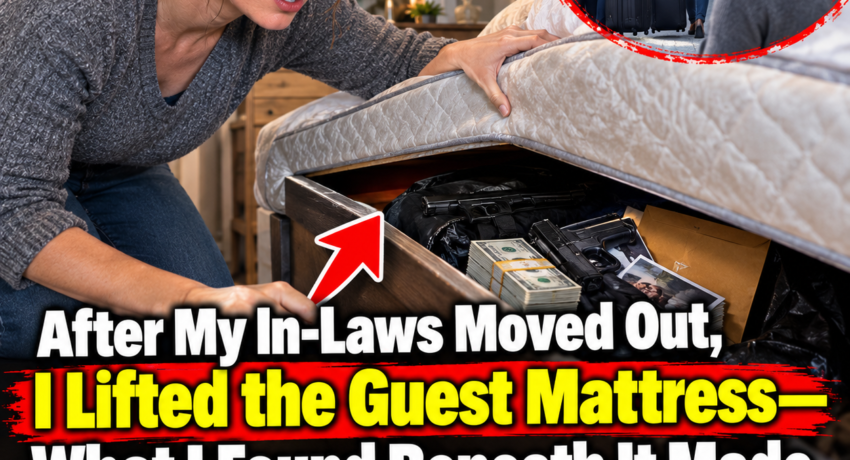
Until I lifted the mattress.
Part 2 — What Was Underneath
The sheet was trapped beneath one corner.
I wedged my hand underneath the mattress and lifted.
Something moved.
Not fell.
Moved.
A small, solid object slid beneath the mattress as I raised it.
I froze.
Downstairs, the coffee grinder suddenly roared to life.
The normal sound felt strangely distant.
I stared at the mattress.
“Probably nothing,” I whispered.
Maybe Eleanor had misplaced something.
A phone charger.
A container.
A book.
I lifted the mattress a little higher and bent down.
Then I saw them.
Small plastic bags.
Several of them.
Neatly arranged in a row.
Each bag had been tightly packed with a fine white powder.
And every single one had a handwritten label.
E-14.
R-07.
B-22.
For several seconds, my brain simply refused to process what my eyes were showing me.
My mouth went dry.
“No.”
I crouched lower.
“No, no, no.”
Eleanor?
My Eleanor?
The woman who attended church every Sunday?
The woman who once apologized for using too much of my dish soap?
The woman who brought me tea whenever I complained about a headache?
There had to be another explanation.
There absolutely had to be.
Then my hand touched something under the bed.
A suitcase.
It had been pushed so far toward the wall that I hadn’t noticed it before.
I dragged it into the light.
It was heavier than an empty suitcase should have been.
My heart began pounding.
I told myself not to open it.
Then I opened it.
The zipper slid around the edge.
I lifted the lid.
My stomach dropped.
There were dozens more bags inside.
Rows upon rows.
White powder.
Cream-colored powder.
Tan powder.
Each bag carefully sealed.
Each one marked with a code.
I stumbled backward.
“Oh my God.”
My hands had begun shaking so badly that I nearly dropped my phone while trying to unlock it.
I called Thomas.
He answered almost immediately.
“Hey, babe. I’m about to jump on a call. Can I—”
“Thomas.”
Something in my voice silenced him.
“Thomas, come here.”
“What happened?”
“I found something.”
“Found what?”
“In the guest room.”
A pause.
“Bags.”
“What kind of bags?”
“Small plastic bags full of white powder.”
Another pause.
Longer this time.
“Claire… what?”
“There are dozens of them, Thomas. And they have codes written on them.”
He gave a short, nervous laugh.
Not because anything was funny.
Because sometimes the brain laughs when reality becomes too strange.
“Okay. Don’t touch anything else.”
“I already opened the suitcase.”
“Claire.”
“Just come here!”
“I will. I just need to finish this call.”
I ended the conversation and stared at the suitcase.
Don’t touch anything else.
That would’ve been excellent advice.
Unfortunately, I ignored it.
Part 3 — The Evidence Only Got Worse
Near the bed, I spotted a small notebook that must have fallen out when I dragged the suitcase free.
I picked it up.
Every page was filled with Eleanor’s neat handwriting.
Dates.
Numbers.
Ratios.
Checkmarks.
Short coded notes.
I flipped through it faster.
My heart beat harder with every page.
Then I noticed something tucked into a mesh compartment in the suitcase.
A folded piece of paper.
I opened it.
A map of our county.
Tiny X marks appeared all over it.
One was near the farmers’ market Thomas and I visited almost every Saturday.
Others appeared along the highway and in small towns nearby.
Beside one location, Eleanor had written:
“J.J. Mill — Sat. 9 a.m. Bring thank-you card.”
I stared at the words.
A meeting place.
A time.
A coded notebook.
Bags of powder.
It suddenly felt impossible to invent an innocent explanation.
I took a picture and sent it to my sister, Margot.
Me: Look what I found under my in-laws’ mattress.
Her reply came almost immediately.
Margot: CLAIRE WHAT IS THAT?!
Me: I DON’T KNOW.
Margot: Is that what I think it is???
Me: There are dozens of bags.
Margot: CALL SOMEONE.
Then another message.
Margot: Actually I don’t even know who you’re supposed to call. OH MY GOD.
Despite everything, I almost laughed.
Almost.
Instead, I sat on the edge of the stripped bed and looked around the room.
For six months, Eleanor had shut this door.
For six months, she’d insisted on doing her own laundry.
For six months, I’d heard that strange humming.
For six months, there had been unexplained little outings and private jokes.
Suddenly every innocent memory rearranged itself into something sinister.
And then an older memory surfaced.
My mother.
When I was twelve, I’d learned that the locked doors in our house had hidden something too.
She’d been struggling with compulsive stealing for years.
As a child, I hadn’t understood why certain closets were always locked or why unfamiliar objects occasionally appeared in our home.
Until one terrible afternoon when everything came into the open.
I had spent years teaching myself that a closed door didn’t automatically mean danger.
That secrets weren’t always terrible.
That privacy wasn’t the same thing as deception.
And yet there I was again.
Sitting outside another person’s secret.
My chest tightened.
“Please,” I whispered.
“Not again.”
Footsteps sounded in the hallway.
Thomas rushed into the room.
“Honey, what did you—”
He stopped.
His eyes went to the bags.
Then the suitcase.
Then the notebook and map.
His face lost its color.
“Claire…”
“Tell me I’m overreacting.”
He didn’t answer.
“Thomas.”
“I don’t know what I’m looking at.”
“Exactly.”
Before either of us could say more, a car pulled into our driveway.
I looked through the window.
And my stomach dropped for the second time that morning.
Eleanor’s silver sedan.
Harold sat in the passenger seat.
I turned toward Thomas.
“What did you do?”
His eyes widened.
“I called them.”
“You called them?!”
“I told them you found something they’d left behind! I didn’t know it was all this!”
“Thomas!”
“They were already nearby!”
The front door opened.
And suddenly, the people I had spent the last hour imagining as participants in some impossible secret operation were walking casually into my house.
Part 4 — Eleanor Came Back Carrying Banana Bread
Eleanor entered first.
She was holding a plastic container filled with banana bread.
Banana bread.
Harold followed behind her, hands tucked casually into his coat pockets.
“Sweetheart,” Eleanor called. “We were actually already headed over. I made you something to thank you for letting us stay so long, and then Thomas said you’d found something and sounded upset—”
She stopped when she saw my face.
I didn’t say anything.
I simply pointed toward the guest room.
Thomas touched my elbow.
“Claire, whatever this is, we’ll figure it out.”
“Figure it out?”
My voice rose.
“There are bags of suspicious white powder hidden under our mattress!”
Eleanor’s expression changed instantly.
She stepped into the room.
Saw the bags.
Saw the suitcase.
Saw the notebook.
Saw the map.
First came confusion.
Then recognition.
Then horror.
Her cheeks turned bright pink.
The container of banana bread tilted dangerously in her hands.
She sat heavily on the edge of the bed.
“Oh.”
I stared at her.
“Oh?”
She covered her mouth.
“Eleanor, ‘oh’ is not enough.”
“Claire…”
“Do you want to explain why I spent the last hour believing my mother-in-law has been running an illegal operation from my guest bedroom?”
Behind Eleanor, Harold made a tiny noise.
I spun around.
“Are you laughing?”
“No.”
“Harold!”
“I’m absolutely not laughing.”
His shoulders were shaking.
“You are!”
“I’m sorry.”
Eleanor closed her eyes.
“Harold, please.”
He immediately composed himself.
Thomas looked at his mother.
“Mom, seriously. Tell us what this is.”
Eleanor twisted her wedding ring around her finger.
“I meant to take all of it yesterday.”
I stared at her.
“All of what?”
“The bags.”
“That does not make this sound better.”
“I know.”
“The suitcase wouldn’t close,” she continued, speaking faster. “So I took a few bags out and put them beneath the mattress. I planned to come back today and collect them.”
Thomas pinched the bridge of his nose.
“Mom, I love you. Deeply. But every sentence you’re saying is making this worse.”
Harold cleared his throat.
“It’s not really that serious.”
Then he added gently:
“My flour girl.”
Eleanor flinched.
Not angrily.
Embarrassed.
Harold immediately noticed.
His teasing expression disappeared.
“I’m sorry, Ellie.”
Something about that small exchange made me pause.
For the first time that morning, I wondered whether I had misunderstood something enormous.
I reached down and picked up one of the bags.
E-14.
Eleanor’s eyes widened.
“Claire, don’t.”
“I have to know.”
“Please.”
Thomas stood beside me and rested one hand on my shoulder.
I opened the bag.
Part 5 — The Truth
I expected a sharp chemical smell.
Something frightening.
Something that would confirm every terrible thought I’d had.
Instead…
I smelled almost nothing.
I brought the bag closer.
There was a faint warmth to it.
Dry.
Nutty.
Familiar.
My confusion deepened.
I dipped the tip of one finger into the powder.
“Claire!” Eleanor gasped.
I touched the tiniest amount to my tongue.
Thomas stared at me like I’d lost my mind.
I frowned.
Then I tasted it again.
And suddenly my entire morning collapsed into absurdity.
“This is flour.”
Nobody spoke.
I stared down at the bag.
“It’s flour!”
Harold burst out laughing.
Thomas covered his face.
And Eleanor immediately began explaining.
“E-14 is einkorn!”
“What?”
“Einkorn flour. From a small mill in Vermont. They only grind certain batches during the year, and that was batch fourteen.”
She grabbed another packet.
“R-07 is rye.”
Another.
“B-22 is buckwheat.”
I slowly lowered myself onto the bed.
“You’re telling me… all of these bags…”
“Flour.”
“Are flour.”
“Yes.”
I pointed at the suitcase.
“All of them?”
“Every one.”
“The notebook?”
“My feeding schedule.”
“Feeding schedule?”
She hesitated.
“For my sourdough starters.”
I closed my eyes.
Of course.
The humming.
The warm yeasty smell.
The mysterious “little projects.”
I opened my eyes again.
“The map?”
“Mills.”
“What?”
“Flour mills I wanted to visit while we were living here. J.J. Mill has this wonderful stone-ground flour, and the owner helped me find a particular grain, so I wanted to take her a thank-you card.”
Harold was laughing so hard now that he had tears in his eyes.
I pointed at him.
“You’re still in trouble.”
“I’m sorry.”
“You are not sorry.”
“I’m trying very hard to be sorry.”
Thomas finally let out a laugh too.
Not a small laugh.
A helpless one.
He leaned against the wall as though his legs had stopped working.
I looked back at Eleanor.
“And the humming?”
She looked embarrassed again.
“I talk to my starters.”
There was silence.
“You talk to them?”
“They’re alive!”
Harold nodded solemnly.
“She has conversations with jars of yeast.”
“They respond to attention.”
“They bubble.”
“That’s a response.”
I couldn’t help myself.
A laugh escaped me.
Then another.
Soon Thomas was laughing too.
Even Eleanor started smiling.
But one question still bothered me.
“Why hide everything?”
That changed her expression.
Part 6 — The Secret Behind the Closed Door
Eleanor looked down at her hands.
For the first time all morning, she seemed genuinely vulnerable.
“Because I was embarrassed.”
I blinked.
“Of baking?”
“Not exactly.”
She glanced at Harold.
“He teases me about it.”
Harold immediately stepped forward.
“Ellie, I only tease because I think it’s adorable.”
“I know.”
Her voice softened.
“I know you do.”
She looked back at me.
“At home, I don’t mind. Harold calls me his flour girl. He makes jokes when I talk to the starters. He tells people I have more emotional attachment to sourdough than I do to most humans.”
“Which,” Harold added carefully, “may occasionally be true.”
Eleanor almost smiled.
“But this wasn’t our home,” she continued. “It was yours.”
Her eyes became shiny.
“You’d already opened your house to us. I didn’t want to take over your kitchen too. And I didn’t want Harold making jokes about my silly hobby every day until you thought I was ridiculous.”
“Eleanor…”
“So I kept most of it in the bedroom. I cleaned up after myself. I washed the bedding because flour dust gets everywhere. I kept the door shut.”
Suddenly, all those months looked different.
The closed door hadn’t been hiding danger.
It had been hiding vulnerability.
A woman trying not to inconvenience her daughter-in-law.
Trying not to feel foolish about something she loved.
And I’d transformed it into something frightening because of wounds Eleanor didn’t even know I carried.
“I would’ve loved it,” I said softly.
She looked up.
“What?”
“The baking. The starters. The ridiculous amount of flour.”
Her mouth trembled into a smile.
“You would’ve?”
“Yes.”
I looked around at the bags scattered across my floor.
“Although labeling them with mysterious codes and hiding them under a mattress was probably not your best choice.”
Thomas laughed.
“Definitely not.”
“I can see that now,” Eleanor admitted.
Harold wrapped an arm around her shoulders.
“I told you Claire would’ve liked the bread.”
She leaned into him.
“You also told everyone at church that I spent twenty minutes encouraging a sourdough starter.”
“It needed encouragement.”
Despite herself, she laughed.
Then I did too.
But the laughter hit something deeper inside me.
Relief.
Embarrassment.
The release of fear I’d been carrying since childhood.
Suddenly I was laughing and crying at the same time.
Thomas sat beside me.
“Hey.”
“I’m fine.”
“You don’t look fine.”
“I thought your mother was a criminal.”
Harold laughed again.
Eleanor threw a pillow at him.
“Harold!”
“Sorry!”
I wiped my eyes.
“I genuinely thought I was about to discover some horrifying family secret.”
Eleanor’s face softened.
Then she took my hands.
“Claire, I’m sorry I frightened you.”
“You didn’t know.”
“I should’ve told you.”
“And I probably shouldn’t have decided you were running an underground empire based entirely on Ziploc bags.”
Thomas nodded.
“That’s probably fair.”
I glared at him.
“You weren’t exactly calm when you saw them.”
“True.”
Eleanor suddenly remembered the container she’d carried into the room.
“Oh!”
She picked it up.
“The banana bread.”
We all stared at it.
She smiled sheepishly.
“It’s made with R-07.”
I looked at the rye packet.
“The suspicious one?”
“The very same.”
Part 7 — Every Sunday
We spent the next half hour packing everything back into Eleanor’s suitcase.
This time, Harold carried it.
“Careful,” I told him. “Apparently that’s extremely valuable merchandise.”
He grinned.
“Street value is probably twelve dollars.”
“Harold.”
“Sorry.”
Eleanor collected her notebook.
I took it from her for a moment.
I’d spent the morning seeing coded evidence.
Now I saw recipes.
Experiments.
Years of patience.
Tiny handwritten notes beside certain entries:
Good rise.
Too sour.
Try warmer water.
Harold liked this one.
I handed the notebook back to her carefully.
It suddenly felt less like evidence and more like a diary.
Something personal.
Something loved.
At the front door, Eleanor hesitated.
“I really am sorry.”
“Stop apologizing.”
“I frightened you.”
“You also gave me the most interesting Saturday morning I’ve had in years.”
She smiled.
I glanced toward the suitcase.
“You’re taking all of them?”
“Of course.”
Something occurred to me.
“Wait.”
I pointed toward her.
“Come back tomorrow.”
She blinked.
“What?”
“Sunday. Come over.”
“For what?”
“We’re baking.”
Her face changed completely.
It was such a small thing, but I’ll never forget it.
She looked delighted.
Almost childlike.
“Really?”
“Really.”
“With the starters?”
“All of them if necessary.”
Harold groaned.
“We’ll be here until Tuesday.”
Eleanor elbowed him.
I laughed.
“Every Sunday.”
Her eyes widened.
“Every Sunday?”
“Every single Sunday.”
She hugged me.
And this time, the hug felt different.
For six months, we had lived on opposite sides of a closed bedroom door, each of us trying so hard not to inconvenience the other that we’d accidentally kept something wonderful from happening.
That evening, after Eleanor and Harold left, Thomas and I stood at the kitchen counter eating slices of banana bread with our fingers.
No plates.
No forks.
Just warm bread disappearing faster than either of us wanted to admit.
Thomas glanced toward the hallway.
“You really thought Mom was involved in something illegal?”
I pointed my piece of bread at him.
“You saw those bags.”
“Fair.”
“And the map.”
“Very fair.”
“And she wrote codes on everything!”
“Extremely fair.”
I took another bite.
The bread was incredible.
On the windowsill beside us sat a small glass jar.
Before leaving, Eleanor had spooned some of R-07 into it.
“For you,” she’d said.
Tiny bubbles were already appearing inside.
Thomas nodded toward it.
“So… are you going to talk to it?”
“Absolutely not.”
A bubble rose to the surface.
I stared at the jar.
Thomas raised an eyebrow.
I leaned closer.
“You’re doing great,” I whispered.
Thomas burst out laughing.
I did too.
Behind us, the guest room door stood wide open.
For the first time in six months, there was nothing hidden behind it.
And somehow, that strange morning taught me something I’d spent most of my life struggling to believe:
Not every closed door hides something terrible.
Sometimes, behind it, there is only a woman protecting a harmless passion because she’s afraid someone might laugh.
Sometimes the secret you’ve feared is simply flour.
And sometimes, when the door finally opens, what you find isn’t something that tears a family apart.
It’s something that brings everyone closer together.