Part 1 — The Outfit I Almost Asked Her to Change
By the third time I reached over to fix Chloe’s sleeve, my husband gently caught my hand.
“Liv,” Ryan murmured, keeping his voice low, “it hasn’t moved.”
I froze.
Then I looked down.
He was right.
The cuff of my six-year-old daughter’s enormous black jacket was still folded exactly where I had rolled it ten minutes earlier.
I wasn’t fixing anything.
I was fidgeting.
And Ryan knew exactly why.
The hallway outside the recital room was packed with families. Parents leaned against walls, grandparents held bouquets, and children posed beneath bright fluorescent lights while phones flashed from every direction.
Most of the little girls in Chloe’s group looked recital-ready in the traditional sense—sparkling dresses, pastel skirts, shiny shoes, carefully curled hair.
And then there was my daughter.
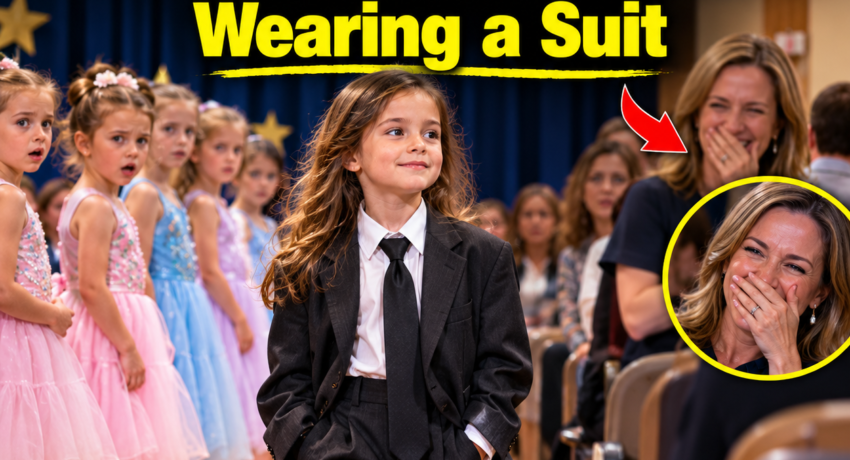
Chloe stood among them wearing a black suit nearly four sizes too large.
The shoulders swallowed her tiny frame.
The pant legs had been folded and pinned so many times they looked almost comical.
Her tie hung slightly crooked against her white shirt.
She looked as though she had borrowed an exhausted businessman’s clothes on the way to an important meeting.
And she had never looked happier.
Chloe placed both hands on her hips.
“Do I look sharp?”
Ryan’s face immediately broke into a grin.
“Very sharp.”
She turned toward me.
“Mom?”
For half a second, my eyes drifted past her toward a little girl in a pale pink dress.
Then another in blue sequins.
Then another wearing a bow almost as large as her head.
I forced my attention back to Chloe.
“You look amazing, sweetheart.”
Her whole face lit up.
Then she spun around, sending the oversized jacket flapping behind her like a cape.
Ryan waited until she had wandered several steps away.
Then he leaned toward me.
“You’re doing it again.”
I frowned. “Doing what?”
“That thing where you study everyone else’s reaction.”
“I’m not studying anyone.”
He raised an eyebrow.
“You’ve been counting dresses since we got here.”
“I have not.”
“Okay. How many?”
I stared at him.
His mouth twitched.
I hated that he knew me so well.
Because the truth was, I had been counting.
Not because I disliked Chloe’s outfit.
At least, that was what I kept telling myself.
That morning, I had actually found the whole thing adorable.
Chloe had marched into our bedroom while Ryan and I were getting ready, dragging several inches of black trouser fabric across the floor behind her.
“This is what I’m wearing tonight.”
Ryan had nearly choked on his coffee.
“Where did that come from?”
“The closet.”
I recognized it after a moment.
My sister had dropped off several bags of clothes her children had outgrown. The suit had belonged to my nephew. He’d once planned to use it for a costume before choosing something else.
I stared at Chloe.
“What happened to the blue dress?”
For the entire week she had talked about that dress.
She had chosen a matching ribbon.
She had asked me twice whether I could curl her hair.
Now she simply shrugged.
“I changed my mind.”
She attempted to knot the tie.
Ryan crouched beside her to help.
“This thing is enormous, kiddo.”
“I know.”
I smiled uncertainly.
“But why the suit?”
Chloe turned toward the bedroom mirror.
Her expression became strangely serious.
“Because it’s my brave outfit.”
That answer had made me smile.
At six years old, Chloe believed objects could acquire special powers simply because she decided they had them.
One particular pair of socks made her run faster.
A yellow hair clip helped her remember spelling words.
A small plastic ring made her less afraid of thunderstorms.
So I hadn’t argued.
I rolled the sleeves.
Pinned the trousers.
Straightened the tie.
And told myself I was proud to have a daughter who knew what she wanted.
I had always told Chloe that.
Choose for yourself.
Be yourself.
You don’t have to copy everyone else.
I believed those things.
At least I thought I did.
Then we arrived at the recital.
And suddenly I became painfully aware of every person who looked at her.
A woman walking past us slowed down.
Her eyes moved over Chloe’s suit.
“Oh.”
Just one syllable.
Yet I felt every muscle in my shoulders tighten.
“Well,” she continued with a thin smile, “that’s certainly… different.”
Chloe looked up at her.
“I like it.”
And instead of simply saying, “So do I,” I laughed nervously.
“She chose it herself. We actually brought another outfit too, just in case.”
Ryan’s head snapped toward me.
“What?”
I avoided his eyes.
“Her blue dress. It’s in the car. If she changes her mind.”
The woman nodded approvingly.
“Probably a good idea.”
Then she walked away.
The silence she left behind felt heavier than the conversation itself.
Chloe looked at me.
“You brought my dress?”
“It’s only a backup, honey.”
“I don’t want a backup.”
Her voice had changed.
The excitement that had filled it minutes earlier was gone.
“I know. I just thought that when you saw the other girls, you might feel differently.”
“I don’t.”
“I know.”
“Then why did you bring it?”
I opened my mouth.
Nothing came out.
Chloe watched me carefully.
“Do you want me to put the dress on?”
It should have been the easiest question in the world.
No.
Of course not.
Wear what makes you happy.
That was what the mother I believed myself to be should have said immediately.
Instead, I hesitated.
Maybe two seconds.
Maybe three.
But sometimes a child doesn’t need a speech to understand what you’re thinking.
Sometimes silence tells them everything.
Chloe’s chin lifted.
“No.”
“Sweetheart—”
“I’m wearing my suit.”
“I know. That’s fine.”
She stared at my face.
“You don’t look like it’s fine.”
Then she walked over and stood beside her father.
And for the first time that evening, I realized the person making Chloe doubt herself might not be one of the strangers staring at her.
It might be me.
Part 2 — The Laugh
I was still trying to recover from that realization when I heard someone call Chloe’s name.
“Chloe!”
I turned.
Ellen was approaching with her daughter, Sadie.
Our girls were in the same class.
Ellen and I weren’t close, but we had spoken often enough at school pickups, birthday parties, and parent events to recognize one another easily.
Sadie was sweet and quiet, usually hovering close to her mother.
That night she wore a glittery dress and matching shoes.
Ellen noticed Chloe’s suit almost immediately.
She stopped.
Then she laughed.
Not a small surprised chuckle.
A loud laugh.
“Oh my goodness!”
Sadie tugged urgently at her mother’s arm.
“Mom…”
But Ellen kept staring at Chloe.
“Why are you dressed like a little man instead of a pretty princess?”
My stomach dropped.
“Ellen.”
She waved one hand.
“Oh, come on. I’m joking.”
Sadie’s cheeks turned pink.
“Mom, stop.”
But Chloe didn’t hide behind me.
She didn’t cry.
She simply looked directly up at Ellen.
“I’m not a little man.”
Ellen’s laughter faltered.
“No, sweetheart, of course not.”
“I’m Chloe.”
“I know.”
“Then why did you call me something else?”
Ryan turned his face away and coughed into his fist.
Ellen looked briefly trapped.
“I was only joking about your clothes.”
Chloe glanced down at herself.
Then she said something that made my heart twist.
“My mom says clothes don’t decide who you are. You’re supposed to wear what makes you feel good.”
Relief washed through me.
Yes.
That was what I had taught her.
That was the mother I wanted to be.
But then Chloe looked straight at me.
“Usually.”
One word.
That was all.
I felt it like a spotlight turning toward me.
Nobody spoke.
Ellen blinked.
Sadie stared at her shoes.
Ryan looked at me without saying anything.
And I suddenly understood that Chloe had not only defended herself against Ellen.
She had called me out too.
A teacher appeared at the end of the hallway and began gathering the children.
“Recital group, line up please!”
Sadie hurried toward the others.
Chloe started after her.
“Bug?”
She stopped.
I crouched slightly.
“Can we talk?”
Her first question shattered something in me.
“Do I have to change clothes?”
“No.”
The answer came instantly this time.
Chloe searched my face.
“You promise?”
“I promise.”
She remained still for another second.
Then I smiled.
“Go have fun. You’re going to do great.”
She nodded and walked away.
Ellen shifted awkwardly beside me.
“I really was only teasing.”
Normally, that would have been my cue to rescue the conversation.
I would have smiled.
Said something like, “Oh, I know.”
Made everything comfortable again.
But I looked toward the hallway where Chloe had disappeared.
Then I faced Ellen.
“She didn’t think it was funny.”
Ellen seemed genuinely surprised.
She looked away.
A moment later, she left.
Ryan remained beside me.
Neither of us spoke at first.
Then he asked quietly, “Why did you really bring the blue dress?”
“I already explained.”
“You explained it to Chloe.”
I folded my arms.
“I didn’t want her to come here, see everybody staring, and suddenly feel embarrassed.”
Ryan nodded slowly.
“And what if she never would have been embarrassed?”
“She’s six, Ryan.”
“Exactly.”
He lowered his voice.
“She was perfectly happy until you started worrying on her behalf.”
That hurt because it was true.
“I was trying to protect her.”
“I know.”
His tone softened.
“But you’ve spent six years telling her to trust herself. You can’t panic the moment somebody notices she’s different.”
I looked toward the recital room.
My throat tightened.
I thought about Chloe asking whether I wanted her to wear the dress.
I thought about those few seconds when I had failed to answer.
“I need to talk to her.”
Ryan nodded.
This time, he didn’t follow.
Part 3 — Why the Suit Mattered
I found Chloe sitting on a folding chair near the side of the auditorium.
Her feet didn’t reach the floor.
She was pushing one oversized sleeve back toward her elbow.
I knelt in front of her.
“Hey.”
“Hi.”
I took a breath.
“I owe you an apology.”
She looked at me.
“I shouldn’t have brought your blue dress.”
“Why did you?”
There it was again.
The question I had avoided.
This time I decided she deserved the truth.
“Because I got nervous.”
Her eyebrows pulled together.
“Because of my suit?”
“Not exactly. I got nervous about what other people might think about your suit.”
Chloe looked down at the crooked tie resting against her shirt.
“I still like it.”
“I know.”
“Even if that lady doesn’t.”
“I know that too.”
I paused.
Then something occurred to me.
“Can I ask you something?”
She nodded.
“You told me this morning that this is your brave outfit. Why?”
Chloe stared at me as if the answer should have been obvious.
“Because you wear yours when people need to listen to you.”
I went still.
“My what?”
“Your work jackets.”
She sat straighter and pulled her little shoulders backward.
Then she raised her chin.
“You stand like this.”
I nearly smiled.
“Like what?”
“Like a superhero.”
I laughed softly despite myself.
“I do?”
“Yep.”
She leaned forward.
“And you sound different too.”
“How?”
“Like you know what you’re doing.”
My throat tightened.
There were several dark blazers in my closet that I wore for difficult meetings, presentations, and days when I needed to appear far more confident than I actually felt.
I remembered once telling Ryan before an important meeting that wearing my blazer helped me feel sharp and prepared.
I had never realized Chloe had been listening.
“I was scared about tonight,” she admitted.
I stared at her.
“You were?”
She nodded.
“Why didn’t you tell me?”
“There are a lot of people.”
She glanced toward the stage.
“So the suit helps?”
“Yeah.”
Then she smiled.
“It makes me feel like you.”
For several seconds, I couldn’t speak.
All evening, I had been telling myself that I was protecting my daughter from standing out.
But Chloe hadn’t chosen the suit because she wanted attention.
She had chosen it because she was frightened.
She had watched me walk into rooms carrying my own fear beneath a dark jacket.
She had seen me straighten my shoulders.
Lift my chin.
Walk forward anyway.
And somehow, in her six-year-old mind, she had decided my clothes contained courage.
She had borrowed my suit because she wanted to borrow my bravery.
And I had nearly made her take it off because strangers might misunderstand.
I reached for her hand.
“I got this wrong, baby.”
Chloe nodded solemnly.
“You did.”
I burst out laughing.
A tiny smile appeared on her face too.
“Yes,” I admitted. “I really did.”
“Can I still wear it?”
“Absolutely.”
“What if people stare?”
“They might.”
“What if somebody laughs?”
That question stopped me.
A few minutes earlier, I might have told her not to worry about it.
Instead I said, “Then we remember that we don’t have to change ourselves just to make somebody else more comfortable.”
Chloe smiled.
“Okay.”
I squeezed her hand.
“And I mean it this time. The suit stays.”
“I know.”
A teacher appeared and called Chloe’s group.
She stood up.
Then she hesitated.
“Mom?”
“Yeah?”
Her voice became small.
“I’m still scared.”
That confession mattered more than everything that had happened with Ellen.
Because courage had never meant she wasn’t afraid.
I reached up and straightened her tie.
Then I stopped myself before adjusting anything else.
“You know what?”
“What?”
“You don’t have to stop feeling scared before you go onstage.”
She looked uncertain.
“Really?”
“Really. Just do your superhero pose.”
Chloe pulled her shoulders back.
Raised her chin.
I smiled.
“There you go.”
She stared toward the stage entrance.
Then she looked back at me once.
“Okay, Mom.”
And she walked away.
I remained where I was.
Because maybe one of the hardest things about being a mother is learning that helping your child doesn’t always mean stepping in.
Sometimes it means stepping back.
Part 4 — The Stage
A few minutes before the performance, I caught sight of Chloe near the curtain.
The confidence was still there.
So were the nerves.
Her fingers kept finding the bottom of her jacket.
My instinct was immediate.
Go to her.
Fix the tie.
Fix the sleeves.
Tell her exactly what to do.
But I stayed where I was.
Eventually, she looked toward the audience and found me.
I mouthed, “You okay?”
She nodded once.
Then she grabbed both sides of her oversized jacket, tugged them into place, lifted her chin, and turned back toward the other children.
I returned to my seat beside Ryan.
For years, motherhood had trained me to intervene before Chloe fell, before she struggled, before something hurt.
But maybe support wasn’t always about removing discomfort.
Maybe sometimes it meant being close enough that she knew where to find me while still allowing her to move forward by herself.
The music began.
The children walked onto the stage.
And there was Chloe.
Under the bright lights, her suit looked even larger than it had in the hallway.
For one terrible second, my old anxiety came rushing back.
I noticed everything.
The oversized shoulders.
The folded trousers.
The crooked tie.
The sleeves.
Then Chloe found us in the audience.
Our eyes met.
I smiled.
Her face immediately changed.
She smiled back.
And suddenly all I could see was my daughter.
Not the outfit.
Not the audience.
Not the parents who might be whispering.
Just Chloe.
Halfway through the performance, one sleeve slipped almost completely over her hand.
Without thinking, my own hand lifted from my lap as though I could somehow fix it from twenty feet away.
Ryan glanced at me.
I caught myself.
Slowly, I lowered my hand.
Onstage, Chloe looked down.
Then she shoved the sleeve up herself.
And kept going.
She missed a cue.
She looked sideways at another child.
Found the right place.
Continued.
It wasn’t perfect.
It wasn’t disastrous.
It was something much more important.
It was real.
My little girl was doing something that frightened her without needing anybody to remove the fear first.
When the recital ended, Chloe came racing toward us.
Ryan scooped her into a hug.
“You crushed it!”
“I messed up.”
“Once.”
“Twice!”
“Still crushed it.”
She laughed.
Then she threw her arms around me.
I hugged her tightly.
“You were wonderful.”
And I meant every word.
Then I saw Ellen approaching.
Sadie walked beside her.
Ellen gave Chloe a long look.
“Well,” she said, “she definitely has confidence. I’ll give her that.”
Earlier that evening, I might have accepted those words as praise.
Now I heard what sat underneath them.
I looked at Ellen.
“She was actually nervous.”
Ellen frowned.
“The suit made her feel braver.”
“Oh.”
She laughed lightly.
“I just meant she must have confidence to wear something like that in front of everyone.”
“I know what you meant.”
Ellen glanced around the room.
“I’m just saying kids already get singled out for enough things. Sometimes helping them blend in makes life easier.”
There it was.
The lesson so many of us had been taught without realizing it.
Blend in.
Don’t give people a reason to stare.
Be yourself—but only within acceptable limits.
Call it protection.
Call it common sense.
Call it making life easier.
I looked at Chloe.
Then at Sadie.
And something inside me settled.
“I almost made her change tonight.”
Ryan looked at me.
Ellen blinked.
“What?”
“I brought another dress because I was afraid people would judge her.”
Ellen lifted one hand.
“You don’t need to justify that to me.”
“I’m not justifying it.”
I kept my voice calm.
“I’m saying I was wrong.”
Chloe was standing beside us.
Listening.
That mattered more than whether Ellen agreed with me.
I continued.
“If Sadie loves her sparkly dress, that’s wonderful. Chloe loves her suit. I don’t want either of them learning that one choice is safer or better just because more people understand it.”
Ellen opened her mouth.
Then closed it again.
For a second, nobody said anything.
Then Sadie pointed toward Chloe’s tie.
“Can I try that?”
Chloe’s eyes lit up.
“Sure!”
She loosened the tie and handed it to Sadie.
Sadie slipped it around the collar of her glittering dress.
Ellen stared.
“It doesn’t match your dress, Sadie.”
Sadie’s smile disappeared.
Then Ellen stopped.
She looked at her daughter.
Then at me.
Something in her expression changed.
“But…”
She exhaled.
“I suppose the world won’t end.”
Sadie grinned.
Chloe grinned back.
I said nothing.
Ellen hadn’t suddenly become a different person.
Neither had I.
But both of us had caught ourselves.
Sometimes change begins exactly there.
Part 5 — What Brave Really Means
On the drive home, Chloe leaned forward between the front seats.
“Mom?”
“Yeah, bug?”
“Did you really want me to wear the blue dress?”
Ryan glanced sideways at me.
I could have softened the truth.
I could have told Chloe I had only brought it for emergencies.
But she had already shown me that evening that children often recognize dishonesty long before adults realize they’re using it.
So I answered plainly.
“For about ten minutes, yes.”
“Why?”
“Because I was scared people wouldn’t understand why you wanted the suit.”
She rested her chin against the back of my seat.
Then she asked a question so simple it made every excuse I had feel ridiculous.
“Why do they have to understand me?”
I looked at her in the rearview mirror.
They didn’t.
Of course they didn’t.
“They don’t,” I said.
Chloe nodded as though that settled the matter.
A few moments passed.
Then she asked, “Were you scared when you wore your suit?”
That caught me off guard.
“Sometimes.”
“Even when you looked brave?”
I smiled faintly.
“Especially then.”
She thought about that.
“So you can be brave and still be scared?”
“Yes.”
I glanced at Ryan.
“Most of the time, I think that’s exactly what being brave is.”
“Good.”
I laughed.
“Why is that good?”
“Because I was scared too.”
Then she leaned back into her seat.
And somehow that quiet little confession stayed with me more than Ellen’s laugh had.
When we got home, Chloe immediately changed into pajamas and abandoned the suit in a heap beside her bed.
Apparently even magical brave outfits did not come with magical cleaning powers.
I picked up the jacket.
“Can I wear it again?” she asked.
“If you want to.”
Her eyes widened.
“Anywhere?”
“Anywhere appropriate. But next time, we’re getting the pants properly altered before you trip over them.”
She giggled.
Then she pointed toward the blue dress, which I had carried inside from the car.
“Can I wear that next week?”
I paused.
“The blue dress?”
“Yeah.”
“You still like it?”
“Of course.”
She looked confused by my surprise.
“I like both.”
And there it was.
I had spent the entire evening turning the suit and the dress into symbols.
One represented individuality.
The other represented conformity.
One represented bravery.
The other represented fitting in.
But Chloe had never seen them that way.
To her, they were simply clothes she liked.
The point wasn’t choosing a suit instead of a dress.
The point was that the choice belonged to her.
Part 6 — My Brave Suit
The next morning, I had an important meeting.
I stood in front of my closet, mentally going over talking points, deadlines, and all the ways the conversation could go wrong.
Without thinking, I reached for my dark blazer.
Chloe wandered into my bedroom carrying a piece of toast.
The moment she saw the jacket, she grinned.
“Your brave suit.”
My hand stopped.
I looked at her through the mirror.
Then I looked at myself.
For years, I had thought confidence meant entering a room already certain that you belonged there.
I thought confident people didn’t wonder who was staring.
They didn’t second-guess themselves.
They didn’t feel afraid.
My six-year-old had reminded me otherwise.
Sometimes confidence is simply walking into the room before you feel ready.
Sometimes courage is wearing the thing that helps you stand taller.
Sometimes being brave means hearing someone laugh and deciding not to disappear.
I slipped my arms into the blazer.
“Yeah,” I said softly. “I suppose it is.”
Chloe took another bite of toast.
“You need a tie.”
I laughed.
“I think I’ll manage without one.”
She shrugged.
“Your choice.”
Those two words stopped me.
Your choice.
The evening before, I had nearly forgotten how important they were.
I looked at my reflection again.
And suddenly I saw everything from the night before.
The blue dress waiting in the car.
The stranger’s raised eyebrow.
Ellen’s laugh.
Chloe saying, “Usually.”
Her sleeve falling onstage.
My hand automatically rising to fix it.
And then my hand lowering again as she fixed it herself.
None of those moments seemed enormous on their own.
But together they had taught me something I desperately needed to understand.
There was a line between guiding Chloe and controlling her.
Between protecting her and teaching her to fear other people’s opinions.
Between helping her and quietly telling her that I trusted strangers’ approval more than I trusted her instincts.
My job was not to make every road smooth before she reached it.
My job was to give her enough love, security, and confidence to know that when the road became uncomfortable, she could still keep walking.
I picked up my bag.
Chloe followed me down the hallway.
“Mom?”
I turned.
“Yeah?”
She smiled.
“You look sharp.”
I felt my own smile spread across my face.
“Thanks, bug.”
Then I walked out the door.
And for once, I didn’t look around to see whether anyone else agreed.