PART 1
The folder hit the tray table before he said a single word.
Not flowers. Not a card. A folder.
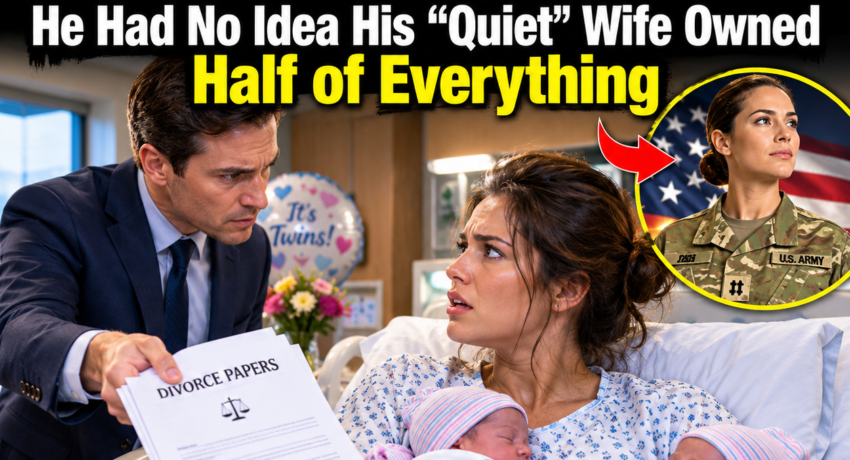
I was still in the hospital bed, my son asleep against my chest, my daughter in the bassinet beside me, and my husband of thirteen years stood at the foot of that bed like a man closing out a business deal.
“These are the divorce papers,” Marcus said.
I looked down at the folder, then up at him, waiting for the joke to land somewhere. It never did.
“You brought divorce papers into a hospital room,” I said. “Our children are eleven hours old.”
“There’s no reason to wait.” His voice was flat, rehearsed, like he’d practiced it on the drive over. “You’ll want to read it before you sign.”
I didn’t move. Owen stirred against my collarbone, and I pressed my palm flat against his back, more to steady myself than him.
Three days earlier, none of this would have made sense to me. Three days earlier, I still believed I was married to a man who loved me, even if he’d forgotten how to show it. It’s strange, looking back, how fast a marriage can come apart once you finally see the seam that was already torn.
To understand how I ended up staring at a folder full of lies while holding two newborns, you have to understand what I built before Marcus ever walked into it.
My name is Vivian Calloway. For most of the people in our corner of Loudoun County, Virginia, I was simply Marcus’s wife — pleasant at dinner parties, quiet at his company events, the woman who remembered everyone’s birthday and never seemed to have much of a career worth mentioning. Marcus told people I worked “in federal administration,” said it the way you’d mention a weather forecast, forgettable and vague. I let him say it. My work required discretion, and more than that, I’d never believed a marriage should be a contest over whose job sounded more impressive at a barbecue.
While Marcus spent a decade building a name for himself — Calloway Financial Group, a firm he was proud enough to put his own last name on — I spent that same decade building the parts of our life that don’t show up on a business card. I planned his mother’s seventieth birthday. I sat in the waiting room the year his father had his hip replaced. I quietly wired the money that kept Calloway Financial’s doors open during a brutal first year, back when Marcus was too proud to ask his own parents for a loan and too scared to ask a bank.
I never once needed a thank-you for any of it.
I needed honesty. That was the only thing I ever actually asked for.
I didn’t get it.
There’s a particular kind of loneliness that comes from being married to someone who has decided, quietly and without ever announcing it, that you’re no longer worth explaining himself to. It doesn’t arrive all at once. It arrives in small omissions — a dinner he forgets to mention, a late night he doesn’t bother accounting for, a laugh shared with someone else that he doesn’t think to bring home. I’d felt that loneliness for longer than I ever admitted to myself, and I’d folded it neatly into the same drawer where I kept everything else I chose not to examine too closely.
I told myself it was the cost of loving a driven man. I told myself every marriage has its quiet seasons. I told myself a great many things, in those years, that I no longer believe.
I was seven months pregnant with our twins when I learned exactly how little of it I’d been given, and those months, the ones that should have been the softest of my life, became instead the months everything I thought I knew came apart in my hands.
PART 2
It started with a tablet left charging on the kitchen counter.
Marcus had gone upstairs to take a call, and the screen kept lighting up with the soft, insistent buzz of a phone nobody was answering. I only meant to silence it. That’s the part I keep returning to — how something so small, so accidental, was the thread that unraveled thirteen years.
The message was already on the screen when I picked it up.
Once she’s gone, everything will finally belong to us.
I read it twice, certain I’d misunderstood a joke, a group text, anything but what it plainly said. Then a second message arrived, from the same name — Renee Sutter, Marcus’s executive assistant for the past four years.
Don’t worry. Once the babies come, she’ll be too exhausted to fight back.
My hands went cold before my mind caught up to what I was holding. I sat down at the kitchen table because I genuinely wasn’t sure my legs would hold me, and I stared at those two lines until the screen dimmed on its own.
Footsteps on the stairs. I set the tablet down exactly where I’d found it.
Marcus walked in still smiling from whatever conversation he’d just finished, and the smile faltered the instant he saw the tablet in my hand instead of on the counter.
“Why are you on my tablet?”
“It wouldn’t stop buzzing,” I said, and it was true, which made it easier to say without my voice shaking.
He took it from me too quickly, the way you snatch something away from a child before they can look closer. For one unguarded second, I saw something cross his face that looked almost like fear. Then it was gone, replaced by the same easy tone he used on clients.
“Work stuff,” he said. “Nothing important.”
I nodded. I said nothing. I have spent thirteen years being a woman who says nothing at the right moments, and that night, lying beside him while rain moved across the windows, I finally understood what all that silence had cost me.
He slept soundly. I didn’t sleep at all.
I thought about our wedding, the money I’d put into his company without asking for a single share of it, the nursery we’d painted together only weeks before. I thought about Renee Sutter’s manicured hands passing him coffee every morning, and the way he’d started coming home smelling like a perfume that wasn’t mine.
I thought, too, about the version of me Marcus must have described to her, late at night, in whatever quiet corner they carved out for these conversations. A wife who had “changed.” A wife who no longer understood him. It’s an old trick, I realized, lying there in the dark — rewrite the person you’re betraying until the betrayal sounds almost reasonable. I wondered how long he’d been perfecting that story, and how many people had already heard it before I did.
By morning, I’d made a decision, though it wasn’t the one Marcus would have expected from the quiet wife he thought he knew. I wasn’t going to scream. I wasn’t going to confront him in the kitchen with a phone in my hand and no proof beyond two lines on a screen.
I was going to watch. And I was going to wait for him to give me something I could actually use.
PART 3
To understand why that message cut as deep as it did, you have to understand what I’d already given Marcus’s family, quietly, and without asking for credit.
Two years earlier, his parents, Walter and Doris Calloway, had come within weeks of losing the house they’d lived in for three decades outside Middleburg. Neither of them had ever warmed to me. Doris often mentioned, in that offhand way some mothers-in-law perfect, that I “worked entirely too much for a wife.” Walter once told Marcus, within my hearing, that a woman who out-earned her husband would eventually make him feel small in his own home. I let both comments pass. I told myself it wasn’t my job to win them over.
But when the letter came about the second mortgage, and Marcus showed up at my office looking like a man who hadn’t slept in a week, I didn’t hesitate.
“Please, Viv,” he’d said. “They’re my parents. I can’t let them lose the house.”
I covered the balance that same week and arranged a restructured loan through a financial adviser I trusted, someone who’d keep the details quiet the way I asked her to. I never brought it up again. Not once, not even when Doris made another comment about my long hours.
I never told my own parents what I’d done, either. It wasn’t a secret born of shame — it was simply how I’d always operated, quietly closing gaps in other people’s lives without expecting a parade for it. I’d done the same thing three years earlier when Marcus’s company nearly missed payroll, wiring the shortfall from an account he didn’t know existed and letting him believe a delayed client payment had come through just in time. I kept a small, private ledger of every moment like that, not because I intended to collect on it one day, but because some part of me, even then, understood that a marriage built entirely on one person’s invisible labor eventually needs a record somewhere.
I learned, months later, exactly what story Marcus had told Renee about that house.
According to him, he’d saved it single-handedly — a devoted son rescuing his aging parents while his cold, career-obsessed wife refused to lift a finger. He’d told it so many times, apparently, that people at his own company believed it as fact. The man I had quietly protected for over a decade had spent that same decade rewriting me into the villain of a story where I’d done nothing but stand in his way.
I found out from an email Renee had cc’d to someone else by mistake, an email meant to celebrate Marcus’s “generosity” toward his parents. I read it standing in my own kitchen, holding a glass of water I never drank, feeling something inside me go very still and very clear.
That was the night I stopped waiting for him to trip over his own lie in front of me. That was the night I decided that if Marcus wanted to hand me a fabricated version of our marriage, I would simply let him keep building it, right up until it collapsed under its own weight.
I want to be honest about something most people skip over in stories like this one: I didn’t feel powerful in that moment. I felt gutted. I sat at that kitchen table with a pregnancy that already ached in my lower back, grieving a version of my marriage I now understood had never really existed, and grieving, too, the version of myself who had believed silence was the same thing as grace. It would be many weeks before grief made room for anything resembling resolve.
PART 4
The confrontation came on its own timeline, the way these things always do.
Marcus came home a few minutes past midnight, carrying a perfume that wasn’t mine into a kitchen that was. He poured himself a glass of water he didn’t drink either, then finally looked at me the way you look at someone you’ve already decided to leave.
“We need to talk,” he said.
I rested one hand over the curve of my stomach, feeling one of the twins shift beneath my palm. “I’m listening.”
“I don’t think this marriage should continue.”
I let the words land before I answered. “How long have you felt that way?”
“A while now.”
“And Renee?”
He didn’t flinch. If anything, he stood a little straighter, like admitting it was a relief. “She understands me.”
“After everything we built together?”
He shrugged, actually shrugged, the same motion he used when a client asked about a bad quarter. “You’ve changed, Vivian.”
I hadn’t changed. Not one bit. He had simply decided, somewhere along the way, that the version of me who never argued, never demanded recognition, never made him feel smaller than his own ambition, had become too ordinary to keep.
Two weeks after that conversation, my doctors moved up the delivery. Complications, they said, nothing catastrophic, but enough that they wanted the twins out rather than risk waiting. After eleven hours of labor that felt like eleven years, Owen and Grace arrived four minutes apart, and for the first time in months I let myself believe the worst of it might be behind me.
Owen came first, small and furious, his cry filling the delivery room before the nurses had even finished checking him over. Grace followed four minutes later, quiet by comparison, her fingers already curled tight around the nurse’s gloved hand like she intended to hold onto something from the very first second she arrived. I remember thinking, in that exhausted, floating way you think things right after childbirth, that I would do anything — absolutely anything — to make sure the world these two small people grew up in was built on something more honest than the one I’d been living in.
Marcus came to the hospital the evening they were born, stood at the edge of the room for exactly eleven minutes by the clock on the wall, took two photos on his phone, and left before either baby had opened their eyes for him. I told myself it was exhaustion. Looking back, I think some part of me already understood what he was really doing that night, which was saying goodbye without having the nerve to say it out loud.
That belief lasted less than a day.
Marcus walked into my hospital room the following afternoon carrying that leather folder, and everything that had been circling quietly for months finally landed at once.
“These are the divorce papers,” he said again, as if repeating it might make it feel less monstrous.
I opened the folder with one hand, my newborn son still asleep against the other arm. According to the papers, I had contributed nothing to Calloway Financial Group. According to the papers, Marcus alone had rescued his parents’ home. According to the papers, I had no legitimate claim to any part of the life we’d spent thirteen years building.
Every line of it was a lie so complete it was almost impressive.
“Who wrote this?” I asked, quiet enough that it didn’t wake Owen.
“My attorney.”
Then he smiled, the same smile he used to reassure nervous investors. “You’ve got two newborns now, Vivian. You don’t exactly have the resources to fight me on this.”
Before I could answer him, there was a knock at the door.
PART 5
The woman who walked in wore an Army combat uniform, its creases sharp enough to cut, and behind her came an attorney I recognized instantly and two officers Marcus had never seen in his life.
Marcus’s whole posture changed, the confidence draining out of him in real time.
The woman in uniform smiled at me first, warm and familiar. “Colonel Calloway, we’ve finished the review you requested.”
“Colonel?” Marcus repeated the word like it belonged to a different language.
I nodded slowly. “Yes, Marcus. Colonel.”
Thirteen years, and he had never once asked what my job actually involved beyond the vague phrase he liked to repeat at parties. He never knew I’d spent most of that decade overseeing logistics coordination and strategic planning at a level that required a security clearance he couldn’t have guessed the color of. He never knew, because knowing would have required asking, and asking would have required seeing me as something other than a supporting character in his own story.
I watched it settle over him in stages, the way bad news does when it arrives too fast to absorb all at once. First the confusion. Then something closer to recalculation, his eyes moving over me like he was seeing the outline of a stranger standing where his wife used to be. Thirteen years of quiet dinners, quiet school drop-offs, quiet evenings where I’d let him talk uninterrupted about his own ambitions — and somewhere in all that quiet, he had built an entire private mythology in which I contributed nothing worth mentioning. It is a strange thing, to watch a man realize in real time that the woman he underestimated was never the smaller person in the room. It was simply easier for him to believe that she was.
My attorney, Diane Wexler, stepped forward and opened a second folder of her own.
“Mrs. Calloway purchased the family residence outright before the marriage,” she said, her voice even and unbothered by the audience. “She also provided the entire initial investment that allowed Calloway Financial Group to open its doors. Every disbursement is documented. Every signature is yours, Mr. Calloway.”
Marcus took a step back like the floor had tilted under him. “That’s not — that isn’t possible.”
“You signed the paperwork yourself,” Diane said. “More than once.”
His face lost every trace of color it had left.
Then Colonel Reyes, the officer who’d walked in first, spoke again, quieter this time, the kind of quiet that makes a room lean in.
“There’s another matter you’ll want to address, Mr. Calloway. It’s considerably more serious than the divorce.”
I watched something new settle into his expression. Not confusion anymore.
Fear.
PART 6
Months before that hospital room, Marcus’s company had been chasing a lucrative government contract, the kind that could double the firm’s revenue in a single year. I’d warned him, more than once, never to invoke my name or my position anywhere near that bid.
He’d promised he understood.
Instead, Renee Sutter had reached out directly to members of my staff, using my rank and my professional standing to try to pry loose information she had no clearance to touch. It hadn’t taken long for that contact to be flagged, reported, and pulled into a formal review.
What the investigators found went well beyond one overreaching phone call.
Buried in Renee’s correspondence were emails describing me, to potential partners, as a “useful connection” — language that made my stomach turn when Diane read it aloud. Other emails contained financial figures about Calloway Financial Group that didn’t match a single filing the company had actually submitted. Numbers inflated here, liabilities buried there, the kind of quiet manipulation that only shows up once someone finally goes looking for it.
One figure stayed with me longer than the rest: a client disclosure listing the firm’s total assets at nearly double what its actual filings showed, dated the same month Marcus had asked me, almost in passing, whether my “old contacts” might be willing to look favorably on a bid. I remembered brushing the question off at the time, assuming it was idle curiosity. It hadn’t been idle at all. It had been a test, to see how far he could use me without my noticing, and for a while, he’d been right.
Diane laid out three separate instances where my name, my rank, or my agency’s reputation had been invoked without my knowledge, each one small enough on its own to explain away, and devastating once you saw them stacked together on a single page.
“You reported me?” Marcus asked, and for the first time that day, his voice cracked.
“No,” I said. “You did that yourself. I only stopped protecting you from it.”
“You could make this go away.”
“I couldn’t. Even if I wanted to.”
“Think about our children, Vivian.”
I looked down at Owen, still sleeping despite everything happening two feet from his bassinet, and then at Grace, who’d just begun to stir.
“I am thinking about them,” I said. “That’s exactly why I’m done rewriting the truth to protect you from it.”
He didn’t have an answer for that. For once in thirteen years, neither did I need to give him one.
PART 7
Three weeks later, Marcus called an emergency meeting at Calloway Financial’s headquarters, the kind of meeting men call when they still believe they’re the ones holding the leverage.
Renee sat beside him in a cream-colored suit that looked more expensive than anything I’d seen her wear before, her chin lifted the moment I walked in like she still had something to prove.
Marcus folded his hands on the conference table. “This won’t take long. Vivian has never been involved in daily operations here.”
I set three documents on the table without raising my voice. “I was involved from the very beginning.”
Renee crossed her arms. “Supporting someone from behind the scenes doesn’t make you a leader.”
I met her eyes directly. “No. But honesty does. And neither of you has much left of that.”
The silence that followed wasn’t the kind people describe in stories, the room going still like a held breath. It was quieter than that. It was the sound of people doing math in their heads, recalculating who actually held the power in a room they thought they understood.
Patricia Vance, one of the firm’s earliest investors, slid the documents toward herself and read them without a word. When she looked up, she looked only at Marcus.
“These match the ownership records I was given when I invested,” she said. “They don’t match anything you’ve told this board in the last three years.”
Between Patricia’s voting shares and mine, we held enough authority to suspend Marcus from active leadership pending the outcome of the federal review. Renee’s employment was terminated before the meeting even formally closed, escorted from the building by the same two officers who’d stood in my hospital room three weeks earlier.
I watched Renee’s face as security walked her toward the elevator, and I felt none of the satisfaction I might have expected to feel. Mostly I felt tired. She had spent years positioning herself as the answer to a marriage she’d never actually understood, and in the end she was leaving with a box of desk photos and nothing else, no ring, no title, no version of “us” left to inherit. I doubt Marcus had ever told her that, either — that everything they’d planned to take from me had never really been his to give away in the first place.
Marcus stood up so fast his chair nearly went over. “You planned this. All of it.”
I stayed seated, hands folded, voice steady. “No, Marcus. I planned a marriage. You’re the one who planned everything else.”
PART 8
He followed me into the hallway once the meeting broke apart, and for the first time in the thirteen years I’d known him, I watched real fear settle into his face instead of the practiced confidence he usually wore like a second suit.
“Please, wait,” he said.
“There’s nothing left to say.”
“We could fix this. I know we could.”
“You handed me divorce papers while I was still holding our newborns, Marcus. There is no version of ‘fixing’ that erases that afternoon.”
He lowered his head. “Renee — she pushed me toward all of it.”
“You made every choice yourself. She only gave you somewhere to put the blame.”
“Can you help me? With the investigation, I mean.”
I shook my head slowly. “No.”
“Then what am I supposed to do now?”
I looked at him for a long moment, searching for even a trace of the man I’d married, and found only the outline of someone I no longer recognized.
“Tell the truth for once,” I said. “Accept what it costs you. And try to be a better father than you ever managed to be a husband.”
The elevator doors closed between us, and that was the last real conversation we ever had.
The divorce was finalized five months later. I kept the house, the one I’d bought long before his name was ever on a deed beside mine. Calloway Financial continued under new leadership, with Marcus retaining a minority stake he no longer had any real say in. He got to keep a fraction of the empire he’d tried to build on someone else’s foundation, and nothing more.
I built the rest of my life around Owen and Grace. My son grew obsessed with airplanes, tracking every flight that crossed over our backyard with a small pair of binoculars. My daughter turned into a fearless little girl who insisted on tying her own shoes long before she actually knew how, refusing help every single time.
Life, slowly, became something close to peaceful again.
I won’t pretend the first year was easy. There were nights I sat awake doing the math on a marriage I’d once believed was permanent, wondering which parts of those thirteen years had ever been real and which parts I’d simply wanted badly enough to imagine into existence. Grief, I learned, doesn’t disappear just because the person who caused it no longer deserves your tears. It just changes shape. Mine eventually became something quieter — not forgiveness yet, not anger anymore, just a steady, unremarkable kind of peace that showed up on ordinary Tuesday mornings while I packed two small lunches and drove two small children to school.
One autumn evening, Marcus stood on my porch after dropping the twins home from his weekend visit, hands in his pockets, looking older than thirty-nine.
“I never understood who you really were,” he admitted.
“You understood enough,” I said gently. “You just never believed I’d actually leave.”
He was quiet for a long moment. Then he asked the question I’d been expecting for months.
“Will you ever forgive me?”
I looked at the man I had once loved without reservation, and found, somewhere underneath everything, that I meant what I said next.
“I already have,” I told him. “But forgiveness was never a promise to go back to the life that hurt me.”
I closed the door gently and walked back toward the sound of my children’s laughter filling the house, and for the first time in years, I didn’t look back to see if he was still standing there.
Sometimes the people who underestimate you the longest are the ones who’ve quietly depended on you the most.
Real strength rarely announces itself. It simply keeps showing up, long after everyone stopped expecting it to.
Love should never require a person to shrink themselves down just to keep someone else’s pride intact. A generous heart is not an open invitation for someone to help themselves to more than they were ever offered. The truth has its own patience — it can wait years, if it has to, for the moment someone finally stops hiding from it.
Walking away from a life built on lies isn’t weakness. Some days, it’s the only honest thing left to do. And the children watching us do it learn far more from that one act of dignity than they ever will from the version of a family we might have pretended to keep intact.
I think about that folder sometimes, the one Marcus set down on my hospital tray table without a single word of warning. He meant it as an ending. It turned out to be the moment I finally stopped editing myself out of my own story.