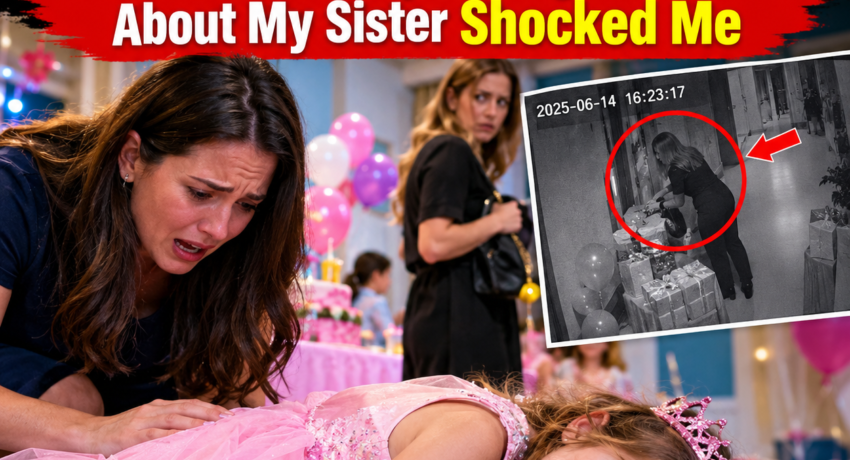
Thirty seconds before we lit her candles, my seven-year-old collapsed at her own birthday party. My sister told me not to overreact. She was the one who’d handed Lucy her drink. By the time my hands stopped shaking, our home security camera had already shown me the truth — she didn’t come back for her niece. She came back for the evidence.
PART 1
My seven-year-old daughter collapsed thirty seconds before we were supposed to sing “Happy Birthday,” and the first person who told me not to overreact was my younger sister.
My name is Colonel Allison Carter. Nearly twenty years in the United States Army, most of it in intelligence work. I know the difference between panic and observation the way other people know their own address.
None of that saved me when Lucy’s knees buckled beside her own birthday cake.
I caught her before her skull hit the hardwood. Her body was wrong in my arms. Loose. Heavy in a way a laughing seven-year-old should never be. Ninety seconds earlier she’d been shrieking with delight under a ceiling of lavender balloons.
“Lucy. Look at me. Lucy.”
My sister Vanessa didn’t move.
Everyone else did. My mother lunged forward. Guests yanked their kids back like the floor was on fire. Someone was already shouting into a phone, 911, my address, hurry. Vanessa stood by the glass lemonade dispenser with her hands folded, still as a photograph.
Then her mouth curved. Just slightly. Just enough.
“Allison. Don’t turn this into another emergency before we even know what’s wrong. Kids get tired at parties.”
I’d heard some version of that line for eighteen months.
You see threats everywhere. The Army wired you to distrust everyone. You go cold and controlling the second someone disagrees with you.
I’d gotten it every time I asked about Whitaker Foodservice Supply — the company our grandfather Charles built out of one Richmond warehouse into six states of restaurant and school-cafeteria contracts. After he died, the trust split ownership three ways: my mother, Vanessa, me. I was still in uniform, so Vanessa and her husband, Colin Doyle, ran the place day to day.
For eighteen months I’d asked why construction bills ran high, why vendor rebates disappeared sideways, why a six-figure “consulting fee” kept showing up with no consultant attached.
Paranoia, Vanessa called it.
Deployment stress, Colin called it.
My mother just wanted the noise to stop.
Michael shoved through the crowd still in his county emergency-management polo, eleven years in response work, five of them as a flight nurse before a desk took him. One look at Lucy and his whole face changed.
“What did she eat?”
“Cake. Strawberries. Nothing new.”
“What did she drink?”
I pointed at the pink insulated cup with the silver unicorn.
He picked it up like it was armed.
“Who made this?”
Silence. I looked at Vanessa.
“She made the lemonade. She brought Lucy that cup herself.”
Vanessa’s spine went rigid.
“Because she’s my niece. Because it’s her birthday.”
Michael set the cup somewhere no one could reach it.
“Nobody touches this until the paramedics get here.”
And there it was — the detail my brain had already flagged and filed, the way it used to flag a name that shouldn’t have been on a manifest.
Vanessa hadn’t filled that cup from the dispenser everyone else had used all afternoon.
She’d carried it in already full. From the kitchen. Where no one had been watching.
The paramedics lifted Lucy onto the stretcher four minutes later. Vanessa caught my arm before I could climb in after her.
“If you start accusing people, you could destroy this family.”
I pulled free.
She hadn’t asked if my daughter was going to live.
She’d asked what the truth might cost her.
PART 2
The pediatric ER smelled like antiseptic and burnt coffee, and I sat in a molded plastic chair memorizing every word the attending said, the way I used to debrief a source I didn’t fully trust.
“Elevated heart rate. Slowed reflexes. We’re running a full tox panel, but Colonel Carter — I’ll be straight with you. This isn’t exhaustion.”
Michael stood at the foot of the bed, arms crossed, watching the monitor instead of me. I knew that posture. It was the one he used at work right before he delivered something worse.
“How fast does prelim come back?”
“An hour. Maybe less.”
I nodded and made myself go still. Not calm. Still. There’s a difference, and only one of them is useful. Panic doesn’t gather intelligence. Stillness does.
So I gathered.
Fact: Vanessa filled that cup somewhere I couldn’t watch her do it.
Fact: in thirty minutes, she never once asked if Lucy would be all right.
Fact: for eighteen months, she and Colin had sat on every financial document that moved through Whitaker Foodservice Supply, and every time I pulled a thread, someone in my own family cut it.
I didn’t know yet how those facts connected. I knew, with the same flat certainty I used to feel reading a compromised comms log, that they did.
My mother arrived twenty minutes later, mascara running, asking is she going to be okay four different ways without once asking what had happened to her.
“Mom. Did you see Vanessa fill that cup?”
“Allison. Please. Not now.”
“That’s not an answer.”
“Your sister loves that little girl.”
She hadn’t answered the question. I noted that too.
Michael found me at the vending machines an hour later, two coffees in hand.
“Something about tonight doesn’t add up.”
“I know.”
“You’ve got that look.”
“What look.”
“The one before you tell me you’re going somewhere I can’t follow.”
“I’m not going anywhere. I’m going to find out exactly what happened in my own house tonight. Quietly. With proof. Before I say one accusing word to anyone.”
“You think Vanessa did this to her.”
“I think my sister filled a cup where no one could see her, felt nothing when it mattered, and told me not to overreact before we had a single fact between us. That’s not proof. That’s a reason to look.”
Michael didn’t argue. He’d spent five years flying trauma patients out of car wrecks and farm accidents, and he knew the same thing I did — that the people closest to a scene almost never look the way you expect them to look, and the ones who look wrong almost always are.
“Look where?”
The four cameras Michael had bolted around the house after a run of break-ins. All four had stayed on. Nobody had killed the system for the party.
“The cameras,” I said. “Every angle. Tonight.”
His jaw locked.
“Then let’s see what they caught.”
PART 3
I called Grace Kowalski next door — retired county IT, the one who’d helped Michael wire the whole system — and asked her to pull footage remotely. She didn’t ask why. She just said, “Ten minutes,” in the voice people use when they can already tell it isn’t a small favor.
A nurse came out while we waited. Lucy was stable. Sedated. Moving to a monitored room overnight. Better vitals. Still no ID on what she’d swallowed.
I took Grace’s call in the hallway so Michael could stay with Lucy.
“Backyard camera, six-forty,” Grace said. “That’s the party.”
Thirty minutes of my daughter’s birthday, scrubbed down to a timeline. Balloons. Cake. My mother laughing at nothing. Vanessa weaving through guests with a plate of appetizers, smiling at everyone.
Then, at 7:52 p.m. — eleven minutes after I remembered the ambulance pulling out of my driveway — a shape stepped through the side gate.
Vanessa.
She wasn’t supposed to be there. I’d assumed she’d followed us to the hospital.
She walked straight to the folding table. No glancing around. No hesitation. She moved like she was retracing her own footprints in the dark.
She picked up the glass lemonade dispenser with both hands.
Set it inside a canvas grocery bag.
Reached into her purse. Pulled out a small plastic bottle.
Dropped that in too.
The whole thing took under ninety seconds. She was gone before the clip ended.
“Allison.” Grace’s voice went careful. “You want me to send this, or do you want me to call somebody?”
“Send it. Don’t delete anything on your end. Not one file.”
Here was the part that should have felt like relief and instead felt like the floor dropping an inch under my chair.
Vanessa had come back for the dispenser. For the bottle.
Not the cup.
Because the cup was already gone. Michael had bagged it the instant he suspected something, kept it out of every hand in that yard, and it had ridden to the hospital strapped in beside our daughter.
Vanessa didn’t know that.
She’d walked eleven minutes back into a house full of shocked guests to erase evidence that no longer mattered, because the evidence that did matter was already under fluorescent lights at a lab thirty minutes away.
I watched those eleven seconds four times. My sister’s hands closing around that bottle like she’d rehearsed the motion in a mirror.
Whatever she’d put in that cup, she’d needed it gone.
Which meant this wasn’t an accident.
And something told me — cold, immediate, the way it does right before an operation goes sideways — that it wasn’t the first time she’d planned something like it either.
PART 4
Prelim tox came back at 5:40 the next morning, while Lucy slept with a monitor clipped to her finger, its green pulse the only thing keeping me upright in a plastic chair.
Diphenhydramine. A children’s sedating antihistamine, in the cup residue at a concentration well past anything you’d give a seven-year-old for allergies.
“In a healthy kid, this dose would’ve made her drowsy, maybe sick to her stomach,” the attending said. “But your daughter has a minor cardiac conduction issue nobody had caught — the kind that only shows on an EKG if you’re specifically hunting for it. That dose, on top of that heart, is why she dropped the way she did. She’s going to be fine. But this was not a normal reaction, and it was not an accident of quantity. Someone measured wrong, or measured on purpose.”
“Are you required to report it?”
“Given the substance, the dose, a minor — yes. Henrico PD’s already notified. A detective’s coming today.”
I didn’t cry. Michael looked at me the way you look at someone you’ve decided, in that exact second, you’re a little afraid of.
At eight, before the detective even arrived, my phone rang. Priya Chandran — the forensic accountant I’d quietly hired three months earlier after my family stonewalled me one time too many.
No hello.
“Allison, someone broke into my car last night. My laptop bag’s gone. The physical backups I kept separate on purpose — gone too.”
My stomach fell through the floor.
“When?”
“Six to nine p.m. I was at my daughter’s soccer practice. Nobody knew I had those files except you and me.”
I thought of Vanessa’s hands on that bottle.
Not the folder. The dispenser. But someone had known enough to hit Priya’s car the exact night my daughter went down at a party my sister had personally staffed.
“Send me anything you’ve still got. Tonight.”
“There’s something else,” Priya said. “Colin called an hour ago. He wants Monday’s trustee meeting moved up. To this afternoon.”
The meeting where I was finally going to lay eighteen months of discrepancies on a table, in front of the whole board, so nobody could call it paranoia again.
Moved up four days. The same morning my daughter lay wired to a monitor and my accountant’s backups had vanished from a parking lot.
“For everyone’s convenience,” Priya said, reading my silence. “That’s the phrase he used.”
I stared through the glass at Lucy — small, tubed, seven years old — and felt something in me go quiet and very, very focused. The way it used to right before an operation stopped being a theory.
Someone had wanted me too shattered to walk into that room today.
Someone had nearly gotten exactly what they wanted.
PART 5
Priya met me in the cafeteria at eleven with a laptop, two backup drives she’d kept at her sister’s “out of habit,” and the exact expression I used to see on analysts right before they told a commander something he didn’t want to hear.
“Three things,” she said. “Tell me if I’m seeing what I think I’m seeing.”
First: $340,000 over fourteen months, routed to Meridian Advisory Group for “strategic consulting.” Meridian’s address was a condo in Short Pump. Owner: Derek Doyle.
Colin’s brother. Who sells cars for a living and has never consulted on anything in his life.
Second: a warehouse renovation budgeted at $610,000, completed — per the county’s own permit filings — for $390,000. The remaining $220,000 paid out anyway, to a contractor with exactly one client on record.
Whitaker Foodservice Supply.
“Third thing,” Priya said, “is the one that made me call instead of email.”
A trust amendment. Full, unilateral authority for Vanessa “in the event of the primary trustee’s incapacitation.” Signed by my grandfather Charles.
Notarized eight months after he died.
I stared at that date until the numbers stopped being numbers.
“Priya. He died in March. This says November.”
“I checked the notary’s license three times. Active commission. And the signature on file doesn’t match three years of his tax filings.”
I sat back. Let it land.
Vanessa hadn’t just skimmed money for a year and a half. Sometime after our grandfather’s funeral — while I was still overseas and couldn’t contest a single document from six thousand miles away — someone had forged his signature onto a piece of paper that handed her authority she’d never legally held.
Every dismissal. Every you’re overreacting. Every meeting where my questions got smoothed flat like wet cement. All of it had been guarding that one forged page.
And today, with my daughter still tethered to a monitor two floors above us, they’d tried to move a vote up four days and erase the one outside record that could prove it.
“I’m going to be at that meeting,” I said.
Priya closed the laptop.
“There’s a fourth thing,” Priya said, before I could stand up. “Small, but it bothered me enough to check twice. Six weeks ago, Vanessa opened a personal account at a bank Whitaker doesn’t use — joint with no one, just her name — and she’s moved sixty-one thousand dollars into it since, in deposits kept just under the ten-thousand-dollar reporting threshold. That’s not sloppy bookkeeping. That’s someone who knows exactly where the line sits and is staying under it on purpose.”
I thought of her hands closing around that bottle on the security footage. Steady. Unhurried. A woman who had clearly rehearsed this kind of math long before my daughter’s birthday.
“You’ll need copies of everything. And Allison — the notary’s office confirmed something else this morning. Somebody requested a duplicate of that exact file two days ago.”
“Who.”
“Colin.”
PART 6
Vanessa came to my house that evening, not the hospital. That told me something on its own.
I found her on my porch, standing like she still had a key. She did.
“You didn’t come to the meeting.”
“I was with my daughter.”
“It happened anyway. Colin ran the vote.”
“I know. I got the minutes an hour ago.”
Something flickered across her face and was gone.
“Why did you fill Lucy’s cup in the kitchen instead of at the table, like everyone else?”
“Because I was being a good aunt.”
“Why did you come back after the ambulance left and take the dispenser?”
Silence.
“I was cleaning up.”
“At eight o’clock at night. Before anyone else came back to clean anything.”
“You’re doing this again.” Her voice climbed a register. “Turning one bad night into an interrogation. Lucy’s always had a sensitive stomach and you cannot let this family have one difficult evening without treating all of us like suspects.”
“I have the footage, Vanessa.”
Her mouth shut.
“I have Priya’s records. I have a trust amendment dated eight months after Grandpa died, with a signature that doesn’t match anything he ever signed while he was alive.”
Three seconds of nothing. I watched my sister decide something behind her eyes.
“You have no idea what you’re accusing me of.”
“Then tell me.”
“You weren’t here.” Her voice cracked — a crack I might have believed a year ago. “Not when Grandpa got sick. Not when this company needed someone to actually run it instead of question it from a bunker overseas. I built something. I kept four hundred people employed. And the second I make one decision you don’t like, you fly home and burn it to the ground.”
“I’m not asking about a decision. I’m asking about a forged signature and a drug in my daughter’s drink.”
“That’s not—”
“Say it.”
“I’m not doing this on your porch.”
She left. I didn’t chase her down the driveway. People rarely break in front of the person forcing them to.
I called Detective Marsh instead and gave her everything.
She was quiet a long moment.
“Colonel Carter,” she said finally, “I think it’s time we talked to your brother-in-law.”
PART 7
Colin sat for a formal interview two days later, lawyer present, after the financial crimes unit subpoenaed Meridian’s accounts and found exactly what I’d expected them to find.
I wasn’t in the room. Marsh gave me the outline that night. Later, once charges were filed, I read the full statement myself, and it did not get easier the second time.
It started three years earlier with Colin’s gambling. Sports books, then poker games where the stakes outran his paycheck fast. By the time our grandfather died, he owed close to two million dollars to people who don’t send polite reminders.
Vanessa found out four months after the funeral. Instead of leaving, she buried it — Whitaker’s accounts, the payments to Derek’s shell company, the padded warehouse invoices, all of it moved in pieces small enough that no casual read of the books would catch it.
Then the forged trust amendment. Me deployed. Our mother willing to sign whatever kept the peace. A notary Colin knew from a card table, paid to backdate the one document that gave Vanessa cover for every transaction they’d already made.
It worked for over a year.
Marsh showed me one exhibit from the interview herself, off the record, because she said I deserved to see it before it became a court document. A text thread between Colin and Vanessa from the week I flew home for good. Colin: She’s going to find the Meridian payments eventually. Vanessa: Not if there’s nothing left to find by the time she looks.
That message was sent four days before Lucy’s party.
Then I came home and wouldn’t stop asking questions.
Colin told Marsh the party was never supposed to put Lucy in a hospital bed. Vanessa wanted a distraction — something loud enough to keep me from walking into Monday’s meeting with the folder Priya had helped me build. Enough chaos to buy them time to finish scrubbing what was left before an outside audit could trace it.
She used an over-the-counter antihistamine parents give kids for allergies. Far more than a normal dose. Expecting drowsiness. An upset stomach. A canceled party.
Not a heart that stopped keeping its own rhythm.
She hadn’t known about Lucy’s heart.
Neither had any of us, until that night.
I sat with that longer than I sat with almost anything else in this — that my sister’s plan to protect a lie about money had become something that could have killed my daughter, and that in whatever calculation she’d run in her head, that had been the acceptable risk.
Every piece I’d gathered on instinct now had an explanation.
None of the explanations made me want to forgive a single one of them.
PART 8
The choice wasn’t hard to understand. It was hard to make, and I refused to let it be easy.
Vanessa faced felony charges — reckless endangerment of a child, evidence tampering. That was never negotiable, not for one second, not for anyone’s comfort. My daughter had nearly died on our living room floor while her aunt watched and smiled. I wasn’t trading that for anyone’s convenience.
The financial fraud was where my lawyer and the county prosecutor tried to build me an off-ramp. A quiet civil settlement. A negotiated repayment. Keep the worst of it out of the papers, they said, and Whitaker Foodservice Supply might survive — four hundred and twelve jobs, warehouse workers and drivers who’d never touched a shell company in their lives.
I understood the argument. I’d built my whole career around understanding exactly that kind of argument — the one where protecting an institution means burying what happened inside it.
I said no.
Full public exposure. Every charge filed openly, no sealed plea, no quiet settlement negotiated behind closed doors to spare the family name. I gave the local paper the trust amendment, the notary’s forged commission, the security footage, the toxicology report — every piece of it, on the record, under my own name.
My lawyer asked me, one more time, if I understood what that would cost.
I did. I said it out loud anyway, the way I’d been trained to name a price before I signed off on an operation.
Whitaker Foodservice Supply would not survive this intact. Contracts would cancel within the month. The company my grandfather built from one warehouse would very likely be sold off in pieces or shut down entirely, and most of those four hundred and twelve people would lose their jobs regardless of anything I did.
I chose the truth anyway.
Not because I didn’t grieve every one of those jobs. I did, and I still do. But protecting an institution my sister had already gutted from the inside, to spare her one more year of comfort, was just another version of the lie that almost killed my daughter — and I was done being the person who kept that lie standing.
PART 9
Vanessa was arrested eleven days after the party. Felony child endangerment. Evidence tampering. Her mugshot ran on the front page of the Richmond paper under a headline that used our grandfather’s name.
Colin pleaded guilty to wire fraud and forgery-related charges, cooperating fully in exchange for a reduced sentence that still put him behind bars for years, not months.
The forged trust amendment was voided by court order. The story of how it had been backdated, notarized, and used to strip an active-duty officer of any real say in her own family’s company ran in three regional outlets. A trade publication picked it up next. Then a local news segment.
Whitaker Foodservice Supply lost eleven of its fourteen largest contracts within six weeks. The board voted to liquidate rather than restructure. Three hundred and eighty of the four hundred and twelve jobs were gone by the following spring. I read every layoff notice. I made myself read every one.
My mother has not spoken to me since the arraignment.
She told a cousin at Thanksgiving — not me, a cousin, so it would find its way back to me exactly the way she intended — that I had destroyed this family for the sake of being right. She did not ask about Lucy’s heart. She did not ask what it had been like to watch her granddaughter’s eyes roll back at a birthday party. She asked why I couldn’t have handled it the way our family always handled things.
Quietly.
I called her once, the week the layoff notices went out, and got four rings and a voicemail I know she heard land. I left a message anyway. Told her the number of jobs lost, told her I hadn’t chosen it lightly, told her Lucy still asked sometimes if Grandma was coming to visit. She never called back. I stopped expecting her to somewhere around the second week, and I’ve made my peace with the version of my mother who chose a forged signature and a poisoned birthday cup over asking her granddaughter one honest question.
I’m not calling her again.
At a gas station in December, a woman I didn’t recognize walked up while I was pumping gas and told me my sister used to buy her kid’s Girl Scout cookies every year, and did I know what I’d done to this town. I said nothing. I got in my car and drove home, and I did not apologize, not to her, not to anyone, because the version of this story where I stayed quiet to keep people comfortable is the version that already almost cost me my daughter.
Lucy recovered fully. Her cardiologist confirmed the conduction issue is minor, manageable, nothing that changes how she gets to live her life. She knows she got sick at her party. She knows Aunt Vanessa did something wrong and isn’t allowed near her anymore. She does not know the rest, and I have decided she doesn’t need to, not at eight years old, maybe not for a long time.
PART 10
Lucy turned eight this past June.
We had the party in the backyard again, under a new string of paper lanterns, and I stood by the drink table the entire afternoon and poured every cup myself. Some habits don’t get unlearned. Some shouldn’t be.
Michael caught me watching the side gate at one point — the same gate the camera had caught eighteen months earlier.
“She’s not coming,” he said.
“I know.”
Lucy blew out her candles on the first try, laughing so hard she nearly missed one, and for the first time in over a year, the moment didn’t feel like a test I was running. It felt like a birthday.
That night, after the guests left, I found the pink unicorn cup at the back of Lucy’s cabinet — chipped now, two years old, a relic from a night I will never fully put down. I almost threw it out.
I didn’t. I washed it, dried it, and put it back on the shelf, where I can see it every time I open that cabinet, because forgetting what happened in my own house is not a comfort I’m willing to let myself have.
My grandfather built something out of one warehouse and an idea, and my sister burned it down from the inside to cover a debt she was too proud to admit. I didn’t save the company. I’m not sure, given the same choice again, that saving it would have been the right thing to do.
I saved the truth instead. Some nights, that’s the only version of winning I get.