Part 1 — “Maybe Next Time”
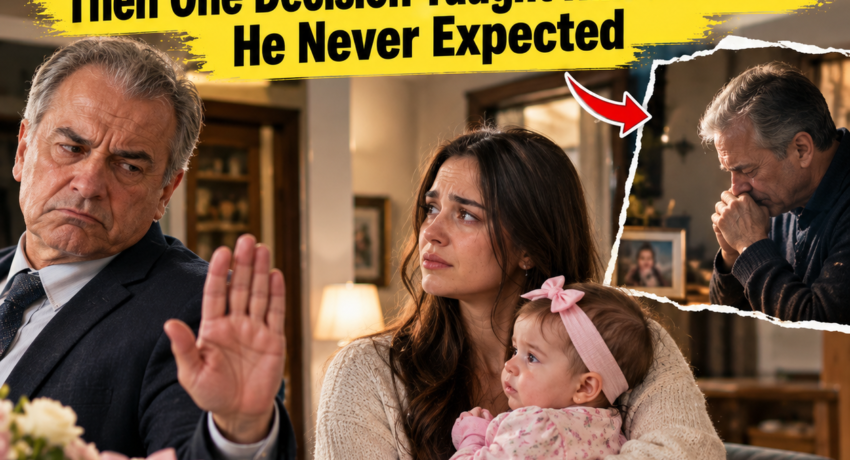
My father-in-law’s first words after seeing my newborn daughter were not congratulations.
They were not, “She’s beautiful.”
They were not even, “How are you feeling?”
He simply looked into the bassinet and said,
“Well… maybe next time.”
For a moment, I honestly thought I had misunderstood him.
I was exhausted after giving birth, my emotions were all over the place, and little Nora had only been in the world for a few hours. Maybe George had made some awkward joke that had landed badly.
But then I saw my husband Daniel’s face.
He had heard exactly what I had.
George stood beside the hospital bassinet for only a couple of seconds before turning away and lowering himself into the chair near the window.
Daniel glanced at me, then back at his father.
“Dad, don’t you want to hold her?”
George adjusted his jacket.
“Later.”
Daniel tried to smile.
“She’s your granddaughter.”
“I know.”
“So come meet her.”
George looked toward the bassinet without moving.
“I said later.”
But later never came.
He stayed in my hospital room for almost an hour.
He drank the coffee Daniel brought him. He complained about how difficult it had been to find parking. He asked whether the nurses were treating me well. He talked about work, traffic, the weather, and a dozen other things that suddenly seemed absurdly unimportant.
But he never walked back to Nora’s bassinet.
When he finally stood to leave, he hugged Daniel and kissed him on the cheek.
Then he walked out.
He never touched his granddaughter.
As the door closed behind him, I looked down at Nora sleeping peacefully beside me.
That was when I understood.
“Maybe next time” had not been a joke.
George had wanted a grandson.
And to him, my daughter was a disappointment.
Throughout my pregnancy, he had talked endlessly about “the boy.”
The grandson he would take fishing.
The grandson he would teach baseball.
The grandson who would supposedly inherit all the mysterious knowledge passed from father to son.
And above everything else, there was one phrase he repeated constantly:
“Someone has to carry on the family name.”
Daniel and I had decided not to find out whether we were having a boy or a girl.
Apparently, George had interpreted our decision as permission to assume that the baby must be male.
When Nora arrived instead, he behaved as though she had somehow failed to live up to an agreement no one else had made.
At first, I told myself he simply needed time.
Surely, once he saw her little face more often, he would soften.
Surely, once she smiled at him, he would forget all this nonsense about surnames and legacies.
Surely no grandfather could continue ignoring his own grandchild.
I was wrong.
For the next five months, George kept Nora at an emotional distance.
At family gatherings, he happily lifted my sister-in-law’s three-year-old son, Ethan, into his arms.
He bounced Ethan on his knee.
He carried him around the room.
He bragged about him to anyone willing to listen.
“There’s the future of the family,” he would say.
Or,
“There’s the one keeping our name alive.”
Meanwhile, Nora could be lying only a few feet away, and George barely acknowledged her existence.
One evening, after watching his father play with Ethan while completely ignoring Nora, Daniel finally confronted him.
“Dad, she’s your granddaughter too.”
George frowned.
“I know that.”
“Then maybe start acting like it.”
George gave a dismissive shrug.
“I’m not saying she isn’t my granddaughter. I’m saying having a grandson is different.”
I came to hate that sentence.
A grandson is different.
Different enough to deserve affection?
Different enough to deserve pride?
Different enough that my daughter could simply be treated like a consolation prize?
Still, I remained quiet more often than I wanted to.
Partly for Daniel.
Partly for Helen, my mother-in-law, who clearly hated the tension.
And partly because I kept hoping George would eventually realize how foolish he was being.
Then came Nora’s baptism.
And whatever patience I had left disappeared.
Part 2 — The Empty Space in the Photograph
After the ceremony, both families gathered in the church hall.
There was food, cake, flowers, and the usual chaos of relatives trying to take pictures before the baby started crying.
Nora had behaved beautifully through the ceremony and was sleeping against my chest while everyone gathered around us.
My parents held her.
Helen held her.
Aunts, uncles, cousins, and family friends all took turns admiring her.
Everyone except George.
When the photographer announced that it was time for the grandparents’ picture, Helen came to stand beside me.
George remained seated at one of the tables.
Helen looked toward him.
“George, come on. Get in the picture.”
He didn’t move.
“George,” she repeated. “At least hold Nora for one photograph.”
He crossed his arms.
Then, loudly enough for several nearby relatives to hear, he said,
“I’ll wait until there’s a real one.”
The room seemed to shrink around me.
Daniel’s face turned crimson.
Helen looked horrified.
“George!”
But I barely heard her.
I looked down at my sleeping daughter.
Nora knew nothing about surnames.
Nothing about family pride.
Nothing about the expectations an older man had placed on a baby before she was even born.
She simply slept against me, warm and trusting.
And her grandfather had just announced, in a crowded room, that she did not count.
Something inside me became very calm.
I turned toward the photographer.
“Take the picture without him.”
George finally looked up.
“What?”
“You heard me.”
“Christina, don’t be ridiculous.”
I faced him.
“You said you’re waiting for your real grandchild. So I won’t force you into a photograph with the one you apparently don’t consider real.”
The room went silent.
George gave a short laugh.
There was no humor in it.
“You’re excluding me from a family picture because of one joke?”
“Jokes are supposed to make people laugh.”
He opened his mouth, but I turned away.
I stood beside Helen.
Daniel moved closer.
And the photographer raised the camera.
“Go ahead,” I said.
The flash went off.
George was not in the picture.
Strangely, that seemed to affect him more than being absent from Nora’s life had affected him for the previous five months.
Three days later, Helen called me.
“George is upset.”
I nearly laughed.
“About the photographs?”
“Yes. Partly.”
“Partly?”
She hesitated.
“He also wanted to know why Nora didn’t wear the christening gown.”
I knew exactly which gown she meant.
George kept an old cream-colored baptism gown inside a cedar box. I had seen photographs of Daniel wearing it as a baby.
George always called it “the family gown.”
“I didn’t know he expected us to use it,” I said.
“He assumed Daniel would want Nora baptized in it.”
That irritated me more than I expected.
“So he won’t even hold her because she’s a girl, but he’s offended that we didn’t dress her in his precious family gown?”
Helen was quiet.
Then she said something unexpected.
“Christina… it isn’t his family gown.”
I paused.
“What do you mean?”
“It belonged to my family.”
That evening, Helen arrived at our house carrying the cedar box.
Inside was the delicate gown, carefully wrapped in old tissue paper.
Beneath it was a thick leather-bound photo album.
“My grandmother made this gown,” Helen explained. “My mother wore it when she was baptized. I wore it too. After Daniel was born and wore it, George simply started referring to it as ‘the family gown.’”
Daniel shook his head.
“That sounds like Dad.”
I smiled faintly.
At that point, it seemed like little more than another example of George claiming family traditions as his own.
Then I opened the photo album.
And everything changed.
Part 3 — The Name George Had Before
The album contained generations of family photographs.
Black-and-white portraits.
Faded baptism pictures.
Children standing stiffly beside parents and grandparents.
Handwritten names and dates filled the pages.
Near the back, I found an old photograph of a young boy.
He looked about seven.
His hair was neatly combed, and he stood beside a woman I didn’t recognize with an expression far too serious for such a young child.
But I recognized his face immediately.
It was George.
Under the photograph, someone had written his full name and age.
I read it once.
Then again.
Then a third time.
The first name was correct.
George.
But the surname was not Daniel’s surname.
It was not our family name at all.
“Daniel?”
He leaned over my shoulder.
The moment he read the inscription, his expression changed.
“Mom?”
Helen looked at the photograph.
She became very still.
After several seconds, she sat down.
“That was your father’s original surname.”
Daniel frowned.
“I knew Grandpa Thomas adopted Dad. But I never knew Dad had a different surname before that.”
Helen nodded.
“George’s biological father left when George was very young. He was only four. Years later, his mother married Thomas.”
She gently touched the old photograph.
“Thomas raised George as his own. When George was twelve, the adoption became official, and George took Thomas’s surname.”
Daniel stared at the page.
“So Dad wasn’t born with the family name he’s always talking about.”
“No.”
“Why has he never told us?”
Helen sighed.
“Your father hated talking about the years before Thomas adopted him. He rarely showed anyone photographs from that time.”
“Why?”
“I think because he never wanted to feel like an outsider again.”
For the first time since Nora’s birth, I saw George’s obsession differently.
I thought about his constant speeches about family tradition.
His pride in the surname.
His fixation on boys who would supposedly keep that surname alive.
Until that moment, I had assumed it was simple old-fashioned sexism.
Maybe part of it was.
But suddenly I saw something else.
Perhaps George clung so tightly to the family name because there had once been a time when he didn’t have it.
Maybe twelve-year-old George had believed that taking Thomas’s name finally made him belong somewhere.
Maybe every time adult George spoke proudly about “our family name,” some frightened little boy inside him was still trying to prove that he had earned his place.
For one brief moment, I felt something close to sympathy.
It did not excuse the way he had treated Nora.
But perhaps it explained part of it.
Then Helen reached for the album.
As she lifted one page, an old folded piece of paper slipped onto the table.
She stared at it.
Daniel picked it up.
“What’s this?”
Helen carefully unfolded it.
The paper was yellow with age, covered in faded handwriting.
Her eyes widened.
“That’s Thomas’s handwriting.”
Daniel read the letter first.
Then he handed it to me.
It was short.
But two sentences changed everything.
Thomas had written the letter shortly before George’s adoption became official.
In it, he explained that George had already been his son long before the legal paperwork gave them the same surname.
The adoption certificate, Thomas wrote, would merely confirm what their hearts and their household already knew.
I looked up.
“He wrote this about George?”
Helen nodded.
“Thomas loved him completely.”
She smiled sadly.
“George kept that letter for years. After Thomas passed away, he placed it in this album. I don’t think he has looked at it in a very long time.”
I stared down at the words.
The irony was almost painful.
George had not grown up learning that blood determined family.
His own life proved the opposite.
The surname he was so desperate for a grandson to preserve had been given to him by a man who had looked at a child with different blood and a different name and said:
You are mine anyway.
Thomas had given George unconditional belonging.
And decades later, George had turned that beautiful gift into a standard my daughter could never satisfy.
Daniel watched my expression.
“What are you thinking?”
I carefully folded the letter again.
“I’m thinking your father needs to remember where his precious family name came from.”
Part 4 — The Question George Couldn’t Answer
The opportunity arrived the following Sunday.
Helen invited everyone to lunch.
George barely acknowledged me when we arrived.
He was still angry about the baptism photographs.
For most of the meal, no one mentioned what had happened.
Then, after dessert, George finally put down his cup and said,
“I hope you’re pleased with yourself.”
Daniel immediately stiffened.
“Dad.”
George ignored him.
“Apparently, I’m no longer important enough to be included in family photographs.”
I looked across the table.
“You weren’t excluded because you didn’t matter.”
“Could have fooled me.”
“You were left out because you refused to treat Nora as if she mattered.”
He frowned.
“I never said that.”
“You said you were waiting for your ‘real’ grandchild while your granddaughter was sleeping in my arms.”
George sighed impatiently.
“We’re still talking about this?”
“Yes.”
I kept my voice calm.
“Because apparently I still don’t understand. So explain it to me.”
He leaned back.
“A grandson carries on the family name.”
I reached beside my chair.
Then I placed the old leather photo album on the table.
The instant George saw it, his entire expression changed.
“Where did you get that?”
“Helen brought it to our house.”
His eyes went to his wife.
Then back to the album.
I opened it to the photograph of seven-year-old George.
My sister-in-law leaned forward.
“Wait. Why does Dad have a different last name there?”
George’s jaw tightened.
He looked at Helen.
“You told them?”
Helen answered quietly.
“They’re your children, George.”
I turned the album toward him.
“You’ve spent months telling us how important it is that Nora probably won’t carry the family surname.”
He said nothing.
“So I have one question.”
I touched the photograph.
“Were you born with that surname?”
His cheeks reddened.
“That was different.”
“How?”
“My father gave me his name.”
I held his gaze.
“Exactly.”
The table became completely silent.
Then I removed Thomas’s old letter from the album.
George froze.
All the anger vanished from his face.
He recognized the folded paper before I even placed it in front of him.
“Where did you find that?”
“In the album.”
His hand moved toward it and stopped halfway.
Finally, he touched the paper with his fingertips.
His thumb passed over Thomas’s signature.
For several seconds, George seemed to forget anyone else was in the room.
The angry grandfather disappeared.
What remained looked strangely like the little boy in the photograph.
I asked quietly,
“Was Thomas your real father?”
George immediately looked up.
“Of course he was.”
“But you weren’t biologically related.”
His chair shifted sharply.
“Don’t compare the two situations.”
“Why not?”
“Because Thomas was my father.”
“What made him your father?”
George stared at me.
“He raised me.”
I waited.
“He was there.”
I said nothing.
George’s voice became quieter.
“He chose me.”
There it was.
The answer.
I nodded.
“Exactly. He didn’t become your real father because you shared blood. You didn’t.”
George looked down at the letter.
“He became your father because he chose to love you as his son.”
No one at the table moved.
“So when you stood at Nora’s baptism and said you were waiting for your ‘real’ grandchild, what did you mean?”
George opened his mouth.
Then closed it again.
For once, he had no answer.
I continued.
“Thomas looked at a child who didn’t have his blood and didn’t have his surname and decided none of that mattered.”
George’s eyes remained fixed on the letter.
“He gave you his name because you were already his son. The name didn’t create the family. The love came first.”
I glanced toward Nora.
“And yet my daughter was born with your blood. She is your son’s child. She is unquestionably part of this family.”
My throat tightened.
“And somehow that still wasn’t enough for you because she was born a girl.”
George finally whispered,
“I never said she wasn’t enough.”
“You didn’t need to.”
He flinched.
Then, after a long silence, he said the words I had been waiting five months to hear.
“I was wrong.”
Nobody rushed to comfort him.
Nobody told him it was fine.
Because it wasn’t fine.
Then Nora began fussing in Daniel’s arms.
George turned toward the sound.
And for what felt like the first time since she had been born, he really looked at her.
He slowly stood.
Then he held out his arms.
“Can I hold her?”
Five months earlier, I would have cried with relief.
Now I shook my head.
“No.”
His hands slowly dropped.
“I thought that was what you wanted.”
“I wanted you to want her.”
“I do.”
“Today you do.”
The words hurt him.
I could see that.
But they needed to.
Not because I wanted revenge.
Because Nora was too young to defend herself.
And until she could, that was my job.
“You don’t get to reject her for five months,” I said quietly, “realize you were wrong for five minutes, and expect everyone to pretend it never happened.”
George looked at Nora again.
“What am I supposed to do?”
“Be her grandfather.”
“I just tried.”
“No.”
I shook my head.
“You tried to hold her. That isn’t the same thing.”
George sat back down.
For the first time I could remember, he did not argue.
Part 5 — Earning His Way Back
The following week, George called Daniel.
He didn’t ask whether I was still angry.
He didn’t complain about the family lunch.
Instead, he asked a surprisingly ordinary question.
“What size diapers does Nora wear?”
The next afternoon, he arrived with a box.
He put it beside the front door.
“Thought you might need these.”
“Thank you,” I said.
He didn’t ask to hold Nora.
He stayed for ten minutes.
Then he left.
The following week, he returned with a children’s book.
“This used to be Daniel’s favorite,” he said.
He sat at the far end of the couch while Nora lay in her little seat nearby.
Then he opened the book and began reading.
His voice was stiff at first.
But gradually, it softened.
Nora kicked her legs whenever he changed his voice for one of the characters.
George noticed.
He smiled.
He finished the story, closed the book, and went home.
Again, he never asked to hold her.
Something had changed.
Not dramatically.
Not magically.
But genuinely.
At Helen’s birthday dinner, Ethan ran straight toward George as usual.
George laughed and lifted him into his arms.
A relative smiled.
“There’s the little heir.”
Five months earlier, George would have loved the comment.
He might even have been the one who said it.
This time his smile disappeared.
He shook his head.
“He’s Ethan.”
The relative blinked.
George looked across the room toward Nora.
“And she’s Nora.”
Then he added,
“That’s enough.”
Conversation moved on.
Nobody treated the moment as important.
But I did.
Later that evening, George walked over to Nora.
He crouched beside her chair.
“Hello, Nora.”
Nothing about the family name.
Nothing about heirs.
Nothing about boys.
Just Nora.
Over the next several weeks, he kept showing up.
He brought formula once.
Another time, he brought a ridiculous stuffed rabbit that was almost as big as she was.
He learned which songs made her quiet.
He discovered that she laughed whenever someone pretended to sneeze.
One afternoon, while George was visiting, I went into the kitchen.
When I returned, he was sitting cross-legged on our living-room rug.
He was making the most ridiculous faces I had ever seen.
Nora was laughing so hard she had started hiccupping.
George laughed with her.
Then she reached forward and wrapped her tiny hand around his finger.
George became completely still.
He looked down at her hand.
Then he looked at me.
He did not reach for her.
He did not assume.
He waited.
And in that moment, I remembered everything.
The hospital room.
“Maybe next time.”
Daniel asking him twice to hold his granddaughter.
George refusing both times.
The baptism.
“I’ll wait for the real one.”
The empty place beside Helen in the photograph.
Then I thought of Thomas.
A man who had understood decades earlier what George had almost forgotten.
Family is not something a surname creates.
It is something people choose every day.
George looked back at Nora.
His expression changed.
“I’m sorry,” he whispered.
But he wasn’t speaking to me.
He was speaking to her.
I watched him for a moment.
Then I walked across the room.
“Do you want to hold her?”
George slowly looked up.
There was no entitlement in his face this time.
“Only if you’re comfortable with it.”
I lifted Nora.
Then I carefully placed her into her grandfather’s arms.
George held her as though someone had entrusted him with something unbelievably precious.
Maybe, finally, he understood that they had.
Nora immediately grabbed a fistful of his shirt.
George laughed.
Daniel quietly reached for his phone.
Click.
George looked toward him.
“Send me that one.”
Daniel smiled.
“I will.”
And he did.
Part 6 — What Family Really Means
George never asked us to recreate the baptism photograph.
I’m grateful for that.
There is still an empty space beside Helen in the original picture.
Some people might think we should replace it with a happier photograph now that things have changed.
I don’t.
That empty space belongs in Nora’s story.
It marks a moment when George made a choice.
And the photographs that came later mark all the different choices he made afterward.
Because love is not proven by standing in front of a camera and claiming the title of grandfather.
Love is proven by showing up.
By bringing diapers when nobody asked you to.
By reading an old children’s book from the opposite side of a couch.
By learning what makes a baby laugh.
By understanding that forgiveness is not something you are owed simply because you finally say you were wrong.
For months, I believed George needed to learn that a girl could carry a family legacy just as meaningfully as a boy.
Eventually, I realized that was not the lesson he needed most.
He needed to remember how he had entered that family himself.
Thomas had not waited for a son with the right blood.
He had not waited for a boy born with his surname.
He had looked at George—a child who desperately needed to know he belonged—and chosen him.
The surname came afterward.
The family came first.
Somewhere along the way, George had reversed the lesson.
He had begun treating the name as more important than the people carrying it.
Nora reminded him that he had been wrong.
My daughter should never have needed to prove that she deserved her grandfather’s love.
She should never have needed to earn a place she had possessed from the moment she was born.
And in the end, George finally understood something his own father had known all along.
Blood alone did not make Thomas his father.
A surname did not make George Nora’s grandfather either.
Choice did.
Thomas chose George.
And eventually, George chose Nora.
The difference was that after spending five months refusing to make that choice, I wasn’t going to let him pretend it had never happened.
He had to show us that he meant it.
He had to rebuild what he had damaged.
He had to earn his way into the relationship he had nearly thrown away.
And little by little, he did.
Not because Nora became the grandson he had once wanted.
But because he finally learned to see the granddaughter who had been right in front of him all along.