PART ONE — THE FACE I LEARNED TO HIDE
For twenty-three years, I believed one feature had the power to define my entire face—and, somehow, my entire worth.
It was not my eyes, even though people often said they were warm. It was not my smile, though Daniel swore it could brighten a room. It was not the laugh that escaped me whenever I forgot to be careful.
It was my nose.
By the age of twelve, I could recognize cruelty before anyone even finished saying it. The nicknames changed, but the message never did. Some children called me a witch. Others compared me to birds with long beaks. A few tried to be clever. Most were simply unkind.
I became skilled at pretending their words did not reach me. I walked through crowded hallways with my shoulders straight and my eyes fixed ahead. I learned not to react when laughter followed me. I learned which angle made my profile look smaller and which side of my face I should turn toward a camera.
Soon, those habits stopped feeling like choices. They became instincts.
Whenever friends gathered for a photograph, I volunteered to take it. When someone lifted a phone unexpectedly, I turned away before the picture could be captured. I avoided mirrors in bright light and studied them obsessively in dim rooms. I was always searching for proof that the cruel voices had been right.
People described me as quiet. Some assumed I was shy.
The truth was harder to admit: I was hiding in plain sight.
Then I met Daniel.
On our third date, we sat across from each other in a small restaurant with soft yellow lights. Every time he looked at me, I shifted my face slightly to the side. I had done it so often that I hardly noticed anymore.
Daniel noticed.
“You keep turning away,” he said gently.
Heat rushed into my cheeks. “I’m sorry.”
His brow furrowed. “Why are you apologizing?”
I gave a nervous laugh and pointed toward my nose. “Because you have to keep looking at this.”
For a moment, he seemed honestly confused.
“I wasn’t looking at your nose,” he said. “I was looking at your eyes.”
I smiled, but I did not believe him. “You don’t have to say that.”
“I’m not saying it to be polite.” He reached across the table and took my hand. “Cora, I think you’re beautiful.”
There was no hesitation in his voice. No pity. No performance. He meant every word.
That should have comforted me.
Instead, it frightened me, because believing him would have required me to question everything I had believed about myself for years. I wanted to trust his eyes, but the voices from my childhood were louder.
Daniel never stopped seeing beauty in me. I never stopped wondering how long it would take before he saw what I saw.
PART TWO — THE CHOICE I HAD WAITED YEARS TO MAKE
Over the years, I brought up cosmetic surgery more times than I could count. Sometimes I mentioned it casually while washing dishes. Sometimes I studied before-and-after photographs late at night and asked Daniel what he thought. Other times, after an unflattering picture or an old memory resurfaced, I spoke about it with a desperation I could not hide.
His answer was always steady.
“If this is truly what you want, I’ll stand beside you,” he would say. Then he would brush a strand of hair away from my face and add, “But I still hope you’ll eventually see yourself the way I do.”
I never did.
So I opened a savings account that belonged to one purpose only. Overtime pay went into it. Birthday money went into it. Tax refunds, small bonuses, and anything extra I could spare went into it. The amount grew slowly, but every deposit felt like a step toward freedom.
Daniel knew about the account. He never mocked me, argued with me, or tried to control my decision. He simply remained beside me, even when he wished I could understand that my face had never needed his permission to be worthy.
When I finally scheduled the procedure, I expected him to look disappointed. Instead, he kissed my forehead.
“I’ll be there when you wake up,” he promised.
And he was.
The last thing I remember before the anesthesia carried me under was Daniel smiling from beside the bed. The first thing I noticed when I opened my eyes again was his hand wrapped around mine.
“You’re safe,” he whispered. “I’m right here.”
My face felt heavy and tight beneath layers of bandages. My throat was dry, and even blinking seemed to require effort. When I tried to answer, only a weak sound came out.
Later, the surgeon visited before I was discharged. He told me the operation had gone as planned. There would be bruising and swelling, he explained, and I should not judge the final result too soon. The bandages would stay in place for a week, and the true healing would take months.
I nodded, relieved.
Daniel thanked the surgeon, helped me into a wheelchair, and held my hand as if letting go might cause the entire room to disappear.
During the drive home, he kept checking on me.
“Are you warm enough?”
“Do you need water?”
“Is the seat comfortable?”
After the sixth question, I smiled under the bandages. “You know you’re allowed to breathe, right?”
He tried to smile back. “I’m working on it.”
I assumed he was anxious because I had just undergone surgery. I thought his silence came from ordinary fear—the kind any loving husband might feel after watching his wife disappear behind operating-room doors.
I did not know he had already lived through a nightmare I knew nothing about.

PART THREE — A HOME WITHOUT REFLECTIONS
The first sign that something was wrong appeared before I even stepped inside.
As Daniel guided me from the car, I noticed the curtains in the living room were open. Through the window, the room looked strangely unfinished, as though someone had packed in a hurry.
He opened my door and reached for me. “Slowly.”
“I’m sore, not breakable,” I murmured.
“I know.” Still, he placed an arm around my shoulders and kept it there all the way to the front door.
The moment we entered, I stopped.
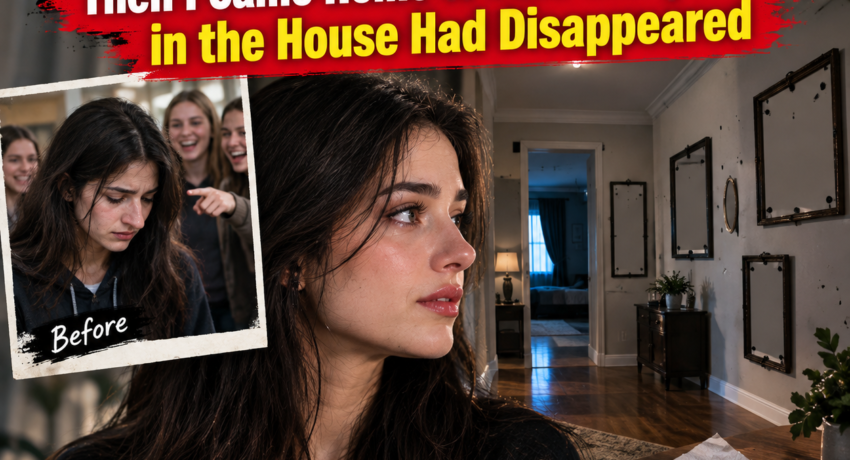
The large mirror above the fireplace was missing. Two metal hooks remained in the wall, bare and awkward.
I stared at the empty space. “Did you take that down?”
Daniel did not answer.
I looked toward the hallway. The narrow mirror that usually reflected the staircase was gone too.
A cold uneasiness began to gather inside me.
I walked toward the bathroom. The mirror above the sink had been removed. Even the mirrored door of the medicine cabinet was gone.
My pace quickened as I moved to the bedroom. The full-length mirror I had owned since college had vanished. On my dresser, the jewelry box with the glass lid had been replaced by a plain wooden one. When I pulled open the closet, I found white sheets taped carefully across the mirrored sliding doors.
Every reflective surface had either been removed or hidden.
I turned around.
Daniel stood in the doorway with his shoulders rigid and his face drained of color.
“Where are the mirrors?” I asked.
He looked at the floor. “I couldn’t leave them up.”
“Why not?”
His mouth opened, but no answer came.
I touched the bandages around my face. “The doctor already warned me about the swelling.”
“This isn’t about swelling.”
His voice broke on the final word.
My chest tightened. “Then what is it about?”
Daniel’s hands were trembling. I had seen him worried before. I had seen him tired, frustrated, and grieving. But I had never seen fear move through him like this.
“You can’t look at yourself yet,” he said.
A nervous laugh escaped me. “What does that mean?”
He took one step forward. Tears gathered in his eyes.
“I couldn’t let you go through it,” he whispered.
The room seemed to tilt beneath me.
Without thinking, I reached toward the edge of my bandages.
“No.” Daniel’s voice was sharp enough to make me freeze. He rushed toward me. “Please, Cora. Don’t.”
His panic turned my fear into certainty.
“Something happened,” I said. “Something went wrong.”
“No.”
“You told me I didn’t need the surgery.”
“I told you that you were already beautiful.”
Tears slipped beneath the bandages and stung my skin. “And you were right. I ruined my face.”
“You didn’t ruin anything.”
“Then why did you remove every mirror in the house?”
He said nothing.
In that silence, my imagination built its own answer. I pictured the surgeon hiding the truth. I pictured nurses smiling at me because they felt sorry for me. I imagined Daniel seeing whatever lay beneath the bandages and realizing that the face I had spent years trying to fix had become even harder to look at.
My knees weakened.
Daniel caught me before I hit the floor.
“I’m so sorry,” he whispered, holding me tightly.
I pressed my face against his chest and broke apart. “I just didn’t want to feel ugly anymore.”
His arms closed around me. “You never were.”
“Then tell me the truth.”
He shut his eyes. “I don’t know how.”
Before I could demand an answer, three hard knocks struck the front door.
PART FOUR — THE PEOPLE AT THE DOOR
Daniel flinched as if the sound had hit him physically.
Another knock followed, louder and more urgent.
He looked toward the hallway, then back at me. The fear on his face deepened.
“I need to answer that,” he said.
“Who is it?”
“I don’t know.”
The lie was obvious.
He walked toward the front door, and I followed despite his attempt to stop me.
When he opened it, a woman in a navy blazer stood on the porch beside a man wearing a hospital identification badge. Both looked shaken. The woman’s eyes moved from Daniel to me, and one hand rose to cover her mouth.
“Oh, thank goodness,” she breathed. Then her expression collapsed into guilt. “We are so sorry.”
The word sorry dropped into my stomach like a stone.
“What happened?” I asked.
The woman straightened, though her hands remained tightly clasped. “My name is Linda. I’m the patient services director at Green Valley Surgical Center. This is Mark, the supervisor of the recovery unit.”
Mark gave a strained nod.
Linda looked at Daniel before turning back to me. “We came because there was a serious mistake.”
My hand rose again toward my bandages. “With the surgery?”
“No,” she said quickly. “Your operation was successful.”
I stared at her. “The surgeon told me that.”
She blinked. “You were told?”
“Yes. So why is my husband acting as though something terrible happened?”
Daniel lowered his eyes.
Linda drew a slow breath. “Because something terrible did happen—but not to you.”
The room went silent.
Mark stepped forward. “When your husband came to the recovery area, another patient had just been brought in after a similar procedure. Your last names were very close, and for several minutes, the wrong chart was placed beside the wrong bed.”
Daniel closed his eyes.
Mark continued. “Mr. Daniel asked to see his wife. A nurse believed he was standing beside your bed.”
My pulse began to race. “Whose bed was it?”
Linda’s face tightened with pain. “Another woman who had undergone nasal surgery.”
She paused, choosing each word carefully.
“Her operation had involved severe complications. She was heavily bandaged, and there was significant trauma and swelling.”
I reached for Daniel’s arm. Beneath my fingers, he was shaking.
“I thought she was you,” he said.
His voice sounded far away.
“I walked into that room and saw her lying there. I kept waiting for someone to stop me. I kept expecting them to say I had the wrong patient.”
No one spoke.
“But nobody did,” he continued. “So I held her hand. I told her I loved her. I thought I was saying goodbye to my wife.”
Tears filled my eyes again, but this time they came for him.
“Daniel…”
He looked at me, and I saw the terror he had been trying to carry alone.
“I asked why you looked like that. They told me swelling was different for every person. I thought they were trying to protect me from the truth.”
Mark’s expression crumpled. “We were not trying to deceive you. We simply had not yet realized the identification error.”
“How long?” I asked.
“Less than four minutes,” Linda answered.
Daniel let out a hollow sound that was almost a laugh. “It felt longer than the rest of my life.”

PART FIVE — THE FOUR MINUTES THAT BROKE HIM
Daniel finally looked directly at me.
“When I left the hospital, I believed your whole world had been destroyed,” he said. “And I thought I had failed you.”
I shook my head, but he kept talking, as though the words had been trapped inside him since the moment he entered the wrong recovery room.
“I kept hearing what you said the night before surgery.”
The memory returned instantly.
We had been lying in the dark, both too anxious to sleep. My head rested against his shoulder, and I had asked the question I was almost too afraid to say aloud.
“What if it makes everything worse?”
Daniel had pulled me closer. “It won’t.”
“But what if it does? I’ve spent my whole life hiding from my own face. What if tomorrow gives me even more to hide from?”
I had laughed after saying it, pretending the fear was smaller than it was.
Daniel had known better.
Now he looked around our mirrorless bedroom.
“When I came home, all I could imagine was you walking through that door and seeing yourself,” he said. “I pictured you looking into the fireplace mirror. Then the hallway mirror. Then the bathroom. I imagined every cruel thing anyone had ever said to you returning all at once.”
His breathing became uneven.
“So I started taking the mirrors down.”
He pointed toward the empty wall. “That one first. Then the one in the hall. Then the bathroom cabinet. Then your full-length mirror.”
His voice weakened. “I carried them all into the garage. I covered the closet doors because they were too heavy to move. I even replaced your jewelry box.”
I stared at him, overwhelmed by the image of my usually calm husband tearing through the house, removing every reflection while believing he was preparing for the worst day of my life.
“What did you think would happen?” I asked softly.
Daniel covered his face with both hands.
“I thought that if I could keep you from seeing yourself, maybe I could give you one more day before the world hurt you again.”
The last of his control disappeared.
He folded toward me, and I caught him. Daniel—the man who stayed composed in every crisis, the man who had held me together through years of insecurity—began to sob against my shoulder.
“I couldn’t protect you,” he said. “I couldn’t fix it.”
I held him as tightly as he had held me minutes earlier.
“There was nothing for you to fix,” I whispered.
Linda wiped her eyes before explaining the rest. The staff had discovered the charting error almost immediately, but Daniel had already left the recovery room. They called him, but his phone was in his truck. By the time he returned, the staff had changed shifts. The nurse handling my discharge had not been involved in the confusion. She reviewed the correct chart, confirmed that I had been cleared, and released me to go home with my husband.
Only afterward did the hospital realize we had already left together.
“We came here as soon as we confirmed your address,” Linda said. “There will be a full investigation. What happened should never have happened.”
For a few seconds, no one moved.
Then I asked the question still trembling inside me.
“So my face is really okay?”
Linda’s expression softened. She opened the folder she was carrying.
“Your surgeon asked me to tell you that you are exactly where he expected you to be.”
I frowned.
“Swollen, bruised, and healing normally,” she clarified. “Nothing about your recovery is unusual.”
A small laugh escaped me—uneven, shaky, but real.
Daniel stared at me. “You’re laughing?”
“I think my body forgot how not to cry.”
To my surprise, he laughed too. It lasted only a moment before tears returned, but the sound changed the room.
Mark added that the surgeon still wanted me to avoid judging the result too soon. Healing required patience—not because anything was wrong, but because swelling could distort what I saw and give my old insecurities fresh material to use against me.
I looked at the empty hooks above the fireplace, the covered closet doors, and the plain wooden jewelry box. Then I looked at Daniel.
“You really removed every mirror?”
He sniffed and nodded. “Almost.”
“Almost?”
“I missed the toaster.”
For one confused second, I stared at him. Then I pictured Daniel standing in the kitchen, panicked by the thought that I might catch a warped reflection in the chrome.
I laughed so hard my face hurt.
Daniel started laughing with me. Linda smiled through her tears, and even Mark let out a quiet chuckle.
It was absurd. Heartbreaking. Tender. Completely irrational.
And it was one of the purest expressions of love I had ever seen.
PART SIX — THE FIRST REFLECTION
One week later, Daniel sat beside me in the surgeon’s office while the bandages were removed.
He held my hand so tightly that my fingers began to tingle.
“You’re cutting off my circulation,” I whispered.
He loosened his grip for two seconds, then tightened it again.
The surgeon smiled. “Are you ready?”
I looked at Daniel. He appeared more frightened than I felt.
For years, I had imagined this moment. In those fantasies, I had expected instant relief. I thought the bandages would fall away and the girl who had been mocked would vanish with them. I believed I would look into the mirror and finally become someone new.
But after everything that had happened, I no longer wanted a stranger’s face. I wanted to recognize myself without immediately searching for a reason to turn away.
“I’m ready,” I said.
The surgeon unwound each layer slowly. Cool air touched skin that had been hidden for days. When he finished, he lifted a small mirror and placed it in my hand.
Daniel immediately looked away.
I touched his arm. “You can look.”
He turned back carefully, as though he feared even hope might be dangerous.
I raised the mirror.
The woman staring back at me was still swollen. Faint bruises rested beneath her eyes. Her face was healing, unfinished, and not at all like the polished images I had studied online.
But she looked familiar.
That surprised me more than anything.
I had expected to search for perfection. Instead, I found myself noticing the softness in my eyes, the curve of my mouth, and the quiet strength in a face that had carried me through every cruel hallway, every avoided camera, every moment of shame, and every year of learning how to survive.
For the first time, I did not examine my reflection as though it were evidence in a trial.
I simply looked.
Then I lowered the mirror.
Daniel studied my expression. “Well?”
I smiled. “I think she’s going to be all right.”
He laughed through the tears gathering in his eyes. “I’ve been trying to tell her that for years.”
The surgery had changed the shape of my nose, but the moment that changed me most had happened before I ever saw the result. It had happened in a house stripped of mirrors, while my husband confessed that he had tried to protect my heart from a reflection that did not even belong to me.
I began to understand that no procedure could erase the past. Surgery could alter bone and cartilage. It could not automatically silence old voices or undo the years I had spent measuring my value by one part of my face.
That healing would require a different kind of courage.
PART SEVEN — WHEN THE MIRROR LOST ITS VOICE
Three months later, the house looked normal again.
The large mirror returned above the fireplace. The narrow one was rehung in the hallway. The medicine cabinet reflected our toothbrushes and half-empty bottles once more. Daniel removed the sheets from the closet doors, though he asked three times whether I was certain.
Life returned to its familiar shape.
I did not.
One afternoon, I ran into a woman I had known in high school while shopping for groceries. She stared for a second too long, then offered an awkward smile.
“I almost didn’t recognize you,” she said.
I understood what she meant. Years earlier, that sentence would have followed me home. I would have stood in front of a mirror, turning my face from side to side, wondering whether I finally looked acceptable. I would have analyzed her expression, searching for hidden judgment.
This time, I simply smiled.
“It’s good to see you,” I said, and continued down the aisle.
That evening, I was washing dishes when I caught my reflection in the kitchen window. For a moment, I saw the outline of my face against the dark glass.
But I did not focus on my nose.
I remembered Daniel carrying mirrors into the garage with tears streaming down his face. I remembered him covering the closet doors, replacing the jewelry box, and somehow overlooking the toaster. I remembered how completely he had believed that one reflection might destroy me—and how desperately he had tried to stand between me and that pain.
I had once thought love meant being told I was beautiful often enough to believe it.
Now I understood that love could also look like a frightened man dismantling an entire house because he refused to let the person he loved face heartbreak alone.
Daniel had never asked me to remain unchanged. He had supported my choice even when he wished I could see that my worth had never depended on it. And when he thought everything had gone wrong, his first instinct was not to mourn the face he had loved. It was to protect the woman behind it.
I still had difficult days. Sometimes I caught myself studying an old photograph or wondering how strangers saw me. Healing did not arrive in one perfect moment. It came gradually, through small decisions: staying in a picture instead of stepping behind the camera, meeting my own eyes in the mirror, and refusing to let a childhood insult become an adult truth.
I changed my nose.
But Daniel helped change the authority I had given my reflection.
For twenty-three years, I allowed one feature—and the people who mocked it—to speak louder than everything else about me.
Now, when I look in the mirror, I no longer ask whether my face deserves kindness.
I already know the answer.
And for the first time in my life, the reflection does not get the final word.