Part 1
“We took the treatment money for the cruise. You can handle Victor when you get back. We’re sick of taking care of him.”
That was the note my mother had left on the kitchen counter.
I read it twice because the first time, my mind refused to accept what the words meant.
I had just returned home to Norfolk after nine months away. As a Navy flight surgeon, most of those months had blurred together in punishing shifts, emergency transfers, sleepless nights, and a long medical-support mission at sea. Whenever exhaustion threatened to swallow me whole, I pictured home.
My old bedroom.
The kitchen that always smelled faintly of coffee in the mornings.
And Victor.
My stepfather had come into my life when I was eight years old, after my biological father died. He never tried to replace him. He never demanded that I call him Dad.
He simply stayed.
Through scraped knees, school dances, bad report cards, track meets, heartbreaks, and eventually my decision to join the Navy, Victor had been there with a quiet steadiness I had learned to rely on.
For months, I had imagined walking through the front door and hearing his familiar voice.
Instead, when I unlocked the house, I stepped into silence.
A cold, unnatural silence.
The air inside was so frigid that I could see a faint mist when I exhaled.
“Victor?”
No answer.
I dropped my duffel bag in the hallway.
“Victor!”
Still nothing.
A knot formed in my stomach as I hurried toward his bedroom.
The sight waiting for me stopped me cold.
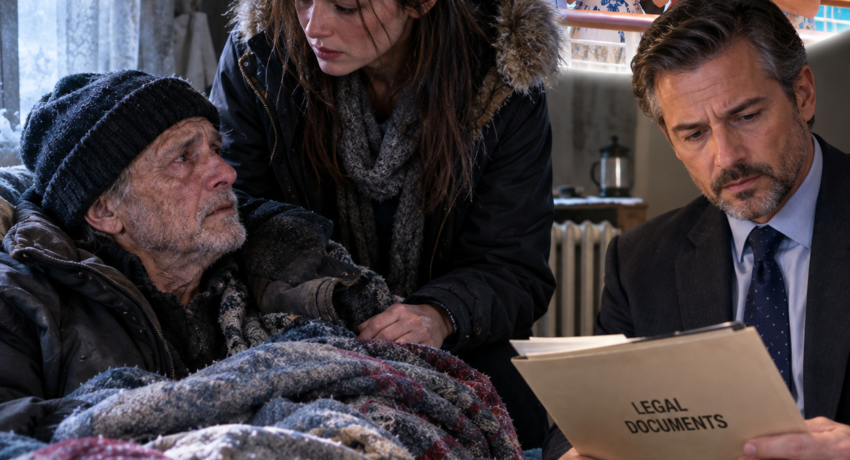
Victor was curled on his side beneath a thin, worn blanket, shivering so violently that the fabric trembled around him. His cheeks were hollow. His lips were dry and cracked. His clothes were soiled, and the room carried the stale odor of sickness, cold air, and neglect.
For one stunned second, the doctor in me and the daughter in me seemed to collide.
Victor had late-stage pancreatic cancer. Before I left, his condition had been serious but manageable with proper medication, nutrition, home-hospice support, and basic care.
Now he looked as though he had been abandoned for weeks.
I rushed to his side.
“Victor?”
His eyelids fluttered.
“Maya…”
His voice was barely more than breath.
“You’re home.”
Something inside me cracked at the relief in those three words.
I pulled the blanket higher around him before rushing to the thermostat. The heat had been turned almost completely off.
I turned it up.
Then I returned to Victor, helped him take several tiny sips of water, cleaned him as gently as I could, changed his bedding, and contacted his home-hospice team for immediate instructions.
While waiting for them to return my call, I searched the refrigerator.
There was almost nothing inside.
A few condiments.
Half a carton of expired milk.
Two eggs.
I eventually found a can of broth in the pantry and heated it on the stove.
When I returned with the cup, Victor managed only a few sips.
“Where is Mom?” I asked.
His eyes closed.
“A trip.”
“What trip?”
He didn’t answer.
That was when I saw the note.
It sat on the kitchen counter beneath a ceramic fruit bowl, written in my mother’s unmistakable handwriting.
We took the treatment money for the cruise.
You can handle Victor when you get back.
We’re sick of taking care of him.
I stood there for a long time with the paper in my hand.
My mother, Evelyn, along with my brother Mason and my sister Chloe, had gone on a luxury Caribbean cruise.
And they had paid for it with the family emergency fund.
The same fund into which I transferred a substantial portion of every Navy paycheck.
I had created that cushion for emergencies—for Victor’s prescriptions, groceries, home-care visits, utility bills, transportation to appointments.
Not cocktails.
Not casinos.
Not designer shopping.
My gaze shifted toward the tablet on the coffee table just as the screen lit up.
An Instagram notification appeared.
Mason was standing on the top deck of a cruise ship wearing expensive new sunglasses, one arm around his girlfriend and a drink in his other hand.
His caption read:
“Working hard to play harder. Living the life we deserve.”
My stomach tightened.
I opened the banking app on my phone.
The available balance was $14.12.
I stared at the number.
Then refreshed the screen.
$14.12.
“No.”
I opened the transaction history.
Cruise tickets.
Designer boutiques.
Premium drink packages.
Spa treatments.
ATM withdrawals.
Port excursions.
Casino charges.
The numbers blurred together.
In less than six days, they had spent nearly ten thousand dollars.
Ten thousand dollars that was supposed to keep a dying man comfortable.
My hands had begun to shake by the time I lowered my phone.
Then I noticed something else.
In the living room stood a glass display cabinet that Victor had treasured for as long as I could remember.
For years, it had contained mementos from his twenty-two years of service in the United States Marine Corps—medals, photographs, insignia, old unit patches, and small keepsakes that had followed him through decades of his life.
The cabinet was empty.
I walked back to his bedroom.
“Victor?”
His eyes opened.
“Where are your military decorations?”
A strange expression crossed his face.
Not anger.
Something emptier.
“Your mother sold them.”
I thought I had misheard him.
“She what?”
“Listed the shadow box online.”
His mouth twisted into a bitter smile.
“Said they were only old pieces of metal and she needed spending money for the excursions.”
I stared at him.
Those decorations had never been about money.
Victor rarely spoke about his years in uniform. He had never displayed those things to impress people. They were pieces of his history, reminders of friends, sacrifice, youth, and years that had shaped him.
And my mother had reduced all of it to spending cash.
Before I could answer, Victor suddenly doubled over.
A deep groan escaped him.
I rushed toward the nightstand.
His liquid morphine was there, prescribed for breakthrough pain.
I reached for the bottle.
Victor’s hand shot out and caught my wrist.
Even weak and trembling, his grip carried urgency.
“Don’t.”
“Victor, you’re in severe pain.”
“Don’t give me that.”
I looked at him.
“It’s your medication.”
His eyes filled with tears.
“No,” he whispered. “It isn’t.”
A chill unrelated to the cold house moved through me.
“What do you mean?”
He swallowed painfully.
“Evelyn poured the medicine out three days ago.”
I stopped breathing.
“She did what?”
“She emptied what was left.”
His voice broke.
“Then she filled the bottle with tap water.”
For a moment, the room seemed to tilt.
“Why?”
Victor looked away.
I had spent years working in medicine. I had witnessed fear, grief, anger, confusion, and families struggling under impossible circumstances.
But nothing in my training prepared me for his answer.
“She said the real refills cost too much for someone who was going to die anyway.”
The words hung in the room.
I looked at the prescription bottle in my hand.
Then at Victor.
My mother had not merely gone on vacation.
She had left a terminally ill man without proper care.
She had taken money intended for his treatment.
And someone had deliberately tampered with his prescription medication.
I placed the bottle down carefully, away from everything else.
I did not throw it away.
I did not pour it out.
I treated it exactly as I would treat evidence.
Because at that moment, I understood something with terrible clarity.
This was no longer simply a family betrayal.
It had become something much more serious.
And I had no idea yet that the bottle of water disguised as pain medication would eventually expose a secret powerful enough to tear my family apart.
Part 2
By morning, grief had been forced into a narrow corner of my mind.
Training took over.
I photographed everything.
Victor’s physical condition.
His bedroom.
The soiled linens.
The thermostat.
The nearly empty refrigerator.
The unpaid utility notices.
The bank statements.
The transaction history showing where the emergency money had gone.
Then I photographed the prescription bottle without touching it again.
Afterward, I called Victor’s lead oncologist, Dr. Vance.
I explained everything.
For several seconds after I finished, there was silence.
Then his voice became firm.
“Maya, leave that bottle exactly where it is. Do not dispose of it.”
“I won’t.”
“If Victor experiences another severe pain crisis, bring him directly to the hospital transport unit. We’ll document his condition officially from our end.”
“I understand.”
“And Maya?”
“Yes?”
“I’m sorry.”
Those two words almost broke through the professional wall I had built around myself.
“Thank you.”
Afterward, I spoke with our longtime neighbor, Mrs. Gable.
She had seen my mother, Mason, and Chloe leave several days earlier.
“They looked thrilled,” she told me, shaking her head. “Mason kept talking about how they were finally going to travel like rich people.”
“What did Mom say about Victor?”
Mrs. Gable’s face tightened.
“I asked her if someone was staying with him.”
“And?”
“She shrugged.”
Mrs. Gable hesitated before continuing.
“She said, ‘He’s sleeping. He doesn’t need anyone bothering him.’”
I closed my eyes.
Every new detail seemed to carve something out of me.
By afternoon, Victor had grown weaker.
His breathing became shallow, and even speaking exhausted him.
Eventually, he looked toward the bedroom door.
“Lock it.”
“What?”
“Close the door and lock it, Maya.”
I did.
When I turned back, he was watching me with an expression I could not read.
“There’s something your mother never knew.”
I pulled the chair closer.
At first, I assumed he meant debt.
Perhaps unpaid medical bills.
Some financial mistake he had been too proud to admit.
Instead, Victor pointed weakly toward the closet.
“Behind the winter coats.”
I pushed several coats aside and found an old leather briefcase tucked against the wall.
“Bring it here.”
I set it on the bed.
“Open it.”
Inside were legal documents.
Investment statements.
Property records.
Trust agreements.
Tax documents.
I looked from the papers to Victor.
“What is all this?”
“Years ago,” he said, pausing to catch his breath, “after I left the Marines, I eventually went into private wealth management.”
“I know.”
“What Evelyn doesn’t know is that I did very well.”
I frowned.
“She always said you lost most of it after retirement.”
“I let her believe that.”
I pulled out the first investment statement.
Then the second.
The numbers seemed impossible.
“Victor…”
He watched me silently.
“How much money is here?”
“A little over three million dollars.”
I stared at him.
“Three million?”
He nodded.
The money was not sitting carelessly in one bank account. Victor had accumulated assets over decades—diversified investments, commercial real-estate interests, and an irrevocable trust he had established years before marrying my mother.
His premarital agreement with Evelyn clearly separated the property they had owned before their marriage.
My mother had never controlled those assets.
She had never even known they still existed.
“Why would you hide this from her?”
Victor stared toward the window.
“Because after we married, I noticed something.”
“What?”
“When people thought I had money, they were attentive.”
He paused.
“Your mother. Mason. Even Chloe, sometimes.”
I stayed quiet.
“When I stopped talking about investments and let everyone believe the money was gone, things changed.”
His voice was tired, but steady.
“Phone calls got shorter. Visits became less frequent. Every favor became an inconvenience.”
My chest tightened.
“You were testing them?”
“Not exactly.”
He turned back toward me.
“I was watching.”
“For what?”
“To see who would stay.”
There was no triumph in his face.
No satisfaction that his suspicions had been proven correct.
Only sadness.
“The money wasn’t the test, Maya.”
He reached for my fingers.
“The test was whether anyone would bring me a glass of water when they thought I couldn’t pay them for it.”
His hand tightened weakly around mine.
“And you were the only one who came back.”
My eyes filled.
“I didn’t come back because of money.”
“I know.”
“I didn’t even know this existed.”
“I know that too.”
He closed his eyes briefly.
“That’s why I’m telling you.”
Later that afternoon, Victor’s estate attorney, Sarah Jenkins, arrived at the house with a notary. Dr. Vance also came to evaluate Victor’s condition.
Before anything was signed, Dr. Vance spoke with Victor privately and then formally documented that he was lucid, mentally competent, and fully understood the decisions he was making.
For nearly two hours, Sarah sat beside his bed.
She read every provision aloud.
Victor asked questions.
He made corrections.
He changed his estate plan carefully and deliberately.
Most of his assets would eventually support organizations serving homeless and terminally ill veterans.
A significant portion would remain in a private trust placed under my administration, along with a personal bequest to me.
My mother, Mason, and Chloe were removed from any voluntary inheritance or benefits.
Victor did not look happy while signing.
That was what I remember most.
People sometimes imagine revenge as something satisfying.
For Victor, it was anything but.
When Sarah asked one final time whether he was certain, he looked at the documents for several seconds.
Then he said quietly:
“I have no intention of rewarding people who waited for me to die so they could divide up a fortune they didn’t even know existed.”
That evening, I opened the family group chat.
I stared at the screen for a long time before typing.
“Victor’s condition has deteriorated sharply. The doctor believes he may not make it through the night. Please come home. This may be your last chance to say goodbye.”
Mason read it first.
Chloe opened it two minutes later.
My mother replied five minutes after that.
“Stop being dramatic, Maya. The cruise doesn’t dock until Tuesday.”
Mason added:
“You’re a doctor. Deal with it. That’s what you’re there for.”
Victor was awake.
I wished he hadn’t seen the messages.
But he did.
Something in his expression seemed to go still.
Until that moment, I think some small part of him had continued hoping they might return.
Not because of money.
Not because of guilt.
Simply because he was dying.
I pressed the video-call button.
My mother answered.
Bright sunlight flooded the screen.
Behind her, music pounded across the cruise deck. People laughed and danced. Glasses clinked.
“What do you want now, Maya?” she called over the noise.
“I want you to come home.”
She rolled her eyes.
“Victor is dying.”
For a fraction of a second, I searched her face for something.
Fear.
Regret.
Love.
Anything.
Her expression barely changed.
“Maya, we paid thousands for this vacation. We are not cutting it short because he decided to take a turn for the worse right now.”
My fingers tightened around the phone.
Then Mason appeared over her shoulder holding a margarita.
He grinned.
“Tell him to hold on until Tuesday!”
Someone nearby laughed.
Victor heard everything.
I turned toward him.
His eyes were open.
I reached for the button to end the call.
Before I could, my mother spoke again.
“And if he passes before we get back, just call the funeral home and handle it.”
Then, almost mockingly, she added:
“You’re the responsible one, aren’t you?”
The call ended.
The music vanished.
The bedroom fell completely silent.
Victor took a slow breath.
I could see the pain on his face, but this time it had nothing to do with cancer.
“Victor…”
“Save that recording.”
I looked at him.
“What?”
“The video.”
He pointed weakly toward the leather briefcase.
“Save it.”
I did.
Then Victor looked at me with a steadiness I had not seen in days.
“When they walk through that front door, Maya, they’re going to learn something.”
“What?”
He took another slow breath.
“The most expensive cruise of their lives didn’t cost ten thousand dollars.”
His eyes held mine.
“It cost them three million.”
Part 3
I stayed beside Victor all night.
I dragged an armchair close to the bed and curled beneath a blanket, though I barely slept.
Every so often, Victor opened his eyes.
Not to ask for medication.
Not to ask the time.
He simply looked toward me.
The first few times, I asked, “Do you need something?”
Eventually, I understood.
He was checking whether I was still there.
So each time his eyes opened, I reached out and touched his hand.
“I’m here.”
Around three in the morning, a strange little spark appeared in his face.
“Maya?”
“Yes?”
“Do you know how to make cinnamon apples?”
The question was so unexpected that I laughed through the exhaustion.
“Roughly.”
“Roughly?”
“I’m a doctor, not a chef.”
His mouth twitched.
“My mother made them when I was a boy in Ohio.”
“Is that what you want?”
He nodded.
So I went into the kitchen.
There was almost nothing in the house, but deep in the pantry I found a can of sliced apples.
I found cinnamon.
A little brown sugar.
Some butter.
I stood over the stove in the middle of the night, stirring canned apples in a scratched saucepan while the rest of the house remained silent.
The smell slowly filled the kitchen.
Warm sugar.
Butter.
Cinnamon.
For the first time since coming home, the house smelled alive.
I carried a small bowl back to Victor.
He managed two bites.
Then he smiled.
A genuine smile.
The first I had seen since I arrived.
“This is terrible,” he whispered.
I stared at him.
“You asked for cinnamon apples at three in the morning. Your standards are unreasonable.”
A faint laugh escaped him.
Then his expression softened.
“But it tastes like home.”
My throat tightened.
Victor lifted his left hand.
For as long as I could remember, he had worn the same old sterling-silver Marine Corps signet ring.
The metal was scratched and softened by forty years of wear.
With trembling fingers, he removed it.
Then he held out his hand.
“Maya.”
I opened my palm.
He placed the ring inside.
“They share your blood,” he whispered.
I knew exactly who he meant.
My mother.
Mason.
Chloe.
Then Victor closed my fingers around the ring.
“But you are my real daughter.”
Whatever composure remained inside me collapsed.
I bent beside the bed and cried against his arm.
Victor had never tried to replace my biological father.
He had never once demanded a title he believed had to be earned.
Instead, he had simply shown up.
He taught me how to drive in an empty supermarket parking lot, gripping the dashboard the first time I nearly jumped a curb.
He sat through every track meet, even when rain soaked through his jacket.
He waited outside in bitter cold for almost four hours when I took my Navy commission examination because he refused to leave until he knew how it went.
And when my mother complained that joining the military was “unbecoming for a young woman,” Victor always gave the same answer.
“Leave her be, Evelyn. If she wants to fly high, let her fly.”
I held his hand.
“I love you, Dad.”
The word came naturally.
Dad.
After all those years, it finally belonged to him.
Victor’s eyes closed.
A peaceful smile touched his face.
It was the first time I had ever called him Dad.
And it was the last.
He died shortly before dawn.
There was no dramatic final struggle.
No great speech.
His breathing simply became slower.
Then quieter.
Then stopped.
His hand remained in mine.
I sat there long after he was gone.
I smoothed the blanket over his chest.
Closed his eyes.
And called Dr. Vance.
I did not scream.
I did not collapse.
Grief came differently.
It felt enormous and silent, like standing alone at the edge of an ocean at night.
The man my family had treated as an inconvenience had held on long enough for me to return home.
Long enough not to die alone.
Sarah handled the necessary legal notifications while I arranged Victor’s cremation and a small memorial honoring his years of Marine Corps service.
Six Marine veterans attended.
Two neighbors.
Dr. Vance.
Sarah.
And me.
My mother did not attend.
Neither did Mason nor Chloe.
They were still on the cruise.
That evening, another photograph appeared online.
My mother stood against a glowing sunset, raising a champagne glass toward the camera.
Her caption read:
“Last night in paradise!”
I did not comment.
I did not call.
I did not confront anyone.
For the first time since arriving home, I stopped chasing them.
I simply waited.
They returned Tuesday afternoon.
I heard the car pull into the driveway.
By then, everything was ready.
Victor’s brass urn rested on the mantel.
Beside it sat a framed photograph of him in uniform.
The Marine Corps ring rested nearby.
There was also a certified copy of his revised estate documents and an official evidence receipt for the prescription bottle investigators had collected.
Sarah sat on the sofa with the estate notary.
I stood near the fireplace.
The front door opened.
Laughter spilled into the hallway.
My mother entered first, deeply tanned and carrying a new designer bag.
Mason came behind her dragging an expensive suitcase.
Chloe followed.
“Maya!” Mom called.
Then she laughed.
“I hope you aired this place out. It smelled like a nursing home when we left.”
She stepped into the living room.
Stopped.
Her eyes went to the urn.
Her smile disappeared.
“What is that?”
Nobody answered.
Mason let go of his suitcase.
“Where’s Victor?”
I pointed toward the mantel.
“Right there.”
Mom’s face drained of color.
“No.”
Chloe covered her mouth.
“He died?”
“Sunday morning.”
My mother stared at me.
Then anger appeared before grief ever did.
“You had him cremated without us?”
That was her first question.
Not whether he had suffered.
Not whether he had been afraid.
Not whether he had asked for her.
She was angry because she had missed the funeral.
I picked up my phone.
Without saying anything, I connected it to the living-room speaker.
Then I played the video recording.
My mother’s own voice filled the room.
“We paid thousands for this vacation! We are not cutting it short because he decided to take a turn for the worse right now.”
Then Mason:
“Tell him to hold on until Tuesday!”
The room went still.
Mason swallowed.
“We were drinking.”
I looked at him.
“It was a joke,” he muttered.
“A joke?”
He said nothing.
“A dying man asked his family to come home, and you thought it was funny.”
Mom stepped forward.
“Enough, Maya. We used the family account for the trip. So what? I was his wife. I had every right to manage household money.”
I placed a thick stack of bank records on the coffee table.
“You spent nearly ten thousand dollars of money I transferred from my military pay while Victor was left without food, heat, proper medication, or basic care.”
Mason raised both hands.
“Fine. We’ll pay you back after the estate settles.”
I turned toward him.
“With what?”
He frowned.
Mom gave a dismissive laugh.
“With Victor’s life insurance, his pension, whatever savings he had. I’m his widow.”
She adjusted the strap of her expensive new bag.
“I’m the primary beneficiary of his estate, so stop behaving as though you’re morally superior to everyone.”
That was when Sarah stood.
She carried a leather portfolio in one hand.
“Mrs. Salgado,” she said calmly, “I’m Sarah Jenkins, Victor’s estate attorney.”
Mom frowned.
“I know who you are.”
“Then I suggest you sit down.”
My mother’s expression changed.
“What is this?”
Sarah opened the portfolio.
“We are here to formally carry out Victor Salgado’s final estate instructions. Prior to his death, Victor executed a comprehensive revision of both his will and his master trust agreement.”
Mom actually laughed.
A short, nervous sound.
“Victor didn’t have a master trust. He was living on a modest disability stipend.”
Sarah removed a certified asset summary.
She placed it on the table.
Mom picked it up.
Her eyes moved across the first page.
Then the second.
The color slowly drained from her face.
“Three million…”
Mason snatched the papers from her.
“What?”
He stared at the number.
“Three million dollars?”
His head snapped toward Sarah.
“Where did Victor get three million dollars?”
Sarah remained perfectly composed.
“Victor maintained an independent investment portfolio established prior to his marriage to your mother. Those assets included investment accounts, trust holdings, and commercial real-estate interests.”
Mom shook her head.
“No.”
“Your premarital agreement specifically preserved those assets as Victor’s separate property.”
Mom’s eyes darted toward me.
Sarah continued.
“Under the revised estate documents, the bulk of the portfolio has been designated for charitable purposes supporting veterans, with an additional private trust administered exclusively by Maya.”
Nobody moved.
Chloe slowly sat down.
Mason stared at the pages as if he could force the numbers to change.
Mom’s hands began trembling.
“What about me?”
Sarah closed the file.
“What about you?”
“I was his wife.”
“Yes.”
“I’m legally entitled to a spousal share.”
Sarah’s expression did not change.
“Under the premarital agreement you executed twenty years ago, you waived any claim to Victor’s separate premarital assets, including an elective spousal share associated with those holdings.”
Mom stared at her.
Then Sarah added quietly:
“And considering the ongoing investigation surrounding Victor’s care, contesting these documents would present additional complications.”
Mom’s head snapped toward me.
“Investigation?”
I picked up the evidence receipt.
“The contents of Victor’s prescription bottle were tested.”
Her face changed immediately.
I noticed.
So did Mason.
“So?” she said.
“The liquid was almost entirely water.”
Nobody spoke.
“The authorities have opened a formal investigation into Victor’s neglect and the tampering of his controlled prescription medication.”
Mom opened her mouth.
Nothing came out.
Mason immediately stepped backward.
“I didn’t touch his medicine.”
My mother spun around.
“Mason.”
“I didn’t!”
His voice rose.
“You handled his prescriptions!”
“Mason!”
“You told me you were cutting costs!”
“You told me we needed more spending money for the cruise!”
Within seconds, they were shouting at each other.
Blaming each other.
Protecting themselves.
And standing less than ten feet from Victor’s ashes.
That was when I finally understood that there would never be a moment when the three of them suddenly realized what they had done.
There would be no transformation.
No perfect apology.
No wave of remorse powerful enough to undo Victor’s final days.
Some people only become sorry when consequences arrive.
I let them argue for several seconds.
Then I spoke.
“You have until six o’clock tomorrow evening to collect your personal belongings.”
The room went silent.
Mom stared at me.
“What?”
“This property is held by the trust.”
Her face tightened.
“You cannot throw me out of my own house.”
“It isn’t your house.”
I held her gaze.
“The locks will be changed at six-oh-one tomorrow evening.”
PART 4
The legal consequences unfolded over the next several months.
After reviewing the evidence and Victor’s medical records, prosecutors pursued charges against my mother related to elder neglect and reckless endangerment.
Rather than face a lengthy trial, she eventually accepted a plea agreement that included probation, mandatory community service, and restitution for the funds taken from the family account.
To meet that obligation, she sold her vehicle and much of her jewelry.
The luxurious cruise photographs disappeared from her social-media pages one by one.
Mason’s life changed too.
Without my monthly financial assistance and without the inheritance he had been counting on, the lifestyle he had been pretending to afford collapsed quickly.
His girlfriend eventually left.
He moved into a small one-bedroom apartment and took two retail jobs to begin paying down his debts.
For the first time in years, he had to live on money he actually earned.
Chloe made a different choice.
She cooperated with investigators.
Eventually, she admitted that she had known Victor was not receiving proper care before they left.
She had not tampered with his medicine, but she had seen enough to understand that something was wrong.
She had simply been too afraid—or too selfish—to challenge our mother.
I did not completely remove Chloe from my life.
But our relationship never returned to what it had been.
There was a boundary between us after Victor died.
Firm.
Necessary.
Some forms of trust can be rebuilt.
Others can only be remembered.
With the assets Victor placed under my administration, I eventually established the Victor Salgado Veteran Care Initiative.
Its mission was simple: provide emergency home-care assistance, meal delivery, transportation, and legal advocacy to low-income and terminally ill veterans who might otherwise fall through the cracks.
At the regional office, I hung one photograph of Victor on the wall.
It was not his formal Marine portrait.
It was not a photograph of medals.
It was not an image designed to make him look heroic.
It was a picture I had taken years earlier in our backyard.
Victor sat in an old lawn chair wearing a faded T-shirt.
His hair was messy.
His head was tipped back in laughter.
And balanced on his lap was a plate of homemade cinnamon apples.
Underneath the photograph, I placed a small plaque.
“Family isn’t defined by blood. It is proven by who stands beside you when you have nothing left to offer.”
I still wear Victor’s silver Marine Corps ring on a chain around my neck.
Sometimes my fingers find it without me thinking.
Whenever they do, I remember that last night.
The cold house.
The smell of cinnamon filling the kitchen.
The terrible apples.
Victor’s smile.
And the way he kept opening his eyes just to make sure I was still sitting beside him.
My mother and Mason believed they had been clever.
They spent nearly ten thousand dollars that was never meant for them.
They drank champagne aboard a luxury ship.
They bought expensive clothes.
They gambled.
They posted photographs online so strangers could admire a life they could not actually afford.
And without realizing it, they traded away any chance of sharing in a three-million-dollar legacy.
But money was never the greatest thing they lost.
They lost Victor.
They lost his trust.
They lost the love of a man who had spent years quietly watching to see who would remain when he had nothing left to give.
I used to think family was something we inherited.
Something written into our blood before we were old enough to understand what it meant.
Victor taught me differently.
Blood may explain how people enter our lives.
But loyalty determines who deserves to remain.
Integrity determines who can be trusted.
And love—real love—is revealed not when someone has wealth, strength, status, or something valuable to offer.
It is revealed in the quietest moments.
When someone is sick.
When the house is cold.
When there is nothing left to gain.
Sometimes, family is simply the person who stays.
And in Victor’s final hours, I finally understood that he had been my father all along.