Part 1 — The Future My Parents Had Already Chosen for Me
For eight months, I had been trying to accept that choosing my husband had cost me my parents.
I told myself I had made peace with it.
I told myself I no longer needed their approval.
I told myself that the life Andrew and I were building mattered more than the family that had turned its back on me.
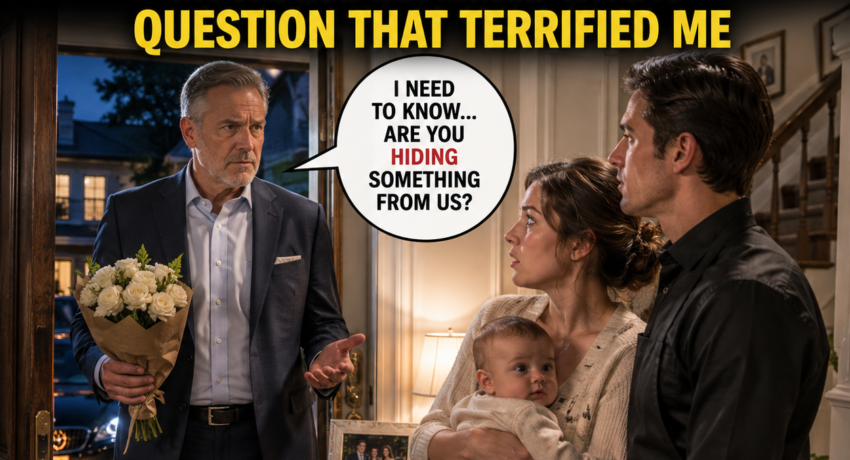
Then, one Friday evening, my father appeared at our front door.
He hadn’t visited once since my wedding.
And the expression on his face told me he hadn’t come to apologize.
I stood frozen with one hand wrapped around the doorknob.
“Dad?”
His eyes settled on me with an unsettling seriousness.
“Natalie.”
Just my name.
No hello. No smile. No sign that eight silent months had passed between us.
But before I explain why my father was standing there—or why the first question he asked my husband nearly shattered everything I believed—I need to explain the kind of family I came from.
In my parents’ home, love was rarely unconditional.
Achievement earned affection.
Success earned praise.
Disappointment earned lectures.
My father, Roman, had built his company from almost nothing, and that accomplishment became the standard against which he measured nearly everyone. My mother, Vivienne, had grown up surrounded by wealth and social expectations, and she believed reputation mattered almost as much as character.
Maybe more.
When I brought home perfect grades, Dad nodded approvingly.
When I earned a scholarship, they took me somewhere expensive for dinner.
But one B+ could turn the ride home into a forty-minute conversation about discipline, ambition, and “wasted potential.”
My mother had been planning my adulthood before I even understood what adulthood meant.
“You’ll marry someone established one day,” she would say while trimming flowers at the kitchen table. “A doctor, perhaps. Or an attorney. Someone respected.”
Dad would glance over his newspaper.
“Someone ambitious.”
Then, after a pause:
“And financially secure.”
They never asked what kind of person I wanted to love.
They asked what kind of résumé he would have.
For most of my life, I followed the path they had drawn for me.
Then I met Andrew.
I was twenty-two and finishing university.
Andrew was a student too, but unlike many of us, he couldn’t rely on family money to cover his expenses. He worked evening shifts as a waiter at a small restaurant a few blocks from campus.
The place wasn’t impressive.
The menus were always slightly sticky. One of the tables wobbled no matter how many folded napkins were shoved beneath the leg. The coffee was mediocre.
But their tiramisu was extraordinary.
And so was Andrew.
He owned one pair of shoes with a small tear near the heel, counted every dollar carefully, and somehow still managed to be more generous than anyone I had ever known.
Our first date was coffee.
Not good coffee.
Cheap coffee.
He apologized for it before we even sat down.
“I’d take you somewhere nicer,” he said, “but my bank account has filed a formal complaint.”
I laughed.
That was probably the moment I started falling for him.
Our second date was a long walk through campus because walking cost nothing.
By the third, I realized I didn’t care what anything cost.
Andrew listened when I spoke.
He remembered tiny details.
He asked how I felt instead of telling me how I should feel.
Most importantly, he never treated me like a project that needed improvement.
One night, while we were sharing fries because ordering two meals seemed unnecessary, I caught myself watching him.
He smiled.
“You’re staring at me.”
“I’m evaluating you.”
His eyebrows rose dramatically.
“And the verdict?”
I pretended to consider it.
“You’ll do.”
Andrew laughed so loudly the couple beside us turned around.
I remember staring at him afterward, almost confused.
My parents had spent years teaching me how to impress people.
Andrew was the first person who made me feel that I didn’t have to.
For three years, he loved me without conditions.
No grades.
No status.
No checklist.
Just me.
And once I understood what that felt like, I knew I could never go back.
Part 2 — The Proposal That Changed Everything
Our relationship was full of small, imperfect moments that somehow became my favorite memories.
On our first anniversary, Andrew decided he was going to cook dinner.
This was a mistake.
I walked into his apartment and immediately smelled smoke.
The kitchen looked as though a culinary disaster had taken place.
Andrew stood beside the stove holding a saucepan containing what appeared to be one enormous, solid mass of pasta.
He lifted it proudly.
“I made you something.”
I stared at it.
“What is that?”
“Pasta.”
“Andrew, I think you’ve invented concrete.”
He looked offended.
“It’s sculpture.”
“It’s carbon.”
“It’s art, Natalie.”
I laughed until my stomach hurt.
We eventually gave up and sat on the floor eating cereal from mismatched bowls.
And I remember looking at him and thinking something I had never understood before.
Maybe this was love.
Not expensive restaurants.
Not perfect photographs.
Not matching expectations.
Maybe love was burnt pasta, cereal on the floor, and laughing until your cheeks hurt.
For years, I kept most of my relationship with Andrew away from my parents.
I knew exactly what would happen when they learned he waited tables.
My father’s mouth would tighten.
My mother would become painfully quiet.
They would look past everything Andrew actually was and reduce him to his job title.
So I delayed the confrontation.
Until Andrew proposed.
It happened on a cool Thursday evening in October.
He took me to the bench outside the restaurant where we’d had our first terrible coffee.
I thought we were simply going for a walk.
Then he stopped.
His hands were shaking.
Before I fully understood what was happening, he lowered himself onto one knee.
For once, Andrew wasn’t joking.
“Natalie,” he said softly, “I don’t have much to offer you yet.”
My heart was already pounding.
He looked up at me.
“I have myself. I have whatever future I can build. And I know that isn’t the kind of impressive speech people are supposed to give.”
My eyes filled before he even finished.
“But if that’s enough for you, will you marry me?”
“Yes.”
The answer left my mouth instantly.
Andrew blinked.
“I hadn’t finished.”
“I don’t care.”
“You’re supposed to let me finish.”
“Then finish. The answer is still yes.”
He laughed and stood, and I wrapped my arms around him.
For a few beautiful minutes, nothing else existed.
Then reality returned.
My parents.
I knew what they would say.
I knew what they would think.
I even suspected what they might do.
But for the first time in my life, that knowledge didn’t change my decision.
A few days later, I sat across from my parents at their dining table.
The ring on my hand suddenly felt much heavier.
Dad noticed it almost immediately.
He slowly put down his fork.
That movement alone made my stomach tighten.
“So,” I said, forcing myself to stay calm. “Andrew proposed.”
Silence.
“I said yes.”
My mother lowered her eyes toward her plate.
Dad stared at me.
Finally, he spoke.
“You’re throwing away your future for a waiter.”
The words landed exactly where I knew they would.
“He’s not just a waiter, Dad.”
“That’s what he does, isn’t it?”
“He’s a student. Just like I am. He works because he pays his own way.”
Dad gave a humorless laugh.
“And that’s supposed to impress me?”
“It does impress me.”
My voice shook, but I kept going.
“He works hard. He doesn’t expect anyone to rescue him. He’s kind. He’s loyal. He treats people well when there’s absolutely nothing he can gain from them.”
My mother finally looked up.
“We raised you to expect more from your life.”
Her words hurt more than Dad’s anger.
Because she said them softly.
Almost sadly.
As though loving Andrew meant I had failed some test they had prepared me for since childhood.
I swallowed hard.
“The wedding is in spring.”
Neither responded.
“I want you both there.”
Dad’s expression didn’t change.
“I can’t stand there smiling as if I support this.”
“I’m not asking you to approve of him.”
My voice cracked.
“I’m asking you to come to your daughter’s wedding.”
Mom looked away.
Dad shook his head.
That was their answer.
I left before dessert.
I cried in the car.
Then I wiped my face before I reached Andrew’s apartment because I didn’t want him to believe, even for a second, that I regretted choosing him.
I didn’t.
I regretted that my parents had made love feel like a choice between them and him.
But if they were going to force me to choose, I knew where I belonged.
Part 3 — The Two Empty Chairs
Our wedding wasn’t glamorous.
It was small, warm, and almost aggressively imperfect.
And I loved every minute of it.
Andrew’s parents cried throughout most of the ceremony.
His mother kept dabbing her eyes.
His father tried to remain composed until he started hiccuping halfway through the vows.
Once that happened, everyone began laughing—including him.
My best friend, Genevieve, walked me down the aisle through a garden overflowing with lavender.
The air smelled like fresh grass and flowers warmed by the afternoon sun.
There were two empty chairs in the front row.
My parents’ chairs.
I noticed them the moment I arrived.
Then I made a decision.
I wasn’t going to spend my wedding looking at what was missing.
So I kept my eyes on Andrew.
At the altar, he squeezed my fingers.
“Too late to escape now,” he whispered.
I smiled through tears.
“Good.”
At the reception, he attempted to open a bottle of champagne and somehow managed to spray most of it directly down the front of his shirt.
Everyone burst into laughter.
Andrew stood dripping wet, staring at the bottle.
“I think it attacked me.”
I laughed harder than anyone.
Despite the empty chairs, it became one of the happiest days of my life.
The following eight months were harder.
My mother sent one brief message about a relative’s new baby.
Dad sent nothing.
No congratulations.
No apology.
No attempt to repair what had happened.
I insisted I was okay.
Whenever Andrew gently asked, I smiled and told him I had accepted it.
That wasn’t completely true.
I missed them.
Sometimes I would see something funny and instinctively reach for my phone to text Mom.
Sometimes I passed my father’s favorite restaurant and remembered childhood dinners.
Sometimes anger arrived first.
Sometimes grief did.
But Andrew never pushed me.
He simply stayed beside me while I learned to live with the silence.
Slowly, our little apartment became home.
Andrew still worked at the restaurant while finishing his studies.
I worked too.
We bought secondhand furniture.
We argued about laundry.
We learned that neither of us could keep basil alive.
It wasn’t the prestigious life my parents had imagined for me.
It was better.
Because it was ours.
Then, eight months after the wedding, someone knocked on our door.
And when I opened it, my father was standing outside.
Part 4 — “Does My Daughter Know What You Did?”
Dad wore the dark coat he usually reserved for important meetings.
His posture was rigid.
His expression was unreadable.
My heart began beating faster.
“Dad?”
“Natalie.”
Again, no warmth.
“Can I come in?”
Before I could answer, Andrew emerged from the kitchen.
A dish towel hung over one shoulder, and he was still holding a wooden spoon.
He stopped when he saw my father.
“Roman.”
Dad stared at him.
Andrew tried again.
“Hello.”
My father ignored the greeting.
Instead, he turned toward me.
When he spoke, his voice was frighteningly calm.
“Does my daughter know what you did to that family?”
The room seemed to shrink around me.
“What are you talking about?”
Dad kept looking at Andrew.
“Ask your husband.”
My chest tightened.
“Ask him about Isaac and Amira.”
At those names, Andrew’s expression changed.
Not dramatically.
But enough.
His face went still.
A cold sensation moved through my stomach.
I looked from Andrew to Dad.
“Who are Isaac and Amira?”
Andrew didn’t answer immediately.
That brief silence frightened me more than anything Dad had said.
I stepped aside and let my father into the apartment.
Then I closed the door.
“Someone needs to explain this. Now.”
Dad walked into our living room and placed a thick folder on the coffee table.
The gesture was almost theatrical.
Evidence.
That’s what it felt like.
“What is that?” I asked.
“I hired someone.”
I stared at him.
“You what?”
“After the wedding.”
My disbelief quickly became anger.
“You had Andrew investigated?”
“I needed to know who you married.”
“You had no right.”
“I am your father.”
“That doesn’t give you the right to secretly investigate my husband!”
Dad’s jaw tightened.
“If you’d listened to us, perhaps it wouldn’t have been necessary.”
Andrew remained near the doorway.
He didn’t look angry.
He didn’t even look surprised.
Mostly, he looked exhausted.
Dad opened the folder.
“There is an elderly couple named Isaac and Amira. They’ve been customers at Andrew’s restaurant for years.”
I looked at Andrew.
He said nothing.
Dad continued.
“Your husband has been financially connected to them for a long time. They established a trust.”
He pulled out a document.
“Andrew is named as a beneficiary.”
I felt my mouth go dry.
“What are you saying?”
Dad’s eyes met mine.
“I’m saying the poor waiter you married may not be what he claims to be.”
“Dad—”
“I’m saying he became close to an elderly couple with no children and somehow ended up in their financial documents.”
My chest felt hollow.
“He took advantage of them, Natalie.”
I turned toward my husband.
“Andrew?”
He finally spoke.
“I know Isaac and Amira.”
Dad gave a grim nod, as if the admission proved everything.
Andrew continued.
“I know them very well.”
My fingers curled against my palm.
“But your father has completely misunderstood what happened.”
Dad pushed one of the documents toward me.
“Then explain this.”
I looked down.
There it was.
Andrew’s name.
I read it once.
Then again.
Beneficiary.
For one terrible moment, something buried deep inside me resurfaced.
My parents’ voices.
You’re making a mistake.
You don’t know who he really is.
You’ll regret choosing him.
I hated how quickly those old fears returned.
I hated myself for allowing them in.
But I couldn’t pretend the documents weren’t real.
“Why have you never told me about them?” I asked.
Andrew’s expression softened.
“Because there was nothing to tell.”
“Nothing?”
My voice became sharper.
“We’ve been together for years. We’re married. And you’ve never once mentioned being named in someone’s trust.”
His eyes dropped briefly.
“It wasn’t something I thought of as mine to talk about.”
Dad scoffed.
“How convenient.”
“Dad, stop.”
“I’m trying to protect you.”
“Stop.”
My voice rose.
The room fell silent.
Andrew took a breath.
Then he looked directly at me.
“Come with me.”
“What?”
“Come meet them.”
Dad shook his head immediately.
“Absolutely not. He’s had years to prepare them.”
Andrew stared at him.
“Prepare them for what?”
“For this.”
Andrew rubbed a hand over his face.
“They’re in their seventies, Roman. I haven’t been secretly rehearsing a defense with them.”
Then he looked back at me.
“You don’t have to believe me right now, Natalie.”
That hurt.
Because part of me didn’t.
“Just come and hear it from them.”
I stared at him.
My wedding ring suddenly felt hot against my skin.
I hesitated.
Only for a second.
But Andrew noticed.
Something passed across his face.
Not anger.
Pain.
He didn’t argue.
He simply waited.
Exactly the way he had waited on one knee all those years earlier.
Finally, I nodded.
“Okay.”
Dad frowned.
“We’re going?”
“Yes.”
I grabbed my coat.
“We’re going to find out the truth.”
Part 5 — The Longest Fifteen-Minute Drive of My Life
The drive took barely fifteen minutes.
It felt like an hour.
Andrew drove.
I sat beside him.
Dad sat in the back with the folder on his knees.
No one spoke.
Streetlights slid across the windshield.
Every few seconds, I looked at Andrew’s profile.
I knew that face.
I knew the small scar beside his eyebrow.
I knew the way he pressed his lips together when concentrating.
I knew how he looked when nervous, embarrassed, exhausted, amused.
But that night, uncertainty had distorted everything.
What else didn’t I know?
I hated myself for thinking it.
At a red light, Andrew finally broke the silence.
“For what it’s worth,” he said calmly, “if I’ve secretly built an international criminal empire, I probably should have used some of the money to buy us more than two forks.”
A broken laugh escaped me before I could stop it.
Half laughter.
Half panic.
Dad remained silent.
But in the rearview mirror, I caught him studying Andrew differently.
For the first time, he didn’t look certain.
We eventually turned into a quiet residential street and stopped outside a modest house.
There were no gates.
No expensive cars.
No signs of extraordinary wealth.
Just a small porch with a slightly crooked light and a carefully tended garden surrounding the walkway.
Someone had spent years loving that garden.
Andrew climbed out.
Dad followed with his folder still tucked beneath his arm.
I stood on the sidewalk for a moment, breathing in the cool evening air.
Then I followed them.
Andrew knocked softly.
A moment later, the door opened.
An elderly man with white hair and oversized glasses appeared.
The instant he recognized Andrew, his entire face brightened.
“Andrew!”
Before anyone could introduce themselves, he wrapped my husband in a hug.
Not a polite hug.
Not the awkward embrace of an acquaintance.
He held Andrew like family.
I glanced at Dad.
His expression changed.
Only slightly.
But enough.
The certainty was beginning to leave him.
“Come in, come in,” the old man said.
Inside, the house smelled like lemon tea, old books, and something sweet baking somewhere in the kitchen.
An elderly woman came toward us.
She smiled when she saw Andrew.
Then she looked at me.
“You must be Natalie.”
I blinked.
“You know who I am?”
She laughed.
“Of course we do.”
Andrew looked embarrassed.
Apparently, strangers knew plenty about me while I knew almost nothing about them.
The man introduced himself as Isaac.
His wife was Amira.
We sat together in their small living room.
Old photographs covered the shelves.
Plants crowded the windows.
Nothing about the home felt staged.
Nothing felt rehearsed.
Amira reached for Andrew’s hand.
“This boy used to sit with us every Friday.”
Andrew sighed.
“Amira—”
“Every Friday,” she repeated.
“During his break. Do you know how many people see old people sitting alone and decide we’re invisible?”
My throat tightened.
She continued.
“Andrew didn’t.”
Isaac smiled.
“He’d bring our groceries when my knees got bad.”
“He fixed the kitchen faucet,” Amira added.
“And the porch railing,” Isaac said.
Andrew shifted uncomfortably.
“It wasn’t a big deal.”
“Not to you,” Isaac replied.
Then he looked at me.
“To us, it was.”
I stared at my husband.
He wouldn’t look at me.
He seemed genuinely embarrassed by the praise.
Dad remained standing near the doorway.
His folder was still under his arm.
But he no longer looked eager to open it.
Finally, I asked the question that had brought us there.
“What about the trust?”
The room became quiet.
Isaac frowned slightly.
“What about it?”
“Andrew is listed as a beneficiary.”
“Oh.”
Isaac exchanged a look with Amira.
Then he laughed softly.
“Yes. Because we put him there.”
Dad finally spoke.
“He agreed to it.”
Isaac turned toward him.
“Eventually.”
“Eventually?”
Amira gave Andrew an affectionate look.
“He refused us for nearly a year.”
I stared at him.
Andrew shrugged.
“They needed their money.”
“It is our money,” Isaac corrected him. “Which means we get to decide what happens to it.”
Amira looked at me.
“We never had children.”
Her voice softened.
“We have relatives, but none who are especially close. Andrew became family long before any document said so.”
My eyes burned.
Isaac continued.
“When we finally convinced him, Andrew insisted on conditions.”
“What conditions?”
“He doesn’t control anything while we’re alive. He doesn’t receive anything from us now. He wanted it written clearly so there could never be confusion.”
My father’s face lost what little color remained in it.
Amira turned toward him.
Her voice wasn’t angry.
That somehow made it more powerful.
“Your daughter’s husband didn’t take anything from us.”
She glanced at Andrew.
“He gave.”
Silence filled the room.
“He gave us his time when he had very little of it,” she continued. “He helped my husband when his health became difficult. He made sure we weren’t alone when we needed someone.”
Isaac nodded.
“Andrew is one of the reasons I’ve been able to stay in this house and continue tending that ridiculous garden.”
“It’s a beautiful garden,” Andrew said.
“It’s ridiculous and you know it.”
Andrew smiled.
For the first time that evening, I recognized him completely.
My husband.
The man I had chosen.
And suddenly, I understood why he had never told me.
To Andrew, none of these things were achievements.
He hadn’t helped Isaac and Amira so someone would admire him.
He hadn’t done it so I would think he was a good man.
He had simply seen two people who needed kindness.
So he gave it.
Without applause.
Without expecting anything in return.
I looked at my father.
The folder under his arm suddenly seemed absurd.
His shoulders had dropped.
And for the first time in my life, Roman looked less like the powerful businessman who always had the answers and more like an aging father realizing he had made an enormous mistake.
Part 6 — What My Father Had Really Been Afraid Of
The drive home was very different.
No one spoke for several minutes.
Eventually, Dad cleared his throat.
“I’m sorry.”
Andrew glanced at him in the mirror.
Dad continued.
“I owe you an apology.”
Andrew remained quiet.
Then Dad turned toward me.
“And you.”
I watched him carefully.
He looked exhausted.
“I investigated Andrew because I didn’t trust him,” Dad admitted. “But if I’m truthful, it wasn’t only that.”
He looked down at his hands.
“I was afraid.”
I had rarely heard my father admit fear.
“Afraid of what?”
“That we’d lost you.”
I almost laughed because the irony was painful.
“You did lose me.”
He nodded.
“I know.”
“No, Dad. You didn’t lose me because Andrew stole me from you. You pushed me away because I made a choice you didn’t approve of.”
He closed his eyes briefly.
“I thought I was protecting you.”
“From what? A man without an impressive salary?”
His face tightened.
“From making a mistake.”
“And you decided you knew what my mistake would be before you ever tried to know him.”
Dad had no answer.
So I continued.
“You saw his job and decided you understood his character.”
He swallowed.
“I was wrong.”
“Yes.”
The word came out more sharply than I intended.
But I didn’t apologize.
There were some things he needed to hear.
“He didn’t take me away from you. You made me choose between loving him and keeping your approval.”
Dad looked out the window.
“I know that now.”
I glanced at Andrew.
He reached across the center console and quietly took my hand.
I intertwined my fingers with his.
Then I looked back at my father.
“Love isn’t a résumé, Dad.”
He nodded slowly.
“I understand.”
“No.”
I shook my head.
“I hope you understand. But I’m going to need time before I believe you do.”
His eyes filled, though he quickly looked away.
“That’s fair.”
It wasn’t a magical reconciliation.
I didn’t suddenly forget the empty chairs at my wedding.
Andrew didn’t instantly treat Dad like family.
And Mom still had to face what she had done too.
Forgiveness wasn’t a switch.
It was work.
So we worked.
Slowly.
Dad began calling occasionally.
Mom invited me for coffee.
The first meeting was awkward.
The second was slightly less awkward.
At some point, Dad asked Andrew about his studies without adding a judgmental comment.
That felt like progress.
Later, Mom apologized for telling me she had raised me to make “better choices.”
She cried when she admitted she had spent years believing security could only be measured in money and status.
I told her how much her words had hurt.
For once, she didn’t defend herself.
She listened.
And little by little, we began rebuilding something.
Not the family we’d had before.
Something better.
Something more honest.
Part 7 — What Family Finally Came to Mean
Several months later, my parents came to our apartment for dinner.
It was the first time the four of us had eaten together since everything happened.
Andrew insisted on cooking.
I objected immediately.
“Have we learned nothing from the pasta incident?”
He pointed a wooden spoon at me.
“That happened years ago.”
“So did the invention of fire. You’re still struggling with it.”
Dad overheard me and nearly smiled.
That alone felt miraculous.
Andrew eventually carried a roast into the dining room with the seriousness of a chef presenting his greatest masterpiece.
I looked at it.
“It’s burnt.”
“It’s caramelized.”
“It’s black.”
“It’s rustic.”
Mom cut herself a piece.
We all watched as she tasted it.
“It’s lovely.”
I stared at her.
“Mom.”
“What?”
“It’s almost charcoal.”
She took another bite.
“Then it’s very flavorful charcoal.”
Dad suddenly laughed into his napkin.
A real laugh.
Not a polite one.
Not the restrained sound I had heard throughout childhood.
I looked across the table at Andrew.
He was smiling.
For a moment, I simply watched everyone.
My mother was buttering bread while asking Andrew about one of his classes.
Dad was telling me that he wanted to invite Isaac and Amira over the following weekend.
Andrew was refilling everyone’s glasses.
The apartment was small.
Our dining table didn’t match the chairs.
Dinner was slightly burned.
There was nothing about the scene my parents would once have described as impressive.
And yet I had never felt richer.
I thought about the two empty chairs at my wedding.
For a long time, I had believed those chairs represented what I had lost by choosing Andrew.
But sitting at that table months later, I finally saw everything differently.
I hadn’t lost my family because I married a waiter.
I had refused to accept a version of family where love depended on achievement, appearances, and approval.
Andrew hadn’t broken my family apart.
If anything, his quiet kindness had forced all of us to confront what we’d misunderstood.
My parents had spent years teaching me to choose a life that looked successful from the outside.
Andrew taught me to recognize a life that felt meaningful from within.
And eventually, even my parents began to understand the difference.
That night, as Dad laughed at another one of Andrew’s terrible cooking jokes and Mom reached for a second piece of his overdone roast, something inside me finally settled.
I didn’t need the perfect family I had once wished for.
I needed people willing to learn.
People willing to apologize.
People willing to return after getting things wrong.
And people like Andrew, who did good things when nobody was watching and never thought they deserved recognition for it.
My parents once believed I was wasting my life on a waiter.
It took them losing me, investigating my husband, and discovering the truth about two elderly strangers to understand what I had seen from the beginning.
Andrew’s worth had never been hidden.
They had simply been looking in all the wrong places.