Part 1 — The Second Coffee Cup
The morning after my wife left me, I still made her coffee.
It wasn’t a conscious decision.
At 6:10 a.m., my alarm rang exactly as it had every weekday for years. Half asleep, I walked into the kitchen, filled the kettle, and reached into the cupboard.
I took down two mugs.
Mine was an old navy-blue mug with a chip near the handle, something I had owned since college.
Sienna’s was white, decorated with a ring of tiny gold stars.
I placed both on the counter.
Then I froze.
For several seconds, I simply stared at her mug.
The house was so quiet that I could hear the refrigerator humming behind me.
Her suitcase was gone.
So was her makeup bag.
The small ceramic dish on her nightstand—the one that was always overflowing with earrings, rings, and loose hairpins—was completely empty.
And suddenly I heard her words again.
“I married a provider, Rowan. Not a problem.”
Twenty-four hours earlier, she had said them while standing in our bedroom with a half-packed suitcase on the bed.
Now they seemed to echo through every room.
Slowly, I put her mug back in the cupboard.
Then I poured one cup of coffee, opened my laptop, and began searching for jobs.
Or at least I tried.
I updated my résumé.
I answered two messages from former colleagues.
I opened three job listings.
But every few minutes my mind returned to that sentence.
It wasn’t because I thought losing my job had destroyed us financially.
It hadn’t.
We had savings.
I had severance coming.
We could pay the mortgage, buy groceries, keep the lights on, and live normally for months if we were careful.
I had fourteen years of management experience and a phone full of contacts. Several people had already sent me openings before I even got home the previous evening.
I was scared, yes.
But I wasn’t defeated.
What frightened me far more was realizing that the woman I had shared six years of marriage with had disappeared the moment my paycheck did.
Until that day, I had believed Sienna and I were a team.
Suddenly, I wasn’t sure we had ever been one.
The previous afternoon had begun like any ordinary workday.
By lunchtime, seventy-eight people had lost their jobs.
Our company had decided to close the entire local branch.
No warning that mattered. No negotiation. Just a meeting, a few carefully chosen corporate phrases, and the announcement that all our positions were being eliminated.
Afterward, I spent hours helping my employees.
I carried boxes.
I exchanged personal numbers.
I promised recommendations.
I connected people with contacts I knew at other companies.
Some were angry.
Some cried.
One man simply sat in his chair staring at the family photograph beside his monitor.
When almost everyone was gone, I finally packed my own things.
Then I sat inside my car for nearly twenty minutes without starting the engine.
For the first time in fourteen years, I had nowhere to report to the following morning.
That terrified me.
Still, I kept telling myself one thing.
Sienna and I would handle it together.
On the way home, I even stopped to buy her favorite Thai food.
I imagined us sitting at the kitchen table while I explained everything.
“We’ll cut back for a few months.”
“I’ll call people tomorrow.”
“We’re going to be okay.”
Maybe she would be frightened.
Maybe we would argue.
Maybe she would cry.
But never—not once—did I imagine she would pack a suitcase.
When I walked into the house, Sienna was curled into the corner of the couch.
“You’re home early,” she said.
“Yeah.”
Her eyes moved toward the paper bag in my hand.
“Thai?”
Normally I would have smiled.
Instead, I placed the food on the kitchen counter.
“Sienna, I need to tell you something.”
Something in my voice made her sit straighter.
I took the chair across from her.
“The company closed our branch today.”
She stared at me.
“The entire branch?”
“Yes.”
“And your job?”
“Gone too.”
Her expression changed immediately.
Not sadness.
Not sympathy.
Fear.
“You lost your job?”
“The whole office closed.”
“But you don’t have a job anymore.”
“No.”
She stood suddenly and headed toward the bedroom.
I followed.
“We’re okay,” I said. “We have the emergency fund. My severance should arrive next week. And I already have people sending me openings.”
She didn’t answer.
Instead, she opened our closet and pulled down the largest suitcase we owned.
At first, I thought she was looking for something stored behind it.
Then she placed it on the bed and unzipped it.
“Sienna?”
She started folding clothes.
Two dresses.
A sweater.
Jeans.
“Sienna, what are you doing?”
“I’m going to my parents’ place.”
I actually laughed.
Not because anything was funny.
Because my mind refused to accept what I was watching.
“For tonight?”
She stopped.
Then she turned toward me.
The fear on her face had hardened into irritation.
“I can’t do this, Rowan.”
“Do what?”
“This.”
She waved one hand toward me.
Toward me.
As though unemployment had become a stain she could suddenly see on my clothes.
“I didn’t agree to spend my life wondering whether the mortgage is going to be paid,” she said. “Or whether we’ll have enough money for groceries.”
“We have money for groceries.”
“That isn’t the point.”
“Then tell me what the point is.”
She pulled the zipper halfway across the suitcase.
Then she looked directly into my eyes.
“I married a provider, Rowan. Not a problem.”
For a moment, I couldn’t speak.
There are sentences that hurt because they are cruel.
Others hurt because they reveal something you didn’t know was true.
That sentence did both.
I watched her finish packing.
At the bedroom door, I finally managed to ask, “You’re leaving me because I lost one job?”
“I’m leaving because I need time to think.”
“About us?”
She sighed.
“About what my life looks like if this becomes permanent.”
Permanent.
I had been unemployed for approximately four hours.
Sienna wheeled the suitcase down the hallway.
I didn’t chase her.
I didn’t beg.
I simply stood there until I heard the front door close.
A few seconds later, her car started.
Then silence swallowed the house.
Part 2 — All the Things I Had Been Carrying
The following day was when I began noticing how our marriage actually worked.
At 9:15 a.m., my phone reminded me that Sienna’s car insurance renewal was due.
My thumb automatically moved toward the payment app.
Then I stopped.
She knew how to pay it.
At least, I hoped she did.
I closed the notification.
Around eleven, I remembered that she had a dentist appointment the following Tuesday.
I typed a message.
Don’t forget your appointment Tuesday at 2.
I stared at it.
Then deleted it.
At noon, the dry cleaner sent me a notification telling me that three of Sienna’s dresses were ready.
For years, I had dropped off and collected her cleaning because the shop was on my route home from work.
Only now there was no route home.
No office.
No suit jacket hanging behind my chair.
No Sienna calling at five-thirty to ask whether I remembered her dresses.
By late afternoon, I had completed seven job applications.
And I had also realized something about myself that made me deeply uncomfortable.
I hadn’t merely earned most of the money in our household.
I had been managing nearly everything.
Insurance.
Taxes.
Travel arrangements.
Home repairs.
Subscriptions.
Retirement accounts.
Passwords.
Appointments.
Renewals.
Bills.
Even the ridiculous replacement filter for our refrigerator.
I had become the operating system of our marriage.
Sienna once joked that she had “outsourced adulthood” to me.
I had laughed.
She had kissed my cheek and said, “That’s why I married you.”
Back then, I had been proud of it.
Now the memory left a strange taste in my mouth.
Because Sienna hadn’t always been like this.
When we met, she was halfway through a design program.
Interior drafting.
Space planning.
Computer-assisted design.
She could walk into an empty room and immediately start talking about lighting, proportions, movement, and how badly the furniture had been placed.
She loved it.
Then I received a promotion.
We moved.
Her credits didn’t transfer neatly to the college near our new home.
She decided she would return to school later.
I told her there was no rush.
Then came another promotion.
More money.
A larger house.
Better vacations.
Restaurants where we no longer looked at prices before ordering.
I liked giving her those things.
I liked seeing her happy.
And somewhere along the way, “later” became “maybe someday.”
Then “maybe someday” quietly disappeared altogether.
I had believed I was giving my wife security.
Maybe I had.
But comfort can turn into dependence so slowly that neither person notices until someone removes the support holding everything up.
I wondered if Sienna had realized that.
I wondered if I had.
She didn’t call that day.
The following morning, she still hadn’t called.
Her mother sent me one message.
Sienna needs some space. Please respect that.
I stared at the screen for nearly a minute.
Then typed:
I will.
That afternoon, I gathered several things Sienna had forgotten.
Her tablet charger.
Medication.
A pair of shoes.
A thick sweater she wore constantly while watching television.
I found an empty shipping box in the closet of my home office and placed everything inside.
What I didn’t notice was the thick cream-colored folder hidden beneath the cardboard insert at the bottom.
If I had seen it, everything that happened next might have unfolded differently.
Part 3 — The Folder
On the third morning, I woke before my alarm.
This time, when I walked into the kitchen, I removed only one mug from the cupboard.
Coffee.
Laptop.
Job listings.
I was halfway through an application when someone began pounding on the front door.
Not knocking.
Pounding.
I checked the time.
8:42.
When I opened the door, Sienna was standing there.
Her hair was tied into a messy knot. She wore leggings, an oversized sweatshirt, and the expression of someone who had barely slept.
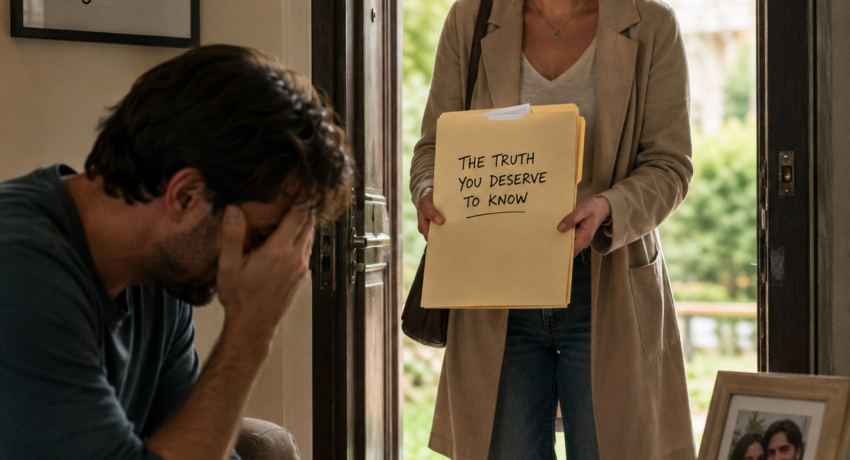
In her right hand was a thick cream-colored folder.
My stomach dropped.
I recognized it instantly.
“Sienna?”
She pushed past me.
“How long?”
I closed the door slowly.
“Sienna—”
“How long were you planning to keep this from me?”
She slammed the folder onto the dining table.
Documents spilled from the side.
Printed emails.
A college brochure.
Transfer-credit information.
Tuition calculations.
Course requirements.
Notes about design software.
And sitting on top was a page in my handwriting.
SIENNA — PROGRAM OPTIONS + FINANCIAL PLAN.
She tapped the date on one of the emails.
“You’ve been planning this behind my back.”
“It isn’t what you think.”
“Really?”
“Yes.”
“You contacted my old college.”
“I did.”
“You asked them which of my credits were still valid.”
“Yes.”
“You asked how long it would take me to graduate.”
“Yes.”
Her voice cracked.
“And you never said a word to me?”
That answer was harder.
“No.”
Sienna stared at me.
For the first time since she arrived, underneath her anger, I saw something else.
Hurt.
“You were preparing to get rid of me.”
“What?”
“You were making sure I could support myself first.”
“No.”
“Don’t lie.”
“I’m not lying.”
She pulled another page from the folder.
“Tuition. Course schedules. Software requirements. You worked all of this out without telling me.”
“I know.”
“So what was it?”
Her voice grew louder.
“A backup plan? Something you could hand me when you got tired of paying for everything?”
“No, Sienna.”
“Then explain it.”
I looked toward the clock.
If the schedule hadn’t changed, there was someone who could help me explain far better than I could inside that dining room.
I walked toward the small bowl by the door and picked up my keys.
Sienna let out a disbelieving laugh.
“Are you seriously leaving?”
“No.”
“Then where are you going?”
“To show you.”
“Show me what?”
I opened the front door.
“The part of this story I should have told you fourteen months ago.”
She stared at me.
Then looked at the folder.
Finally, she followed.
We barely spoke during the drive.
Sienna sat beside me with the folder pressed tightly against her chest.
About twenty minutes later, I turned into a familiar parking lot.
Her entire body went still.
“No.”
I parked.
Across from us stood the community college Sienna had attended before we were married.
She stared through the windshield.
“Why are we here?”
“You wanted to know what I was hiding.”
I switched off the engine.
“So I’m showing you.”
Part 4 — The Plan Was Never About Leaving Her
The design department was on the second floor.
Sienna walked beside me without saying anything.
At reception, I asked for Elaine.
A moment later, a woman in her sixties appeared from an office doorway.
“Rowan?”
Then she saw Sienna.
Her expression changed completely.
“Sienna?”
My wife frowned.
“Do I know you?”
Elaine smiled gently.
“I taught your second-year drafting course.”
Sienna stared.
Elaine’s eyes moved toward the folder in her hands.
“I remember your portfolio too.”
That affected Sienna more than I expected.
Her fingers loosened around the folder.
Someone remembered the person she had been before becoming my wife.
Elaine invited us into her office.
She pulled Sienna’s old records onto her computer.
Some credits still counted.
Others didn’t.
The program had changed.
Technology had changed.
The design software was far more advanced than what Sienna had used years earlier.
If she wanted to finish, there would be refresher courses.
Portfolio work.
Several semesters of classes depending on how many she took at once.
It wasn’t an easy shortcut back into her old life.
But it was possible.
The door hadn’t closed.
Sienna barely looked at the screen.
Instead, she kept watching me.
Finally she asked, “Why did you first come here fourteen months ago?”
Elaine sensed what was happening.
“I’ll let you two talk.”
When the door closed behind her, Sienna waited.
I took a breath.
“Because of Derek.”
Her forehead creased.
“Who?”
“He worked under me for eleven years.”
“What does he have to do with me?”
“He had two children. A mortgage. His wife had stopped working years earlier when their youngest was born.”
I looked down at my hands.
“One morning, the company eliminated his position.”
Sienna said nothing.
“I watched him carry a cardboard box past my office. And I suddenly realized something.”
“What?”
“That everything in our life depended on one person continuing to earn.”
Her expression hardened slightly.
“So you decided I needed to work.”
“No.”
I met her eyes.
“I decided I hated that your entire sense of security depended on whether something happened to me.”
The anger in her face began to shift.
“I started thinking about what would happen if I got sick. Or lost my job. Or something happened that I couldn’t control. You gave up something you loved when we moved for my career. And afterward, I made it so easy for you not to go back that eventually neither of us talked about it anymore.”
Sienna looked down at the papers.
“You could have asked me.”
“I did.”
She glanced up.
“Six months ago. I mentioned finishing school.”
Her expression changed as she remembered.
“You asked whether we were having financial problems,” I continued. “I told you we weren’t. Then you laughed and asked why you should go through all that work if you didn’t need to.”
Sienna slowly sank farther into the chair.
“I should have kept talking,” I said.
“But instead?”
“I did what I always do.”
“What?”
“I tried to fix everything myself.”
Her eyes lowered again.
“You should’ve told me about the folder.”
“Yes.”
The answer seemed to surprise her.
I wasn’t going to pretend I had handled it perfectly.
I hadn’t.
Marriage isn’t supposed to be one person secretly designing solutions for the other.
Then I added quietly, “But you should have stayed long enough for me to tell you that losing one job didn’t mean I had lost my ability to be your husband.”
Sienna closed her eyes.
Neither of us spoke for several moments.
Outside the window, students crossed the courtyard carrying backpacks and coffee cups.
Some were barely adults.
Others looked older than us.
People starting over.
People continuing something they had once stopped.
Eventually, Sienna asked the question I suspected had been haunting her since the night she left.
“Are we actually in financial trouble?”
“No.”
Her shoulders dropped before she could stop herself.
Relief.
Immediate, visible relief.
“We have savings,” I continued. “My severance is coming. I told you all of that the night I came home.”
She frowned.
“You did?”
“Yes.”
She looked genuinely ashamed.
“You heard the words ‘I lost my job,’ and everything after that disappeared.”
Her eyes filled.
I kept my voice calm.
“You didn’t hear that we had savings. You didn’t hear that I had contacts. You didn’t hear that I had a plan.”
I paused.
“You heard that I wasn’t earning money anymore, and somehow that became the same thing as me having no value.”
She looked away.
And for once, I didn’t rescue her from the silence.
Part 5 — The Question She Couldn’t Answer
After leaving the college, neither of us was ready to go home.
So I drove to the diner where we had gone on our first date.
We sat in the same corner booth, though everything else seemed smaller than I remembered.
Halfway through our coffee, Sienna suddenly smiled.
“Do you remember our first date?”
“Of course.”
“My card paid for dinner.”
I laughed quietly.
“My card declined.”
“You looked like you wanted to disappear under the table.”
“I was twenty-eight and trying very hard to impress you.”
“You kept apologizing.”
“And you told me I could pay next time.”
Her smile slowly faded.
For a few seconds, neither of us spoke.
Then Sienna stared into her coffee.
“When did I become this person?”
There was no defensiveness in her voice anymore.
Only sadness.
I could have told her that she had done it to herself.
I could have used that moment to punish her.
But somewhere between the empty coffee mug at home and Elaine’s office, I had realized I wasn’t entirely innocent either.
So I told her the truth.
“Probably around the same time I started feeling proud that you depended on me for everything.”
She lifted her eyes.
“I liked being needed,” I admitted. “Maybe too much.”
A tear slid beneath one of her eyes, and she wiped it away quickly.
“I thought taking care of everything made me a good husband.”
“You were a good husband.”
“I was useful.”
“That isn’t the same thing?”
“No.”
The answer came easier than I expected.
“A marriage can’t survive if one person is valuable only because they provide something.”
Sienna’s face tightened.
Then she asked the question I knew was coming.
“Do you want me to come home?”
I looked at her.
Part of me desperately wanted to say yes.
I missed her.
I missed hearing her move around upstairs.
I missed the smell of her shampoo in the bathroom.
I missed the way she tucked her cold feet under my leg when we watched television.
I even missed finding five different water glasses abandoned around the house every evening.
But missing someone and trusting them are two different things.
So I said, “No.”
Sienna flinched.
“I’m not saying I want a divorce.”
She stared at me.
“I honestly don’t know what I want yet.”
“Then why can’t I come home?”
“Because you found out we’re financially okay.”
“That isn’t why—”
“Then answer one question.”
She went quiet.
“If there had been nothing in our savings account… if the severance hadn’t been coming… if I had told you we genuinely needed to struggle together for a few months…”
I paused.
“Would you still be sitting here asking to come home?”
Sienna opened her mouth.
Then closed it.
Her eyes dropped toward the table.
She couldn’t answer.
And that was the answer I needed.
Part 6 — Maybe There Would Be a Next One
Two weeks passed.
I continued interviewing.
Sienna remained at her parents’ house.
We spoke occasionally, but neither of us pretended things were normal.
Then she asked me to meet her at the diner again.
When I arrived, she was already sitting in our booth.
There was a folder beside her.
For one terrible second, the sight of it made my stomach twist.
Then she pushed it across the table.
Inside was an enrollment confirmation.
“I signed up for a refresher design class,” she said.
I looked at her.
“Because of me?”
She shook her head.
“No.”
Then, after a pause, she added, “That’s the first thing I needed to figure out.”
I waited.
“I kept thinking about what you said. About whether I would have come back if the account had been empty.”
Her voice became quieter.
“I hated myself because I couldn’t answer.”
“Sienna—”
“No. I need to say this.”
So I let her.
“I spent years thinking security meant never having to worry about anything. I didn’t realize how much of my life I had handed over to you. And when your job disappeared, I panicked because suddenly I felt like I had no control over anything.”
She swallowed.
“But instead of admitting I was afraid, I treated you like you were the problem.”
I looked down at the enrollment paper.
“What happens now?”
“I don’t know.”
For once, that answer didn’t frighten either of us.
When the waitress brought the check, I reached toward it automatically.
Sienna reached at exactly the same time.
Our hands stopped above the little black tray.
For a second, we looked at each other.
Then Sienna picked it up.
“I’ve got this one.”
I slowly pulled my hand back.
A faint smile crossed her face.
“You can get the next one.”
Then she paused.
The smile disappeared slightly.
“If there is a next one.”
There was something painful about those words.
But there was something honest in them too.
No promises.
No pretending three days of fear and betrayal could disappear because of one heartfelt conversation.
Just two people deciding whether they could learn to meet each other again as equals.
Outside the diner, we walked toward separate cars.
Sienna stopped beside hers.
“Your interview is tomorrow, right?”
“Ten o’clock.”
“Good luck.”
“Thanks.”
She opened her car door, then hesitated.
“Rowan?”
“Yeah?”
“Would you mind if I called afterward?”
A month earlier, I wouldn’t have understood why such a simple question mattered.
Sienna never used to ask whether she could call.
She simply assumed I would be there.
Maybe I had assumed the same thing about her.
I thought about it for a moment.
Then nodded.
“Yeah.”
Relief softened her expression.
“Okay.”
She got into her car.
I walked toward mine.
Before opening the door, I glanced back through the diner window.
Our booth was empty now.
Two coffee cups sat on opposite sides of the table.
Not beside each other.
Not yet.
But between them rested the bill Sienna had paid herself.
For years, I had thought love meant making sure my wife never had to carry anything alone.
Sienna had believed love meant knowing someone would always carry it for her.
Maybe we had both been wrong.
Maybe real partnership was something less comfortable and far more difficult.
Two people capable of standing on their own—
who still chose, whenever possible, to stand beside each other.
I didn’t know whether our marriage would survive.
Neither did Sienna.
But for the first time in a long time, whatever came next would not be built on dependency, fear, or the balance of a bank account.
It would have to be built on choice.
And maybe that was the only kind of marriage worth saving.