PART 1 — TABLE 19
The first thing I noticed when I entered my sister’s wedding reception was not the flowers, the orchestra, or the glittering chandeliers.
It was my place card.
Table 19.
I stared at it for several seconds before looking across the enormous ballroom.
My younger sister Vanessa’s wedding had taken over one of Boston’s most elegant hotels. Nearly three hundred guests filled the room—business executives, attorneys, socialites, and people my parents had spent decades trying to impress.
The center tables were decorated with towering arrangements of white roses and crystal candleholders. Champagne flowed freely. A string quartet played near the dance floor.
And then there was Table 19.
It had been pushed into a dim corner beside the swinging kitchen doors.
My chair was so close to the service entrance that waiters carrying trays would have to squeeze past me all evening.
I almost laughed.
Some things never changed.
At thirty-two, I should have been used to being placed in the corner of my own family.
Vanessa had always been the shining daughter.
I was the convenient disappointment.
“Eleanor!”
I turned.
My cousin Brooke hurried toward me in a shimmering gold dress.
Her eyes moved slowly over my silver-gray silk gown.
“Oh,” she said.
That single word contained enough judgment for an entire conversation.
I smiled. “Hello, Brooke.”
She touched the fabric near my sleeve without asking.
“This is… surprisingly nice.”
“Thank you.”
“Vanessa was worried you might wear something too plain.”
Of course she was.
Brooke lowered her voice.
“She said you were trying to save money.”
I almost smiled.
The gown had been made specifically for me by a small Paris fashion house whose waiting list stretched nearly a year.
But correcting Brooke would have been pointless.
My family had already written my story.
In their version, I was Eleanor Harper, the quiet older daughter who worked an unimportant office job, lived modestly, remained unmarried, and had somehow failed to become impressive.
They preferred that story.
It made Vanessa’s life look brighter.
Brooke gave me a sympathetic little pat on the arm.
“Well, at least you came.”
“I wouldn’t miss my sister’s wedding.”
Her eyebrows lifted.
“That’s mature of you.”
Before I could answer, Vanessa appeared.
She looked beautiful.
Her ivory gown was covered in hand-sewn crystals, and a cathedral-length veil trailed behind her.
“Eleanor,” she said.
“Congratulations, Vanessa.”
I leaned forward to hug her.
She stepped back before I could.
Her eyes flicked toward my dress.
“You look better than I expected.”
“Thank you…I think.”
One bridesmaid laughed.
Vanessa smiled sweetly.
“Table 19 should be perfect for you. It’s quieter back there.”
“I noticed.”
“Some of Daniel’s family members are very important people,” she continued. “Dad thought it might be better if you weren’t in the middle of everything.”
There it was.
Not even disguised.
I glanced toward our father.
Richard Harper stood near the head table, entertaining businessmen with a glass of champagne in his hand.
He looked confident.
Successful.
Untouchable.
That had always been his greatest talent: convincing everyone outside our family that he was a generous, sophisticated man.
Inside our home, things had been different.
When I succeeded, he found something missing.
When Vanessa succeeded, he celebrated.
I had stopped trying to impress him years ago.
At least, I thought I had.
Then everything changed.
I had barely crossed half the ballroom when someone struck my shoulder.
Hard.
A silver tray tilted beside me.
And suddenly—
cold red wine poured over my face, chest, and dress.
The ballroom went silent.
PART 2 — THE PUBLIC HUMILIATION
Several glasses of wine had soaked into my gown.
For a moment, nobody moved.
The waiter froze.
“Oh my God,” he whispered.
But something about the way he looked toward the head table made my stomach tighten.
He had not simply lost his balance.
I followed his glance.
Vanessa was pressing her lips together.
Trying not to smile.
My mother, Margaret, lifted one hand toward her mouth.
And then—
she laughed.
A few nearby guests joined her.
Then more.
I looked down at myself.
My gown was ruined.
Wine dripped from my fingertips.
The string quartet stopped playing.
Nearly three hundred guests stared.
Then a microphone squealed through the speakers.
I raised my head.
My father had taken it from the wedding band.
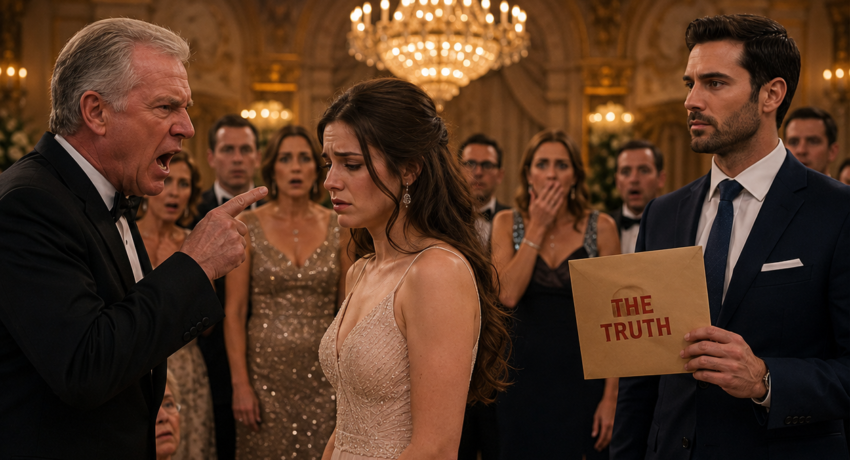
“Well,” Richard announced, smiling broadly, “I suppose some things really never change.”
More laughter.
“Our Eleanor has always had a talent for creating a scene.”
A few people chuckled.
Richard had consumed enough champagne to make cruelty feel entertaining.
“Thirty-two years old,” he continued, “still sitting behind a desk, still arriving alone to family events, and somehow she manages to turn her sister’s wedding into a spectacle.”
The laughter became louder.
My mother shook her head dramatically.
“Poor Eleanor,” Margaret said. “Always so serious.”
Someone near her whispered something.
She answered loudly enough for me to hear.
“What do you expect? She’s practically married to her office.”
More laughter.
I closed my eyes.
Once.
Then opened them.
And something inside me changed.
I stopped caring.
For years, I had protected them.
I had made excuses for their behavior.
Dad was stressed.
Mom cared too much about appearances.
Vanessa needed more attention.
Tonight, standing beneath crystal chandeliers with red wine running down my dress, I finally understood.
They enjoyed making me smaller.
Because my silence had taught them there would never be consequences.
I picked up a white dinner napkin and calmly wiped the wine from my cheek.
The laughter slowly faded.
I looked directly at my father.
“You finished?”
Richard blinked.
“What?”
“Your speech.”
The ballroom quieted.
“I just want to know whether you’re finished humiliating me or whether there’s a second act.”
Vanessa stood.
“Eleanor, don’t ruin my wedding.”
I looked at her.
“Your wedding?”
I glanced down at my ruined gown.
“That’s interesting.”
Her expression changed.
“This dress was custom-made in Paris,” I said calmly. “Replacing it will be expensive.”
Richard laughed.
“Don’t be ridiculous.”
“You’re right.”
I smiled.
“The dress isn’t important.”
My calmness seemed to disturb him more than tears would have.
Margaret stood.
“Stop being dramatic, Eleanor.”
“Dramatic?”
“You’ve always had this victim mentality.”
That was when I reached into my clutch.
My phone screen lit up.
One message was waiting.
I’m downstairs. Do you want me to come up?
I stared at it.
Then typed three words.
Please come up.
Richard pointed toward the ballroom doors.
“You know what? Leave.”
I looked at him.
“This is Vanessa’s day,” he snapped. “You’ve embarrassed this family enough.”
I nodded slowly.
“Then perhaps we should stop pretending I belong to it.”
My mother gasped.
“Eleanor!”
“You’ve spent my entire life reminding me that Vanessa is prettier, more charming, and more worthy of your attention.”
“That isn’t true!”
“It is.”
I looked toward my sister.
“And tonight you placed me beside the kitchen, mocked me, spilled wine over me, and let Dad humiliate me in front of hundreds of people.”
Vanessa’s face paled.
“I didn’t spill anything!”
“No?”
I looked at the waiter.
He dropped his gaze.
Vanessa saw it too.
Richard slammed the microphone onto the table.
“Get out!”
I took one step toward the exit.
Then the ballroom doors opened.
Four men in dark suits walked in.
And suddenly no one was laughing anymore.
PART 3 — THE MAN AT THE DOOR
The four men wore discreet communication earpieces and moved with the precision of professional security.
They separated without speaking.
Then another man stepped through the doors.
My husband.
Adrian Cole.
The entire ballroom seemed to freeze.
At forty, Adrian was tall, composed, and dressed in a perfectly tailored charcoal suit.
Business magazines often described him as intimidating.
As chairman of Cole International, he controlled investment companies, financial firms, commercial properties, and technology holdings across several countries.
But that was not the man I knew.
The man I knew made coffee for me every Sunday.
He remembered which side of the bed I preferred.
He called before every flight.
And whenever I doubted myself, he reminded me of everything I had already survived.
My father recognized him immediately.
Of course he did.
Nearly everyone in the ballroom did.
Richard straightened his jacket.
“Mr. Cole!”
His entire personality transformed.
The furious father disappeared.
In his place stood Richard Harper, ambitious businessman.
“What an unexpected honor,” he said, rushing forward. “I wish someone had told us you were attending.”
Richard extended his hand.
Adrian walked straight past him.
The room became completely silent.
Adrian crossed the ballroom.
Toward me.
My father’s expression changed as he realized where Adrian was going.
Adrian stopped in front of me.
His eyes moved over my stained gown.
His jaw tightened.
“Eleanor,” he said softly.
“I’m all right.”
He removed a clean handkerchief from his pocket and gently wiped a drop of wine from beside my jaw.
Then he looked into my eyes.
“Who did this?”
Nobody breathed.
I gave a tired smile.
“My family.”
Adrian’s gaze shifted toward Richard.
Then Vanessa.
Then Margaret.
Finally, he slipped one arm protectively around my waist.
Richard laughed nervously.
“There’s clearly been some misunderstanding, Mr. Cole. Eleanor can be sensitive—”
Adrian looked at him.
Richard stopped talking.
“Do not describe my wife to me.”
The ballroom exploded in whispers.
Vanessa grabbed the edge of the table.
Margaret stared at me.
Richard’s face went blank.
“Your… what?”
Adrian looked down at me.
“My wife.”
My mother dropped into her chair.
Vanessa whispered, “No.”
Richard shook his head.
“That’s impossible.”
I almost laughed.
“We married eleven months ago.”
“But you never told us!” Margaret cried.
“You never asked whether I was happy,” I replied. “Why would I tell you?”
Vanessa stared at me.
“You married Adrian Cole?”
“Yes.”
My father looked as though he were seeing me for the first time.
“But your job…”
“My job?”
“You said you worked in administration.”
“I said I worked for a private investment foundation.”
Adrian answered for me.
“Eleanor is executive trustee of the Cole Community Investment Foundation.”
Several people gasped.
The foundation managed billions in philanthropic and long-term investment projects.
My father knew the name well.
What he did not know was that I had spent years building the career that led me there.
Adrian had not given me my position because we were married.
We had met because I already had it.
Richard opened his mouth.
But Adrian was not finished.
“And since we’re correcting misunderstandings,” he said, “perhaps we should discuss Harper Development.”
My father’s face turned gray.
PART 4 — THE TRUTH ABOUT MY FATHER’S EMPIRE
Adrian’s head of security handed him a slim leather folder.
My father stared at it.
“What about my company?”
Adrian opened the folder.
“Harper Development currently has a fifteen-million-dollar commercial credit facility through one of Cole International’s financial subsidiaries.”
Richard swallowed.
“Yes. That’s a standard business arrangement.”
“It was.”
“Was?”
“Our risk department completed an emergency review this evening.”
Richard looked at me.
Then Adrian.
“You can’t possibly be serious.”
I spoke quietly.
“He is.”
Richard’s expression hardened.
“Eleanor, this has nothing to do with business.”
“You brought business into this family years ago.”
My voice remained calm.
“You measured everyone by money, status, connections, and usefulness.”
I paused.
“You just made the mistake of assuming I had none.”
Richard stepped closer.
“Think carefully.”
“For the first time in my life, I am.”
His face reddened.
“You would destroy your own father over a dress?”
“No.”
I shook my head.
“This is not about a dress.”
I looked around the ballroom.
“It’s about thirty-two years of being told to stay quiet while you treated me as though I should be grateful just to remain in the room.”
My mother began crying.
“We’re family.”
I looked at her.
“That word is supposed to describe love, Mom. Not immunity from consequences.”
Adrian closed the folder.
“The company has violated several financial covenants. Under the loan agreement, the lender has the right to begin formal review and enforcement procedures.”
Richard stared at him.
“You’re calling the loan?”
“We’re enforcing the contract,” Adrian replied.
Nothing more.
That distinction mattered.
Adrian was not destroying my father simply because he insulted me.
Richard had created his own financial disaster.
For years, he had borrowed aggressively to finance a lifestyle he could no longer afford.
The enormous wedding.
The champagne.
The flowers.
The luxury cars.
The country club.
The Beacon Hill home.
All of it rested on debt.
Richard simply believed nobody would look closely.
Until now.
“What will happen?” Vanessa whispered.
Richard did not answer.
He knew.
Without the credit facility, Harper Development would face a serious cash crisis.
Margaret grabbed my wrist.
“Eleanor, please.”
I gently removed her hand.
“You laughed while wine ran down my face.”
Her lips trembled.
“I was upset.”
Richard stepped toward me.
“You ungrateful—”
Adrian moved between us.
Richard stopped instantly.
“Your daughter came here tonight because some part of her still hoped you would treat her like family,” Adrian said.
His voice was quiet.
“You had hundreds of opportunities throughout her life to give her basic dignity.”
He looked around the ballroom.
“Tonight was simply the final one.”
Then he turned to me.
“Ready?”
I looked at Vanessa.
For one fleeting moment, I saw the little girl who used to crawl into my bed during thunderstorms.
Maybe our parents had taught us both the wrong lessons.
Maybe competition had slowly replaced affection.
But understanding someone’s cruelty did not mean I had to keep accepting it.
“I’m ready,” I said.
Adrian removed his jacket and placed it over my shoulders.
Together, we walked toward the doors.
Nobody laughed.
PART 5 — WALKING AWAY
Outside, the cool Boston air touched my face.
A black sedan waited near the hotel entrance.
Adrian opened the door, but I didn’t get inside immediately.
I looked back at the glowing hotel windows.
For years, I had imagined finally impressing my family.
I thought success would make them respect me.
I thought marriage might make them stop calling me lonely.
I thought achievement might eventually earn the affection I had spent my childhood chasing.
Standing there in a ruined gown, I finally understood something.
People committed to misunderstanding you will simply invent another reason to diminish you.
There is no finish line.
Adrian touched my shoulder.
“Are you okay?”
I thought about it.
Then I smiled.
“For the first time in a very long time.”
He wrapped his arm around me.
And we left.
What happened afterward spread across Boston business circles quickly.
But the truth was less dramatic than the gossip.
Cole International did not invent Harper Development’s problems.
Its financial team simply uncovered them.
My father’s company had been drowning long before Vanessa’s wedding.
Once lenders examined the books closely, they discovered layers of debt, overdue taxes, leveraged properties, and obligations Richard could no longer support.
Within weeks, Harper Development entered restructuring.
Several properties were sold.
The family’s Beacon Hill house went onto the market.
The luxury cars disappeared.
So did the club memberships.
The image my parents had spent years building unraveled once there was no money left to maintain it.
Vanessa’s marriage lasted twenty-three days.
Daniel’s family had believed Harper Development was far healthier than it really was.
Once the financial truth became public, both families began fighting.
Eventually, Vanessa and Daniel separated.
Part of me felt sorry for her.
But I did not rescue her.
Sometimes loving someone means refusing to protect them from every consequence.
My mother called forty-six times during the first month.
I knew because I counted.
At first, her messages were angry.
Then accusatory.
Then tearful.
Finally, pleading.
“Family forgives family.”
“You can’t abandon your mother.”
“Your father made one mistake.”
One mistake.
I sat with those words for days.
Then I realized why they bothered me.
My childhood was not one mistake.
Table 19 was not one mistake.
The wine was not one mistake.
The microphone was not one mistake.
It was a pattern.
And pretending a pattern was an accident was how people convinced themselves to remain trapped inside it.
My father contacted me only once.
Not personally.
Through a lawyer.
He requested that I use my influence to negotiate more favorable restructuring terms.
At the bottom, he wrote one sentence by hand.
You’re still my daughter.
I stared at those words for several minutes.
Then I placed the letter in a drawer.
I never answered.
Maybe someday I would.
Because healing had taught me something forgiveness stories rarely mention.
Forgiveness and access are not the same thing.
I could let go of hatred without handing someone the key to hurt me again.
PART 6 — SIX MONTHS LATER
Six months after Vanessa’s wedding, the sunset over Boston Harbor turned my office windows gold.
I stood on the upper floor of Cole International headquarters, reviewing the final report for a community housing initiative our foundation had spent nearly two years developing.
My nameplate sat on the desk behind me.
Eleanor Cole
Executive Trustee
Six months earlier, I would have hesitated before letting anyone from my family see it.
Now I understood that hiding my achievements had never protected my peace.
It had simply made it easier for them to pretend I had accomplished nothing.
A knock sounded.
Adrian entered.
His jacket was gone, his sleeves rolled to his elbows.
“Still working?”
“Five more minutes.”
“You said that twenty minutes ago.”
I smiled.
“You married me knowing this.”
“I did.”
He came behind me and wrapped his arms around my waist.
For several moments, we watched the harbor together.
“Your father’s house closes next week,” Adrian said quietly.
“I know.”
“Do you want anything from it?”
I thought about my childhood bedroom.
The family portraits.
The enormous dining table where every holiday somehow became a comparison between Vanessa and me.
“No.”
“Nothing?”
I shook my head.
“I spent years believing memories lived in objects.”
I looked around my office.
“They don’t.”
Adrian smiled.
“There is one thing you might want.”
“What?”
He reached into his pocket and handed me a photograph.
I recognized it immediately.
I was seven.
Vanessa was four.
We were sitting beneath a maple tree, barefoot and laughing.
It was taken long before anyone taught us that sisters were supposed to compete.
“Where did you get this?”
“Your mother mailed it.”
I turned the photograph over.
A message had been written on the back.
There was a time when we were happy. I’m sorry I forgot how to protect it.
I swallowed.
Adrian said nothing.
For the first time in months, I cried.
Not because I wanted my old life back.
I didn’t.
I cried for the childhood we might have had.
For the mother Margaret might have been.
For the father Richard never learned to become.
For Vanessa, who had been taught that love was something she earned by winning.
And for the younger version of myself who had spent years believing that if she became quiet enough, successful enough, and useful enough, somebody would finally choose her.
Adrian held me.
When the tears stopped, I placed the photograph in the top drawer of my desk.
I didn’t throw it away.
I didn’t display it either.
Some memories belong somewhere in between.
FINAL PART — I WAS NEVER THE WOMAN AT TABLE 19
“The foundation gala starts downstairs in forty minutes,” Adrian said.
“I should change.”
“You look beautiful.”
“I’m wearing work clothes.”
“You still look beautiful.”
I laughed.
“Biased.”
“Completely.”
Ten minutes later, I stood before the mirror in my private dressing room.
I wore an emerald silk gown.
It came from the same Parisian designer who had created the dress ruined at Vanessa’s wedding.
Six months earlier, red wine had soaked through expensive silk while hundreds of strangers watched.
At the time, I thought the moment represented humiliation.
Now I saw it differently.
The dress had been ruined.
But the woman wearing it had finally stopped asking permission to stand tall.
I studied my reflection.
No wine stains.
No Table 19.
No swinging kitchen doors.
No relatives laughing.
Just a woman who had stopped measuring herself through the eyes of people determined not to see her clearly.
Adrian appeared in the doorway.
“Ready, Mrs. Cole?”
I picked up my clutch.
“Ready.”
We walked toward the elevator together.
Before the doors closed, I looked once more at the office behind me.
For most of my life, my family had treated me like something that belonged in the shadows.
They mistook silence for weakness.
Privacy for failure.
Kindness for submission.
And because I never announced what I was building, they assumed I had built nothing.
They were wrong.
My greatest victory was not marrying a powerful man.
It was not watching my father’s company collapse.
It was not seeing the shock on Vanessa’s face when Adrian called me his wife.
My greatest victory was much quieter.
I finally understood that I had never needed their approval to become worthy.
I had always been worthy.
All I needed was to stop standing at the door of people who refused to let me in.
The elevator opened onto the gala floor.
Warm light spilled into the hallway.
I heard music.
Laughter.
People waiting to celebrate a foundation initiative that would provide housing, education, and opportunity for thousands of families.
Adrian offered me his arm.
I took it.
Then I walked forward.
Not as Richard Harper’s disappointing daughter.
Not as Vanessa’s overlooked sister.
Not as the woman sitting alone at Table 19.
But simply as Eleanor.
And for the first time, that was more than enough.