Part 1 — The Photo That Was Supposed to Reassure Me
My twelve-year-old daughter, Ava, had never given me much reason to doubt her.
If I forgot to sign a school form, she reminded me before breakfast.
If she accidentally brought home someone else’s pencil, she returned it the next morning.
She earned good grades without being pushed and usually confessed to small mistakes before I even knew they had happened.
So when she begged me to let her spend a week at scout camp with her troop, I wasn’t worried that she would get herself into trouble.
I was worried about me.
It would be the first time she had been away from home for more than one night.
“Mom, I’m twelve,” she said while I checked her duffel bag for what must have been the fourth time.
“I’m aware.”
“You’re acting like I’m six.”
“I am not acting like you’re six.”
“You put my name on my sunscreen.”
“Because you lose everything.”
Ava stared at me.
I stared back.
Then, with perfect timing, she reached into her backpack and pulled out the bottle of sunscreen.
The cap was missing.
Neither of us said anything for several seconds.
Finally, she sighed.
“Okay. That one doesn’t count.”
I laughed.
And somehow, after months of preparation and days of worrying, I let her get on the bus.
The first two days were harder on me than they seemed to be on her.
Phones were discouraged during activities, so parents had been warned not to expect constant messages.
I told myself this was healthy.
Ava needed independence.
I needed to learn that her being out of my sight didn’t mean something was wrong.
The first night, she sent one short message.
Made it. Cabin is tiny. Food is weird. Love you.
That was it.
No photograph.
No long update.
No complaint that she missed home.
I read the text about six times anyway.
The second night, there was nothing.
I nearly messaged her twice.
Both times, I stopped myself.
She was probably busy.
That was a good thing.
At least, that was what I kept saying.
Then, on the third afternoon, my phone buzzed while I was eating lunch at my desk.
Ava.
My whole face softened before I even opened the message.
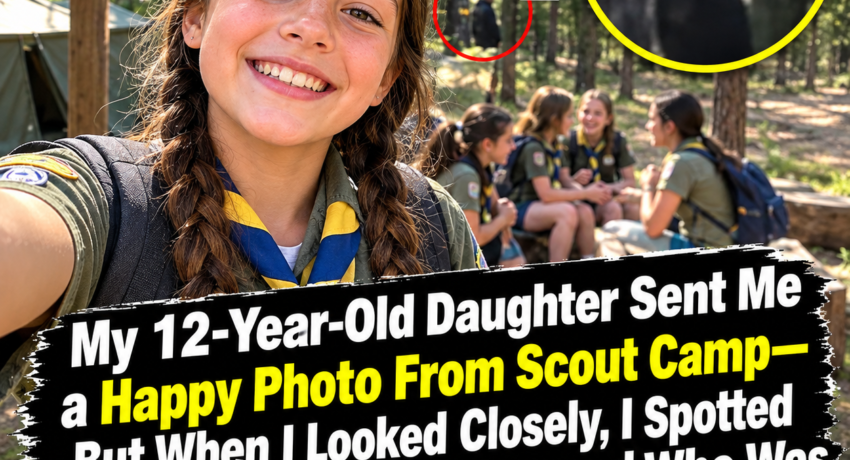
There was a photograph.
Ava stood near several picnic tables with girls from her troop behind her.
Her hair was pulled into a messy ponytail.
Her cheeks were pink from the sun.
She was smiling.
Underneath, she had written:
We just finished training and we’re heading to lunch. See? Everything’s fine. It’s so much fun here! Love you and miss you!
I smiled.
Actually smiled at my phone like an idiot.
Then I whispered to myself,
“See? She’s fine.”
I almost put the phone down.
Almost.
Instead, I looked at the photograph one more time.
And that was when I noticed the girl sitting behind Ava.
Loose light-brown hair.
Pink shirt.
Her body was turned partly away from the camera, but I knew her immediately.
Maddie.
I knew Maddie because her mother, Beth, and I had talked for nearly twenty minutes in the parking lot before the girls left for camp.
And I knew something else.
Maddie wasn’t at camp anymore.
Beth had called me the night before.
Maddie had gotten sick.
She had gone home.
I zoomed in.
My heartbeat changed.
Definitely Maddie.
I reread Ava’s message.
We just finished training.
Not This was earlier.
Not Look at yesterday.
Present tense.
I called Ava.
No answer.
I waited twenty seconds.
Called again.
Nothing.
And just like that, a photograph that had been meant to reassure me became the most unsettling thing I had seen all week.
Part 2 — “Where Is My Daughter?”
For the first few minutes, I tried to be rational.
Maybe Ava had accidentally attached an older picture.
Maybe the message had been sitting unsent for a day.
Maybe the camp had terrible service.
Maybe Maddie had only left that morning and Beth had misunderstood something.
Every reasonable explanation lasted about ten seconds before another question destroyed it.
Finally, I called the camp office.
A woman answered in the calm, practiced tone of someone who had probably spoken to hundreds of nervous parents.
“Good afternoon, Pine Ridge Camp.”
“Hi. My daughter is there with Troop 214. Her name is Ava.”
“Of course. Is everything all right?”
“I don’t know.”
That answer changed her tone immediately.
She transferred me to Ava’s group counselor, Marissa.
I explained the photograph.
The girl in the background.
The fact that Maddie had already gone home.
Then Marissa gave me a number and asked me to send the image.
I did.
Silence followed.
Too much silence.
“Marissa?”
“I’m here.”
“Please tell me there’s an obvious explanation.”
Another pause.
Then she asked,
“Are you sure Ava sent this today?”
My stomach dropped.
“Yes.”
“Okay…”
I stood up from my desk.
“What does ‘okay’ mean?”
“That photograph isn’t from today. Maddie left camp last night.”
“I know that. That’s why I’m calling.”
My voice came out sharper than I intended.
Then another thought hit me.
“Where’s Ava?”
“She’s safe.”
That answer did not comfort me.
It frightened me.
“Where is she?”
“She’s in the health cabin.”
I gripped the edge of my desk.
“What happened?”
“She reported an injury this morning. She said she twisted her ankle and couldn’t participate in activities.”
I stared at the message still glowing on my phone.
We just finished training.
“She told me she had just finished training.”
“I understand.”
“No. I don’t think you do.”
My voice lowered.
“My daughter does not normally lie to me.”
Marissa hesitated.
“Children sometimes behave differently when they’re away from home.”
There was something about that sentence I immediately disliked.
It sounded too easy.
Too dismissive.
“Can I speak to her?”
“Let me check.”
I waited.
Thirty seconds.
A minute.
My stomach grew tighter with every second.
When Marissa came back, her voice was careful.
“Ava doesn’t want to come to the phone.”
Something cold settled in my chest.
“Why?”
“I really can’t answer that.”
I didn’t ask another question.
I grabbed my bag, told my manager there was a family issue, and left work.
The camp was a little more than an hour away.
That drive felt endless.
My mind invented every possibility it could.
Had someone frightened her?
Had she been bullied?
Was she hurt but afraid to tell me?
Was she trying to protect somebody?
Had something happened at camp that no adult wanted to explain over the phone?
I forced myself to hold onto one fact.
Marissa had said Ava was physically safe.
But halfway there, I realized something that frightened me even more.
Physically safe and truly okay were not the same thing.
Part 3 — The Injury That Didn’t Exist
Marissa met me outside the health cabin.
She was younger than I had imagined from her voice.
Maybe twenty-four.
Twenty-five at most.
“Ava’s inside,” she said.
I didn’t bother with small talk.
“How bad is her ankle?”
Marissa shifted slightly.
“The nurse didn’t find any swelling.”
“Bruising?”
“No.”
“Did she fall?”
“She said she twisted it.”
Something about the way Marissa avoided my eyes told me there was more.
I walked inside.
Ava sat on the edge of a narrow bed.
Her backpack was beside her.
Her ankle was not wrapped.
There was no ice pack.
No crutches.
Nothing.
The instant she saw me, panic flashed across her face.
“Mom?”
I closed the door behind me.
“What are you doing here?”
I sat across from her.
“Show me your ankle.”
She froze.
I waited.
“Ava.”
Her eyes dropped.
And in that tiny movement, I knew.
Not what had happened.
Not why.
But I knew she had lied.
“You’re not hurt.”
She said nothing.
“Look at me.”
Slowly, she lifted her eyes.
They were already wet.
“Fine,” she whispered. “I’m not hurt.”
Then she leaned toward me.
“But you can’t tell anyone.”
That was not what I expected.
I sat back.
“Okay.”
She blinked.
“You’re not mad?”
“I’m confused. The mad part can wait.”
For the first time since I walked in, some of the tension left her shoulders.
I lowered my voice.
“Why did you fake an injury?”
Ava picked at the edge of the blanket.
“I didn’t want to do the challenge.”
“What challenge?”
“The final one.”
Her troop had spent months preparing for a large competition at camp.
Navigation.
First aid.
Climbing.
Problem-solving.
Teamwork.
They had practiced almost every weekend.
Ava had talked about it at dinner.
In the car.
While doing homework.
She knew the scoring system.
She knew which troops were strongest.
She had begged to attend camp partly because of that competition.
“You wanted to come here because of that challenge.”
“I know.”
“So why wouldn’t you participate?”
Her mouth tightened.
For a few seconds, she looked as though she might change her mind and tell me nothing.
Then she whispered,
“Because we’re cheating.”
I stared at her.
“What?”
Her eyes filled again.
“Not everybody. And not all the time. But enough.”
I said nothing.
I wanted her to keep talking.
“It started small,” she continued. “I didn’t really understand at first.”
“What kind of small?”
“Looking at things we weren’t supposed to see yet. Getting hints about where stations were. Stuff like that.”
She wiped at her cheek.
“Then we started winning.”
Her voice cracked.
“And people didn’t want to stop.”
My daughter had spent months wanting that trophy.
Suddenly I understood why her face looked more ashamed than frightened.
“I told them we shouldn’t do it,” she said.
“What happened?”
Ava looked toward the window.
“Kayla said everybody bends rules.”
Kayla.
One of Ava’s closest friends.
They had slept over at each other’s houses.
Made friendship bracelets.
Spent entire weekends together.
“What else?”
“She said nobody was getting hurt.”
Ava swallowed.
“Then Brianna said we’d worked all year for this. She said if I made a big deal out of it, everybody would lose because of me.”
My stomach tightened.
“And what did you say?”
“I told them I didn’t like it.”
Ava’s cheeks turned pink.
“Then Kayla asked if I was going to call you.”
I could already hear the tone.
Ava continued.
“She said maybe my mom could come fix camp for me.”
Her eyes dropped.
“Everybody laughed.”
That hurt her more than the cheating.
I could see it.
Being mocked by strangers is painful.
Being mocked by someone you love rearranges something inside you.
“So you told them you wouldn’t call me.”
She nodded.
And suddenly the photograph made sense.
“You sent the old picture because you wanted me to think everything was normal.”
Another nod.
“I just grabbed one where I looked happy.”
Her voice broke.
“Then I saw you calling, and I panicked.”
“Because you knew I’d hear something in your voice.”
“Yes.”
I exhaled slowly.
“And the fake ankle?”
“Today’s event counts the most.”
Ava rubbed her hands together.
“They need my score.”
Everything finally clicked.
If she competed and did well, she would help the team benefit from cheating.
If she deliberately performed badly, everyone would know.
If she reported the cheating, the troop could be disqualified.
So she had created a fourth option.
Or tried to.
“You wanted to disappear.”
Ava nodded.
“I thought if I was hurt, it wouldn’t be my fault.”
And there it was.
Not cowardice.
Not dishonesty for personal gain.
A twelve-year-old trying desperately to escape a choice in which every possible answer cost her something.
Part 4 — The Adult Who Told Her to Stay Quiet
I reached for Ava’s hand.
“Did you tell any adult what was happening?”
Her face changed immediately.
That was my answer.
“Who?”
She didn’t respond.
“Ava.”
“Marissa.”
The anger that had been focused on the girls shifted.
“What did she say?”
“Mom.”
“What did she say?”
Ava stared at the floor.
“She told me I needed to be careful about accusing people.”
I felt my jaw tighten.
“Did you give her examples?”
“Yes.”
“Names?”
“Yes.”
“And?”
“She said maybe I misunderstood some things.”
Ava’s voice became quieter.
“She said we should finish the week and talk about it later.”
I went still.
“Anything else?”
Ava hesitated.
Then whispered,
“She told me to think about the team.”
I stood.
Not suddenly.
Not dramatically.
But something inside me had changed.
Until then, I had been dealing with twelve-year-olds making poor choices because they wanted to win.
That was serious.
But understandable.
Children test boundaries.
Children follow friends.
Children convince themselves that small wrong choices don’t matter.
Adults are supposed to be the people they can go to when they realize they’ve crossed a line.
Ava had done exactly that.
And the adult she chose had essentially told her not to make things inconvenient.
I found Marissa outside.
“We need to talk.”
She looked past me toward the health cabin.
“Rachel, I think emotions are running high.”
“My daughter says she told you members of the troop were cheating.”
Marissa’s posture stiffened.
“She raised concerns.”
“That is a very careful way to say it.”
“I didn’t have proof.”
“Did you investigate?”
“I spoke with some of the girls.”
“Separately?”
Silence.
I stared at her.
“You spoke to them together?”
Marissa’s cheeks reddened.
“I was trying to understand what happened.”
“And what did you tell Ava afterward?”
“I told her to be cautious about making accusations she might not be able to take back.”
“She’s twelve.”
“I know.”
“She came to an adult because she didn’t know what to do.”
“I was trying to prevent unnecessary conflict.”
My anger sharpened.
“There was already conflict.”
Marissa looked away.
“You didn’t prevent anything. You asked the quietest person involved to carry it.”
That finally brought the program director into the conversation.
Her name was Ms. Alvarez.
And from the moment she arrived, the atmosphere changed.
She didn’t begin by telling me to calm down.
She didn’t defend anyone.
She asked questions.
Then she asked Ava if she was willing to tell the story from the beginning.
Ava did.
Slowly.
Painfully.
Ms. Alvarez listened to every word.
Then she began making calls.
The girls were interviewed separately.
And once that happened, the truth unraveled quickly.
Small details didn’t match.
One girl admitted they had received information they weren’t supposed to have.
Another admitted that people had shared answers.
Another confessed that some of them had pressured Ava to stay quiet.
It was messy.
But it was not mysterious.
Marissa hadn’t needed extraordinary proof.
She had only needed to take one frightened child seriously enough to look.
Part 5 — The Choice Ava Had Been Trying to Escape
By evening, Ava looked completely drained.
Ms. Alvarez asked if she would provide a written statement.
That statement would make everything official.
The troop would almost certainly be disqualified from the competition.
Ava asked to speak with me alone.
We sat on a bench behind the office.
For a while, she said nothing.
Then:
“If I write it, we lose.”
“Probably.”
“They’ll all know why.”
“Yes.”
“They’ll hate me.”
“Some of them might.”
“Kayla will.”
I didn’t argue.
Ava picked at a loose thread on her shorts.
Then she asked the question every parent wants to answer and sometimes shouldn’t.
“What do you think I should do?”
Every instinct in me screamed to tell her.
Write the statement.
Tell the truth.
Do the right thing.
But I stopped.
Because this was not a school worksheet.
There was no answer I could hand her that would save her from what came afterward.
So I said,
“I can’t make this choice for you.”
She looked irritated.
“That’s really helpful.”
Despite everything, I almost smiled.
“I can tell you something.”
“What?”
“Faking the injury didn’t get you out of the choice.”
Her expression tightened.
“It just delayed it.”
Her eyes filled.
“I know.”
“I think you were hoping there was a version where nobody lost anything.”
A tear slipped down her cheek.
“I wanted them to stop.”
“I know.”
“I wanted us to still win.”
“I know.”
“I wanted you not to find out.”
That one surprised me.
“Why?”
“Because I knew you’d make it serious.”
I let out a breath.
“Fair.”
She almost smiled.
Then her face crumpled.
“And I wanted Kayla to still be my friend.”
That was the real heart of it.
Not the trophy.
Not the challenge.
Kayla.
I put my hand over Ava’s.
“You were trying to find an answer where you could keep everything.”
She nodded.
“The team. The competition. Your friend. Everybody liking you.”
Another nod.
“But there isn’t one.”
“No.”
For about a minute, she cried.
Not loudly.
Just the exhausted tears of a child who had finally understood that doing the right thing does not always come with a painless ending.
Then she stood.
“I’ll write it.”
I looked up at her.
“You’re sure?”
“No.”
That answer hurt and impressed me at the same time.
She wiped her face.
“But I’m going to do it.”
Part 6 — “You Ruined Everything”
Ava gave the statement.
The troop was disqualified.
The decision was announced before dinner.
Most of the girls reacted exactly as Ava had feared.
Shock.
Anger.
Embarrassment.
A few cried.
Some blamed one another.
Then Kayla found Ava outside.
I was close enough to hear them but far enough away that I didn’t interfere.
“You ruined everything,” Kayla said.
Ava’s shoulders stiffened.
“I didn’t.”
“We would’ve won.”
“Not fairly.”
Kayla looked furious.
“I thought you were my friend.”
Ava’s voice shook.
“I am.”
“No, you’re not.”
Then Kayla walked away.
Ava didn’t chase her.
That mattered.
I could see how badly she wanted to.
But she stayed where she was.
That evening, Ms. Alvarez gathered the troop.
She spoke plainly.
The competition, she explained, was supposed to test skills.
But camp was supposed to teach something larger.
Judgment.
Trust.
Responsibility.
Character when nobody was applauding.
“If you win by breaking the values you’re supposed to be practicing,” she told them, “then the award doesn’t mean very much.”
Then she looked toward Ava.
“The hardest decision made this week was not made during a climbing challenge or navigation course.”
Ava immediately stared at the floor.
“It was made by someone who knew that telling the truth could cost her own team something.”
Ava’s ears turned red.
She clearly wanted to disappear again.
But this time, she stayed.
Marissa was removed from the competition program for the rest of camp pending a formal review.
Ms. Alvarez later apologized to Ava directly for the way her first report had been handled.
By then, I knew my daughter had endured enough for one day.
So I took her home.
Part 7 — Yes, She Was Still Grounded
We had been driving for about thirty minutes when Ava spoke.
“Am I grounded?”
I glanced over.
“Yes.”
Her head snapped toward me.
“What?”
“You heard me.”
“But I told the truth!”
“Eventually.”
She crossed her arms.
“I cannot believe this.”
“You lied to me.”
“I was under pressure.”
“I know.”
“You just saw what happened!”
“I did.”
“You know why I did it.”
“Yes.”
“Then how am I grounded?”
I almost laughed.
“Understanding why you made a bad choice does not magically make the choice good.”
She turned toward the window.
For the next several miles, she didn’t speak.
Then, quietly:
“Are you disappointed in me?”
That question hurt more than I expected.
I tightened my hands around the steering wheel.
“I’m disappointed that you lied to me.”
She didn’t move.
“I’m disappointed that you sent me a fake message.”
Nothing.
“And I’m disappointed that you thought you had to carry all of this by yourself.”
Her eyes stayed fixed on the road ahead.
Then I added,
“But I’m proud of what you did when you finally had to choose.”
She wiped one eye.
“Even though everybody lost?”
“Especially because you knew they might.”
She looked at me.
“I think Kayla hates me.”
“I know.”
“What if she never talks to me again?”
That was the one thing I couldn’t fix.
I couldn’t promise Kayla would understand.
I couldn’t promise friendship would survive.
I couldn’t tell Ava that honesty always repairs everything.
Sometimes it doesn’t.
Sometimes the truth costs something real.
So I said,
“Then telling the truth cost you something that mattered.”
She stared at me.
“You’re supposed to say something inspiring now.”
“I don’t have anything inspiring.”
For the first time all day, Ava laughed.
Just once.
A tired little laugh.
But I took it.
Part 8 — The Picture Wasn’t Completely Fake
When we arrived home, Ava handed me her phone without being asked.
I raised an eyebrow.
“What’s this?”
“If I’m grounded, you’re taking it anyway.”
“Good thinking.”
She started upstairs.
Then stopped at the bottom step.
“Mom?”
“Yeah?”
She hesitated.
“I really did have fun at first.”
I waited.
“The picture wasn’t completely fake.”
“No?”
She shook her head.
“I was happy when we took it.”
For some reason, that sentence stayed with me.
Because that photograph had frightened me so badly when I first saw it.
For hours, I had thought it represented a lie.
And it did.
But not entirely.
The smile had once been real.
That somehow made the whole situation more complicated and more human.
Ava had loved camp.
She had loved her friends.
She had wanted to win.
She had wanted all the things children are allowed to want.
She had simply reached a moment when getting what she wanted required becoming someone she didn’t want to be.
And she hadn’t known how to handle that.
A few nights later, Kayla texted her.
Ava brought me the phone.
“She says she’s still mad.”
“That sounds honest.”
“She says she doesn’t know if we’re friends anymore.”
I watched Ava’s face fall.
Then she kept reading.
After a few seconds, her expression changed.
“What?”
“She said…”
Ava swallowed.
“She said the cheating probably would’ve kept happening if nobody stopped it.”
Neither of us spoke for a moment.
Then Ava placed the phone on the table.
“That’s not exactly an apology.”
“No.”
“But it’s not nothing.”
“No.”
A few weeks later, she told me she might not go back to camp the following summer.
I didn’t push.
Then, about a minute later, she shrugged.
“Maybe I will.”
I looked at her.
“You sure?”
“I still like camping.”
And that was when I realized the lesson had not been that camp was bad.
Or that friends couldn’t be trusted.
Or that speaking up would always make people grateful.
The lesson was harder than that.
Sometimes good people make bad choices.
Sometimes the people you love pressure you to become someone you don’t recognize.
Sometimes adults fail to protect children because avoiding conflict feels easier than confronting it.
And sometimes doing the right thing does not leave everyone happy.
Ava had learned all of that at twelve.
I wished she hadn’t needed to.
But I was proud that when the moment finally came, she chose to tell the truth even knowing it would cost her.
And for now, that felt like enough.