
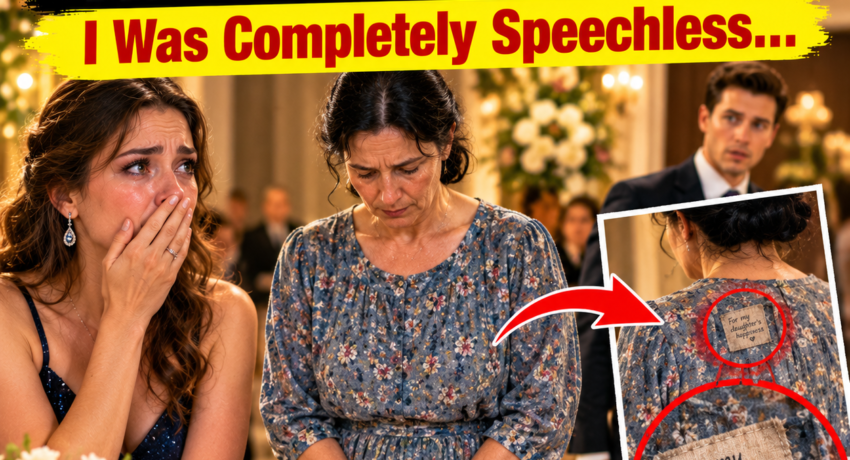
Part 1 — The Dress I Wished She Hadn’t Worn
The moment my mother walked into my engagement dinner, I knew the evening was going to be harder than I had imagined.
Not because she looked nervous.
My mother, Lillian, rarely looked nervous.
She entered the restaurant with her shoulders straight, her old black purse tucked beneath one arm, and the same quiet confidence she had carried through most of my childhood.
What made my stomach drop was her dress.
It was faded.
Floral.
Soft from years of washing.
And painfully familiar.
I hadn’t seen it in a long time, but I recognized it immediately.
Mom had worn that dress to school concerts when I was a child. Parent-teacher nights. Award ceremonies. Little events where she would rush straight from work, change her shoes in the car if she had time, smooth down the fabric, and walk into the auditorium smiling as though she hadn’t just spent ten hours on her feet.
When I was ten, seeing those faded flowers in the audience had made me feel safe.
At twenty-seven, standing in one of the most expensive restaurants in the city, all I could see was how inexpensive the dress looked.
And I hated myself for it.
My future mother-in-law, Deborah, stood as Mom approached our table.
Deborah looked beautiful, of course.
Everything about her had been carefully chosen—her cream silk blouse, the delicate gold bracelet at her wrist, the soft gray jacket that probably cost more than the monthly rent on my first apartment.
Her eyes traveled slowly from Mom’s worn flats to the little flowers on her dress.
Then she smiled.
“Oh,” she said. “How… comfortable, Lillian.”
The pause before comfortable said everything.
Mom smiled pleasantly.
“Thank you, Deborah.”
My fiancé, Josh, shifted in the chair beside me.
His father, Frank, stood and pulled out the empty chair next to mine.
“Lillian, we’re glad you made it.”
“Wouldn’t miss it,” Mom replied.
She sat beside me.
The second she did, I leaned toward her.
“You okay?”
“Perfectly fine.”
Her voice was calm.
Too calm.
I looked at the dress again.
Mom had nicer clothes.
Much nicer.
She owned a navy dress I had helped her choose for a charity dinner the previous year. She had a green wrap dress that looked beautiful on her. She even owned a black cocktail dress that would have fit perfectly into this room.
Yet she had deliberately chosen the oldest-looking thing in her closet.
I couldn’t understand it.
Across the table, Deborah glanced toward the window.
“I hope parking wasn’t too difficult.”
“I found a spot a few blocks away,” Mom said.
“You walked?”
Mom blinked.
“That’s usually how I get from one place to another.”
Frank laughed.
Josh smiled into his water glass.
Deborah didn’t.
I felt heat creeping up my neck.
“My mom’s very independent,” I said quickly.
Mom turned her head toward me.
“I can speak for myself, Grace.”
The words weren’t harsh.
That almost made them worse.
Because she was right.
We had been at the table for less than five minutes, and I was already translating her, smoothing her edges, trying to make sure everyone understood that my mother knew how to behave.
As though she needed my help.
As though I were embarrassed by the woman who had raised me.
Part 2 — The Family I Was Trying Too Hard to Impress
I had spent the entire week worrying about that dinner.
Josh’s family had money.
Not loud money.
Not the kind that came with gold cars and enormous logos.
Their wealth showed itself quietly.
Annual ski trips.
Club memberships.
Wine ordered without checking the price.
Hotels chosen by reputation rather than cost.
Restaurants with no dollar signs on the menu.
Josh had grown up in that world without thinking much about it.
I hadn’t.
Mom raised me alone.
When I was young, she worked two jobs for several years—one at an administrative office during the day and another three evenings a week at a medical billing center.
We were never homeless.
We never went hungry.
But there were years when everything had to be calculated.
School shoes lasted until they truly no longer fit.
Vacations meant driving somewhere close.
Eating out meant a diner or pizza.
Mom clipped coupons, compared prices, and somehow made every Christmas feel generous even when I later realized there hadn’t been much money.
I had spent most of my life being proud of her.
At least, that was what I told myself.
But somewhere between college, my first corporate job, and falling in love with Josh, pride had become mixed with something I didn’t like admitting.
I wanted people like Deborah to see that I belonged.
And I had become very good at polishing the parts of my story that might make them think otherwise.
That night, I wanted the two sides of my life to fit together so badly that I could feel myself trying to manage the whole table.
Deborah looked at Mom’s menu.
“I hope it isn’t too unfamiliar.”
Mom glanced up.
“The menu?”
“It’s a tasting menu, Lillian.”
Josh exhaled quietly.
“Mom.”
Deborah gave him an innocent look.
“I was only trying to be helpful.”
I jumped in before Mom could answer.
“Mom’s been to plenty of nice restaurants.”
Mom turned toward me.
“Grace.”
“I was just saying—”
“I know what you’re doing.”
Her voice was low enough that only I could hear.
“Please stop.”
That hurt.
Mostly because I knew exactly what she meant.
The first course arrived, and for a few minutes, things improved.
Frank asked Mom about her garden.
Josh told a ridiculous story about the first time he had tried to help me assemble a bookshelf and somehow put one entire side on backward.
Mom laughed so hard she nearly spilled her water.
For a moment, I thought maybe I had worried for nothing.
Then Deborah looked directly at Mom.
“Have you ever eaten at a restaurant like this before?”
My fork stopped halfway to my mouth.
“Deborah,” I said.
She turned toward me.
“What?”
“You don’t need to keep asking questions like that.”
“Like what?”
Mom placed one hand gently over my wrist.
“Let me answer.”
Then she looked across the table at Deborah.
“Yes. I have.”
Deborah smiled.
“Of course you have, darling.”
There was something in that smile I couldn’t ignore.
Josh leaned closer to me.
“She’s nervous,” he murmured. “Ignore her.”
I turned toward him.
“Why should I?”
“Because if you react to everything she says, this dinner is going to turn into something else.”
“It already is.”
His hand came down on my knee beneath the table.
“Grace, please. Let’s just get through tonight.”
I stared at him.
“By pretending your mother isn’t insulting mine?”
Before he could answer, Deborah lifted her wineglass.
“Grace, your dress is lovely.”
I looked at her cautiously.
“Thank you.”
“You understood exactly what kind of evening this was.”
I felt my spine stiffen.
“What does that mean?”
Her eyes flickered toward my mother.
“You dressed for the occasion.”
Josh sat back.
“Mom. Enough.”
Deborah frowned.
“I gave her a compliment.”
Mom lifted her own glass.
“Grace always looks beautiful.”
She sounded completely unbothered.
That bothered me more than if she had snapped.
I leaned closer.
“Mom, why aren’t you saying anything?”
She looked at me.
“About what?”
“About her.”
Mom calmly took a sip of water.
“Because I’m listening.”
“To what?”
“Everyone.”
The answer stopped me.
There was something behind her calm.
Something deliberate.
And suddenly the faded floral dress didn’t feel accidental anymore.
Part 3 — “Why This Dress?”
I lasted another ten minutes before I couldn’t take it.
Under the table, I tugged lightly at Mom’s sleeve.
“You own nicer dresses.”
Her eyes stayed on Frank as he spoke.
“I know.”
“Then why did you wear this one?”
She finally looked at me.
“Not here, Grace.”
“Then where?”
She placed her napkin beside her plate.
“The restroom will do.”
She stood.
Josh touched my hand as I moved to follow her.
“Give her a minute.”
I pulled away.
“No. I’m done guessing.”
Mom was washing her hands when I entered the restroom.
The door closed behind me.
For the first time all evening, we were alone.
“Mom.”
She looked at my reflection in the mirror.
“What?”
I hesitated.
There was no graceful way to ask the question.
So I didn’t try.
“Why would you wear that tonight?”
She dried her hands slowly.
Then she turned around.
“You’re embarrassed.”
It wasn’t a question.
My eyes dropped.
“A little.”
The admission tasted terrible.
“I just wanted tonight to go well. I wanted to make a good impression.”
“On Deborah?”
“On everyone.”
Mom studied me.
There was no anger in her face.
That somehow made me feel younger.
Smaller.
Then she gave me a sad little smile.
“Honey, I didn’t choose this dress by accident.”
I looked up.
“What do you mean?”
She reached into her purse.
Pulled out her phone.
Unlocked it.
Then held it toward me.
“Read.”
Deborah’s name appeared at the top of the message thread.
The first message was polite enough.
The restaurant is more formal than it sounds. I didn’t want you to feel underdressed, Lillian.
Mom had replied that she already had something appropriate.
Deborah answered:
If cost is an issue, please let me send you something for the outfit. I’d hate for Grace to feel awkward.
I stared at the screen.
“She offered you money?”
“Keep reading.”
Below that were several links.
Expensive dresses.
Designer department stores.
A pair of shoes.
Mom had declined again.
Then came the message that made my stomach tighten.
I just want everyone to look like they belong together.
I read it twice.
Then I scrolled.
The final message was worse.
Josh said you’d understand. He knows how important the engagement dinner is to us.
My hands went cold.
“Josh?”
Mom gently took the phone from me.
“I don’t know exactly what he knew.”
“Why didn’t you tell me?”
“What would you have done?”
“I would’ve called her immediately.”
“Exactly.”
“She deserved it.”
“I’m not saying she didn’t.”
“Then why keep this from me?”
Mom leaned against the counter.
“Because you would have called Deborah. Deborah would have apologized just enough to end the argument. Josh would have tried to smooth everything over. And then you probably would’ve asked me to wear something else tonight.”
My mouth opened.
I wanted to deny it.
I couldn’t.
Mom nodded.
“I know you, Gracie.”
My eyes began to sting.
“So this was a test?”
“No.”
Her answer came immediately.
“I didn’t wear this because I needed Deborah to prove what kind of woman she is. She already did that in those messages.”
“Then why?”
Mom looked down at the faded flowers.
“When you were little, I wore this dress everywhere because it was cheap, washable, and decent enough that I could leave work and go straight to your school events.”
I swallowed.
“I remember.”
“I was tired most of those nights.”
Her voice softened.
“Sometimes I hadn’t eaten since lunch. Sometimes I had exactly twenty dollars until payday. But you’d find me in the audience and smile.”
Tears pressed behind my eyes.
She looked back at me.
“I spent years working so you would have choices I didn’t have.”
“I know.”
“No, honey. Listen.”
Her voice wasn’t angry.
It was steady.
“I did not work that hard so you could grow up believing people like Deborah get to decide whether we look respectable enough to sit beside them.”
I couldn’t speak.
“And I am tired of people treating me like I belong only after I’ve changed enough to make them comfortable.”
Then she looked directly into my eyes.
“And I needed you to see that before you married into this family.”
The words landed hard.
Because the ugliest realization of the evening wasn’t that Deborah had judged my mother.
It was that I had walked into the restaurant and done the same thing.
In a kinder voice.
With better intentions.
But I had still done it.
Mom opened the restroom door.
“Are you coming back?”
I looked at myself in the mirror.
My makeup was perfect.
My hair was perfect.
My dress was exactly right for the room.
My hand drifted toward my engagement ring.
For the first time since Josh had put it on my finger, it felt heavier than jewelry.
“Yes,” I said.
“I’m coming.”
Part 4 — The Question Josh Couldn’t Answer
We returned to the table together.
Josh immediately stood and pulled out my chair.
“Everything okay?”
I didn’t sit.
“No.”
His expression changed.
Deborah looked between us.
I turned toward Josh.
“Did you know your mother was telling mine what to wear tonight?”
His first instinct told me everything.
He looked at Deborah.
Not at me.
“Josh,” I said.
He rubbed the back of his neck.
“She told me she wanted to help Lillian with the dress code.”
“And what did you say?”
“I said if she thought your mom would appreciate it, fine.”
My chest tightened.
“Did you ask why your mother thought mine needed help?”
He hesitated.
“No.”
Deborah placed her glass down.
“I was trying to be considerate, Grace.”
“By offering my mother money?”
“I wanted to make sure she wasn’t uncomfortable.”
Mom finally spoke.
“Whose discomfort?”
Deborah’s mouth tightened.
“I was trying to prevent an awkward situation.”
Frank shifted in his chair.
“We’ve made the point. Maybe we should finish dinner.”
“Dad’s right,” Josh said quickly.
And suddenly I saw the pattern.
Deborah said something cruel.
Josh asked everyone else not to react.
Frank redirected the conversation.
The problem disappeared without Deborah ever changing.
Everyone called that peace.
But it wasn’t peace.
It was accommodation.
And someone else always had to pay for it.
“Grace,” Josh said quietly. “Please sit down.”
I looked at the empty chair.
“What happens if I do?”
He frowned.
“What do you mean?”
“We finish dinner. We eat dessert. Everyone goes home. Tomorrow your mother says she was misunderstood.”
Deborah stiffened.
“I would never say that. Don’t speak for me.”
I turned toward her.
“You don’t have to. Everyone else speaks for you.”
Frank exhaled heavily.
“This is getting us nowhere.”
I shook my head.
“No. I think this is the first honest conversation we’ve had.”
My hand moved toward my engagement ring.
Josh saw it immediately.
His face changed.
“Grace.”
I slid the ring from my finger.
“Don’t.”
His voice came out sharper now.
For the first time that night, he looked truly afraid.
I placed the ring beside my plate.
The tiny diamond caught the restaurant light.
“I’m not ending our relationship tonight.”
Josh stared at me.
“Then what are you doing?”
“I’m stopping the wedding plans.”
Deborah’s face went blank.
Frank looked down at the table.
Josh whispered my name.
I continued.
“I need to decide whether I can marry into a family where this is considered normal.”
Deborah gave a short, disbelieving laugh.
“Over a dress, Grace?”
I turned toward her.
“No.”
My voice was calm now.
“Over the fact that you decided my mother had to look different before she could sit comfortably at this table.”
I pointed toward Josh.
“And over the fact that your son knew enough about it to let you try.”
“That isn’t fair,” Josh said.
“Then tell me what happened.”
He opened his mouth.
Then looked toward his mother again.
There it was.
Again.
“Josh,” I said quietly. “Look at me.”
He did.
“Did you think my mother needed help fitting in?”
“No.”
“Then why didn’t you ask your mother why she thought she did?”
He had no answer.
Frank interrupted.
“This conversation belongs somewhere private.”
I picked up my purse.
Then I took the ring from the table and placed it inside.
“My mother was expected to swallow the humiliation in public. I’m not moving the truth somewhere private just because it makes the rest of you uncomfortable.”
Mom stood beside me.
She didn’t tell me to stay.
She didn’t tell me to leave.
She let the decision be mine.
Before walking away, I looked at Josh one last time.
“This was never about what my mother wore.”
My voice trembled slightly.
“It’s about why anyone here thought she had to earn the right to belong.”
Then Mom and I left together.
Part 5 — The Part That Hurt Most
We reached Mom’s car before she said anything.
“You didn’t have to do that for me.”
I looked at her.
“I didn’t.”
She waited.
“I did it for me too.”
For the first time that night, she smiled.
Not triumphantly.
Almost sadly.
Then she hugged me.
I cried against her shoulder in a parking garage while people walked past us carrying restaurant bags and car keys.
It wasn’t only Deborah.
That would have been easier.
I was crying because Josh had disappointed me.
Because I had disappointed myself.
Because a dress I used to associate with childhood safety had become something I wanted my mother to hide.
And because I had spent years believing I had escaped the insecurity of growing up with less, when in reality I had simply learned to disguise it.
That night, Josh came to my apartment.
I let him inside.
I didn’t offer him anything to drink.
He remained near the door for several seconds before finally speaking.
“I knew my mother could be difficult.”
I folded my arms.
“Then why have you spent our entire relationship asking me to ignore her?”
“Because that’s how we deal with her.”
“We?”
“My dad. Me. Everyone.”
“And who pays for that?”
He looked away.
I waited.
He finally sat down.
“You embarrassed me tonight.”
The words hit me harder than I expected.
“You think I embarrassed you?”
“You could’ve pulled me aside.”
I stared at him.
“And my mother?”
“What about her?”
“She could be judged publicly, but you deserved privacy?”
His face tightened.
“That isn’t what I meant.”
“But it’s what happened.”
He rubbed both hands over his face.
Then he said something I wasn’t prepared for.
“You were embarrassed by her dress too.”
Silence filled the room.
For one brief, furious second, I wanted to deny it.
To tell him he didn’t get to use my shame against me.
But he was right.
“Yes,” I said.
Josh looked surprised.
“I was.”
I sat across from him.
“But not because my mother did anything wrong.”
He stayed quiet.
“I spent my whole childhood knowing what she sacrificed for me. I used to be proud that she could turn almost nothing into enough.”
My voice began to crack.
“Then somewhere along the way, I started worrying that other people might be able to see how hard things had been.”
Josh’s expression softened.
“I think I started polishing the story.”
“What do you mean?”
“I told people Mom raised me alone. But I talked about her strength more than the struggle. I said she worked hard, but I avoided saying there were months when she counted every dollar.”
I looked toward my bare hand.
“I wanted people to admire where I came from without seeing anything messy about it.”
Josh said nothing.
“I need to understand why I care so much about that before I plan another part of this wedding.”
“And us?”
I looked at him.
“You need to understand something too.”
“What?”
“I’m not asking whether you love me.”
He looked hurt.
“I know you do.”
“Then what are you asking?”
“Whether loving me is enough to make you uncomfortable when your family treats me—or my mother—badly.”
He looked down.
And neither of us had an easy answer.
Part 6 — Deborah Called the Next Day
Deborah called the following afternoon.
I almost let it go to voicemail.
Then I answered.
“Grace.”
Her voice was careful.
“I think last night got away from all of us.”
I stared at my bare ring finger.
“I don’t.”
Silence.
“I was trying to help.”
“I know you believe that.”
“I was trying to make sure you didn’t spend your engagement dinner feeling uncomfortable.”
“Then listen to what actually made me uncomfortable.”
She went quiet.
“You don’t send my mother dress links.”
No response.
“You don’t offer her money because you’ve decided she might embarrass me.”
Still nothing.
“You don’t decide how she needs to look before she walks into a room with your friends or family.”
“I wish you would understand the position I was in.”
I almost laughed.
“What position was that?”
“I wanted the evening to be elegant. There were expectations.”
“And my mother failed those expectations by existing in the wrong dress?”
“That isn’t what I said.”
“No. You were careful not to say it directly.”
Her voice hardened.
“I think you’re overreacting.”
That sentence clarified everything.
I took a slow breath.
“I’m not deciding what kind of person you are, Deborah.”
“What does that mean?”
“It means I don’t need you to agree with my interpretation of last night.”
She was silent.
“I’m deciding what treatment I will accept.”
“And if I think this is unreasonable?”
“Then at least we understand each other.”
I looked at the empty place on my finger.
“There won’t be a wedding until something changes.”
She didn’t answer.
For the first time in my relationship with Josh’s family, I ended a conversation without trying to make sure everyone felt comfortable afterward.
It felt strange.
Then it felt freeing.
Part 7 — What the Dress Really Meant
That evening, I went to Mom’s house.
The floral dress was draped over the back of a kitchen chair.
I stopped beside it.
“Why this one?”
Mom looked over.
“I already told you.”
“No. Why this exact dress?”
A mischievous smile appeared.
“Because Deborah would hate it.”
“Mom.”
She laughed.
Then her expression softened.
“I bought that dress when you were eleven.”
I ran my fingers over one sleeve.
“I remember.”
“It was on sale.”
“Of course it was.”
“Very on sale.”
I laughed.
Mom sat down.
“It was cheap enough that I could afford it. Washable enough that I didn’t need dry cleaning. And respectable enough that if I left work ten minutes late, I could still make it to your school without changing.”
I sat beside her.
“I hated it when I was twelve.”
“So did I.”
I looked at her.
“You did?”
“Grace, look at those flowers.”
For the first time in two days, I really laughed.
Then my smile faded.
“I think I know why I hated it.”
Mom waited.
“I thought it told people something about us.”
“What?”
“That we didn’t have much.”
Mom’s eyes softened.
“I thought if people could see that, they would think less of you.”
“Or you.”
I swallowed.
“Yes.”
For years I had told people I was proud of my mother.
And I was.
But pride had become tangled with concealment.
I was proud of what she had survived as long as nobody could see the scars of surviving it.
“I thought defending you meant making sure nobody could tell we struggled.”
Mom reached for my hand.
“And now?”
I looked at the faded flowers again.
“Now I think acting like survival is something we should hide insults both of us.”
Mom’s eyes filled.
“That’s my girl.”
I leaned against her shoulder.
For a little while, we sat without speaking.
And for the first time in years, that old floral dress looked the way it had when I was a child.
Not cheap.
Not embarrassing.
Familiar.
Part 8 — Josh Had to Decide Who He Wanted to Be
A week passed before Josh came over again.
He didn’t bring flowers.
He didn’t bring gifts.
I appreciated that.
He sat across from me at the kitchen table.
“My mother called me three times yesterday.”
I raised an eyebrow.
“That sounds peaceful.”
He almost smiled.
“She wanted me to explain her position to you.”
“And?”
“I told her no.”
I waited.
Josh continued.
“I told her I wasn’t carrying messages between the two of you anymore.”
That mattered.
But it wasn’t enough.
“And what happens next time she says something insulting?”
His face became serious.
“I address it.”
“Before I have to?”
“Yes.”
“Even if your father wants everyone to move on?”
“Yes.”
“Even if your mother cries?”
He hesitated.
I noticed.
“So that’s harder?”
“She’s still my mother.”
“I’m not asking you to stop loving her.”
“I know.”
“Then what am I asking?”
Josh looked down at his hands.
“To stop making everyone else absorb her behavior because confronting her is uncomfortable.”
I nodded.
“Yes.”
He sat quietly for a moment.
Then said, “I didn’t realize how much we all do that.”
“I think your mom counts on it.”
“She does.”
I leaned back.
“Josh, I’m not going to marry you because you stood up to your mother once.”
“I don’t expect you to.”
“I mean it.”
“So do I.”
“Marriage cannot be me joining your family and learning how to survive the parts you’ve all decided are unchangeable.”
He held my gaze.
“And it can’t be me rescuing you from your family either.”
Something in my chest loosened.
“Yes.”
Josh nodded slowly.
“It has to be us building our own family.”
“And protecting it.”
“Even when the problem comes from mine.”
“Especially then.”
He didn’t argue.
For the first time since the engagement dinner, I believed he understood the difference.
Not completely.
Maybe not yet.
But enough to begin.
I went into my bedroom.
When I returned, the engagement ring was in my hand.
Josh stared at it.
He didn’t reach for it.
I liked that too.
“We’re trying again,” I said.
He nodded.
“That doesn’t mean everything is forgiven.”
“I know.”
“It doesn’t mean we’re rushing back into wedding planning.”
“I know.”
“And if this turns into you waiting for me to stop being angry—”
“It won’t.”
I studied his face.
Then I slid the ring onto my own finger.
Not because everything had been repaired.
Because this time, I wanted wearing it to mean something different.
Not that I had been chosen.
Not that I had entered some better family.
That Josh and I were choosing to build one together.
And that choice came with responsibilities neither of us could ignore.
Part 9 — Whatever Makes You Feel Like Yourself
A few weeks later, Mom and I were sitting at her kitchen table when she looked at me over her coffee.
“So.”
I knew that tone.
“What?”
“If you two actually manage to make it to a wedding…”
I groaned.
“Mom.”
“What am I supposed to wear?”
I smiled.
“Whatever makes you feel like yourself.”
Her eyes slowly moved toward the floral dress hanging near the laundry room.
I pointed at her immediately.
“Don’t test me.”
She burst out laughing.
So did I.
And maybe that was the strangest part of everything.
The dress was still ugly.
I still wouldn’t have chosen it.
It hadn’t magically become stylish just because it taught me something important.
But I no longer cared what anyone might think it said about us.
Because now, when I looked at those faded flowers, I remembered what they had actually represented.
A mother leaving work and racing across town so her daughter could find her in the audience.
A woman stretching one paycheck farther than it should have gone.
A parent making sure her child felt secure even when she herself wasn’t.
There was nothing shameful in that story.
The shame had been in believing it needed to be hidden.
For years, I thought moving upward in life meant distancing myself from anything that revealed how hard the climb had been.
That engagement dinner taught me otherwise.
Marriage wasn’t supposed to give me a more impressive family.
It wasn’t supposed to erase where I came from.
It wasn’t a reward for finally learning how to belong in expensive rooms.
Marriage was supposed to give me a partner.
Someone who would stand beside me even when doing so made the room uncomfortable.
Someone who didn’t ask me to tolerate disrespect simply because confronting it would be inconvenient.
And I needed to be capable of offering the same loyalty to the people who had loved me long before I ever owned the right dress.
Before I walked down any aisle, there was one thing I finally understood.
Belonging was never supposed to depend on what my mother wore.
And love should never require someone to make themselves smaller, quieter, richer-looking, or easier to accept before they are welcomed to the table.