PART 1 — The Knock
The knock came just after nine on a Sunday morning, and it was nothing like the way our neighbors usually knocked.
Three hard hits. Fast. Deliberate.
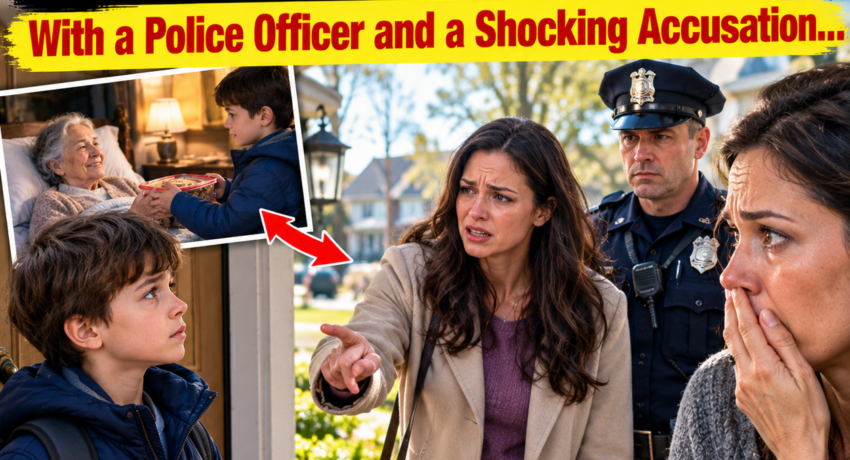
I was still in yesterday’s sweatpants, coffee halfway to my mouth, when I opened the door and found a woman I had never seen before standing beside a uniformed police officer.
My stomach dropped before either of them said a word.
“Ma’am,” the officer began, “is your son home? We need to ask him about something taken from your neighbor’s house yesterday.”
Taken. The word landed strange in my ears, like it belonged to someone else’s morning, not mine.
“Taken?” I looked past him to the woman. She was maybe mid-forties, arms crossed so tightly it looked like she was holding herself together. “Who are you?”
“I’m Diane,” she said. “Margaret is my mother.”
That single sentence rearranged something in my head. In two months of Saturday visits, of cookies and crossword puzzles and Sudoku arguments drifting through our kitchen window, I had never once heard my son mention a daughter. I hadn’t known Margaret had one.
“A wooden bird is missing from my mother’s house,” Diane said, her jaw tight enough to ache. “My mother was hospitalized last night. Your son visited her yesterday afternoon. Now it’s gone.”
“You think my eleven-year-old stole from her?”
“I think he was the last person in that house.”
I want to tell you I had some clever answer ready. I didn’t. I stood there in my doorway with my coffee going cold in my hand, trying to catch up to a conversation that had started three steps ahead of me.
Because to understand why a grown woman had shown up at my house with a police officer over a wooden bird, you’d have to go back to the beginning. Back to a Saturday morning two months earlier, before any of us knew Margaret Whitaker had a secret worth protecting — or that my son was the one she’d chosen to protect it.
It started, like most of the good things Ethan does, with something small enough that I almost missed it.
He is eleven. He has a habit of collecting old people the way other kids collect trading cards — quietly, sincerely, without any of the impatience most children his age have for anyone who talks slowly or repeats a story. At his cousin’s wedding, he once sat with my ninety-year-old great-aunt for the better part of an afternoon because she told him she’d ridden a horse to school as a girl, and he wanted to hear every detail of that horse.
So when Margaret got sick, I wasn’t surprised that Ethan noticed before I did. I was only surprised at how far he was willing to go about it.
PART 2 — Two Houses Down
Margaret Whitaker lived two doors from us, in a small brick house with green shutters that had needed paint longer than either of us had lived on the street. She was somewhere in her seventies, though she never said exactly, and she lived alone. In three years of being her neighbor, I had never once seen anyone visit her. Not a nephew, not a friend from church, not so much as a delivery van that lingered.
We waved when we crossed paths at the mailbox. Sometimes I’d stop and talk to her while she watered the roses that ran along her front walk, the only part of that house she kept meticulously alive. She was polite in the particular way of people who have decided, a long time ago, not to need anything from anyone. Private. Contained.
I had no idea how lonely that containment actually was until my son decided to break into it with a plate of cookies.
It happened on a Saturday morning while I was making coffee. Ethan stood next to me at the counter, quiet in the way that meant he was building up to something.
“Can we bake cookies for Mrs. Margaret?”
I looked over at him. “Why?”
He shrugged, the universal eleven-year-old gesture for I have a real reason but I’m not going to make this easy for you. “She’s sick.”
“How do you know that?”
“She told Mr. Campbell she hasn’t been feeling good.”
Mr. Campbell was our next-door neighbor and, apparently, the unwitting center of an entire intelligence network run by my son.
“You eavesdropping now?” I asked, trying not to smile.
“I was taking out the trash.”
“Convenient.”
He ignored that completely. “She probably gets lonely. I bet some cookies would cheer her up.”
So we baked cookies. Nothing fancy — chocolate chip, the recipe I could make with my eyes closed. Ethan packed them into one of the old tins I keep around from Christmas and walked them down the street himself, refusing my offer to come along. I watched from the kitchen window as Margaret opened her door.
She looked surprised first. Then something in her face loosened, and she smiled.
Ethan disappeared inside. Twenty-five minutes later he came home carrying the tin, empty.
“She ate all of them?”
“No. She put them on a plate.”
“Then why’s the tin empty?”
“She said containers are how people accidentally stop being friends.”
I laughed out loud at that, standing in my own kitchen, not knowing yet how much those two would come to mean to each other.
It became their thing after that. The next Saturday, blueberry muffins. The Saturday after, banana bread that came out a little too dense, which Margaret apparently ate anyway and told him so. Every week, Ethan carried something down the street and stayed for twenty or thirty minutes — sometimes longer. They did crossword puzzles together. He brought his vocabulary homework and she quizzed him without mercy. They argued, seriously and often, over Sudoku.
“She’s cheating somehow,” he told me once, dead certain.
“At Sudoku?”
“Nobody’s that fast.”
I liked seeing him happy in that specific, unhurried way. And if I’m honest with myself now, I liked something else too — I liked knowing that somebody was checking on Margaret every week. Somebody was noticing if her lights were off, if she looked tired, if she was eating.
Because she was getting worse. Some Saturdays she answered the door already in her pajamas, apologizing for it. Other weeks Ethan came home and told me she’d stayed sitting at her kitchen table the whole visit because standing up made her dizzy.
I suggested, gently, that maybe he should let her rest instead of visiting.
He looked at me like I’d suggested something close to betrayal. “She likes when I come.”
“I know. I just don’t want you tiring her out.”
“She says I’m less tiring than adults.”
That sounded exactly like Margaret. And I let it go, because some part of me — some part I hadn’t examined closely enough yet — understood that whatever was happening between an eleven-year-old boy and a woman who used to sit alone in a house nobody visited, it mattered more than my caution.
I had no idea, that whole two months, that Margaret Whitaker was quietly preparing my son for something. That every crossword and every Sudoku argument was also, underneath, a woman deciding who she could trust.
I found that out on the Sunday the knocking started.
PART 3 — The Doorstep
So there we were. Diane on my porch with a police officer at her shoulder, demanding to know where a wooden bird had gone, and me standing in the doorway with no idea what she was talking about — until I heard footsteps behind me in the hallway and turned to see my son.
Ethan had gone pale. Not nervous-pale. Something closer to caught.
Diane’s eyes locked onto him instantly, the way a person looks at someone they’ve already decided is guilty. “Where is my mother’s wooden bird?”
He froze.
That was the moment I understood he knew exactly which bird she meant.
“You have it?” I asked him.
He nodded, not looking at either of us.
“Go get it.”
He came back a minute later holding a small dark wooden wren, its feathers carved in careful, overlapping lines. Diane reached for it before he’d even reached the doorway.
“Give it to me.”
Ethan pulled it against his chest. “No. She gave it to me.”
“My mother would NEVER give that away.”
“She did.”
“Tell me exactly what happened,” I said, crouching slightly to be closer to his height, trying to steady both of us at once.
His voice shook when he answered. “Before I left yesterday, she took it off the shelf and put it in my hands.” He swallowed. “She said, ‘This belongs to you now. Keep it safe. And don’t let anyone take it from you.’”
The room — or rather, the doorway, the porch, the whole strange morning — went very quiet.
Because that wasn’t a woman giving a child a trinket. That was a woman who had known, in advance, that someone would come looking for it.
Diane took a step closer. “He’s eleven. My mother is very ill. Whatever he thinks he heard—”
“He didn’t misunderstand a complete sentence.”
“Then maybe he encouraged her.”
I watched my son’s face collapse, and something in me went hard and still.
“Do not,” I said, “accuse my son of manipulating a sick woman.”
“Then hand me the bird.”
“No.”
The officer stepped between us before either of us could go further. He examined the small carved figure carefully, turning it once in his hands, then looked between Diane and me.
“Mrs. Whitaker can’t give a statement right now,” he said. “He says it was a gift. We don’t have evidence otherwise.” He handed the bird back to Ethan. “I’m not deciding ownership on a doorstep.”
Diane’s eyes stayed on the bird in my son’s hands, and something in her expression shifted from anger into something colder.
“That is not his,” she said. “It belongs to my family. And I am not letting this end here.”
She looked at me directly.
“I will get it back.”
Then she turned and walked to her car. The officer gave me one apologetic glance before following her down the walk.
I shut the door. For a long moment neither of us said anything, my son and I, standing in the hallway with the sound of the officer’s car starting outside.
Then, in a small voice, Ethan said, “Mom?”
I turned.
His eyes were wet. He sat down hard on the bottom stair, the bird still clutched to his chest.
“I didn’t steal it.”
“I know.”
I sat beside him. Neither of us spoke for a while. Then he looked down at the wren in his hands, turning it slowly, like he was deciding something.
“There’s something else,” he whispered. “She told me not to say it. Unless somebody tried to take the bird.”
Diane had just done exactly that.
“What did she say?” I asked, very quietly, like the wrong tone might make him stop.
“That if someone tried to take it, I should tell you to find the bird’s secret.”
I stared at him. “The bird’s what?”
“Secret.”
He held it out to me.
PART 4 — What the Bird Held
I took the wren from his hands and turned it over slowly, my fingers running along the carved feathers the way you’d handle something you suspected might break.
It didn’t feel like just wood.
I shook it once, gently. Something inside shifted.
Clunk.
I froze. Then, almost without meaning to, I shook it again.
Ka-clunk.
My son’s eyes were huge when I looked up at him. “Mom,” he whispered. “There’s something inside it.”
That evening, once he’d finally gone quiet on the couch, I sat at the kitchen table with the bird under the brightest lamp we owned and turned it over in my hands what felt like fifty times. No drawer. No latch. No obvious seam.
Then I noticed a line — so fine it disappeared into the carved feather pattern unless the light hit it exactly right. It ran straight around the middle of the bird’s body.
I pressed along it. Nothing.
I tried twisting it, gently, half expecting nothing to happen.
There was a small, precise click.
The body came apart in my hands.
Inside was a tiny brass key, and folded so small it had to have been done with tweezers, a single scrap of paper.
This was it. This was the bird’s secret.
My hands were shaking before I even unfolded it. The note held a phone number and one line, written in handwriting so careful it looked almost printed:
Call this number. Tell her: “She gave my son the bird.”
That was all. No name. No explanation.
I sat with that key in my palm for a long time before I picked up my phone.
An older woman answered on the second ring.
“Hello?”
“My name is Rachel,” I said. “This is going to sound strange, but Margaret gave my son a wooden bird — the bird —”
There was a sharp intake of breath on the other end. “Oh, my God.”
“What’s going on?” I asked, my heart picking up.
“My name is Joan. I’ve known Margaret for forty-three years.” A pause. “You have the key?”
“Yes.” I turned it over in my fingers, cold and small and suddenly enormous in my hand. “What’s it for? Her daughter came to our house today. She seemed pretty desperate to get that bird back. Does she know—”
“Diane’s already come for it?” Joan’s voice sharpened instantly. “That’s not good.”
Something cold moved down the back of my neck. “Why?”
“The key opens a safe-deposit box. I don’t know everything that’s in it. But Margaret was afraid Diane would try to take it before she could get it somewhere safe.”
I set the key down on the table like it had gotten heavier. Diane had already sent a police officer to my door over a piece of carved wood. I wasn’t sure, in that moment, how much further I wanted to be pulled into whatever this actually was.
“Will you meet me at the bank tomorrow?” Joan asked. “Margaret authorized me to access the box. I just need the key from you.”
I glanced toward the living room, where Ethan had fallen asleep on the couch with the television still murmuring. Whatever this was, Margaret hadn’t handed it to a lawyer or a neighbor her own age. She’d handed it to an eleven-year-old boy who brought her cookies on Saturdays, because she trusted him more than almost anyone else in her life.
The least I could do was carry it the rest of the way.
“I’ll be there,” I said.
PART 5 — The Bank
Joan turned out to be a small woman with silver hair and a red scarf, standing near the entrance of the bank the next morning like she’d been there for a while already. We’d barely made it through the front doors when I heard someone arguing near the front desk.
“My mother is hospitalized. I am her daughter.”
Diane stood at the counter, her voice pitched high enough to carry across the lobby.
“Ma’am,” a bank employee was saying, with the strained patience of someone repeating themselves, “you are not listed as an authorized party on that box.”
“This is ridiculous.”
Then she turned — and saw me.
Her eyes dropped straight to the small dark shape in my hand.
“Give me the key!” She was already crossing the lobby toward me, hand out.
Behind me, Joan said, quietly enough that only I could hear, “Well. That answers one question.”
Diane stopped dead. Her face went red.
“You need to stay out of this,” she said to Joan.
Joan walked past both of us like Diane hadn’t spoken. “Your mother asked me not to.”
The bank confirmed what Joan already knew — she was authorized, listed by name, dated months earlier. When staff moved to walk us back toward the private box area, Diane tried to follow. Two employees stepped into her path before she’d gone three feet.
“This is a family matter!” she shouted after us.
We kept walking.
Inside the box, there was no fortune. No jewelry, no bundle of cash, nothing that explained a woman fighting this hard over a piece of carved wood. Instead there was a folder of documents, a small digital recorder, a page of handwritten instructions, and a sealed envelope with Diane’s name written across the front in the same careful hand as the note in the bird.
Whatever Margaret had been protecting, it had never been about money.
The papers were about her house. A proposed sale — unsigned. In the margins, in ink that pressed hard enough to nearly tear the paper, Margaret had written: I said no. Do not sign. Diane insists.
Then Joan turned on the recorder.
Diane’s voice filled the small room, tinny and clear.
“Mom, you’re being unreasonable. You can’t manage this house anymore.”
And underneath it, weaker but unmistakably sharp, Margaret’s voice answered.
“I manage it just fine. I am not selling my home.”
“You fell last month.”
“I slipped.”
A pause. Then, colder: “You’ve been telling people I’m senile.”
I felt something go tight in my chest.
“I’ve been telling people I’m concerned,” Diane’s recorded voice answered.
“You’re telling them I’m incapable. Because I won’t do what you want.”
Joan reached over and shut the recorder off. Neither of us said anything for a moment.
“She knew exactly what was happening to her,” Joan said finally. “Every bit of it.”
The legal side had already been handled through an attorney, Joan explained — the real protection had come through proper channels months ago. What Margaret had hidden here, in a box only Joan could open, was the proof. The refusal in her own hand. The recording of her own daughter insisting that saying no to her meant she couldn’t think clearly anymore.
Joan picked up the sealed envelope last, turning it over once.
“Might as well give this to her now,” she said quietly.
PART 6 — The Letter
When we walked back out into the lobby, Diane was waiting, arms crossed, jaw set the way it had been on my porch the morning before.
Joan held out the envelope without a word.
“Your mother wanted you to have this.”
Diane stared at it like it might be a trick. Then she tore it open right there, standing in the middle of the bank lobby.
I watched her face change as her eyes moved down the page. I couldn’t read what was written from where I stood, but Joan told me the important parts later, once we were both back in the car with the windows down and the adrenaline finally starting to drain out of us.
Margaret had known exactly what her daughter was saying about her to other people. She’d known Diane wanted the house sold, wanted control handed over quietly before anyone thought to ask Margaret herself what she wanted. She had refused all of it fully aware of what she was refusing — not confused, not incapable, just done being managed.
And there was one line, Joan said, that Margaret had rewritten a dozen times before she was satisfied with it:
You came back into my life determined to manage what was mine, when all I wanted was for you to sit down and spend some of your life with me.
In the lobby, Diane’s hand lowered slowly. For the first time since she’d shown up on my porch, she didn’t look angry. She looked smaller than she had a moment before. Defeated in a way anger can’t fake.
Joan folded the instructions back up.
“Margaret’s attorney already has her written directions,” she told Diane, gently but without any give in it. “You are not authorized to sell that house, or to make that decision for her. This evidence goes to him today.”
Diane looked from Joan to the bank employee who had already turned her away once that morning. Whatever control she had come here to reclaim was gone, and she seemed to understand it all at once.
She turned to me.
“My mother isn’t well,” she said.
“I know.”
“She doesn’t understand everything anymore.”
I looked down at the letter still in her hand. “She understood enough to know exactly what you’d say.”
Diane didn’t answer that. She swallowed once, folded the letter against her chest, and walked out through the glass doors alone. The papers she’d come to find — the ones that would have proven her right — stayed behind with the people Margaret herself had chosen to protect her wishes.
I don’t know what I expected to feel, watching her go. Some version of triumph, maybe. Instead I mostly felt tired, and sad for a woman who’d spent so long trying to take something instead of simply showing up for it.
PART 7 — Chocolate Chip
Two days later, Ethan and I drove to the hospital with a container of chocolate chip cookies balanced on his knees the whole way, like he was afraid they’d go stale if he stopped holding them.
Margaret looked small in the hospital bed — smaller than I’d ever pictured her, tubes and monitors making the room feel too bright and too quiet at once. But she was awake, and when Ethan walked in, her whole face changed.
“About time,” she said.
He laughed, and then, almost in the same breath, started crying. He tried to hide it by staring hard at the cookie container in his hands.
Margaret reached out, and he took her hand without hesitating.
“I kept it safe,” he said. “The bird.”
“I knew you would.”
I stood near the foot of the bed, arms crossed, feeling everything I hadn’t let myself feel over the last three days finally catching up with me. “You could have warned me, you know.”
She looked at me, something wry flickering behind the tiredness in her eyes. “I could have.”
And then she laughed — really laughed, for the first time since any of this had started — and it was such a relief to hear it that I laughed too, right there in a hospital room that had felt like nothing but tension a moment before.
Ethan opened the container. She peered inside like she was inspecting evidence.
“Chocolate chip?”
“Your favorite.”
“Good. The food here is terrible.”
He pulled a chair up beside her bed the way he’d done it a hundred Saturdays before, like the last three days hadn’t happened at all, and produced a folded Sudoku puzzle from his back pocket. Margaret took one look at it and immediately started needling him about the last one he’d lost to her.
I stood there at the foot of the bed and watched them fall back into their rhythm — the puzzle, the teasing, the easy quiet between two people who had never needed anything complicated from each other.
And I understood something, finally, that I hadn’t let myself see clearly until that moment.
Everyone else in this story had been fighting over who got to control Margaret Whitaker’s life. Her daughter wanted the house. The bank wanted authorization. Even the police officer on my porch had been trying to work out who owned what.
Ethan had never wanted anything from her. He’d brought cookies. He’d listened. He’d shown up, every single Saturday, with nothing to gain and nothing to prove.
That was all. And maybe that was exactly why, when Margaret needed someone she could trust with the one thing she couldn’t protect herself, she didn’t choose a lawyer, or an old friend, or anyone her own age.
She chose the boy who kept coming back for no reason at all except that he liked her.
PART 8 — After
It’s been a few months now since that Sunday morning knock that started all of it.
Margaret is home again, a little slower on her feet than before, with a cane she complains about constantly and a home health aide who comes twice a week — arranged, this time, entirely on Margaret’s own terms, through her attorney, with no one else’s name on the paperwork but hers.
The house is still hers. No sale, no signature, nothing signed under pressure in a moment someone else chose for her.
Diane hasn’t come back to the street, as far as I know. Joan told me once, carefully, that the two of them are still not speaking, though she thought maybe someday they would find their way to something smaller than silence. I hope that’s true. I don’t know that it will be.
Ethan still walks down two houses every Saturday. Cookies, mostly, though he’s branched out into a lemon bar recipe that Margaret has strong opinions about. They still argue over Sudoku. She still, as far as I can tell, wins most of the crossword disputes on pure stubbornness.
The wooden wren sits on the shelf in his room now, feathers carved in their careful, overlapping lines, the seam around its middle invisible again unless you know exactly where to look. He knows what it once held. He knows what it cost to hold it.
Sometimes I think about that Sunday morning — the sharp knock, the officer, the woman on my porch demanding an eleven-year-old hand over a piece of wood — and how none of us standing there knew yet that we weren’t fighting over a bird at all.
We were finding out who Margaret Whitaker had decided to trust, right at the very end of deciding for herself.
She picked the boy who showed up with nothing to gain.
I don’t think she was wrong.