Part 1 — “Everyone Was Invited Except Me”
A few weeks ago, my son stood in my kitchen staring at his phone and laughed.
It wasn’t a happy laugh.
I knew immediately.
A mother learns the difference.
“What happened?” I asked.
Evan locked his phone and slid it onto the counter.
“Nothing.”
That word took me back fifteen years.
To school mornings when I’d ask why his backpack was wet and he’d say, “Nothing.”
To afternoons when he’d come home with food stains on his shirt and insist, “Nothing happened.”
To nights when I’d hear him crying quietly in his room, only for him to smile the next morning and tell me he was “just tired.”
So I waited.
Eventually, Evan sighed.
“My class is having a ten-year reunion.”
I smiled cautiously.
“That could be nice.”
“Yeah.”
He unlocked his phone again.
“Except apparently everybody from our graduating class was invited.”
There was something about the way he said everybody.
I felt my stomach tighten.
“Except you?”
He nodded.
At twenty-eight years old, Evan was taller than his father had been, confident in a quiet way, and successful enough that I sometimes forgot the nervous teenager he used to be.
But in that moment, I saw the seventeen-year-old boy again.
The boy nobody saved a seat for.
“Maybe it was an oversight,” I said, although even as I spoke, I didn’t believe it.
Evan gave me a tired smile.
“Mom.”
“What?”
“I’m literally the only person from our class who isn’t in the reunion group.”
I said nothing.
He turned the screen toward me.
There they were.
Names I remembered.
Some because they’d been kind.
More because they hadn’t.
Jenna Walters.
Ryan Cole.
Brittany Haines.
Matt Davenport.
People who were now adults with jobs, spouses, mortgages, children, and social media pages filled with motivational quotes about kindness.
I almost laughed at the irony.
The reunion was scheduled for Saturday night at a renovated downtown event space called The Foundry.
Cocktails.
Dinner.
Music.
Old photographs.
A slideshow.
Everyone remembering the “best years of their lives.”
I looked at my son.
“I’m sorry.”
Evan shrugged.
“It’s fine.”
“No, it isn’t.”
He stared at his phone.
Then something changed in his expression.
Not anger.
Something calmer.
Almost thoughtful.
Finally, he said,
“You know what?”
“What?”
“I think I’m going.”
I frowned.
“Evan…”
“They didn’t invite you.”
“I noticed.”
“Then why would you want to spend an evening with people who deliberately excluded you?”
He looked up.
And smiled.
“Because it’s time.”
“Time for what?”
He picked up his phone.
“You’ll see.”
That Saturday evening, my son put on the best suit he owned.
Dark navy.
White shirt.
No tie.
Before leaving, he checked himself once in the hallway mirror.
I stood near the front door watching him.
“Are you sure?”
“Yes.”
“You don’t owe those people anything.”
“I know.”
“If anyone makes you feel—”
“Mom.”
He smiled.
“I’m not seventeen anymore.”
Then he kissed my cheek.
I watched him walk to his car.
Just before he opened the driver’s door, I called after him.
“Evan?”
He turned.
“Why are you really going?”
For a moment, he simply stood beneath the porch light.
Then he said,
“I’m not going there to make them like me.”
“What are you going there for?”
His smile changed.
“Five minutes.”
I frowned.
“What?”
“That’s all I need.”
Then he got into his car and drove away.
I didn’t understand what he meant.
But two hours later, a video from that reunion began circulating among people in our hometown.
And when I finally watched it, I understood.
My son had never gone there asking to be included.
He had gone there to show them what exclusion had taught him.
Part 2 — The Boy Nobody Picked
Evan had not always been lonely.
When he was little, he was funny.
Not loud funny.
Observant funny.
He noticed ridiculous things adults ignored.
At seven, he once asked why restaurants called children’s menus “kids’ menus” when they didn’t actually serve kids.
At eight, he convinced our neighbor’s daughter that clouds were “sky sheep” and spent twenty minutes explaining how storms happened when they escaped.
He loved drawing.
Building model airplanes.
Taking apart electronics.
Asking questions.
Then middle school happened.
Evan grew faster than the other children.
He put on weight.
His voice changed early.
And when he became nervous, he developed a slight stutter.
That was all it took.
Children can find a weakness faster than water finds a crack.
At first, the teasing seemed small.
Nicknames.
Whispers.
Imitating the way he spoke.
Then came lunch.
Nobody wanted him sitting at their table.
When he tried, conversations stopped.
One boy would dramatically move his tray.
Another would say,
“Seats taken.”
Even when they weren’t.
I didn’t know any of this for months.
Every evening, I’d ask,
“How was school?”
“Fine.”
“Who did you eat lunch with?”
“Some guys.”
Eventually, I discovered the truth accidentally.
I had gone to school one afternoon because Evan had forgotten a science project.
As I walked past the cafeteria, I saw him.
Not at a table.
Not with friends.
He was sitting on the floor beside a vending machine in a side hallway.
Alone.
Eating a sandwich from a plastic bag.
I stopped.
Evan saw me.
The embarrassment on his face broke my heart.
Not because he was alone.
Because he thought being seen alone was something shameful.
“Hey, Mom.”
“What are you doing out here?”
“It’s quieter.”
I looked toward the cafeteria.
“Where are your friends?”
He shrugged.
“They’re inside.”
“Why aren’t you?”
Another shrug.
“Didn’t feel like it.”
I knew he was lying.
But he was thirteen.
And dignity sometimes matters more than interrogation.
That evening, I told his father.
Michael looked furious.
“We’re calling the school.”
We did.
Teachers promised to watch more closely.
Counselors spoke to students.
For a little while, things improved.
Then high school began.
And teenagers became more creative.
Someone made a fake social media account using Evan’s photograph.
Another student edited his face onto a movie poster.
His backpack was once emptied into a trash can.
During sophomore year, someone poured chocolate milk onto his chair before class.
Evan didn’t see it.
He sat down.
Everyone laughed.
He remained in that classroom until the bell rang with brown liquid soaking the back of his jeans because asking to leave would have meant standing up while everyone watched.
When he came home, I found him putting the jeans directly into the washing machine.
“What happened?”
“Spilled something.”
I knew better.
A mother always knows.
But knowing your child is hurting and being able to stop it are two completely different things.
That helplessness nearly destroyed me.
Part 3 — “Maybe If You Tried Harder to Be Normal”
The worst part was how hard Evan tried.
That is what people rarely understand about lonely children.
Most of them aren’t sitting around refusing friendship.
They’re constantly studying everyone else, wondering what rule they somehow failed to learn.
Evan changed his clothes.
Changed his haircut.
Stopped bringing books to lunch because someone had called him a nerd.
Joined the track team even though he hated running.
Quit after three months because nobody spoke to him during practice.
He signed up for student council.
Lost.
Tried theater crew.
Someone hid his tools.
Joined a robotics club.
That went better.
For the first time, he found three kids who cared more about building something that worked than about who sat at which table.
But even there, school followed him.
One Friday afternoon during senior year, Evan came home and went directly upstairs.
Ten minutes later, Michael found him sitting on the floor beside his bed.
I stood in the hallway listening.
“What happened?” his father asked.
“Nothing.”
“Try again.”
Silence.
Then Evan said,
“Do you think I’m weird?”
Michael answered immediately.
“Yes.”
There was a pause.
Then Evan actually laughed.
“So helpful, Dad.”
“Everybody’s weird.”
“Not like me.”
Michael sat beside him.
I could hear the floor creak.
“Who gets to decide what’s normal?”
Evan’s voice became quiet.
“Everybody.”
“No.”
“It feels like everybody.”
That sentence stayed with me.
A few weeks later, students began organizing graduation parties.
Invitations appeared everywhere.
Evan received none.
Then someone planned a large senior lake party.
Nearly the entire class went.
Evan learned about it Monday morning when the photographs appeared online.
He never mentioned it.
He didn’t have to.
On graduation day, I watched students run into one another’s arms.
They posed in groups.
Signed yearbooks.
Promised to stay friends forever.
Evan stood with us.
Smiling.
His grandparents were there.
Michael took hundreds of photographs.
We went to dinner afterward.
Evan seemed happy.
Then, as we were driving home, I noticed him staring out the window.
“Are you okay?”
“Yeah.”
A long silence passed.
Then he said,
“I think everybody keeps telling lonely people that life gets better because nobody knows what else to say.”
I didn’t answer immediately.
He looked at me.
“Does it?”
I wanted to promise him.
Instead, I told him the truth.
“I don’t know exactly what your life will look like.”
He looked back toward the window.
“But?”
“But high school is a building full of people you didn’t choose.”
He turned toward me.
“The rest of your life won’t always be.”
He didn’t respond.
I wondered for years whether he remembered that conversation.
I found out later he did.
Because leaving that building changed him.
Slowly.
But completely.
Part 4 — The Life They Never Saw
College wasn’t magical.
Evan didn’t suddenly become the most popular guy on campus.
Real life rarely works that way.
But something important happened.
Nobody knew who he had been in high school.
Nobody knew the nickname Ryan Cole had given him.
Nobody knew about the chocolate milk.
The fake account.
The lunches beside the vending machine.
For the first time, Evan entered a room without carrying everyone else’s opinion ahead of him.
He studied computer science at a state university two hours away.
During his first semester, he called me constantly.
By sophomore year, less.
I considered that progress.
He made friends.
Real ones.
Not twenty.
Four.
Maybe five.
Enough.
He shared an apartment with two classmates, Sam Ortega and Caleb Morris.
They built ridiculous things together.
A robotic drink dispenser.
A terrible budgeting app.
A website that helped campus organizations reserve unused rooms.
That website eventually became something bigger.
After graduation, Evan and his friends developed software that helped schools, nonprofits, and community centers manage shared spaces and public programs.
It wasn’t glamorous.
Nobody made a movie about them.
They simply found a problem and solved it well.
One school district signed on.
Then several.
A regional nonprofit network followed.
Within four years, the small company had more than forty employees.
Evan never talked much about money.
I knew he was comfortable.
I didn’t know exactly how comfortable until years later.
But the most surprising thing he did had nothing to do with software.
He invested in an abandoned downtown furniture factory.
The building had been empty for years.
Broken windows.
Graffiti.
Pigeons.
People thought he’d lost his mind.
Evan renovated it.
The ground floor became an event venue.
Upstairs became affordable offices for small businesses and nonprofits.
One section became free after-school workspace for teenagers.
He called the building The Foundry.
I remember standing inside before it opened, watching workers hang lights from the restored wood ceiling.
“Why this?” I asked.
Evan looked around.
“Because sometimes people need a place.”
I didn’t understand what he meant then.
I did later.
The Foundry became popular.
Weddings.
Fundraisers.
Company parties.
Community dinners.
Evan rarely involved himself in individual bookings.
He had a management team for that.
Which is why nobody on the reunion committee realized whose building they had reserved.
They booked it almost eight months in advance.
Paid a deposit.
Ordered catering.
Chose decorations.
Created a private online group.
Invited nearly everyone.
Nearly.
When Evan finally discovered the reunion, he didn’t first notice that he’d been excluded.
He noticed the address.
The Foundry.
His building.
His staff.
A room created by the boy they’d once refused to let sit beside them.
He could have canceled their reservation.
He could have doubled their fees.
He could have embarrassed them before the event even began.
He did none of those things.
Instead, he called his general manager.
And made one request.
“Keep my name off everything.”
Then he made a second call.
One I wouldn’t learn about until after the reunion.
That call was the reason he needed five minutes.
Part 5 — The Man at the Door
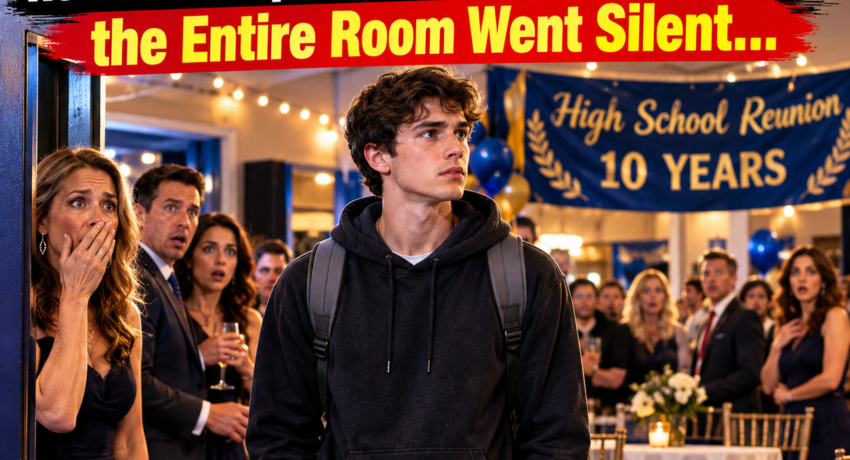
At 7:43 that Saturday evening, Evan walked into The Foundry.
Music was already playing.
A large banner hung over the entrance.
RIDGEVIEW HIGH — CLASS OF 2016
There were old yearbook photographs on display.
A photo booth.
Cocktail tables.
Gold balloons.
People Evan had not spoken to in ten years were hugging as though they’d all remained lifelong friends.
For several seconds, nobody noticed him.
Then Jenna Walters did.
Jenna had organized most of the reunion.
In high school, she’d never been particularly cruel to Evan.
That almost made it worse.
She had simply behaved as though he didn’t exist.
She walked toward him carrying a clipboard.
“Evan?”
He smiled.
“Hey, Jenna.”
Her eyes moved toward the check-in table.
Then back to him.
There was panic in her face.
“What are you doing here?”
“I heard there was a reunion.”
“Oh.”
Just that.
Oh.
Then Ryan Cole approached.
Ryan had changed.
Less hair.
More expensive clothes.
Same expression.
At school, Ryan had been the kind of boy teachers described as charismatic because they never saw what happened when adults left the room.
He smiled when he recognized Evan.
“Well, look who showed up.”
“Ryan.”
“Didn’t know you were coming.”
Evan glanced toward the crowded room.
“I wasn’t invited.”
The smile on Ryan’s face became uncomfortable.
Jenna lowered her voice.
“Evan, this was mostly organized through the private group.”
“I know.”
“We had trouble finding some people.”
“You had my email.”
She looked away.
Ryan stepped closer.
“Come on, man. It’s been ten years. Don’t make this weird.”
Evan almost laughed.
“I’m making it weird?”
“You know what I mean.”
Then Jenna said the sentence that would later sound unbelievable in the video.
“We just thought maybe you’d be more comfortable not coming.”
Evan looked at her.
“Who is we?”
Silence.
Ryan sighed.
“Look, you’re here now. No reason to turn this into some big high-school therapy session.”
Evan nodded slowly.
“Fair enough.”
Jenna relaxed.
Then he asked,
“Can I have five minutes?”
“For what?”
“Five minutes. Then if you still want me gone, I’ll leave.”
Ryan laughed.
“This is a private event.”
Before Evan could answer, one of The Foundry’s managers approached.
Her name was Monica Reed.
She looked from Evan to Jenna.
“Everything okay?”
Ryan gestured toward my son.
“Actually, we have someone here who isn’t on the guest list.”
Monica looked at Evan.
Then said,
“Mr. Carter?”
Ryan’s smile disappeared.
Monica continued.
“Would you like me to ask them to leave?”
Jenna blinked.
Ryan actually laughed.
“Why would he decide that?”
Monica looked confused.
Then she answered.
“Because he owns the building.”
The room around them became quiet.
Not completely.
The music was still playing.
People farther away were still talking.
But the circle closest to Evan went silent.
Ryan stared at him.
“You own The Foundry?”
Evan put both hands into his pockets.
“Yeah.”
Jenna looked as though someone had removed the floor beneath her.
“You never said…”
“You never asked.”
Monica turned toward him.
“Do you want us to stop the event?”
Evan looked around the room.
At people who once moved lunch trays when he sat near them.
People who laughed when he stumbled over words.
People who had somehow reached adulthood while still deciding he was the one person who shouldn’t receive an invitation.
“No,” he said.
“I don’t want anybody thrown out.”
Ryan folded his arms.
“Then what’s this?”
Evan looked directly at him.
“This?”
He smiled.
“This isn’t even the part I came for.”
Part 6 — The Empty Chair
Five minutes later, the music stopped.
That was the first part of the video I eventually saw.
Someone had pulled out a phone when the argument began.
By the time Evan walked toward the front of the room, three people were recording.
He stood beneath the reunion banner.
For a few seconds, nobody spoke.
Then Evan picked up a microphone.
“Relax,” he said.
A few nervous laughs moved through the room.
“I’m not canceling anybody’s dinner.”
More silence.
“I know some of you are probably wondering why I’m here.”
Ryan leaned against the bar.
Evan continued.
“Apparently I wasn’t on the guest list.”
No one laughed that time.
“And I could stand here and give you a twenty-minute speech about high school.”
He shook his head.
“But honestly, I don’t want to.”
He looked around.
“High school took enough of my time.”
That line landed hard.
Then Monica appeared beside him carrying a simple folding chair.
She placed it near the front.
On the chair was a small sign.
FOR THE STUDENT NOBODY SAVED A SEAT FOR.
I had to stop the video the first time I watched it.
Because I knew exactly where those words came from.
Evan looked at the chair.
“For about three years, I ate lunch wherever I could find somewhere nobody would ask me to move.”
No one spoke.
“I used to think there was something wrong with me.”
His voice remained calm.
“I thought if I dressed differently, talked differently, lost weight, joined the right club, laughed at the right jokes, eventually I’d become acceptable.”
Ryan looked down.
Evan continued.
“But here’s the funny thing.”
He glanced around the room.
“Most of you probably barely remember any of it.”
Several faces changed.
“I do.”
Then he added,
“That’s how these things work. What takes thirty seconds for one person can live in someone else for thirty years.”
The room was completely silent.
Then Ryan spoke.
“So what is this supposed to be?”
Heads turned toward him.
Evan lowered the microphone slightly.
Ryan shrugged.
“Seriously. Is this revenge?”
Evan looked at him.
“Revenge?”
“You own the building. You’re standing up there reminding everybody how terrible we supposedly were.”
Someone muttered Ryan’s name.
But Evan raised one hand.
“No. Let him ask.”
He stepped away from the chair.
“Revenge would be making you leave.”
Ryan said nothing.
Evan continued.
“I know what it feels like to be told a room would be better without you.”
Then his voice softened.
“I wouldn’t do that to anybody.”
And that was the moment Ryan stopped smiling.
But Evan still hadn’t revealed his plan.
Part 7 — The Second Phone Call
Evan looked toward the side entrance.
The doors opened.
Three people walked inside.
The first was Mrs. Keller, his former English teacher.
I remembered her immediately.
She had been one of the few teachers who realized Evan spent lunch alone.
For almost an entire semester, she found reasons to keep her classroom open during lunch without ever making him feel pitied.
The second person was Ridgeview High’s current principal.
The third was a teenage boy.
Maybe sixteen.
Thin.
Nervous.
He looked completely overwhelmed by the room.
Evan smiled at him.
“This is Marcus.”
The boy lifted one hand awkwardly.
Nobody understood.
Evan continued.
“Marcus is a junior at Ridgeview.”
He paused.
“And until three months ago, he ate lunch in a stairwell.”
I felt something break inside my chest when I heard that.
Evan looked toward Mrs. Keller.
“She found him.”
Of course she did.
Some people spend their lives noticing the people everyone else walks past.
Evan turned toward the crowd.
“Mrs. Keller called me three months ago because Ridgeview wanted funding for a peer-inclusion program.”
Now I understood the second call he’d made after discovering the reunion.
He had accelerated everything.
That night, Evan announced a $250,000 fund for Ridgeview High.
Not for football uniforms.
Not for a new scoreboard.
Not for something with his name printed in giant letters.
The money would support counseling, student-led lunch groups, after-school clubs, transportation for students who couldn’t afford activity fees, and training designed to identify chronic social isolation before a child disappeared into it.
He called it The Open Seat Fund.
Then he said something I will remember for the rest of my life.
“I don’t care if anybody remembers me as the successful guy who came back.”
He looked toward Marcus.
“I care whether somebody like him makes it through school believing he belongs there.”
Marcus immediately looked at the floor.
Evan walked toward him.
“You don’t have to be embarrassed.”
The boy looked up.
“I used to eat beside a vending machine.”
A few people laughed softly.
Not mockingly.
Humanly.
Marcus smiled.
Then Evan turned back toward his classmates.
“I could have made this donation privately.”
He paused.
“But I wanted to make it tonight.”
Jenna wiped tears from her face.
Evan continued.
“Not because this class deserves credit.”
The room tightened.
“Because this class is the reason I understand why it matters.”
Nobody moved.
Then Mrs. Keller began clapping.
Slowly.
The principal joined her.
Then someone near the back.
Then another.
Within seconds, the entire room was standing.
Except Ryan.
He remained beside the bar.
Looking at the floor.
And what happened next surprised Evan more than anything he had planned.
Part 8 — “I Remember What I Did”
Ryan walked forward.
The applause faded.
He stopped several feet from Evan.
For the first time in the video, he didn’t look confident.
He looked tired.
“You remember sophomore chemistry?”
Evan’s face changed.
“Yes.”
I remembered too.
That was the year someone drew a caricature of Evan on the whiteboard before he entered class.
Ryan swallowed.
“That was me.”
Evan said nothing.
“And the fake account.”
Someone in the crowd whispered.
Ryan looked toward the floor.
“That was mostly me too.”
I felt anger rise even ten years later.
But Evan remained still.
Ryan rubbed his hands together.
“I’ve told people for years that high school was stupid and everybody did dumb things.”
He looked up.
“But I remember what I did.”
His voice cracked slightly.
“I just never had to look at you afterward.”
Evan didn’t rescue him from the discomfort.
He didn’t say, “It’s okay.”
Because it wasn’t.
Ryan continued.
“My daughter is seven.”
The room remained silent.
“She came home crying last month because some girls wouldn’t let another kid sit with them.”
He laughed bitterly.
“I gave her this whole speech about kindness.”
Then he looked at Evan.
“And tonight I realized I’m teaching her lessons I didn’t live.”
Evan finally spoke.
“You were seventeen.”
Ryan nodded.
“So were you.”
That silenced everyone.
Ryan’s eyes filled.
“I’m sorry.”
It wasn’t dramatic.
No hug.
No music.
Just two words ten years late.
Evan nodded.
“Thank you.”
Ryan looked almost startled.
“You forgive me?”
Evan thought for a moment.
Then he said,
“I stopped needing you to apologize a long time ago.”
Ryan’s expression tightened.
“That doesn’t answer me.”
“No.”
Evan smiled faintly.
“It doesn’t.”
Then Jenna stepped forward.
“I knew about the fake account.”
Evan looked at her.
She wiped her face.
“I didn’t make it. But I saw it. I laughed.”
Another classmate raised her hand.
“I remember the lake party.”
A man near the back said,
“We specifically didn’t invite him.”
One admission became another.
Not everyone spoke.
Not everyone cried.
And Evan never demanded confessions.
He simply listened.
People who had forgotten began remembering.
People who claimed they hadn’t participated began realizing silence had been participation too.
Then Marcus—the sixteen-year-old student—walked toward the empty chair.
He turned the sign over.
On the back, someone had written another sentence.
YOU CAN SIT WITH ME.
Marcus stared at it.
Then he sat down.
And one by one, several former classmates pulled chairs beside him.
That was when Evan knew his five minutes had become something else entirely.
Part 9 — The Message I Received at 10:14 P.M.
I was still awake when my phone buzzed.
10:14 p.m.
A message from Evan.
Still up?
I answered immediately.
Of course.
A few seconds later:
Can I come by?
Twenty minutes later, his car pulled into my driveway.
He walked inside without knocking.
That’s what sons do, no matter how successful they become.
I was waiting in the kitchen.
“Well?”
Evan loosened the top button of his shirt.
“Interesting night.”
“Interesting?”
I handed him a glass of water.
“Half the town is apparently sending me videos.”
He groaned.
“I was afraid of that.”
“So…”
I looked at him.
“You own the building?”
He laughed.
“Mom, you knew that.”
“I knew you invested in it. I didn’t know you owned the whole thing.”
“Most of it.”
I stared.
“You might occasionally tell your mother things.”
“I tell you things.”
“You told me you were renovating an old factory.”
“I was.”
“You neglected the part where it became one of the nicest event spaces downtown.”
He smiled.
“Didn’t seem relevant.”
I shook my head.
Then I became serious.
“Are you okay?”
That stopped him.
For several seconds, he stared at the kitchen counter.
“Yeah.”
“You sure?”
“No.”
That was more honest.
He sat down.
I joined him.
After a while, he said,
“I thought walking in there would make me feel seventeen again.”
“Did it?”
“For about thirty seconds.”
He rubbed his palms together.
“Then Ryan looked at me exactly the way he used to.”
My chest tightened.
“And?”
“And nothing happened.”
“What do you mean?”
Evan looked up.
“I didn’t become that kid again.”
He seemed surprised by his own words.
“I kept waiting for my stomach to drop. Waiting to feel ashamed.”
He shook his head.
“But I didn’t.”
I reached for his hand.
He smiled.
“You know what’s weird?”
“What?”
“I spent years imagining what I’d say if any of them ever apologized.”
“And?”
“Turns out I didn’t need a speech.”
He looked toward our dark kitchen window.
“Ryan said he was sorry.”
“What did you feel?”
Evan considered the question.
“Sad.”
That wasn’t the answer I expected.
“For him?”
“For all of us.”
His voice softened.
“We were kids, Mom.”
I started to object.
He continued.
“That doesn’t excuse it.”
“I know.”
“But nobody stopped it either.”
He looked at me.
“Teachers saw pieces. Parents saw pieces. Kids saw everything.”
I squeezed his hand.
“You shouldn’t have had to survive that.”
“No.”
He smiled.
“But I did.”
Then he told me about Marcus.
The sixteen-year-old.
The stairwell.
The empty chair.
And finally I understood what my son had meant when he said he wasn’t going to the reunion for closure.
Closure wasn’t what he wanted.
He had something better.
A chance to take the worst thing that had happened to him and make it useful to somebody else.
Part 10 — The Email Ryan Sent
The next morning, Evan received dozens of messages.
Some were apologies.
Some were awkward.
A few felt defensive.
One person wrote:
I honestly don’t remember treating you badly.
Evan showed it to me.
“What are you going to say?”
“Nothing.”
“Why?”
“Because he probably doesn’t remember.”
He put the phone down.
“That doesn’t mean I don’t.”
Another message came from Jenna.
She apologized for excluding him from the reunion.
Not only from the private group.
From the planning itself.
She admitted his name had been discussed.
Some members believed inviting him would be “awkward.”
Others assumed he wouldn’t come.
Nobody challenged the decision strongly enough.
Evan replied with four words:
Thank you for telling me.
Then Ryan’s email arrived.
It was longer.
Evan read it alone first.
Later, he showed me one paragraph.
Ryan wrote:
I always remembered myself as a decent kid who sometimes made bad jokes. Watching you stand there forced me to remember that for someone else, I was the person who made school frightening. I don’t know what to do with that yet, but I won’t pretend I didn’t see it.
At the bottom, Ryan asked if he could contribute to The Open Seat Fund.
Evan called him.
They spoke for twenty minutes.
I don’t know everything they said.
I don’t need to.
But Ryan donated.
So did Jenna.
Then several other classmates.
By the end of the month, the original $250,000 fund had grown significantly.
More important than the money, however, was what happened at Ridgeview.
The school redesigned an underused room near the library.
Students could eat lunch there.
Join quiet clubs.
Study.
Meet mentors.
Nobody had to prove they were lonely enough to enter.
They simply had to walk in.
Mrs. Keller helped name it.
The Open Table.
Evan hated the idea of putting his photograph on the wall.
So they didn’t.
Instead, beside the entrance, there was a small metal plaque.
It didn’t mention Evan’s company.
It didn’t mention money.
It simply said:
If someone is standing alone, make room.
The first time I saw it, I cried.
Evan pretended not to notice.
Then he hugged me anyway.
Part 11 — What People Got Wrong About That Night
Once the reunion video spread beyond our town, strangers began describing what Evan had done as revenge.
Headlines appeared online.
Bullied Teen Returns Successful.
Excluded Student Owns Reunion Venue.
Former Outcast Gets Ultimate Revenge.
Evan hated them.
“That’s not what happened.”
I understood why people interpreted it that way.
The story had all the ingredients they expected.
The lonely boy.
The successful adult.
The shocked classmates.
The building.
The microphone.
But revenge would have been easy.
Evan could have canceled the event.
He could have had Ryan escorted outside.
He could have stood on that stage and listed every cruel thing they had ever done.
Some of them probably deserved the discomfort.
Instead, my son placed an empty chair in the room.
That was the part people missed.
He didn’t come back to prove he was better than them.
He came back because ten years had taught him something seventeen-year-old Evan didn’t understand.
Being excluded had never proved he was unworthy.
It had only proved that the people around him were capable of excluding someone.
Those are completely different things.
For years, I had wished I could go backward.
I wished I could walk into that cafeteria, find my thirteen-year-old son beside the vending machine, and tell him everything waiting ahead.
The friends.
The company.
The building.
The life.
I wanted to tell him that the world would become bigger than Ridgeview High.
But if I could actually return to that hallway now, I think I would say something else.
I wouldn’t tell him,
“One day they’ll regret this.”
I wouldn’t say,
“One day you’ll be richer than them.”
I wouldn’t say,
“One day they’ll wish they invited you.”
I’d sit on the floor beside him.
Open my lunch.
And say,
“There’s nothing wrong with you.”
Because that was what he needed then.
Not a prediction of future success.
Permission to stop measuring himself through other people’s cruelty.
Part 12 — The Seat Beside Him
Several months after the reunion, Ridgeview held an open house for The Open Table.
Evan nearly didn’t go.
Mrs. Keller forced him.
She called me too.
“You’re coming.”
Apparently teachers never stop giving orders.
So I went.
The room wasn’t impressive in the way people usually mean impressive.
No marble.
No fancy technology.
Just comfortable chairs.
Long tables.
Board games.
Books.
Charging stations.
A small kitchenette.
Sunlight coming through large windows.
But every seat mattered.
Marcus was there.
He looked different from the frightened boy in the reunion video.
More relaxed.
He had joined a coding club.
Made two friends.
Was helping younger students learn basic programming.
When he saw Evan, he walked over.
“Hey.”
“Hey.”
Marcus pointed toward a group across the room.
“They’re saving me a seat.”
Evan smiled.
“That’s good.”
The boy hesitated.
Then said,
“You know that chair from the reunion?”
“The folding chair?”
“Yeah.”
“What about it?”
“Mrs. Keller kept it.”
Evan looked across the room.
Near the wall stood the same chair.
The sign was still attached.
FOR THE STUDENT NOBODY SAVED A SEAT FOR.
Marcus walked over and flipped it around.
YOU CAN SIT WITH ME.
Then he looked at Evan.
“I think the second side is better.”
Evan laughed.
“So do I.”
A few minutes later, I stood near the doorway watching my son talk with Mrs. Keller.
There was another mother beside me.
I didn’t know her.
She had tears in her eyes.
“Which one is yours?” I asked.
She pointed toward a girl sitting at a table near the window.
“She started coming here three weeks ago.”
The girl was playing cards with two other students.
Her mother smiled through her tears.
“She used to eat lunch in the bathroom.”
I couldn’t speak.
The woman looked at me.
“Do you know the person who started this?”
I looked across the room.
At Evan.
Twenty-eight years old.
Laughing.
Comfortable.
Surrounded by people.
For a second, I saw every version of him at once.
The little boy making jokes about sky sheep.
The thirteen-year-old eating beside a vending machine.
The teenager pretending cruelty didn’t hurt.
The graduate asking whether life really got better.
The young man walking into a reunion where nobody expected him.
And the adult who discovered that the most powerful thing he could do with an old wound was stop handing it control over his future.
“Yes,” I said.
“I know him.”
The woman smiled.
“Tell him thank you.”
I looked at my son.
“I will.”
Then Evan turned and noticed me standing there.
He waved.
There was an empty chair beside him.
He tapped it with one hand.
“Mom!”
I smiled.
“What?”
“There’s a seat here.”
And after all those years of watching my son stand outside rooms where nobody made space for him, I walked across that one…
and sat beside him.