PART ONE — THE PROMISE
I waited twenty years for a boy who promised to marry me when we were five.
His name was Leo Bennett, and he lived three houses down from mine on a quiet street in Fairview, Ohio, where everybody knew which porch belonged to which family and no child could get into trouble without three different mothers hearing about it before dinner.
Leo and I walked to kindergarten holding hands.
We traded half-eaten cookies at lunch. We built forts from cardboard boxes. He hated peas. I hated grape jelly. He was scared of thunderstorms but pretended he wasn’t, and I was scared of dogs until he introduced me to his old golden retriever, Murphy.
When we were five, we made a promise beneath the oak tree in my backyard.
We called it a blood oath because we had seen something like it in a movie, though neither of us was brave enough to use a needle.
Instead, Leo snapped a thorn from one of my mother’s rose bushes.
We each pricked a finger, pressed them together for half a second, then screamed because it hurt more than expected.
Leo immediately stuck his finger in his mouth.
I called him a baby.
He told me babies couldn’t get married.
Then he pulled a plastic ring from a cereal box out of his pocket and pushed it onto my finger.
“When we’re grown-ups,” he announced, “I’m marrying you.”
I laughed so hard I fell backward into the grass.
“You can’t marry me. You don’t even have a job.”
“I’ll get one.”
“You don’t have a car.”
“I’ll get that too.”
“Where are we going to live?”
He pointed toward my house.
“Here.”
“My mom lives here.”
“She can stay.”
At five years old, that seemed like a perfectly reasonable plan.
Three weeks later, Leo disappeared.
It happened on a cold October morning.
His family’s driveway was full of boxes and black trash bags. His father moved quickly between the house and a rented truck. His mother barely spoke.
Nobody on the street understood what was happening.
There had been no moving sign.
No farewell party.
No warning.
I ran barefoot down the sidewalk when I saw Leo climbing into the back seat of their station wagon.
“Leo!”
He looked out the open window.
I remember his face more clearly than almost anything else from my childhood.
Scared.
Confused.
Trying desperately not to cry.
His father called his name.
Leo leaned toward me.
“One day I’ll come back,” he whispered. “I’ll find you.”
I wiped my nose on my sleeve.
“And?”
“And I’ll marry you.”
Then the car rolled away.
I stood in the middle of the sidewalk until the taillights disappeared.
Their house stayed dark for months.
No forwarding address.
No Christmas card.
Nothing.
And somehow that silly promise made underneath an oak tree followed me into adulthood.
Not through every second of every day.
Life wasn’t that ridiculous.
I dated boys in high school.
I went to college.
I had two serious relationships.
I built a career decorating cakes at a bakery downtown and eventually became the manager.
But somewhere in the back of my mind, Leo remained.
The boy with green eyes and a crooked smile who had promised that leaving didn’t mean forever.
My mother, Helen, thought I was romanticizing something that had happened before I could even read.
“You’re waiting for a ghost, Monica,” she told me once.
“I’m not waiting.”
“You compare everybody to him.”
“I do not.”
She gave me the look mothers give when they know you’re lying.
Maybe she was right.
Then, twenty years after Leo disappeared, a man walked into my bakery.
It was four in the afternoon on a Tuesday.
He stood at the counter without ordering anything.
I looked up.
Same green eyes.
Same slightly crooked smile.
Older, broader, a faint line beside his mouth that hadn’t existed when we were children.
But somehow I knew.
Before my mind accepted it, my heart did.
He smiled.
“I told you I’d find you.”
I dropped an entire tray of croissants.
PART TWO — THE BOY WHO CAME BACK
I didn’t immediately trust him.
That surprised Leo.
It surprised me too.
I had imagined his return a thousand times, and in every version I ran into his arms.
Reality was different.
A grown man claiming to be the boy I had known at five could have been anybody.
So I tested him.
“What was my dog’s name?”
“Murphy.”
“What happened to my yellow bicycle?”
“You tried riding without training wheels, crashed into Mrs. Cooper’s mailbox, and blamed me.”
“I did not blame you.”
“You absolutely blamed me.”
“What did we bury underneath the oak tree?”
His smile disappeared.
“A blue biscuit tin.”
My stomach tightened.
“What was inside?”
“My green marble. Your plastic bracelet. Two pennies. A drawing of the house we said we’d live in.”
I stared at him.
Leo tilted his head.
“And one dead caterpillar you insisted was sleeping.”
I laughed before I could stop myself.
Still, the moment that convinced me came three weeks later.
We were sitting in my car outside my mother’s house after dinner.
Mom had been washing dishes inside, singing softly to herself.
Leo smiled.
“Your mom still sings that garden song wrong.”
I turned toward him.
“What?”
“She always does the second verse first.”
Nobody knew that.
I wasn’t even sure my mother knew she did it.
For several seconds, I couldn’t speak.
Finally I whispered, “It really is you.”
Something changed in Leo’s face.
His eyes softened.
“Yeah,” he said. “It’s really me.”
Our relationship moved slowly at first.
Then all at once.
We spent months filling twenty missing years with stories.
His family had moved to Oregon.
His father had lost his business unexpectedly, and family debts had forced them to leave Fairview fast.
“We were supposed to say goodbye properly,” Leo explained. “Dad kept saying we would. Then one morning he decided we couldn’t afford another day.”
“Why didn’t you write?”
“I tried.”
He had written three letters when he was six.
His parents didn’t know our exact address, and all three came back.
Later, his family moved again.
Then again.
His parents separated when Leo was thirteen.
Life scattered them.
Eventually childhood became something he remembered rather than somewhere he could return.
But he told me he never forgot me.
“I’d look for you online sometimes,” he admitted.
“You stalked me?”
“I conducted respectful research.”
“That’s stalking with better vocabulary.”
He grinned.
At twenty-five, he’d seen a local newspaper article about the bakery’s anniversary.
There I was in the photograph, standing behind a three-tiered cake.
He booked a flight to Ohio two days later.
Our first kiss happened beside the same oak tree where we’d made our childhood promise.
A year later, he proposed there.
He didn’t use the cereal-box ring.
He’d kept that.
When he opened a tiny wooden box, both rings were inside—the plastic one and a diamond ring beside it.
I cried so hard I couldn’t answer for nearly a minute.
Leo laughed nervously.
“Monica, you’re going to have to say something eventually.”
“Yes.”
“Yes, you’ll say something?”
“Yes, I’ll marry you!”
My mother cried even harder than I did.
For the next year, we planned a wedding neither of us could discuss without becoming emotional.
One hundred and six guests.
My grandmother’s lace veil.
White roses.
The old church where my parents had married.
Leo insisted the bakery make our cake.
I told him absolutely not.
He ordered it behind my back anyway.
Everything felt impossible and inevitable at the same time.
Twenty-two years after a five-year-old boy told me he’d come back, I stood across from him at an altar.
I remember thinking:
Some promises really do survive anything.
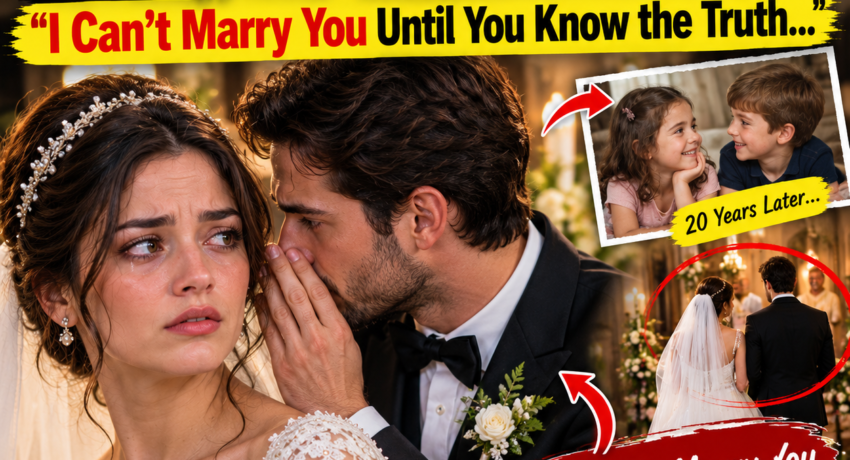
Then Leo stopped the wedding.
PART THREE — THE PHOTOGRAPH
The pastor hadn’t even asked for our vows.
Leo took both my hands.
His fingers were trembling so hard I felt it through my gloves.
At first I thought he was nervous.
I smiled.
Then I saw his face.
“Monica,” he whispered.
Something inside me went cold.
“I have to tell you the truth before we say these words.”
I stopped breathing.
Leo’s eyes filled.
“I can’t build our marriage on a lie.”
One hundred and six people went silent at once.
Somewhere behind me, somebody shifted in a pew.
My mother whispered my name.
Leo reached into his tuxedo jacket.
He removed a photograph.
It was old and creased, its edges softened from being handled too many times.
He placed it facedown in my hands and closed my fingers around it.
“Before you turn that over,” he said, “I need you to know that I’ve loved you my whole life. That part was never a lie.”
I looked directly into his eyes.
“What did you do?”
His jaw tightened.
“I should’ve told you two years ago.”
My hands began shaking.
“Tell me what?”
He looked at the photograph.
So I turned it over.
For three seconds, my brain couldn’t understand what I was seeing.
Leo was younger in the picture.
Maybe nineteen or twenty.
He wore a cheap gray suit.
Beside him stood a dark-haired woman in a simple white dress.
She was holding a baby.
Leo’s arm was around both of them.
Behind them were courthouse steps.
I stared.
Then I noticed the ring on his hand.
I looked up.
“Who is she?”
Leo swallowed.
“Rachel.”
“Who is Rachel?”
“My ex-wife.”
The church disappeared around me.
“You were married?”
“Yes.”
I looked down at the baby.
No.
Something inside me already knew.
I didn’t want him to say it.
But he did.
“His name is Jack.”
I stared at him.
“And Jack is?”
“My son.”
A sound went through the church.
Not one sound exactly.
A hundred little gasps, whispers and sharp breaths blending together.
I stepped backward.
My hands went numb.
The photograph slipped from my fingers.
Leo caught it before it hit the floor.
“You told me you had never been married.”
“I know.”
“You told me you didn’t have children.”
“I know.”
My voice cracked.
“Is he alive?”
Leo looked horrified.
“Yes. Monica, yes.”
“How old?”
“Seven.”
I nearly laughed.
Not because anything was funny.
Because sometimes pain arrives in such an unbelievable shape that your body chooses the wrong response.
Seven.
For two years I’d loved a man who had a seven-year-old son.
For two years we’d discussed children.
Names.
Schools.
How many bedrooms we wanted.
Whether we would be strict parents.
Whether I would reduce my hours at the bakery if we ever had a baby.
And Leo had sat beside me carrying a photograph of his son.
“Where is he?”
“Arizona. With Rachel.”
“Does she know about me?”
“Yes.”
“Does he?”
Leo hesitated.
That hesitation hurt more than anything else.
“Jack knows I’m engaged.”
I felt sick.
“He knows my name?”
“Yes.”
“So a seven-year-old boy I’ve never met knows more about my future husband than I do.”
“Monica—”
“Why today?”
His eyes closed.
“Rachel called me three weeks ago. She’s been offered a job overseas. Jack doesn’t want to leave his school, and—”
He stopped.
I understood before he finished.
I whispered, “He’s coming here.”
Leo nodded.
“Next Monday.”
My legs almost gave out.
“When were you going to tell me?”
“I was trying—”
“When?”
“I don’t know.”
I pulled my hands away.
“You had two years.”
“Monica, please.”
“No.”
The single word echoed through the church.
I’d imagined that altar since the day Leo returned.
Now I stepped away from it.
“I can’t do this.”
My mother was already standing.
Leo’s mother covered her mouth.
The pastor lowered his book.
“Monica—”
I looked at Leo.
And for the first time since he walked into my bakery, I didn’t recognize him.
“The wedding is over.”
Then I turned around and walked past one hundred and six stunned guests.
PART FOUR — THE SECOND DISAPPEARANCE
I spent my wedding night in my mother’s guest room.
My dress lay in a heap across the chair.
My grandmother’s veil rested on the dresser.
At midnight, Mom brought me grilled cheese sandwiches because apparently maternal instinct reduces every catastrophe to one question:
Have you eaten?
I hadn’t.
She sat beside me.
I stared at the sandwich.
“How could he hide a child?”
Mom didn’t answer immediately.
“Fear makes people do stupid things.”
“For two years?”
“That stops being fear and becomes a choice.”
I looked at her.
She squeezed my hand.
“Both can be true.”
I didn’t sleep.
Leo called twelve times.
He sent three messages.
I read none of them.
The following afternoon, he came to the house.
Mom answered the door.
I heard them talking downstairs.
Then she appeared in my doorway.
“You don’t have to see him.”
I wanted to say no.
Instead, I went downstairs.
Leo looked terrible.
Good.
That small, ugly thought passed through my mind, and I didn’t apologize for it.
He had removed his wedding suit.
He wore jeans and the blue sweater I’d given him for Christmas.
“I won’t stay long,” he said.
“Then don’t.”
He flinched.
Good again.
He placed a folder on the kitchen table.
“Everything is in there.”
“What is everything?”
“The truth.”
I almost laughed.
“Little late for that.”
“I know.”
He didn’t ask me to forgive him.
That mattered.
He told me the story.
At nineteen, while attending community college in Oregon, Leo met Rachel.
They were young.
Impulsive.
Rachel became pregnant eight months into their relationship.
Both families pressured them to get married.
They did.
Leo worked nights.
Rachel stayed home with Jack.
Within eighteen months, they both realized they’d confused responsibility with compatibility.
They divorced when Jack was two.
There had been no dramatic betrayal.
No cruel ex-wife.
No secret affair.
Just two young people who had rushed into adulthood before they understood themselves.
Rachel later moved to Arizona to be closer to her parents.
Leo visited Jack whenever he could.
He paid support.
They video-called every week.
Jack spent parts of every summer with him.
Then Leo saw my photograph in that bakery article.
He came home to find me.
“And when were you planning to tell me?” I asked.
“The first week.”
I stared.
“Then the second.”
He rubbed his hands over his face.
“Then we started becoming serious. You told me about your last boyfriend and how he kept major things from you.”
“So you decided to keep a major thing from me?”
“I panicked.”
“No. You lied.”
“Yes.”
The fact that he didn’t argue somehow made me angrier.
He continued.
“Every time I waited, telling you became harder. I thought you’d look at me and see some stranger with an ex-wife and a kid instead of the boy you remembered.”
“You were a stranger, Leo.”
His face changed.
I felt tears burn my eyes.
“You came back saying you kept your promise. You made the whole thing sound like some beautiful story that had been waiting twenty years to finish.”
“I know.”
“But you edited yourself until you fit inside my memory.”
That silenced him.
My voice broke.
“I didn’t fall in love with a perfect childhood promise. I fell in love with you. You never gave me the chance to prove I could love the complicated parts too.”
Leo looked down.
“I know that now.”
“No. You knew it then. You just didn’t trust me enough.”
He slid the folder toward me.
Inside were copies of divorce papers, photographs, school reports, Jack’s drawings and printed emails between Leo and Rachel.
No hidden second family.
No ongoing marriage.
Nothing worse waiting behind the first confession.
Just a little boy.
A real little boy who liked dinosaurs, hated tomatoes and had drawn a picture of himself beside his father beneath the words:
ME AND DAD CAMPING
I closed the folder.
“When Jack comes Monday, where will he stay?”
“With me.”
“Does he know why the wedding didn’t happen?”
“No.”
“Good.”
Leo nodded.
“None of this is his fault.”
“No,” I said quietly. “It isn’t.”
Leo moved toward the door.
Before leaving, he turned around.
“I meant what I said yesterday.”
“What part?”
“I’ve loved you my whole life.”
I looked at him for a long time.
“Love isn’t the part I’m questioning.”
He nodded.
Then he walked away.
This time, I let him.
PART FIVE — JACK
For eleven days, I didn’t see Leo.
Fairview is not a big town, so avoiding someone requires strategy.
I changed grocery stores.
I asked another employee to make bakery deliveries near his apartment.
I ignored people who suddenly had very urgent reasons to ask whether Leo and I were “working things out.”
Then, on a Thursday afternoon, the bell above the bakery door rang.
I looked up.
A little boy stood beside Leo.
Jack.
I knew immediately.
The green eyes gave him away.
So did the crooked half-smile.
Leo looked alarmed when he saw me.
“We can leave.”
Jack looked from him to me.
“Is this Monica?”
Nobody moved.
Leo crouched.
“Buddy—”
Jack ignored him.
He walked toward my counter.
He had dark hair, a backpack decorated with planets and one untied shoelace.
“Your bakery smells really good.”
Despite myself, I almost smiled.
“That’s how we trick people into buying things.”
He considered this.
“That’s smart.”
Leo gave me an apologetic look.
“We were supposed to go to the bookstore. He saw the sign.”
Jack studied the display case.
Then he glanced at me.
“My dad said you make the best cinnamon rolls in America.”
I looked at Leo.
He suddenly became interested in the floor.
“Your dad exaggerates.”
“No, he doesn’t.”
“Trust me. He does.”
That earned me a tiny grin.
Jack chose a chocolate cupcake.
I refused Leo’s money.
He tried again.
I glared.
He stopped.
Jack sat at a corner table.
Chocolate frosting ended up on his nose within thirty seconds.
I watched Leo wipe it away.
There was no awkwardness between them.
No performance.
Leo knew which juice Jack liked.
He reminded him to put his napkin in his lap.
Jack leaned against him while talking about a science project.
They loved each other.
That realization hurt.
Because suddenly the secret wasn’t merely proof that Leo had lied.
It was proof that he’d hidden something beautiful.
Before they left, Jack walked back to me.
“Can I ask something?”
“Sure.”
“Did my dad really know you when he was five?”
I nodded.
“He did.”
“Did he really say he was going to marry you?”
Leo closed his eyes.
“Jack.”
“What?”
I laughed before I could stop myself.
“Yes. He did.”
Jack looked impressed.
“That’s weird.”
“Very weird.”
“He says he always keeps promises.”
The laughter disappeared.
Leo looked at me.
Jack noticed the silence.
Children always do.
He glanced between us.
“Except sometimes,” he added carefully.
I swallowed.
“Sometimes grown-ups make mistakes.”
“My mom says Dad made a big one.”
Leo looked mortified.
Apparently Rachel and I were going to get along.
Jack lowered his voice.
“Are you mad at him?”
I could’ve lied.
Instead I said, “Yes.”
Jack nodded as though this made perfect sense.
“But I’m not mad at you.”
His shoulders relaxed.
I hadn’t realized how much he needed to hear that.
Neither had Leo.
As they reached the door, Jack turned.
“Bye, Monica.”
“Bye, Jack.”
After they left, I went into the kitchen.
Then I cried beside six trays of cooling muffins.
Not because I suddenly forgave Leo.
I didn’t.
I cried because the situation had changed shape.
The secret wasn’t a photograph anymore.
He had a name.
A backpack.
Chocolate on his nose.
And absolutely no responsibility for what his father had done.
PART SIX — NO MORE FAIRY TALES
Rachel called me two weeks later.
I nearly didn’t answer.
“I’m not calling to defend him,” she said immediately.
That was a promising start.
We spoke for nearly an hour.
She confirmed everything Leo had told me.
Then she told me something he hadn’t.
“Leo almost backed out of proposing to you.”
I sat straighter.
“Why?”
“Because of Jack.”
Apparently, months before our engagement, Leo had called Rachel and told her he couldn’t ask me to marry him without telling me the truth.
Rachel told him the same thing.
He promised he would.
Then he proposed anyway.
That information reopened the wound.
When Leo came to collect Jack from the bakery two days later, I asked him directly.
“You knew before you proposed.”
His face answered first.
“Yes.”
I shook my head.
“That matters.”
“I know.”
“You stood under our oak tree with a ring while knowing there was something that could completely change my decision.”
“Yes.”
“Why?”
His eyes filled.
“Because I’m a coward.”
I hadn’t expected that answer.
No excuses.
No complicated childhood explanation.
No attempt to blame Rachel, timing, fear or fate.
“I thought if I told you,” he continued, “I’d lose the best thing that ever happened to me. So I kept waiting for a moment when losing you would feel less terrifying.”
He laughed once without humor.
“There isn’t one.”
I crossed my arms.
“You didn’t protect our relationship.”
“I know.”
“You protected yourself.”
“Yes.”
For once, his honesty did not make everything better.
But it gave us somewhere real to stand.
I told him we weren’t getting married.
Not soon.
Maybe not ever.
I returned the engagement ring.
Leo accepted it.
Then I surprised both of us.
“But I’m not asking you to disappear.”
His head lifted.
“I need time. And if there’s any chance of us having something after this, I need all of you. Not the polished version. Not the five-year-old promise. Not the man you think I want.”
I pointed toward the bakery door, where Jack was waiting with one of my employees.
“Him too.”
Leo’s face crumpled.
“Monica—”
“This is not forgiveness.”
“I know.”
“And we’re starting over.”
He nodded.
“No engagement. No wedding plans. No pretending the last two years didn’t happen.”
“Okay.”
“And if I discover one more secret—one—I’m done.”
“There aren’t any.”
“Good.”
He looked at me.
“What do we call this?”
I thought about it.
“The truth.”
For the first time in our relationship, we stopped trying to fulfill a childhood story.
We began building an adult one.
It was slower.
Messier.
And strangely, more beautiful.
I met Rachel.
She was smart, funny and not remotely interested in stealing Leo back, despite what half the town seemed determined to imagine.
Jack began spending weekends with Leo.
Sometimes I joined them.
Sometimes I didn’t.
Leo went to counseling.
Not because I demanded it, but because he finally admitted that he’d spent most of his life running from difficult conversations.
His father had done the same.
When problems came, the Bennett family packed boxes.
Disappeared.
Started over.
Leo had learned that love survived as long as nobody touched the painful parts.
Now he was learning the opposite.
Jack and I developed our own relationship.
He discovered I could draw dinosaurs badly.
I discovered he could eat three cinnamon rolls in one sitting if unsupervised.
One night, while we were making pizza at Leo’s apartment, Jack looked at me seriously.
“If you marry Dad, do I have to call you Mom?”
Leo nearly dropped a plate.
I answered, “No.”
Jack looked relieved.
“You already have a mom.”
“Yeah.”
“You can call me Monica.”
“What if I want to call you something else?”
“Then we’ll talk about it.”
He thought.
“Can I call you Mo?”
I hated the nickname Mo.
“Absolutely not.”
He laughed so hard he fell off his chair.
And somewhere in the middle of that laughter, I realized I was happy.
Not fairy-tale happy.
Something stronger.
The kind of happiness that knew exactly how badly people could fail each other and still believed some things were worth rebuilding.
PART SEVEN — THE SECOND PROPOSAL
A year passed.
Then another six months.
People eventually stopped asking when the wedding would be rescheduled.
I was grateful.
Leo never pressured me.
He never mentioned marriage unless I did.
The ring stayed in a safe-deposit box.
Then, one October afternoon, exactly twenty-three years after the morning his family had driven away, I found Leo beneath the oak tree.
Jack stood beside him.
So did my mother.
I stopped halfway across the yard.
“Oh, no.”
Jack laughed.
“It’s not what you think.”
“It better not be.”
Leo wasn’t holding a ring.
Instead he held the old blue biscuit tin.
My mouth fell open.
“You found it?”
Jack lifted a muddy shovel proudly.
“Mostly me.”
We sat beneath the tree.
Inside the rusted tin were two pennies.
A faded plastic bracelet.
One green marble.
The cereal-box ring.
And our childish drawing of the house where we had planned to live with my mother.
Leo unfolded it carefully.
Across the roof, in crooked crayon letters, we’d written:
MONICA + LEO HOUSE
He laughed softly.
“We were terrible architects.”
“The door is bigger than the house.”
“I was five.”
“So was I, and my window has perspective.”
He looked at me.
Then he became serious.
“When I came back here, I thought loving you meant keeping a promise I made when I was five.”
I stayed quiet.
“I thought if I could become the person you remembered, everything would work.”
He glanced at Jack.
“But that meant hiding the parts of my life that didn’t fit the story.”
Jack sat beside my mother, unusually silent.
Leo continued.
“I don’t want you to marry the boy who promised he’d come back.”
My throat tightened.
“I want you to choose the man standing here now. The one who messed up. The one who has a son. The one who is still learning how to tell the truth even when he’s terrified of what it might cost.”
Then he did something I didn’t expect.
He handed me the biscuit tin.
No ring.
No kneeling.
“No proposal?” I asked.
He smiled.
“Not today.”
“Why not?”
“Because I already asked before I earned the right to ask.”
My eyes filled.
“So what’s this?”
“Me keeping a different promise.”
“What promise?”
“That I’m done hiding.”
Jack stood up.
“Can we eat now?”
Mom burst out laughing.
The moment broke.
And somehow that made it perfect.
Three months later, I was the one who proposed.
Leo was washing dishes.
Jack was doing homework at the kitchen table.
I walked into the room holding the cereal-box ring.
Leo stared.
“No.”
I smiled.
“Yes.”
“Monica.”
“Leo Bennett, when we were five, you made a terrible proposal with no income, no car and no realistic housing plan.”
Jack started laughing.
“I believe I can improve upon it.”
Leo turned off the faucet.
I slid the plastic ring onto his wet finger.
“Would you like to try again?”
He cried before saying yes.
Jack claimed he had never seen his father cry.
This was a lie.
Leo cried at commercials involving dogs.
But I didn’t correct him.
PART EIGHT — THE VOWS
Our second wedding looked nothing like the first.
Thirty-two guests.
No elaborate flowers.
No orchestra.
No hundred-person reception.
We got married beneath the oak tree.
My mother sat in the front row.
Rachel flew in from Arizona.
Jack stood beside Leo as best man wearing a tie he’d chosen himself—a navy one covered in tiny planets.
I wore my grandmother’s veil again.
Before the ceremony, Leo found me alone on the porch.
“You okay?”
“Ask me again after you finish your vows.”
He smiled nervously.
“No surprises this time.”
“You swear?”
“I have emptied every pocket.”
I laughed.
Then he became serious.
“I’m sorry.”
“I know.”
“I think I’ll always be sorry.”
I touched his face.
“Good.”
He blinked.
I smiled.
“Not miserable. Just aware.”
He nodded.
“I can do aware.”
When I reached the oak tree, Jack whispered loudly, “Don’t mess it up this time, Dad.”
Every guest heard him.
Even the pastor laughed.
Then Leo took my hands.
For a second, I was back inside that church eighteen months earlier.
His trembling fingers.
The photograph.
The silence.
But this time, his hands were steady.
“Monica,” he said, “when I was five years old, I promised I’d come back and marry you.”
I smiled through tears.
“I spent twenty years thinking the important part was coming back.”
He looked toward Jack.
“Then I learned returning is easy compared with staying.”
My throat tightened.
“Staying when you’re ashamed. Staying when you’re wrong. Staying long enough to apologize without demanding forgiveness. Staying long enough to let someone know who you really are.”
He squeezed my hands.
“So today I’m not promising you a perfect marriage.”
His voice broke.
“I’m promising you there will never again be a version of me you aren’t allowed to know.”
I cried.
My mother cried.
Rachel cried.
Jack pretended he had something in his eye.
Then it was my turn.
“When I was five, I thought love meant somebody promising never to leave.”
I looked at Leo.
“Then you left.”
A few people laughed softly.
“Twenty years later, you returned, and I thought that proved the story I’d believed my whole life.”
I glanced toward the house behind us.
Toward the bakery friends.
Toward Rachel.
Toward Jack.
“But the real story started when the fairy tale fell apart.”
Leo swallowed.
“I don’t love you because you came back.”
I tightened my fingers around his.
“I love you because after everything broke, you finally learned how to stay.”
There wasn’t a dry eye beneath the tree.
The pastor pronounced us husband and wife.
Leo kissed me.
Jack shouted, “FINALLY!”
Everybody laughed.
Later that evening, after the food had been eaten and the sun began sinking behind the houses, I found Jack digging near the oak tree.
“What are you doing?”
“Burying something.”
My heart nearly stopped.
“Please don’t tell me it’s another dead caterpillar.”
He looked confused.
“No.”
He held up a new metal box.
Inside were three things.
The cereal-box ring.
A photograph from our wedding.
And a note Jack had written.
I read it.
For whoever finds this someday:
My dad promised Monica he would marry her when he was five. It took him a really long time and he messed it up once.
But he got it right the second time.
I covered my mouth.
Jack frowned.
“You’re not going to cry, are you?”
“Absolutely not.”
I was already crying.
Leo walked toward us carrying three slices of wedding cake.
“What are you two doing?”
“Nothing,” Jack and I said together.
Leo narrowed his eyes.
I smiled.
For most of my life, I believed the most romantic thing anyone had ever done for me was keeping a promise made at five years old.
I was wrong.
Promises are easy when you’re five.
You don’t understand mortgages, divorces, children, fear, disappointment, mistakes or the thousand ordinary pressures that make adult love complicated.
The most romantic thing Leo ever did wasn’t coming back.
It wasn’t remembering my dog.
It wasn’t keeping the plastic ring.
It wasn’t even standing beneath that oak tree and marrying me twenty-three years later.
It was telling the truth when the truth could cost him everything.
And then accepting that forgiveness wasn’t something he could demand just because he was sorry.
Our love story didn’t survive because of destiny.
It survived because eventually, we stopped trying to make it perfect.
We let it become honest.
There is still a small scar on my finger from that rose thorn.
Leo has one too.
Sometimes he’ll catch me looking at mine.
“You know,” he said once, “that was a terrible way to propose.”
“You were five.”
“I could’ve planned better.”
I laughed.
“You came back.”
He put his arm around me.
“I told you I would.”
I leaned against him.
“Yeah.”
Then I looked through our kitchen window.
Jack was at the table doing homework.
Leo’s shoes were abandoned by the door.
A half-decorated cake waited on the counter because I’d brought work home again.
Nothing looked like the picture two five-year-olds had drawn beneath an oak tree.
It was louder.
More complicated.
Far less perfect.
And infinitely better.
Because the boy I’d waited twenty years for had finally fulfilled his promise.
But the man I married gave me something far more important.
The truth.