Part 1 — The Kind of Cruelty No One Else Could See
For years, my mother-in-law had perfected the art of making me feel unwelcome without ever saying anything openly insulting.
Evelyn never raised her voice at me. She never called me names. She never created the sort of dramatic scene that would have given me the right to point at her and say, “There. That’s what she does.”
She was far too clever for that.
Instead, she wrapped every insult in elegance.
When I married her son, Daniel, she greeted me at our wedding reception with the same polite smile she might have offered a distant acquaintance.
She looked me over in my wedding dress, tilted her head, and said, “Daniel certainly has always known how to surprise us.”
A few people laughed.
So did I.
At twenty-six, newly married and hopelessly in love, I had already learned that reacting to Evelyn was dangerous. If I became upset, she looked confused. If I confronted her, she claimed I had misunderstood. If I told Daniel afterward, he usually rubbed his forehead and gave me the sentence I eventually grew to hate.
“That’s just Mom.”
As though being cruel in a sophisticated way somehow made cruelty acceptable.
At family dinners, Evelyn could spend twenty minutes praising someone’s education, career, home renovation, or taste in wine.
Then she would turn to me.
If I baked something, it was “charmingly homemade.”
If I bought a new dress, I looked “surprisingly confident in it.”
If I spoke enthusiastically about my work, she would smile and say, “It’s wonderful that you’re so satisfied with something simple.”
Everything sounded polite.
Everything hurt.
And because the wounds were so small individually, I kept convincing myself they weren’t serious enough to fight over.
Then our daughter was born.
For a while, I believed Lily might be the one person capable of softening Evelyn.
Evelyn adored having a granddaughter—or at least she adored the idea of one.
She ordered blankets embroidered with Lily’s initials. She organized elegant little birthday lunches. She bought clothes that were too expensive for a child who could stain a white dress simply by looking at a strawberry.
She showed Lily off proudly.
But eventually I began to understand something uncomfortable.
Evelyn liked Lily most when Lily behaved beautifully.
When she sat straight.
When she said the right things.
When she wore the outfits Evelyn chose.
When she fit neatly into the picture Evelyn wanted other people to see.
By the time Lily turned eight, she had started noticing things too.
My daughter was observant in a quiet way. She loved drawing animals, hated tomatoes with astonishing passion, and still slept with a worn stuffed rabbit named Mr. Buttons even though she insisted he was merely “decoration.”
More importantly, she had begun watching faces.
Including Evelyn’s.
One evening after a family dinner, Lily asked me why Grandma’s smile sometimes looked different when she talked to me.
I had no answer that an eight-year-old needed to hear.
So I kissed her forehead and told her not to worry about it.
I wish I had listened more carefully to the warning inside me.
Because that summer, Evelyn stopped directing her cruelty only at me.
She aimed it at my daughter.
And suddenly every excuse I had tolerated for years became impossible to accept.
Part 2 — “Grandma Likes Me, Right?”
Every summer, Evelyn hosted what she called “grandchildren week” at her enormous country house.
All of Daniel’s nieces and nephews would stay for several days. The older children ran around the grounds, swam, played games, and disappeared into the gardens. The younger ones usually ate together with the nanny on the back terrace.
That year, however, Evelyn had also arranged an important luncheon.
Several well-connected guests were coming, including Margaret Leland, the head of Saint Bartlett Academy, one of the most prestigious private schools in the area.
Evelyn had spent months trying to impress Margaret because another grandchild in the family would soon be applying there.
The guest list alone made me uneasy.
Whenever Evelyn wanted to impress people, she became even more obsessed with appearances.
The morning Lily was supposed to leave, I packed her suitcase while Daniel stood nearby.
“I’m not comfortable with this,” I told him.
He sighed.
“Claire, she’ll be okay.”
“Your mother has guests coming.”
“So?”
“So you know exactly what she becomes when she’s trying to impress people.”
Daniel leaned against the dresser.
“She’s not going to do anything to Lily.”
I stopped folding.
“She probably won’t do anything obvious,” I said. “That’s the problem. She never does. She’ll make Lily feel ashamed of something and somehow make it sound reasonable.”
For once, Daniel didn’t immediately defend her.
Before he could answer, Lily appeared in the doorway.
She was holding Mr. Buttons by one floppy ear.
“Mom?”
I turned toward her.
“What is it, honey?”
She looked down at her suitcase.
“Do I have to wear the blue dress?”
I knew exactly which dress she meant.
A pale blue one Evelyn had bought because she said it made Lily look “proper.”
“No,” I said. “You can wear anything you want.”
Relief crossed her face.
Then disappeared.
She hesitated before asking the question that should have made me cancel the entire visit.
“Grandma likes me, doesn’t she?”
My heart tightened.
I forced myself to smile.
“Of course she does.”
Lily nodded.
But something about the way she looked at me told me she had needed to ask for a reason.
I drove her to Evelyn’s estate later that morning.
The house looked almost unreal beneath the bright summer sun—perfect hedges, pale stone, wide steps, flowers arranged as if someone had measured the distance between every bloom.
Evelyn stood waiting outside in cream linen.
Perfect hair.
Perfect makeup.
Perfect smile.
She bent and kissed Lily lightly on the cheek.
“There you are,” she said.
Then, before saying anything remotely affectionate, she added, “Please remember your manners today, darling. Grandma has important guests.”
I looked at her.
Not “I’m happy to see you.”
Not “I missed you.”
A warning.
For several seconds, I nearly reached for Lily’s suitcase and put it back in my car.
Instead, I knelt and hugged my daughter.
“Call me anytime,” I whispered.
She smiled.
“I know, Mom.”
I kissed her forehead.
Three hours later, my phone rang.
And the moment I heard her voice, I knew something had happened.
“Mommy?”
She was crying.
Not the loud crying of a child who had scraped her knee.
This was smaller.
Humiliated.
Controlled.
“Please come get me.”
I was on my feet before she finished the sentence.
My chair fell backward behind me.
“Lily, are you hurt?”
“No.”
“What happened?”
“I spilled my water.”
For one confused second, I thought I had misheard her.
“You spilled water?”
“Yes.”
I grabbed my keys.
“Where are you right now?”
She tried to answer, but her breathing kept breaking.
Piece by piece, I finally understood.
Lily had asked if she could eat the first course inside with the adults rather than sitting outside with the younger children.
Evelyn had allowed it.
Then Lily had accidentally knocked over her water glass.
That was all.
No broken plate.
No screaming.
No deliberate misbehavior.
A glass of water.
“Grandma got really upset,” Lily whispered.
“What did she do?”
There was a pause so long that I stopped walking.
Then Lily said, “She took my plate away.”
My fingers tightened around the phone.
“Why?”
“She said I didn’t belong at the table with the guests.”
Something cold moved through me.
I knew that language.
I had lived with versions of it for years.
You don’t belong.
You don’t quite fit.
You’re welcome, but only if you remember your place.
My daughter was eight years old, and Evelyn had finally passed the lesson down to her.
“Where are you eating now?”
Another pause.
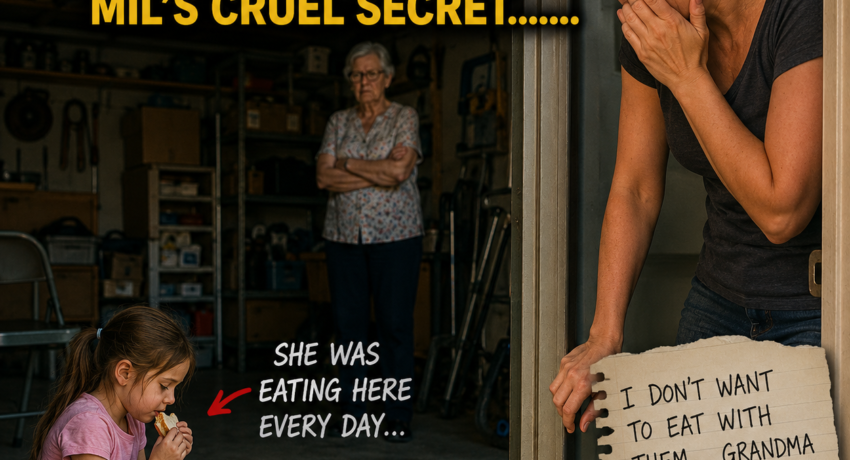
“The garage.”
I closed my eyes.
“The garage?”
“She had someone put a little table here for me.”
That was the moment something inside me changed.
I wasn’t hurt.
I wasn’t uncertain.
I wasn’t wondering whether I was overreacting.
I was done.
Part 3 — The Little Table in the Garage
I called Daniel from the car.
He answered casually.
“Hey, what’s up?”
“Your mother put Lily in the garage.”
Silence.
“What?”
“She spilled a glass of water. Evelyn removed her from lunch, told her she didn’t belong with the guests, and had a table set up for her in the garage.”
There was another silence.
But this one felt different.
All those years when I had complained about Evelyn, Daniel had always found something to say.
She didn’t mean it that way.
You know how she talks.
She’s from a different generation.
That’s just Mom.
This time, there was nothing.
Then he said, “I’m leaving now.”
We arrived within minutes of each other.
Instead of going through Evelyn’s impressive front entrance, we headed directly around the side of the house toward the attached garage.
The door stood partially open.
I will never forget what I saw inside.
Between stacks of folding chairs, storage shelves, and cases of sparkling water sat a tiny round table.
Someone had covered it with a white cloth, as if that somehow made the situation less cruel.
A plate of food rested in front of Lily.
Almost untouched.
She sat very straight, hands folded in her lap.
Mr. Buttons was pressed against her stomach.
She looked impossibly small in that enormous garage.
As though she had decided the safest thing she could do was occupy as little space as possible.
Then she saw us.
For one second, her face filled with relief.
But the expression that followed nearly destroyed me.
Embarrassment.
My eight-year-old daughter was embarrassed that we had found her.
As if she believed she had done something wrong.
I dropped to my knees beside her and pulled her against me.
“Mommy, I’m sorry,” she whispered.
“No.”
I held her tighter.
“No, Lily. You have absolutely nothing to apologize for.”
“But I spilled—”
“It was water.”
I pulled back so she could see my face.
“Listen to me. You made a tiny mistake. Everyone spills things. Adults spill things. Children spill things. That does not mean you deserve to be separated from everyone else.”
Daniel crouched beside us.
His face had changed.
He wasn’t angry in the loud, explosive way people expect anger to look.
He was completely still.
Ashamed.
Furious.
And finally seeing his mother without excuses.
“Lily,” he said quietly.
She looked at him.
“You will never be treated like this again.”
Her mouth trembled.
“Promise?”
Daniel swallowed.
“I promise.”
She began crying all over again.
He took her hand as we walked toward the car.
Once Lily was safely in the back seat, she refused to let go of Daniel, so he climbed in beside her.
I shut the door.
Then I looked back at Evelyn’s house.
Daniel asked through the open window, “Claire?”
“I’ll be right back.”
I walked inside alone.
The dining room was everything Evelyn valued.
Fresh flowers.
Crystal glasses.
Polished silver.
Soft afternoon light pouring through tall windows.
Elegant conversation.
Perfectly folded napkins.
Everything was beautiful.
And fifteen yards away, an eight-year-old girl had been eating lunch beside boxes and folding chairs because Evelyn had decided she was an inconvenience.
The moment I entered, the conversation faded.
Evelyn sat at the head of the table.
When she saw me, something flickered across her face.
Annoyance first.
Then concern.
“Claire,” she said. “We’re still having lunch.”
“I noticed.”
Every person at the table was watching now.
And then I recognized Margaret Leland.
Evelyn’s most important guest.
The woman she had been trying desperately to impress.
That was when I knew exactly what I was going to do.
I didn’t yell.
I didn’t accuse.
I didn’t give Evelyn the public tantrum she could later use to make me look unstable.
I simply told the truth.
“I apologize for interrupting,” I said, “but since everyone is here, I think you should know what happened to my daughter during lunch.”
Evelyn’s posture changed.
“Claire.”
The warning in her voice would once have made me hesitate.
Not anymore.
“Lily accidentally knocked over a glass of water.”
Several guests glanced at each other.
I continued.
“Evelyn removed her plate and told her she did not belong at this table with the guests.”
Evelyn’s face tightened.
“The staff were then instructed to set up a separate table for her in the attached garage, where she has been sitting alone.”
No one spoke.
The silence felt heavier than shouting.
Evelyn recovered quickly.
“That is an extremely misleading description of what happened.”
I looked at her.
“Which part?”
“She became upset after behaving carelessly. I thought she needed somewhere quiet to calm herself.”
Before I could respond, Margaret spoke.
“You put the child in the garage?”
Evelyn’s expression shifted.
Only slightly.
But I saw it.
For perhaps the first time that afternoon, she understood how the situation looked to someone whose opinion mattered to her.
“It’s an attached garage,” she said.
Margaret stared at her.
Then slowly placed her napkin beside her plate.
“I see.”
Two words.
That was all.
And somehow they devastated Evelyn more effectively than any speech I could have delivered.
Because Evelyn understood them.
Margaret didn’t see an elegant hostess.
She didn’t see impeccable manners or old money or a beautiful house.
She saw a grown woman who had humiliated a child over spilled water.
Margaret stood.
One of the other guests followed.
Then another.
Within a minute, the lunch Evelyn had planned so carefully was dissolving around her.
Chairs moved.
Goodbyes were murmured.
Handbags were collected.
Suddenly no one seemed particularly eager to remain at Evelyn’s beautiful table.
As Margaret approached the doorway, I stopped her.
“My daughter is outside,” I said. “Would you mind saying hello before you leave?”
She nodded.
Outside, Margaret walked to the car.
Lily lowered the window.
Margaret bent slightly to speak to her.
I didn’t hear everything.
But I heard the sentence Lily would remember.
“A spilled glass should never determine whether a child belongs at a table.”
Lily stared at her.
Then nodded.
Margaret gently squeezed her shoulder before leaving.
Behind us, Evelyn’s enormous house had gone completely quiet.
Part 4 — The Sentence Daniel Could No Longer Say
That evening, after Lily finally fell asleep, Daniel called his mother.
I stood across the kitchen listening.
“We’re not coming back this summer,” he said.
I could hear Evelyn talking from the other end, though I couldn’t make out the words.
“No.”
Daniel’s voice was firm.
“Not next weekend either.”
Another burst of words from Evelyn.
Daniel closed his eyes.
Then he said something I had waited years to hear.
“When you treated Claire badly, I kept telling myself that was simply your personality.”
His eyes met mine.
“I should never have done that.”
A pause.
“But I will not make the same excuse after what you did to Lily.”
He ended the call several minutes later.
For a while neither of us spoke.
Finally, he said, “I’m sorry.”
I folded my arms.
“For today?”
“For all of it.”
That answer mattered.
Because although Evelyn had caused the hurt, Daniel had spent years asking me to absorb it quietly for everyone else’s comfort.
It had taken seeing the same treatment directed at his daughter for him to understand what “that’s just how she is” really meant.
It meant letting the person being hurt carry the entire cost of keeping the peace.
Three days later, Evelyn appeared at our door.
That alone surprised me.
Normally, she would have sent flowers.
Or an expensive gift.
Or perhaps a beautifully written card containing an apology so vague that no one could identify what she was actually apologizing for.
This time, she brought nothing.
She stood in our living room gripping the strap of her purse.
“I didn’t intend for the situation to become what it became,” she said.
I stared at her.
Even now, she was trying to walk around the truth.
“You humiliated an eight-year-old.”
Her jaw tightened.
For a moment, I expected the familiar defenses.
Instead, she looked down.
“I know.”
I waited.
Silence made Evelyn uncomfortable.
For once, I let her sit in it.
Her eyes moved toward the hallway.
Several of Lily’s drawings were taped unevenly along the wall: a dog with purple ears, our family standing beneath a giant sun, and a rabbit that looked suspiciously like Mr. Buttons wearing a crown.
“I was concentrating on the luncheon,” Evelyn finally said.
“On the guests. On how everything appeared.”
“That doesn’t explain what you did.”
“No.”
Her voice was quieter now.
“It doesn’t.”
There it was.
Not transformation.
Not redemption.
Just a crack.
For the first time since I had known Evelyn, she seemed unable to polish her behavior into something acceptable.
“I’m not going to congratulate you for feeling embarrassed because important people saw what happened,” I told her.
Her face tightened.
“I understand.”
“No,” I said. “I hope eventually you do.”
She looked toward Lily’s drawings again.
Then nodded.
It wasn’t forgiveness.
It wasn’t even close.
But it was the first time Evelyn had ever been forced to stand inside the discomfort she usually handed to everyone else.
Part 5 — Room for Everyone
Several months passed.
We saw much less of Evelyn.
When she did spend time with Lily, Daniel or I was always there.
The rules were simple.
No humiliating corrections.
No comments about whether Lily looked “proper.”
No withdrawing affection because Lily wasn’t behaving like a display piece.
And absolutely no punishment involving exclusion.
Evelyn accepted the boundaries.
Maybe because she understood she had no choice.
Maybe because something had genuinely shifted inside her.
I didn’t try to decide which.
Then, that winter, Lily’s school held an art-show fundraiser.
Children had created paintings and drawings, and parents could bid on them to raise money for school programs.
The gymnasium was crowded with families moving from picture to picture, smiling at crooked houses, giant flowers, rainbow-colored pets, and portraits featuring parents with enormous heads.
Evelyn came quietly.
No dramatic entrance.
No attempt to take over.
She simply followed us through the displays.
Then Lily grabbed my hand.
“Mine is over here!”
She pulled us toward the far wall.
Her painting showed a long dinner table.
Around it sat people meant to represent our whole family.
Daniel.
Me.
Lily.
Cousins.
Grandparents.
Aunts and uncles.
Everyone was there.
At one end of the table, however, Lily had painted an empty chair.
At first, I didn’t understand.
Then I read the words written carefully beneath the picture.
ROOM FOR EVERYONE
I stopped breathing for a second.
Daniel squeezed my hand.
Evelyn said nothing.
She simply stared.
Her eyes moved from the painted table to the empty chair.
Then back to the words.
Room for everyone.
A lesson that should never have needed teaching.
Eventually, Evelyn picked up the pen beside the bid sheet.
She wrote down her name.
And she bought the painting.
Daniel later told me she hung it in her formal dining room.
Not upstairs.
Not in some private hallway.
Directly in the dining room.
The room where she entertained guests.
The place where everyone who sat at her table would see it.
I never asked Evelyn why.
Some things matter more when no explanation is demanded.
About a week after the art show, Lily came home from school and dropped her backpack by the kitchen counter.
“Mom?”
“Yes?”
“There are two girls in my class who usually sit by themselves at lunch.”
I turned toward her.
She shrugged, pretending the question wasn’t important.
“Can I ask them to sit with me tomorrow?”
Something tightened in my throat.
“Of course you can.”
“Okay.”
She reached for an apple.
Then, casually, she added, “There’s enough room.”
And just like that, she walked upstairs.
I stood alone in the kitchen for a moment.
I had spent months worrying that what happened in Evelyn’s garage might teach Lily something terrible.
That mistakes caused rejection.
That belonging could be taken away.
That powerful people got to decide who deserved a seat.
But somehow Lily had taken that painful afternoon and carried away something entirely different.
She had learned what exclusion felt like.
And instead of using that knowledge to harden herself, she used it to notice other people standing outside the circle.
I don’t believe Evelyn changed completely after that afternoon.
People rarely transform that neatly.
She still cared too much about appearances.
She still occasionally began sentences that made Daniel give her a warning look.
She still had decades of habits to unlearn.
But she had finally been forced to look at the person those habits had created.
And she could no longer pretend she didn’t understand.
As for Lily, she never again asked me whether Grandma liked her.
More importantly, she never again wondered whether she belonged.
Because somewhere between that lonely table in the garage and the painting hanging in Evelyn’s dining room, my daughter learned something I wish I had understood much earlier.
Belonging is not a privilege handed out by the person sitting at the head of the table.
And when someone tries to convince you there isn’t a place for you, sometimes the most powerful thing you can do is pull up another chair.
Then make sure no one else is left standing.