Part 1 — The Photograph I Could Never Throw Away
When I agreed to help my eight-year-old granddaughter, Ellie, clean out my attic, I expected nothing more dramatic than dust, forgotten Christmas decorations, and a few photographs I would rather never see again.
I certainly didn’t expect her to reopen a part of my life I had spent forty-two years trying to put to rest.
“Grandma!”
Her voice came from behind a stack of cardboard boxes.
I turned and found her sitting cross-legged on the attic floor with an old photo album spread across her lap.
She was laughing.
“What?”
She held up one of the pages.
“Your hair!”
I groaned the second I saw it.
“Oh, no. Give me that.”
Ellie twisted away from me, giggling.
“It’s huge! It looks like your hair exploded.”
“It was 1984,” I told her with as much dignity as I could manage. “People made questionable decisions.”
That only made her laugh harder.
I sat beside her, and for the next few minutes we flipped through pictures I hadn’t looked at in years.
There were photographs of girls I had once thought would be my friends forever. My parents stood stiffly in several pictures, dressed as if they were attending something far more serious than their daughter’s prom.
Then there was Charlie.
My older brother.
He had been twenty-one by then, although in that photograph he somehow still looked like a boy—dark rented tuxedo, crooked grin, and that nervous expression he always wore whenever someone pointed a camera at him.
Charlie had always been the dependable one.
The responsible son.
The brother who was supposed to know what to do when everyone else was falling apart.
Ellie turned another page.
Then she stopped.
Her laughter faded.
“Grandma?”
Something in her voice made me look down.
My chest tightened immediately.
I knew the photograph before my eyes fully focused on it.
David.
Even after more than four decades, I could still recognize every line of his eighteen-year-old face.
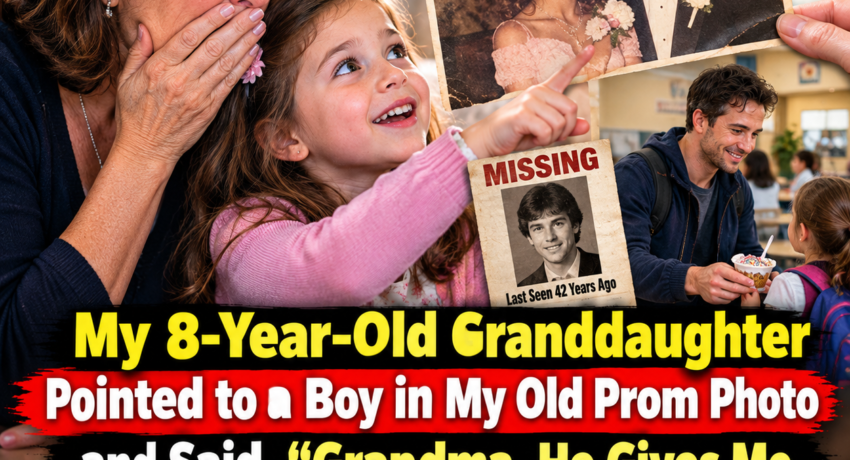
Ellie pointed to him.
“Who’s that?”
For a moment, I couldn’t answer.
In the picture, I stood beside him in my pale blue prom dress. David had one arm awkwardly around my waist, and we were both smiling with the ridiculous certainty of young people who believed the future would patiently wait for them.
“His name was David,” I finally said.
Ellie looked at me.
“Was he your boyfriend?”
“My first serious boyfriend.”
Her eyes widened.
“Before Grandpa?”
I smiled faintly.
“Long before Grandpa.”
She studied the picture again.
“You were really pretty.”
I raised an eyebrow.
“Were?”
She burst out laughing.
But I couldn’t.
Because I was no longer sitting in an attic with my granddaughter.
In my mind, I was eighteen again.
And David was still alive.
Part 2 — The Future We Thought We Had
David and I had been together since our sophomore year of high school.
We were young enough to believe love could solve practically anything, but responsible enough to try to make plans anyway.
David worked evenings at his father’s hardware store.
I spent weekends behind the counter at a bakery.
Neither of us earned much, but every payday felt like one more step toward the life we were building in our heads.
One evening, David emptied a handful of crumpled bills onto the hood of his car and counted them twice.
He looked at me solemnly.
“At this rate, we might be able to afford the smallest apartment in the entire country.”
I leaned against the car.
“Does this glamorous apartment have plumbing?”
He pretended to think about it.
“That might cost extra.”
“What about a window?”
“Laura, don’t get unreasonable.”
I laughed so hard I nearly dropped the paper cup in my hand.
That was our dream.
Community college.
Jobs.
An apartment barely large enough to turn around in.
Nothing extraordinary.
But it belonged to us.
And at eighteen, that made it feel enormous.
We believed that because we had talked about the future so many times, the future was guaranteed.
Six weeks after prom, I learned how wrong we were.
David’s house caught fire before sunrise.
My mother woke me.
She was standing beside my bed in her robe, one hand pressed against her chest.
“Laura, there’s been an accident.”
Those words divided my life into a before and an after.
David survived the initial fire, but his injuries were severe.
His mother called from the hospital.
I begged to see him.
She told me they were keeping him sedated.
“Can I come anyway?” I asked.
“Not yet.”
I waited.
I prayed.
I stared at the telephone.
Three days later, it rang again.
David was gone.
There are some kinds of grief that arrive slowly.
This wasn’t one of them.
It felt as if the entire world had collapsed into one impossible sentence.
David was dead.
I stopped caring about food.
I stopped answering friends.
I barely slept.
His family had lost their home, and not long afterward, his mother told mine that they were taking David to be buried near relatives in another state.
There was no funeral I attended.
No graveside goodbye.
No final moment where I could stand somewhere and say, This is where he is now.
His family simply left.
By the time I understood that they were truly gone, they had vanished from my life as completely as David had.
And somehow, the world kept moving.
Years passed.
I married.
I became a mother to two children.
Eventually, my marriage ended.
My children grew up.
Then I became a grandmother.
Whole chapters of my life began and ended.
Yet through every move, every box packed and unpacked, one thing stayed with me.
That prom photograph.
I told myself it was only a photograph.
Apparently, part of me had never believed that.
Part 3 — “Grandma, That’s Him”
Ellie was still staring at David’s face.
Then she touched the picture with one finger.
“That’s him.”
I blinked.
“What?”
“That man.”
I smiled, assuming I had misunderstood her.
“What man?”
“The man at my school.”
My smile disappeared.
Ellie continued casually, completely unaware that my heartbeat had suddenly become painfully loud.
“He helps clean the cafeteria after lunch. Sometimes he gives me an extra dessert.”
I stared at her.
“Ellie, this picture was taken forty-two years ago.”
She looked from me to the photograph.
“He looks older now.”
I almost laughed.
Almost.
Instead, something cold moved through me.
“Why do you think it’s the same person?”
She frowned.
“Well… maybe he’s his dad or something.”
“That would make more sense.”
I tried to sound calm.
I failed.
Then Ellie added, “He asked about you.”
Every muscle in my body went still.
“What did you say?”
“He asked if my grandma was named Laura.”
The attic suddenly seemed airless.
“What else?”
“He asked if you went to Westbrook High.”
“And what did you tell him?”
“That I thought you did.”
I swallowed.
“What’s his name?”
“Tom, I think.”
Tom.
Not David.
Of course not David.
David had been dead for forty-two years.
Photographs didn’t grow old.
People did.
I forced myself to breathe.
Then Ellie leaned closer to the photograph.
“He has that same little moon mark too.”
I turned sharply toward her.
“What moon mark?”
She pointed above David’s left eyebrow.
There it was.
A faint crescent-shaped scar.
David had gotten it when he was sixteen after crashing Charlie’s bicycle into a fence.
It was so small that most people never noticed it.
But I remembered.
I remembered sitting beside him afterward, teasing him about his terrible riding skills.
I remembered tracing the mark lightly once it healed.
I closed the album.
“We’re going downstairs.”
Ellie looked confused.
“But we’re not done.”
“I am.”
She followed me toward the attic stairs before suddenly gasping.
“Wait!”
She ran back to her backpack.
“I forgot. He gave me something yesterday.”
My entire body tightened.
“Who?”
“The man at school. Tom.”
She dug through the front pocket.
“He said you would know what it meant.”
Then she placed something in my hand.
The instant I saw it, I felt the blood drain from my face.
A red pocketknife.
One blade was broken.
And scratched into the handle were two letters.
L.A.
My initials.
I knew that knife.
David’s father had given it to him when he started working in the family hardware store. David carried it almost everywhere.
Then, shortly before the fire, he lost it.
He told me he had lent it to Charlie while they were fixing a bicycle.
Charlie always said he had given it back.
Wrapped around the knife was a folded piece of paper.
My fingers shook as I opened it.
There was a phone number.
And a message.
Call me. What happened all those years ago isn’t what you were told. You should ask questions about your own family.
The attic tilted beneath me.
Ellie touched my arm.
“Grandma?”
“I’m okay.”
She stared at my face.
“You don’t look okay.”
She was right.
I wasn’t.
Part 4 — The Man Named Tom
I called the number.
A man answered almost immediately.
“Laura?”
My grip tightened around the phone.
The voice was wrong.
Too young.
Not David.
“Who are you?”
“My name is Tom.”
“Where did you get this knife?”
Silence.
Then he said quietly, “I’m not David.”
“I know that.”
Another pause.
“David was my uncle.”
I sat heavily on the bottom stair.
Tom explained that his mother was Nancy—David’s older sister.
Suddenly, the resemblance made sense.
“Ellie thought you were him,” I said.
“I’ve heard that before. My grandmother always said I looked like him.”
“And the mark above your eyebrow?”
“A birthmark. Apparently it’s almost the same shape as his scar.”
I closed my eyes.
“How did you know Ellie was my granddaughter?”
“She mentioned a Grandma Laura one day. Later she said you had gone to Westbrook High.”
“And your family still remembers me?”
“We still have David’s copy of the prom picture.”
That sentence hurt more than I expected.
Somewhere, all these years, his family had kept a photograph of me too.
“Why give an eight-year-old a pocketknife to bring home?”
“I wrapped it up. And I didn’t know how else to reach you without asking a child for personal information. I knew you’d recognize it.”
I looked down at the scratched initials.
“Where did you find it?”
Tom hesitated.
“Charlie had it.”
For a second I thought I had misunderstood him.
“My brother?”
“You know he belongs to the woodworking club?”
“Yes.”
“So do I. We’ve known each other casually for years.”
Tom explained that a few weeks earlier, he had noticed the red knife lying on Charlie’s workbench.
His mother had told him stories about David.
Including the story of the missing knife.
Tom had immediately recognized it.
“When you asked Charlie about it, what did he say?”
“He called it nothing important and put it away.”
“But you didn’t believe him.”
“No.”
“Why?”
“Because my mother remembers David losing that knife right before the fire.”
My heart began pounding.
“What did Charlie tell you?”
“Not everything.”
“Then tell me what you know.”
Tom’s voice softened.
“I don’t think I should tell his story for him.”
Anger flashed through me.
“Then why contact me at all?”
“Because you deserve to ask the right question.”
I stood.
“What question?”
There was a long silence.
Finally, Tom said:
“Ask Charlie where David was the night before the fire.”
The room seemed to disappear around me.
“What?”
“Ask him, Laura.”
I reached for the railing.
My hand missed.
The next thing I clearly remember is opening my eyes and seeing Ellie kneeling beside me with my phone pressed to her ear.
“She’s awake,” she was saying. “Yes. She opened her eyes.”
“Ellie?”
She looked down at me.
“I called 911.”
“What? Why?”
“You fainted!”
“I did not faint.”
“You fell down and didn’t answer me.”
It was difficult to argue with that.
The paramedics arrived and checked me over.
They believed stress had triggered the episode and told me to seek further medical attention if the dizziness returned or if anything else felt wrong.
After they left, Ellie planted her hands on her hips.
“You are not driving anywhere.”
I would have laughed under different circumstances.
Instead, I drank water, called my daughter, and told her enough of the story to make her come over immediately.
A few hours later, once I felt steady, she drove me to Charlie’s house.
She waited in the car.
I walked to my brother’s front door alone.
Part 5 — The Secret My Brother Kept for Forty-Two Years
Charlie opened the door smiling.
“Laura. What brings you—”
I raised the red pocketknife.
The smile vanished.
His face told me the truth before his mouth did.
“Where did you get that?”
“Tom.”
Charlie closed his eyes.
Something inside me broke.
“You lied to me.”
“Laura, come inside.”
“No.”
He glanced toward the driveway.
“Please.”
“I said no. Tell me right here.”
His shoulders sagged.
“Tell you what?”
“Tom said I should ask where David was the night before the fire.”
Charlie stopped moving.
I had known my brother my entire life.
I knew every expression he used when he was irritated, guilty, nervous, amused, or exhausted.
But I had never seen that look before.
He suddenly seemed much older than he had five minutes earlier.
“Charlie.”
He looked at the ground.
“David came here.”
The words barely registered.
“What?”
“The night before the fire. David came to the house.”
My throat closed.
“Why?”
“To see you.”
I stared at him.
“Where was I?”
His answer was almost a whisper.
“Upstairs.”
The world went silent.
I could hear birds somewhere beyond the yard.
A car passed at the end of the street.
Everything ordinary continued while forty-two years of my life shifted beneath my feet.
“You told him I wasn’t home.”
Charlie nodded.
“Why?”
“Laura—”
“Why?”
He rubbed his face.
“You were eighteen. Mom and Dad were worried.”
“About what?”
“David had applied for a training program out of town.”
I stared at him.
“I never knew that.”
“I know.”
“Was he accepted?”
Charlie looked miserable.
“Yes.”
The answer struck harder than I expected.
“He came to tell me.”
“Yes.”
“And you sent him away.”
“Mom and Dad thought you would leave with him. They were afraid you’d abandon college and follow him. They told me that if he came by before they had a chance to talk to you, I should send him home.”
“And you obeyed them?”
“I was twenty-one.”
I laughed once, without humor.
“How impressive.”
He flinched.
“I thought they were overreacting. I didn’t think—”
“No. You didn’t.”
He swallowed.
“I told myself I could give you whatever he left the next morning.”
I froze.
“Whatever he left?”
Charlie’s face changed again.
“What did David leave?”
He didn’t answer.
“Charlie.”
His eyes filled.
“What did he leave?”
“An envelope.”
For several seconds, I forgot how to breathe.
“Where is it?”
“Laura—”
“Did you open it?”
“No.”
“Where is it?”
He turned away.
“The fire happened before I had a chance to give it to you.”
“And after David died?”
Charlie said nothing.
I stepped closer.
“What happened after he died?”
“You were barely functioning. Mom said giving you a letter about David leaving town would make everything worse.”
“So you kept it.”
“Yes.”
“For how long?”
His silence answered me.
Forty-two years.
He had kept it for forty-two years.
“At first,” he said, “I kept thinking I’d tell you later. Then weeks passed. Then months. After enough time, admitting what I had done became harder than staying quiet.”
I stared at my brother.
For years, he must have told himself he was protecting me.
Maybe at the beginning he even believed it.
But eventually, protection had become an excuse.
Fear had become silence.
And silence had turned into a forty-two-year lie.
Part 6 — David’s Last Letter to Me
Charlie led me to his workshop.
Neither of us spoke.
He went to an old desk, pulled open a drawer, removed a wooden tray, then reached behind it.
When he turned around, he was holding a yellowed envelope.
My name was written across the front.
I recognized the handwriting instantly.
Laura.
David’s handwriting.
My knees weakened.
It had never been opened.
For forty-two years, that envelope had existed.
For forty-two years, the last words David had intended for me had been sitting inside my brother’s house.
Waiting.
I tore it open.
Inside was the acceptance information for the training program.
There was also a handwritten sheet of paper.
At first, I didn’t understand what I was looking at.
Then the words came into focus.
Training expenses.
Expected income.
Groceries.
Utilities.
Rent.
David had been making a budget.
Our budget.
My hand covered my mouth.
At the bottom of the page, he had written one final line.
Still think we can afford the smallest apartment in America.
A laugh escaped me.
It turned into a sob almost immediately.
I stood there crying over a joke that had waited forty-two years for me to read it.
For one impossible moment, I could hear him again.
Eighteen years old.
Standing beside that beat-up car.
Pretending our imaginary apartment was the greatest real-estate opportunity in the country.
Charlie remained behind me.
“I’m sorry.”
I turned.
He was crying too.
“I thought telling you later would only reopen everything.”
“You watched me mourn him.”
“I know.”
“No, Charlie. You don’t.”
He lowered his head.
“You watched me spend years believing there was nothing else. No final conversation. No plan. No goodbye. And all this time, you had this.”
“I was trying to—”
“Don’t say you were protecting me.”
He fell silent.
“You didn’t have the right to make that choice for me.”
“I know.”
“You had this letter for forty-two years.”
His voice broke.
“You built a good life, Laura.”
I stared at him.
“That has nothing to do with it.”
He looked away.
And this time, thankfully, he didn’t tell me he understood.
Because he couldn’t.
I put David’s letter in my purse.
Then I walked out of my brother’s house.
My daughter drove me home.
I barely spoke on the way.
I had entered Charlie’s house believing my first love had died forty-two years earlier.
I left realizing something else had been buried with him.
My ability to choose.
Part 7 — The Smallest Apartment in America
For several weeks, Charlie and I barely spoke.
He stopped coming to Sunday dinner.
I didn’t ask him to come.
Ellie eventually noticed.
“Why doesn’t Uncle Charlie visit anymore?”
“We’re having a disagreement.”
“Are you mad at him?”
“Yes.”
She thought about that.
“Forever?”
I looked at her.
“I don’t know.”
It was the most truthful answer I could give.
And strangely, for the first time in weeks, the answer had nothing to do with David.
It was about my brother.
About whether forty-two years of love between siblings could survive forty-two years of deception.
Eventually, Charlie called.
“Can I make something for you?”
“I don’t want a gift.”
“It’s not really a gift.”
“No.”
A few weeks later, he asked again.
This time, I agreed to visit his workshop.
When I entered, something sat in the center of his worktable.
I stopped.
It was a miniature apartment.
Charlie had built it by hand.
There was a tiny kitchen.
A tiny sofa.
A tiny bedroom.
Small enough to fit on a table.
Perfectly ridiculous.
Perfectly familiar.
I moved closer.
Then Charlie explained that Tom had given him scraps of old wood that had been salvaged years ago from David’s father’s hardware store.
On the front of the miniature apartment was a small brass plaque.
It read:
THE SMALLEST APARTMENT IN AMERICA
I couldn’t speak.
Charlie stood several feet away.
“I know this doesn’t fix anything.”
I looked at him.
“I spent most of my life telling myself I kept that letter because I was protecting you. Eventually I had to admit the truth. I was scared. Every year I waited made telling you harder, so I kept waiting.”
His voice trembled.
“I can’t give you back what I took from you. I just thought you should finally have the thing David kept joking about.”
I didn’t forgive Charlie that day.
Not completely.
Perhaps there are things we never forgive in one dramatic moment.
Maybe forgiveness, when it comes at all, arrives quietly and unevenly.
But I took the little apartment home.
Ellie placed it on a shelf beside my prom photograph.
A few days later, I found her staring at them.
The miniature apartment.
The photograph of David and me at eighteen.
“Grandma?”
“Yes?”
“Do you think you and David would’ve been happy living there?”
I looked at the photograph.
At the girl I used to be.
Then at David.
I smiled sadly.
“I have absolutely no idea.”
Ellie frowned.
“But you loved him.”
“I did.”
“So wouldn’t you have stayed together?”
“Maybe.”
She waited.
“Maybe we would’ve been together for the rest of our lives,” I said. “Or maybe we would’ve discovered after six months that we drove each other crazy.”
Ellie considered this seriously.
“So you’re sad because you never got to know?”
I looked at her.
“Yes.”
Exactly.
That was what Charlie had never understood.
I wasn’t mourning some perfect alternate life.
I didn’t believe David and I had been destined to marry, have children, and grow old together.
Maybe we would have.
Maybe we wouldn’t.
Life doesn’t make those promises.
What hurt was that somebody else had decided I wasn’t allowed to find out.
Charlie hadn’t stolen a guaranteed happy ending.
He had stolen something simpler.
A conversation.
A decision.
The chance to say yes.
Or no.
The chance to hear David explain his plans himself.
The chance to decide whether I wanted to follow him, wait for him, argue with him, encourage him, or eventually walk away.
The chance to live my own life instead of having a piece of it quietly edited by people who believed they knew what was best for me.
For forty-two years, I had thought my story with David ended in a fire.
Now I knew it had actually been interrupted the night before.
And somehow, knowing that hurt.
But it also gave something back to me.
His letter.
His ridiculous budget.
His joke.
Proof that, right until the end, David had still been imagining a future in which there was room for me.
Last night, I walked past the shelf where Ellie had placed everything.
The prom photograph stood behind Charlie’s tiny wooden apartment.
For years, whenever I looked at David’s picture, I wondered about the life we never had.
Would we have married?
Would we have stayed together?
Would that tiny apartment have been miserable?
Would we have laughed through every difficult month?
Would our love have survived adulthood?
For once, none of those questions came.
I simply looked at the two eighteen-year-olds in the photograph.
Then I touched the little brass plaque with one finger.
THE SMALLEST APARTMENT IN AMERICA.
And instead of trying to rewrite the past in my head, I let it remain what it was.
A love that mattered.
A choice I should have been allowed to make.
And a future no one will ever know.
Then I turned off the light and went downstairs.